A recovery scam asks someone who has already lost money to pay again for a promised refund or recovery. Be especially cautious about unsolicited offers, guaranteed results and payments to release supposedly located funds. Verify the person, the claimed authority and the proposed process independently.
A convincing recovery offer often starts with a true fact: your loss, the original platform’s name or a transaction you recognize. Knowing that fact does not establish who the caller is. They may be connected to the original operation, have obtained information elsewhere or simply be repeating something you posted.
The FBI’s 2025 Internet Crime Report records 10,516 complaints and $1.4 billion in losses under cryptocurrency-related recovery scams. That qualifier matters. It is not a count of every type of recovery offer.
Anatomy of the second scam
The following is an illustrative sequence based on the FTC’s recovery-scam guidance. It is not a transcript. The diagram summarizes the independent checks; the sequence below explains the pressure behind the offer.
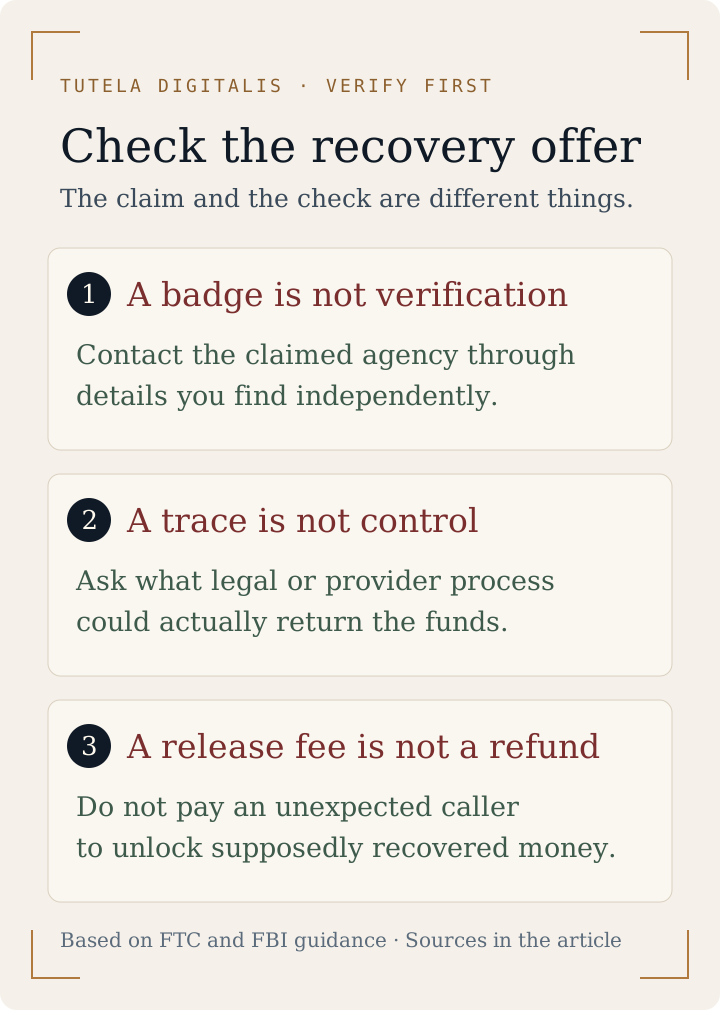
That account of the pressure is our interpretation of the pattern. The essential factual check is simpler: what authority would this person actually use to recover the asset?
What different kinds of help can actually do
The FBI’s recovery-fraud investigation notice explains the limits of private recovery companies. The American Bar Association’s fee guidance is useful for a different reason: legitimate legal representation has a defined scope and an explained fee arrangement. “Charges money” is not a sound fraud test by itself.
Real officials can contact victims. Verify the contact.
The FBI’s Operation Level Up proactively warns some people caught in cryptocurrency investment fraud. A rule that says every unsolicited official contact is fake would be wrong.
End the unexpected conversation and independently find the agency’s contact details. Ask it to verify the person and reference. Do not use a callback number, website or transferred call supplied by the person you are checking. A real official process should be checked through the agency, not through the caller’s “verification department.”
Before hiring anyone, verify the person and the proposed work
Find any required licence in the relevant regulator’s own directory. Contact the professional through details obtained independently, since scammers can impersonate real firms. Check the written scope, costs, jurisdiction and claimed method. Ask who would receive your payment and whether that matches the agreement.
Reviews, domain age and registration records can raise questions, but none settles them. New legitimate firms exist; established firms can be impersonated; reviews can be manufactured. A contingency-fee offer is not a guarantee either. The firm still needs verification, and its contract still needs scrutiny.
If you have already paid a recovery agent
Stop further payments and preserve the offer, invoice, contract, messages and transaction records. Contact the payment provider promptly and accurately explain what was promised. Report the second incident as well as the first, linking reference numbers where appropriate. Do not wait to identify every person involved before alerting the provider.
Our money-back guide sets out the routes by payment method. The reporting directory helps find the appropriate official route. A refund promise should be judged by an independently verifiable process, not by how precisely it tells you what you want to hear.
Questions readers ask
Is every paid recovery service a scam?
No. Independently verified lawyers and investigators may charge for legitimate work. A fee does not establish fraud, and a no-win-no-fee offer does not establish legitimacy. Verify the professional, the written scope and fees, and the legal process they propose. Avoid guarantees and demands to pay to release supposedly recovered funds.
Can the FBI contact a scam victim first?
Yes. Operation Level Up is a real FBI initiative that proactively warns some victims. End the unexpected contact and verify through an FBI office using contact details you find independently. Do not send money or provide passwords, wallet keys or verification codes to the caller.
Does a blockchain tracing report recover my crypto?
No. Tracing can document transactions and may assist an investigation. A report itself neither controls a wallet nor authorizes a seizure. Funds held by a custodial service may be subject to that service’s controls or legal process; recovery is not guaranteed.
Does reporting a scam put me on a public victim list?
A complaint is not automatically a public advertisement for recovery agents. Scammers may know about the loss through the original operation, information sharing, public posts or other sources. Knowledge of your loss is not evidence that the caller is an official.