THE 8-POINT CHECKMay 25, 202611 min read

Is this task platform legit? Run it through these eight checks before you pay a cent.

Reported losses to job and task scams climbed from $90 million in 2020 to $501 million in 2024, according to the US Federal Trade Commission — a more than five-fold jump in four years. Most of those losses were preventable in under ten minutes of checking. Here is the exact sequence.

8
Checks. About ten minutes.
$501M
Lost to job scams in 2024 (FTC)
<90d
Domain age of most scam platforms
$0
A real job ever asks you to deposit
The short answer

A task platform is almost certainly a scam if any one of these is true: it reached out to you unsolicited, the domain is under 90 days old, the company is not in any official registry, the recruiter has no real LinkedIn footprint, or it ever asks you to deposit or top-up to unlock earnings. The full 8-point check on this page confirms it cleanly in under ten minutes. The single rule that beats every variant is unchanged: a real job never asks you to pay money to make money.

“A job you truly enjoy is a good thing, but if the work feels more like an online game than an actual job, you can bet it's a scam.”

— Emma Fletcher, Senior Data Researcher, US Federal Trade Commission, in the FTC Data Spotlight “Paying to get paid: gamified job scams drive record losses” (December 2024). Task-scam reports went from near zero in 2020 to roughly 20,000 in the first half of 2024 alone, with more than $220 million in reported losses in that same half-year.

Here is the most useful thing I can tell you up front: you do not need to be a fraud expert to verify a task platform. You need a checklist and about ten minutes.

I write this because the same shape of question keeps landing in my inbox. Is taskflux legit? Is this Telegram offer legit? My friend got me into this app, it actually paid out $40 the first day, is that real? The platform name changes weekly. The mechanics never do. So instead of writing one post per fake brand — which would be unwinnable, because the scammers spin up a new domain every Tuesday — here is the universal stress test. Eight checks. Any one of them failing is enough to walk away. All eight passing is your green light.

If you are reading this with a chat window open in another tab and a sinking feeling in your stomach, skip to If you already deposited. You are not alone, and the next few hours matter more than the last few weeks.

Before the checklist — what a “legit” task platform actually looks like

Legitimate paid-task work exists. It is just much narrower than the marketing suggests, and it has a recognisable shape.

On the real side: payroll-based gig platforms like DoorDash, Instacart and Uber. Academic micro-task panels like Prolific or MTurk used by vetted researchers. Consumer-research panels run by named firms like YouGov or Nielsen. User-testing platforms like UserTesting or PlaytestCloud. These share two traits, and the traits matter more than the brand names. You find them, they do not find you. And money only ever moves from them to you — never the other way.

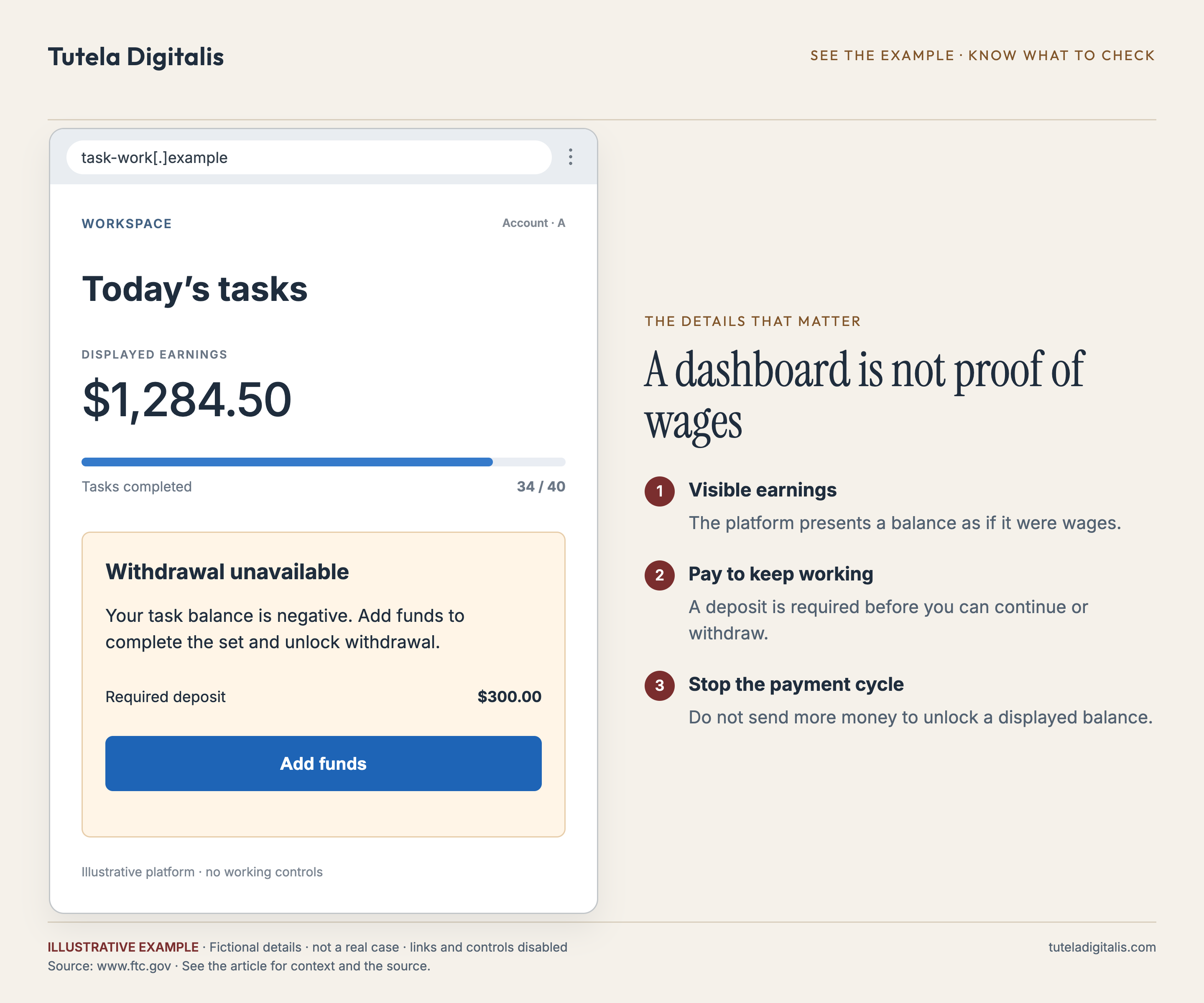
On the scam side, the format is just as recognisable once you have seen it: an unsolicited message, an offer that does not make economic sense for any real business to fund, a slick app that shows your earnings climbing on a dashboard, and a moment — always — where the next big payout requires you to deposit money first. That last part is the entire scam, dressed up in fifty different costumes.

The single rule that defeats every task scam, regardless of brand or country: a real job never, ever requires you to pay money to make money. Not for training. Not for equipment. Not for a deposit to unlock tasks. Not to release a balance. The moment money is supposed to flow from you to them, it is a scam. Full stop. No exceptions.

The eight-point check

Work through these in order. The first three are the fast disqualifiers — most fakes fail one of them inside two minutes, and you can stop there. The last five are for borderline cases where the surface looks plausible and you want to be sure.

1. The 30-second gut check

Before any research at all, two questions:

Did they contact me unprompted? A text, a WhatsApp, a Telegram invite, an Instagram DM, a cold email about a job I never applied to. Yes = guard up.
Will I ever be asked to deposit, top-up, or pay anything? For training, equipment, a background check, software, an activation fee, or to unlock the next set of tasks. Yes, or even maybe = stop here. That is the whole scam in a single question.

You can answer this honestly in thirty seconds. Two thirds of the people who ask me about a platform already know the answer when they think about it — they just want permission to walk away.

2. Search the brand name with “scam” and “review”

On Google, Reddit, Trustpilot and the Better Business Bureau, search the exact platform name combined with the words scam and review. You are looking for two opposite signals:

A real footprint. Years of forum threads, mixed reviews, employee comments on Glassdoor, news coverage. Real companies leave fingerprints across the internet.
Fresh victim threads. Reddit posts from the last few weeks asking the same question you are asking, in the same wording. That is the signature of a scam currently being rolled out.

The dangerous result is the middle case: nothing at all. A platform that supposedly handles real money for real workers, with zero search footprint, is almost certainly a brand-new shell.

3. Check the domain age

Look up the platform domain at who.is or whois.domaintools.com. You are reading one line: the registration date.

A real payroll-based platform does not launch on a domain that was bought last month. If the domain is under 90 days old, the platform is almost always a scam — full stop. Six to twelve months old is suspect; one to three years is reassuring; more than three is the norm for any platform that genuinely employs people.

4. Verify the company in an official registry

The platform will name a company somewhere — in the footer, in the Terms of Service, on the recruiter’s LinkedIn, in the chat. Take that exact name and search the official business registry in the country they claim to operate in:

UK: Companies House — find-and-update.company-information.service.gov.uk
US (federal): SEC EDGAR for public companies; state Secretary of State sites (e.g. Delaware, California, New York) for private.
Australia: ASIC business name lookup — connectonline.asic.gov.au
Canada: Corporations Canada — ised-isde.canada.ca
EU: The European e-Justice portal for cross-border lookups; each country also has its own registry.

If you cannot find a registered legal entity matching the website name, that is the answer. Real businesses register. Scams do not, because registration creates a paper trail.

5. Find the recruiter on LinkedIn

Search the recruiter by name. A real recruiter has all of:

A profile older than your conversation. Created years ago, not last week.
A history at the company they are recruiting for. Listed as an employee, with a normal-looking work history before it.
Mutual connections you can verify. Other people at the company, ideally with public posts you can cross-check.
A photo that survives reverse image search. Drop the headshot into Google Images. A real person’s photo turns up in their own context. A scammer’s photo turns up on a dozen unrelated profiles or stock-photo sites.

A profile created in the last 30 days, with one connection and no work history, is not a recruiter. It is a costume.

6. Demand a company email and a real video call

Reply asking for two things: an email from the company’s actual domain (so jane@companyname.com, not janefromcompany@gmail.com), and a scheduled video call on a known platform — Google Meet, Microsoft Teams, or Zoom. Then watch what happens.

Real employers comply inside a business day. The email arrives, the calendar invite lands, the call happens. Scammers do one of three things: they stall (busy week, system migration, will set up next month), they switch you to WhatsApp or Telegram (more convenient, faster), or they send a free Gmail address and call it official. Each of those three responses is a confession.

From the field. The newest twist on this step is the deepfake video call: scammers now run real-time AI face-swap on a video interview, so the “recruiter” you see is generated. The defences are simple — ask them to turn their head fully sideways (current deepfakes still glitch at extreme angles), wave a hand across their face (face-swap models tear when an object crosses), and read out a specific phrase you give them. A real person passes all three trivially. A real-time deepfake fails at least one. We covered the full pattern in the deepfake-recruiter post.

7. Trace the payment rail

Ask how, exactly, you will be paid. The answer is diagnostic.

Real answers. Direct deposit, payroll, a known invoicing platform (Deel, Remote, Wise, ADP), with the right tax paperwork — a W-9 in the US, a W-8BEN if you are paid US-side from abroad, a UK PAYE setup or self-employed self-assessment, and so on. A real payment rail is dull and paperwork-heavy.
Scam answers. A crypto wallet you must fund. A USDT or USDC top-up. An in-app balance you must keep above a minimum. A custom dashboard with a “withdrawal threshold.” Any structure where the money you supposedly earned lives inside an app the platform controls, and where you have to put your own money in first.

If the payment rail goes through their wallet on the way to yours, you are not the worker. You are the deposit.

8. Run the withdrawal stress test

This is the single most useful check, and almost nobody does it. Before depositing a cent — even if everything else so far looks fine — attempt to withdraw any balance the platform shows. Even one dollar.

A legitimate payroll system pays out cleanly, on the rail you expect, on a normal schedule. A scam platform suddenly invents friction: a minimum withdrawal you have not reached, a “verification” deposit, a fee, a manager who has to approve it, a 24-hour delay that quietly becomes 72, a new task you have to complete first. Every one of those is the platform telling you out loud that it is engineered to take your money, not pay it out.

If you cannot withdraw small money out cleanly, you will never withdraw big money out, no matter what the dashboard says. The withdrawal test is the only definitive proof — every other check is a probability estimate. This one is the ground truth.

If you already deposited

Read this slowly. The next few hours matter more than the last few weeks.

1Stop depositing immediately. No matter what the dashboard says you are about to lose. That balance is not real money — it is a number in software the scammer controls. Every further deposit is your money handed over to them, nothing more.
2Do not confront the scammer. There is nothing to argue and nothing to negotiate. Just stop responding and let them disappear.
3Call your bank or card provider right now if you paid by transfer or card. Say the word fraud. Ask about a recall, a chargeback, or a stop on pending transactions. Some transfers can still be intercepted inside the first 24 to 48 hours — speed is everything.
4Screenshot the entire conversation, the dashboard, the platform URL, the company name, the wallet addresses, the phone numbers, the recruiter profile. These vanish quickly once the scam is over for them, and you will need them to report.
5Report it. US: FTC at reportfraud.ftc.gov and FBI IC3 at ic3.gov. UK: Action Fraud at actionfraud.police.uk. Australia: Scamwatch at scamwatch.gov.au. Full directory at our /report-a-scam page.
6Protect anything you exposed. If you reused a password or shared banking details, change them from a clean device and turn on two-factor authentication everywhere.
Do not pay anyone who promises to recover your money. The moment you have been scammed, you become a known target for a second scam. “Recovery agents,” fake law firms, government imposters, and crypto fund-recovery services hunt recent victims and demand an upfront fee. They take that fee and vanish too. The rule is unchanged: if someone contacts you offering to recover your losses, it is almost always another scam. The honest odds on real recovery — by payment method — are in the 72-hour playbook.

What this checklist is, and isn’t

I want to be honest about the limits, because false confidence is its own danger.

The 8-point check is designed to catch the structural fakes — the brand-new domains, the unregistered companies, the freshly-spun-up recruiter profiles. It catches almost all of them, because almost all task scams reuse the same operational shortcuts. What it does not catch, in five percent of cases, is the more careful operation that buys an aged domain, sets up a registered shell, and runs a recruiter with a built-up LinkedIn presence. Those exist. They are expensive to run, and the operators reserve them for higher-value targets.

Step 8 — the withdrawal stress test — is the one check that catches even the careful fakes, because no scam operation can pay you out without losing its money. That is the one I would do even if the first seven all looked clean. Withdraw before you deposit. Always.

And if even the withdrawal test passes — small amounts come out cleanly to your bank, on the expected rail — that is genuine evidence the platform is real. Combined with the other seven checks, that is the strongest signal you can get short of working there for a year. It is not zero risk. But it is not the same conversation as “a stranger on Telegram says I can earn $400 a day liking videos.”

The thirty-second version, for when you don’t have ten minutes

If a friend is sitting in front of you right now and you have thirty seconds to give them one thing, give them this:

Did the platform reach out to you? If yes, raise the bar by ten times.
Will you ever be asked to deposit or top-up? If yes or maybe, that is the answer. It is a scam.
Can you take a small amount out, on the normal rail, before putting anything in? If no, it is a scam — no matter how slick the app looks.

Those three questions catch the vast majority of fakes in under a minute. The full 8-point check on this page exists for the cases where you want to be certain.

If you’re not sure — just ask

Maybe the platform you are looking at passed some checks and failed others, and you cannot tell which way to lean. Maybe you have already started and you feel sick about it. Either way, you do not have to figure it out alone, and you do not have to pay anything to get a straight answer.

Describe what is happening in our free, confidential case review. A real person reads every single one and writes back within 24 hours, honestly. If it is a scam, I will tell you plainly and walk you through the recovery steps. If it isn’t, I will tell you that too, and you can stop worrying.

For a faster first read, run the platform through the Scam Checker — a few questions, an instant risk read. And if you want the broader picture of how task scams actually work end-to-end, that is the task-scams teardown.

Stay sharp. Use the checklist. And remember the rule that ends this conversation every single time: you never pay to get paid.

Looking at a specific platform right now? Let’s check it together.

Send the name, the message, the website. A real expert reviews every case and replies within 24 hours. Free, confidential, no pressure.

Submit a free case review →Try the Scam Checker

Common questions about verifying a task platform

Is any task-earning platform actually legitimate?

Yes — but the bar is much narrower than the marketing suggests. Legitimate paid-task work exists in tightly-regulated forms: payroll-based gig platforms (DoorDash, Instacart, Uber), academic micro-task panels (Prolific, MTurk for vetted researchers), and consumer-research panels run by named firms (YouGov, Nielsen). They all share two traits: you find them, they do not find you; and money only ever moves from them to you. Anything that requires you to deposit, top-up, or fund a wallet to unlock earnings is not in that category — regardless of how polished the app looks.

Can I verify a remote-work platform in under 10 minutes?

Yes. The 8-point check on this page is designed to take 7 to 10 minutes for one platform. The fastest disqualifiers are the first three steps: an unsolicited contact via Telegram or WhatsApp, a domain that is under three months old, and a company name that does not appear in any registry. Hitting any one of those three is enough to walk away — you do not need to complete the full sequence to be confident.

The platform already paid me my first $30. Doesn't that prove it is real?

No. That is the most engineered part of the scam, not proof against it. Task-scam operations deliberately release small early payouts — typically $20 to $80 — to convert your scepticism into trust before the larger deposits begin. The FTC describes these scams as gamified for exactly this reason: the small win is the bait. A real employer does not need to send you proof-of-life money in week one; the structure of a real payroll is the proof.

Are recruiter messages on Telegram or WhatsApp ever legitimate?

Almost never for an initial cold contact. Real recruiters reach out through company email, LinkedIn InMail, or an applicant tracking system you have used before. They do not start with a WhatsApp from an unknown number. There are narrow exceptions — small agencies in certain regions, follow-ups after you have already given consent — but a cold outreach from a stranger on a chat app, for a job you never applied to, is a scam pattern, not a recruiting pattern.

I already deposited money. What now?

Stop depositing immediately, even if the dashboard shows you are about to lose your balance — that balance is not real money. If you paid by bank transfer or card, contact your bank in the next few hours and use the word fraud; some transfers can still be recalled inside the first 24 to 48 hours. If you paid in crypto, document the wallet addresses and report to the FBI IC3 (US), Action Fraud (UK) or Scamwatch (AU). And do not pay anyone who contacts you offering to recover the money — that is a second scam targeting victims of the first.

Sources & further reading

Every figure in this piece is drawn from these authorities. Click any of them to verify.

FTC Data Spotlight — Gamified Job Scams (Dec 2024)FTC — Report FraudFBI IC3Action Fraud (UK)Scamwatch (Australia)Companies House (UK)SEC EDGAR (US)ASIC Business Lookup (AU)

Keep reading