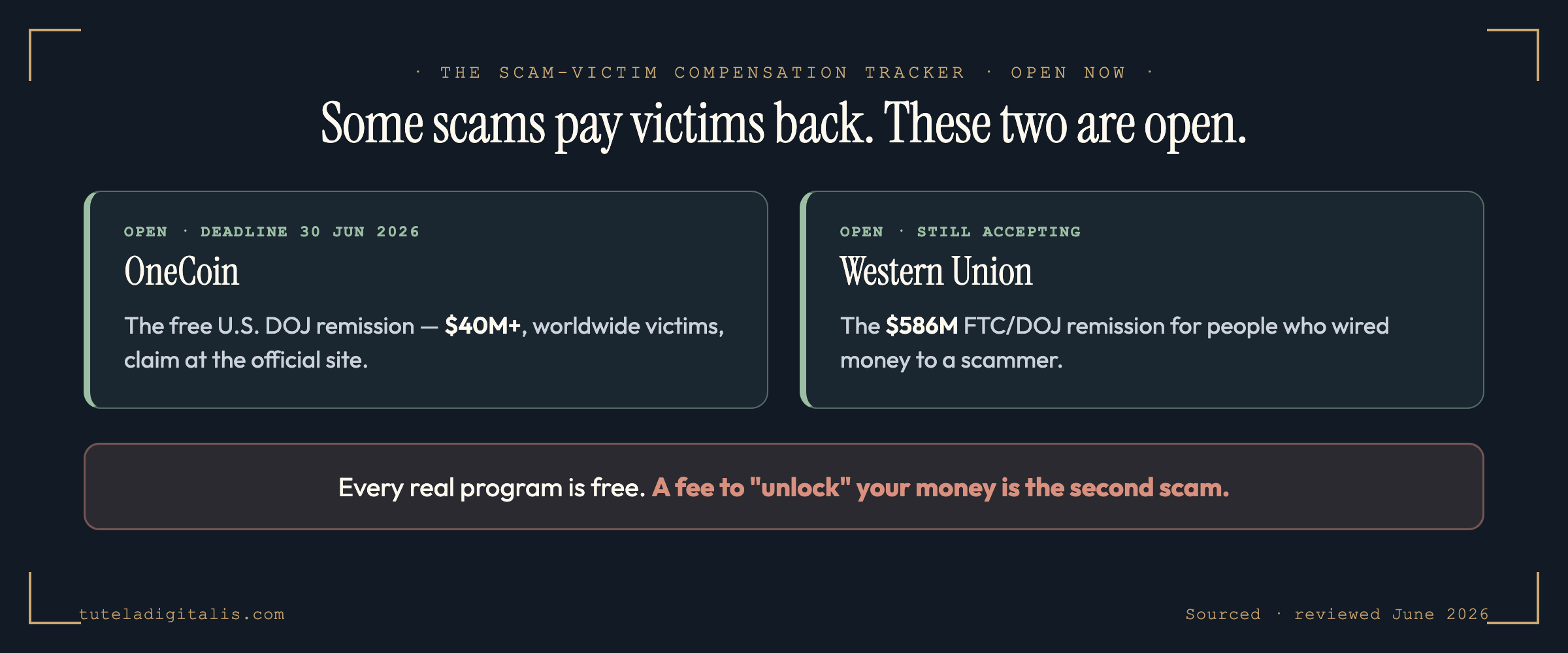
Government victim-compensation (remission & redress)
Money the government seized from a fraud, returned to victims through an official process. These are the ones worth acting on first.
Collapsed crypto platforms (bankruptcy repayments)
Last reviewed June 2026. Programs open, close and change — always confirm on the linked official page before acting. Bankruptcy figures are as reported by each estate. This is general information, not legal advice.
How to claim safely, without falling for the second scam
The single most useful fact on this page is that real compensation is free. Everything else follows from it.
Go deeper
The guides behind this tracker:
How this tracker is built
The tracker asks one question of each case: does an official, free route exist for a victim to be paid — and is it open right now? Every entry is verified against a primary source (a DOJ or FTC press release, a regulator's notice, or a court-appointed administrator's own portal) and links to it, so any claim can be checked at source. We do not estimate, and we do not publish a figure a named authority has not published.
Two different mechanisms sit side by side here, and conflating them is the most common mistake made about fraud recovery. Government remission (DOJ, FTC, SEC, CFTC) redistributes money the state actually seized. Bankruptcy repayment (FTX, Celsius, Voyager) pays creditors from a collapsed company's estate through a court — and crucially it repays the petition-date dollar value, not today's crypto price. They are kept in separate sections for that reason.
The statuses are deliberately blunt, because hope is what recovery scammers sell. Open means you can still file. Rolling means distributions are ongoing but the claims bar has passed. Closed means the window has shut. Ordered · unlikely means a court entered a judgment against people whose assets were already gone — a paper number, not a payout. No fund means exactly that.
That last distinction is the finding most worth carrying away. A restitution figure in a press release is not money in a fund: Mirror Trading International carries a $1.7B restitution order with no active payout, and Forsage produced judgments but no victim-distribution programme at all. Where money genuinely was recovered, it is a small fraction of what was taken — OneCoin's remission made $40M+ available against a fraud US prosecutors size at roughly $4B.
Mirror Trading International also shows that the authority named on an order is not always the one doing the recovering, which matters if you are trying to work out who to watch. South Africa placed the company into liquidation, and that proceeding was recognised in the United States as a foreign main proceeding under Chapter 15 of the US Bankruptcy Code. The joint liquidators record that the CFTC then agreed its claim against the estate would be subordinated to the recovery actions of the liquidators. So the largest civil monetary penalty ever ordered in a CFTC case now sits behind a South African insolvency process, and a claim is lodged against that estate rather than against the order.
What that estate holds is the part worth reading slowly, because it is the clearest illustration on this page of the gap between a headline number and a payout. The liquidators told MyBroadband that 9,441 claims worth almost R6.5 billion had been received as at 16 February 2026, and that R588.5 million remained in the estate two days later, down from R637 million in June 2024. They also said the claims investigation and objection process had not yet begun, and that the claims total will fall once it does. Money is going out to chase money: R1.06 billion was repatriated from a Belize broker, and R178 million more has been clawed back across some 690 settlements, of which a single settlement accounts for R113 million. We publish these in rand, as the liquidators stated them, because the dollar conversions in circulation are somebody else’s arithmetic.
The clock. Each row also carries the elapsed time from the fraud’s collapse to the moment a victim could actually claim, because how long compensation takes is the question this tracker was never asked and always answered. It is derived — computed from dates already sourced in the row itself, never estimated. Where this dataset carries no sourced fraud-era date, we publish no clock rather than guess one, which is why 6 of the 11 are measurable and the rest say so plainly. Across those 6, the wait runs 4 to 22 years. That range is the reason the phrase “we can recover your money in 48 hours” is diagnostic of a scam rather than a service: no legitimate route on this page has ever moved that fast, and none of them can be hurried by paying someone. The full analysis →
Last reviewed June 2026. Deadlines pass and portals close, sometimes without the administrator updating its own page — as OneCoin's did. Each row links its source; tell us if one is stale and we will correct it.
For journalists
This tracker is free to cite, with credit (CC BY 4.0). The one-line finding: of the 11 major fraud-compensation programmes tracked, only 1 is still open to new claims; where the wait can be measured (6 of 11) it runs 4 to 22 years from a fraud’s collapse to a claimable payout; and 2 have never paid a victim at all — because a court-ordered restitution figure is not the same thing as money a victim can actually be paid.
The dataset is archived with a permanent DOI, so it stays citable and resolvable independently of this site: 10.5281/zenodo.21454167 (a concept DOI, so it always resolves to the newest version rather than pinning to one deposit). (CSV + JSON + methodology, 1.0.0).
Suggested citation: Tutela Digitalis (2026). The Tutela Digitalis Scam-Victim Compensation Tracker (Version 1.0.0) [Data set]. Zenodo. https://doi.org/10.5281/zenodo.21454168
Need the underlying data, a correction, or a quote? Email press@tuteladigitalis.com. We publish corrections.
Common questions
Is there really a fund to compensate scam victims?
Sometimes — it depends on the specific scheme. When authorities seize money from a fraud (through criminal forfeiture, an FTC or SEC enforcement case, or a bankruptcy estate), they often set up an official process to return it to victims. This tracker lists the major ones and whether each is open, rolling, or closed. The most important rule: a real compensation program is always free. If you have to pay a fee to claim, it is not the real program — it is a second scam aimed at people who already lost money.
How do I know a compensation offer is real and not another scam?
Three tests. First, it never charges you — the FTC and FBI are explicit that no legitimate program asks for an upfront 'fee', 'tax', 'retainer', or 'release charge' to send your money. Second, you go to it; it doesn't cold-call or DM you out of the blue. Third, the claim runs through an official .gov-linked administrator (like a DOJ remission site or the FTC's refund page), not a lookalike website or a 'recovery agent'. If any of those three is off, stop.
Can victims outside the US claim from these programs?
Often, yes. Several of the largest programs are explicitly worldwide: the OneCoin remission and the Western Union remission both accept international victims, and the BitConnect restitution reached victims in 40+ countries. US-based fraud frequently has global victims, and the forfeited money is meant to go back to them wherever they are. Always check the eligibility on the official page for the specific program.
Is a bankruptcy repayment (FTX, Celsius, Voyager) the same as government compensation?
No, and the difference matters. Programs like the OneCoin, Western Union or MoneyGram remissions are run by the government from money seized in fraud cases. FTX, Celsius and Voyager are bankruptcy repayments run by court-appointed administrators — you're a creditor of the estate, recovery is based on the value of your balance on the date the company failed (not today's crypto price), and the deadline to file a claim has usually already passed. We list them separately for that reason.
I missed the deadline / my scheme isn't listed. Is there anything I can do?
Possibly. Even with no dedicated fund, report the fraud — to the FTC at ReportFraud.ftc.gov and the FBI at IC3.gov (or your country's equivalent) — because reports feed the investigations that create these funds in the first place. Check whether your card or bank can still dispute the payment, and watch the FTC's live refund list, which adds new programs regularly. What you should not do is pay anyone who promises to recover it for a fee.
Got a "compensation" or "recovery" offer, and not sure it's real? Send it to us first.
Paste the email, the website, or the "agent" who contacted you. A real expert reviews every case and replies within 24 hours. Free, confidential, no pressure.