Contact the company that moved your money immediately and ask what can be stopped, recalled or disputed. Describe accurately who initiated the payment and how the scam worked. Recovery depends on the payment method, jurisdiction and facts; there is no universal refund percentage or 72-hour cutoff.
Read the image explanation
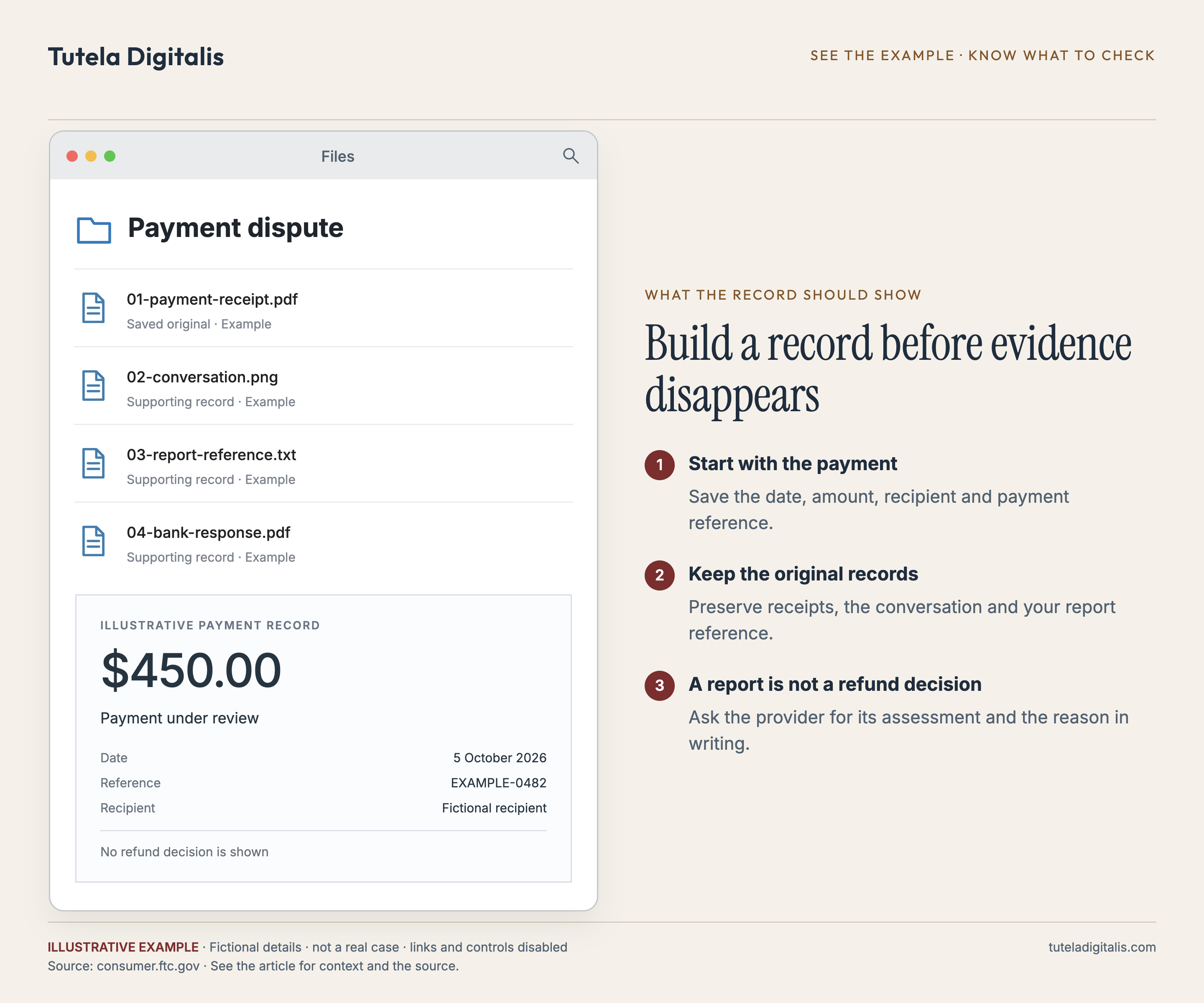
Illustrative example: Payment dispute $450.00 Payment under review 01-payment-receipt.pdf 02-conversation.png 03-report-reference.txt 04-bank-response.pdf
- Start with the payment. Save the date, amount, recipient and payment reference.
- Keep the original records. Preserve receipts, the conversation and your report reference.
- A report is not a refund decision. Ask the provider for its assessment and the reason in writing.
If you are reading this with a transaction still pending, start the call now using your bank’s official app or the number on your card. You can organize the rest of the evidence afterward. If the loss happened weeks ago, still report it: some routes may remain open even when others have closed.
First actions: begin now, even if more than 72 hours have passed
1. Contact the payment provider
Report the payment immediately through the official bank, card, payment-app or exchange channel. Ask what can be stopped, recalled or disputed.
2. Describe who initiated the payment
Explain whether a third party used your account or you sent money because of deception. Give transaction dates, amounts and recipient details.
3. Preserve evidence and secure exposed access
Keep receipts, messages, payment references and a timeline. Secure affected accounts from a clean device without delaying the initial report.
4. Report and follow up
File with the appropriate police or fraud-reporting body, retain reference numbers and meet the payment provider’s written dispute deadlines.
For U.S. internet crime, report through IC3; consumer fraud can also be reported at ReportFraud.ftc.gov. Reporting does not replace contacting your bank. Outside the U.S., use our country reporting directory.
Choose the route by how the money moved
For a guided starting point, use the scam-refund options checker. It asks how you paid, who initiated the payment and where you bank; its result is general guidance, not a prediction or decision on your claim.
| Payment | Ask the provider | Important distinction |
|---|---|---|
| Credit card | Open the appropriate billing-error or merchant dispute; secure the card if exposed. | Unauthorized use, non-delivery and dissatisfaction with quality do not all follow identical rules. |
| Debit card or account transfer | Investigate an unauthorized transfer or assess recall, dispute and reimbursement options. | Who initiated the payment matters. Do not describe a payment you made as account takeover. |
| Bank wire | Send an urgent recall or fraud notification to the receiving institution. | A recall is a request, not a guaranteed reversal. |
| Payment app | Report through the app and, where relevant, the linked bank or card issuer. | Purchase protection, unauthorized use and scam reimbursement have different eligibility rules. |
| Cryptocurrency | Notify the exchange or service involved and report transaction hashes and recipient addresses. | An on-chain transfer is generally not reversible; a custodial service may only control funds within its reach. |
| Gift card | Contact the issuer with the card number and receipt and ask whether funds can be blocked or refunded. | Do not assume a refund is impossible—or guaranteed—without asking the issuer. |
The FTC’s payment-method guidance recommends asking the provider for help even when return of the money is uncertain. The more detailed U.S. distinctions below explain why the facts you give the provider matter.
Credit cards: protect the dispute deadline
For a covered U.S. credit-card billing error, notify the issuer promptly and send the required written notice within 60 calendar days after the first statement containing the error was sent. Follow the billing-inquiry instructions, keep a copy and retain proof of delivery. Paying the bill does not automatically end your ability to dispute it.
Under Regulation Z’s billing-error procedure, the issuer generally has 30 days to acknowledge the notice unless it resolves the matter first, and two complete billing cycles, no more than 90 days, to resolve it. These are procedure deadlines, not a promise that the claim will succeed. Some complaints about quality or contractual performance require a different analysis.
Ask about card-network chargeback options too. Do not assume a purchase of crypto or a money transfer becomes refundable merely because it was funded by a credit card. See our credit-card scam refund guide for the distinctions.
Debit cards and electronic transfers: who pressed send?
The CFPB’s Regulation E FAQs distinguish a fraudster initiating a transfer using credentials obtained through deception from a consumer personally initiating a payment. The first can be an unauthorized electronic fund transfer. Do not let “you shared a code” substitute for an investigation into who actually made the transfer.
Conversely, if you sent the money yourself because you believed a lie, explain that accurately. Ask about scam reimbursement, a recall, any relevant network policy and the bank’s complaint process. Do not invent account takeover to fit a rule.
Regulation E’s liability limits depend on the circumstances. Losing a card or other access device can trigger a two-business-day reporting rule; unauthorized transfers shown on a statement involve a separate 60-day rule and possible liability for later transfers if reporting is delayed. These are not a universal $50/$500/unlimited ladder for every scam. Report promptly and ask the bank to identify the rule it is applying.
Payment apps: ask about the relevant protection
Do not assume every app payment has purchase protection, or that every authorized scam payment has no possible remedy. Eligibility varies by provider, payment type and facts. Zelle describes reimbursement for certain qualifying imposter scams; that is not a blanket refund promise for every Zelle scam.
Use our guides for Zelle, Venmo and Cash App to find the provider-specific route. Tell each provider about other disputes you have opened so the record is accurate.
Wires, crypto and gift cards: act without buying a promise
A bank may be able to notify the receiving institution before funds move onward. A crypto exchange may be able to act on assets held within accounts it controls, subject to its procedures and legal requirements. Neither can simply reverse any payment anywhere. Keep account details, transaction references and exact timestamps.
For gift cards, keep the card and purchase receipt and contact the issuer immediately. For crypto, keep the transaction hash, network, sending service and recipient address; never share a seed phrase as “evidence.” Use our gift-card guide and recovery-scam guide for the next steps.
Why we do not give you a recovery percentage
The FBI’s 2025 report says its Recovery Asset Team initiated the Financial Fraud Kill Chain in 3,900 incidents involving about $1.164 billion in attempted theft and froze about $679 million, or 58%. This describes a selected set of incidents and funds frozen. It does not say 58% of all scam victims got their money back.
Dividing that frozen amount by all reported cybercrime losses would be misleading too. The populations and outcomes differ. Neither calculation tells you whether your bank should refund your particular transaction.
If the provider says no
Ask for the decision, the transaction classification, the evidence considered and the available appeal or complaint process. Correct factual mistakes with documents and a short chronology. Keep the original notice date and meet any remaining deadlines. In the U.S., a complaint about a covered financial provider can be submitted to the CFPB; other countries have their own ombudsman and regulatory routes.
Legal advice may help in some cases, but independently verify the professional and written costs. Do not pay an unsolicited caller a “release fee” or assume that a blockchain chart means funds have been recovered.
Questions readers ask
Is it too late to report after 72 hours?
No. Report promptly even if days or months have passed. Fast action may help stop money moving, but there is no universal 72-hour deadline covering every scam, payment method and country. Legal and provider deadlines vary.
What percentage of scam money is recovered?
There is no reliable single percentage for your situation. The FBI’s 2025 figures describe funds frozen in selected incidents handled through its Financial Fraud Kill Chain, not a refund rate for all victims. Payment type, timing, jurisdiction and the facts matter.
Does Regulation E cover money I sent to a scammer?
U.S. Regulation E distinguishes unauthorized electronic transfers from payments you personally initiated. A fraudster using credentials they tricked you into sharing can initiate an unauthorized transfer. Tell the bank precisely who made the transaction and ask it to assess the applicable protections.
Can I dispute a payment I already paid off?
Paying a credit-card bill does not automatically prevent a dispute. Report the issue promptly and follow the written-notice requirements for a covered billing error. Other disputes, including some complaints about quality, can follow different rules.
Should I pay someone to speed up a refund?
Do not pay an unsolicited caller to release a claimed refund. A real lawyer may charge for independently verified legal work, but no professional can guarantee a bank refund, a seizure or the return of stolen crypto.