It comes down to one word: authorised. If someone used your card or account without your consent — an unauthorised payment — Irish law caps your loss at €50 and your bank must refund the rest, unless you acted fraudulently or with gross negligence. If you were tricked into sending the money yourself — an authorised push payment — there is no automatic refund in Ireland, unlike the UK's mandatory £85,000 scheme. Your free escalation route, when the bank says no, is the Financial Services and Pensions Ombudsman.
Read the image explanation
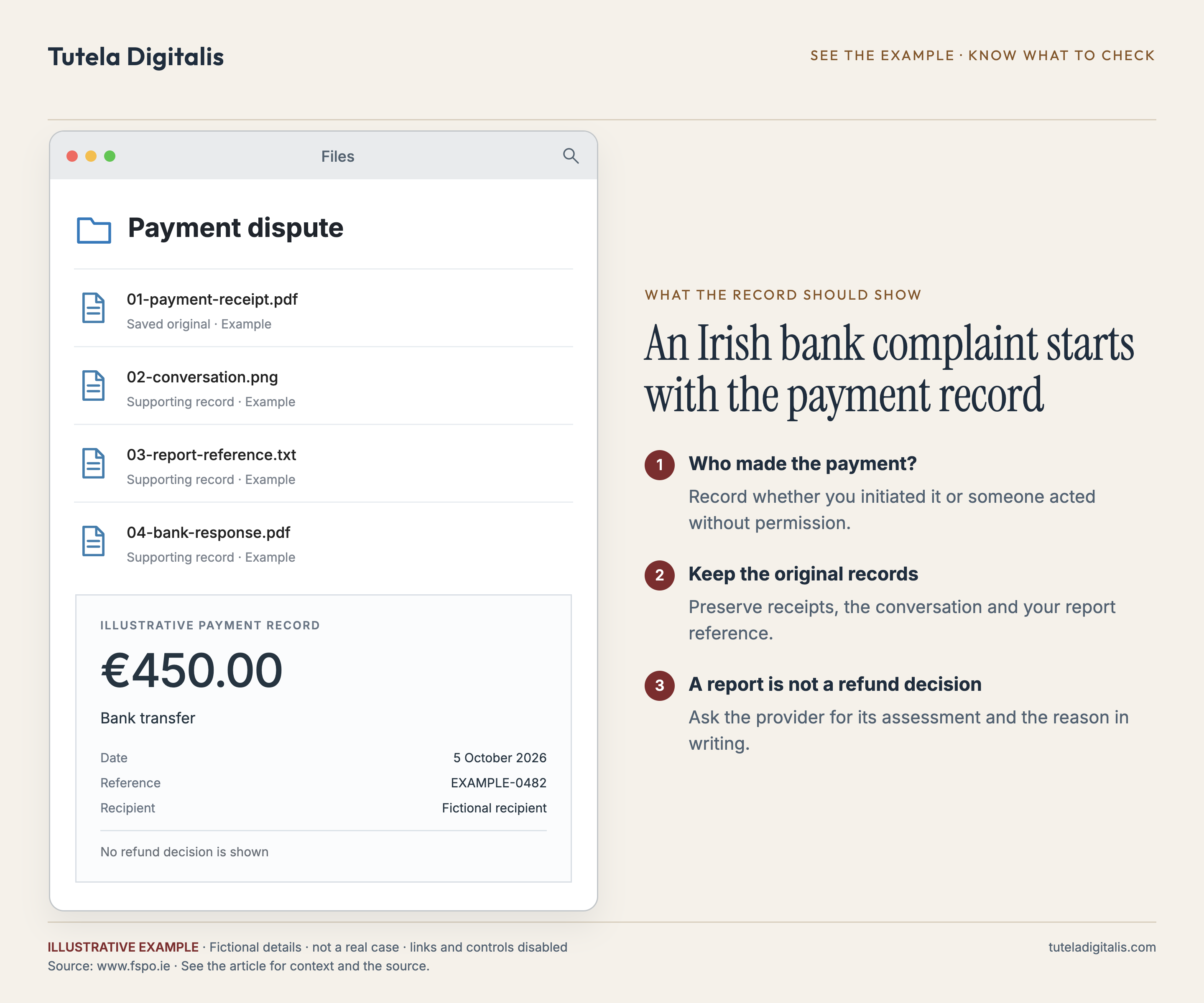
Illustrative example: Payment dispute €450.00 Bank transfer 01-payment-receipt.pdf 02-conversation.png 03-report-reference.txt 04-bank-response.pdf
- Who made the payment?. Record whether you initiated it or someone acted without permission.
- Keep the original records. Preserve receipts, the conversation and your report reference.
- A report is not a refund decision. Ask the provider for its assessment and the reason in writing.
"Financial frauds and scams continue to be a key area of concern for the Central Bank of Ireland, as it is for regulators and law enforcement agencies all over the world."
— Colm Kincaid, Deputy Governor, Central Bank of Ireland, on the regulator's 2024 payment-fraud statistics and consumer fraud research (April 2026). Concern is not the same as a cheque. The Central Bank tracks the losses; it does not refund them — and that gap is exactly where you stand.
Here is the thing the banks would rather you learned after the fact: in Ireland, whether you get your money back has almost nothing to do with how badly you were deceived, and almost everything to do with a legal category you have never heard of. A scam that empties your account can be fully refundable. A scam that costs you the exact same euro can be refundable to the tune of nothing. Same victim, same loss, same lie — different word on the form. So before we talk about how to claw your money back, you need the one distinction the whole system turns on.
The whole game is one word: authorised vs unauthorised
Every refund decision in Ireland sorts your loss into one of two boxes. Which box it lands in is set the moment the money moves, and it decides almost everything that follows.
A recreated Irish bank smishing text — the sender ID is spoofed to read "AIB," the link is defanged. The tells: it manufactures panic with a fake new payee, the link is not aib.ie, and it pushes you to "secure your balance" — the first move in turning a refundable fraud into an authorised payment the bank need not repay. No real bank ever texts you a link to move money.
Why Ireland has no UK-style refund scheme, and who is blocking it
Across the Irish Sea, this gap was closed. Since 7 October 2024, UK payment firms are legally required to reimburse APP-fraud victims up to £85,000, generally within five business days, with the cost split 50/50 between the sending and receiving bank. A victim in Belfast has a right a victim in Dublin does not. For how the UK scheme has worked in its first year, and which payments still fall outside it, see the UK refund rules one year on.
Ireland has been circling this for years and has not landed it. The Oireachtas Joint Committee on Finance examined APP fraud across five public sessions — hauling in the Department of Finance, the Central Bank, the Garda economic-crime bureau, and Amazon, Google and Meta — and published its report in October 2024.
"Instances of this type of fraud have increased significantly in recent years."
— John McGuinness TD, Cathaoirleach of the Oireachtas Joint Committee on Finance, Public Expenditure and Reform, and Taoiseach, on the Committee's report on Authorised Push Payment Fraud, 23 October 2024.
Be clear about what that report did and did not do, because the headlines blurred it. The Committee stopped short of recommending a mandatory UK-style refund scheme. Its formal recommendations were prevention-shaped: a shared fraud database, a designated lead entity accountable for customer rights, uniform fraud-reporting standards, and a National Economic Crime Strategy. It noted plainly that the current legislative framework does not even set out liability for APP fraud. The push for mandatory reimbursement is the louder political fight happening around the report — and it is being resisted.
What you are actually owed, by payment type
Forget the politics for a second. Right now, today, your odds depend entirely on how the money left your account. There are three routes, and they are not equal.
| How you paid | Your route, and the rule behind it | Refund odds |
|---|---|---|
| Card (debit or credit) | Chargeback via Visa/Mastercard — up to 120 days | Strongest — use this lever first |
| Unauthorised bank transfer | €50 liability cap (PSD2); bank must refund the rest | Strong — the law is on your side |
| Authorised transfer (you sent it) | No automatic refund; duty-of-care argument + FSPO | Hard — but not hopeless |
| Revolut / e-money | FSPO for the Irish branch; report within 13 months | Depends on category — same two boxes |
What the bank must do for an unauthorised withdrawal, in the law's own words
The Irish rules are the EU rules, transposed by the European Union (Payment Services) Regulations 2018, so the cleanest statement of what you are owed is the Directive itself. Two articles carry the whole answer.
What the Directive does not do, and what the section above on the UK explains, is cover a transfer you were deceived into authorising yourself. That is the line Irish law still draws in 2026: an unauthorised withdrawal is refunded by rule, an authorised push payment is argued case by case. In November 2025 the Central Bank's Deputy Governor for consumer and investor protection, Colm Kincaid, described what the cases now look like: "Across society we see increasingly sophisticated scams, principally on social media and other digital channels." The rule has not moved to meet them. Know which side of it your loss sits on before you make the call.
The FSPO: your free referee, and yes, it covers Revolut
When your bank says no, you are not finished. The Financial Services and Pensions Ombudsman (FSPO) investigates complaints against regulated providers, can find that the bank failed its duty even on an authorised payment, and can order redress. Two things matter enormously here.
Demand your refund: the 72-hour playbook
None of the above means you should give up. It means you should move fast, name the category correctly, and pursue every parallel path at once. This is the sequence.
So, do Irish banks refund scam victims?
Sometimes. They refund unauthorised payments far more readily than authorised ones, they refund card payments through chargeback far more readily than bank transfers, and they refund fast reporters far more readily than slow ones. The authorised-but-deceived payment — the one that describes most modern fraud — is the one with no automatic right, and that is the gap the whole scam economy is built to push you into.
Ireland built a payments system that moves money in seconds and cannot move it back, then left you to read the small print after the loss instead of before it. The pages that rank for this question will tell you to "act fast" and "contact your bank," and that is not wrong. What they leave out is the one word that decides your case, the law you cite to make your argument, and the fact that the strongest help — the Garda, your bank's own duty, the Ombudsman — costs nothing.
Until there is a scheme that says otherwise, your protection is not a law — it is a habit: treat any unexpected message that pushes you to move money as a scam until you have hung up and called the bank back on a number you already trust. That one pause is worth more than every refund route in this guide combined — because the refund you never need is the only one you can count on.
An Irish bank already told you no? Let's look at the angle they didn't.
Tell us how you paid, how fast you reported, and the reason the bank gave. A real expert reviews every case and replies within 24 hours. Free, confidential, no pressure, nothing to sell.
Common questions about bank refunds after a scam in Ireland
Do Irish banks have to refund scam victims?
Only in some cases. If the payment was unauthorised — made without your consent, like a cloned card or a hacked account — Irish law (the European Communities (Payment Services) Regulations, which implement PSD2) caps your liability at €50 and the bank must refund the rest, unless it can show you acted fraudulently or with gross negligence. If you were tricked into authorising the payment yourself — an 'authorised push payment' — there is no automatic refund in Ireland. You can still argue the bank breached its duty of care and escalate free of charge to the Financial Services and Pensions Ombudsman, but reimbursement is not guaranteed.
Does Revolut refund scams in Ireland?
Revolut's buyer-protection policy covers fraud by a merchant on eligible purchases, but not third-party 'authorised push payment' fraud where you were tricked into sending money to a scammer. You must report fraud to Revolut within 13 months or it may decline to act. Crucially, Revolut operates here as Revolut Bank UAB, Irish Branch, so complaints about its regulated services can be escalated free to the Irish Financial Services and Pensions Ombudsman — you are not limited to Lithuania. Report the moment you realise: speed is the single biggest factor in whether the money can still be recalled.
What is the difference between an authorised and unauthorised payment?
An unauthorised payment is one you never approved — someone else used your card or account. An authorised payment is one you approved yourself, even if you only did so because a scammer deceived you. The distinction decides your refund rights: unauthorised payments carry a strong legal refund right, with your liability capped at €50; authorised ones do not, because in law you consented. Scammers deliberately engineer situations where you authorise the payment — the fake bank-security call, the 'move your money to a safe account' text — precisely to strip away the protection the law gives you.
How long do I have to claim a refund or chargeback in Ireland?
For card payments, you generally have up to 120 days from the transaction to request a chargeback through the Visa or Mastercard scheme (the CCPC cites 90 to 120 days). For unauthorised payments, report without undue delay — the outer limit is 13 months. The Financial Services and Pensions Ombudsman can be contacted within six years of the conduct, or three years from when you became aware of it. In every case, report the moment you realise something is wrong: the faster you report, the more chance the money can still be frozen or recalled before it is withdrawn.
Will Ireland get a mandatory refund scheme like the UK?
Possibly, but not yet. Since 7 October 2024 the UK requires firms to reimburse authorised push payment fraud victims up to £85,000, generally within five business days. Ireland's Oireachtas Finance Committee examined the issue and reported in October 2024, but stopped short of recommending a mandatory scheme — it focused on a shared fraud database, a lead accountable entity and better coordination, and noted that the current legislative framework does not even set out liability for APP fraud. A cross-party push for reimbursement continues, but the banks and Revolut oppose a UK-style mandate and argue tech platforms should share the cost. Until the law changes, you rely on the existing rules.
Should I pay a company to recover my scammed money in Ireland?
No. No legitimate body charges a fee to recover scammed money in Ireland. Your bank, An Garda Síochána, and the Financial Services and Pensions Ombudsman are the real channels, and all of them are free. UK-style claims-management firms that take a percentage are not scams, but you do not need one here — the Ombudsman does the same job for nothing. Treat anyone who guarantees a refund, demands an up-front fee, or claims to be a 'recovery agent' as a likely second scam: your details are sold on the same infrastructure that ran the first one.
Sources & further reading
Every figure in this piece is drawn from these authorities. Click any of them to verify.