Ofcom announced new scam-text rules. What protects you today?
A bank name on a text is not proof of origin. The UK has not mandated a central sender-ID registry; its new provider duties have two start dates.
- Now · checked 20 September 2026
- Existing network filtering and voluntary sender-name protection continue. The July announcement did not activate all the new duties.
- 18 January 2027 · person-to-person
- New duties cover SIM sending limits, scam-number blocking and filtering reported malicious links and numbers.
- 15 July 2027 · business messaging
- New duties include business identity checks, sender-name checks, traffic monitoring and action against scam senders.
Same inbox, different protections. SMS and MMS are covered. WhatsApp and iMessage sit outside this package, under a separate online-safety framework. RCS coverage depends on how the service is implemented. An ordinary mobile number does not establish who sent a message.
Source: Ofcom’s final statement, sections 2.31–2.36 and 9.14. Dates describe requirements, not a guarantee that every scam is blocked.
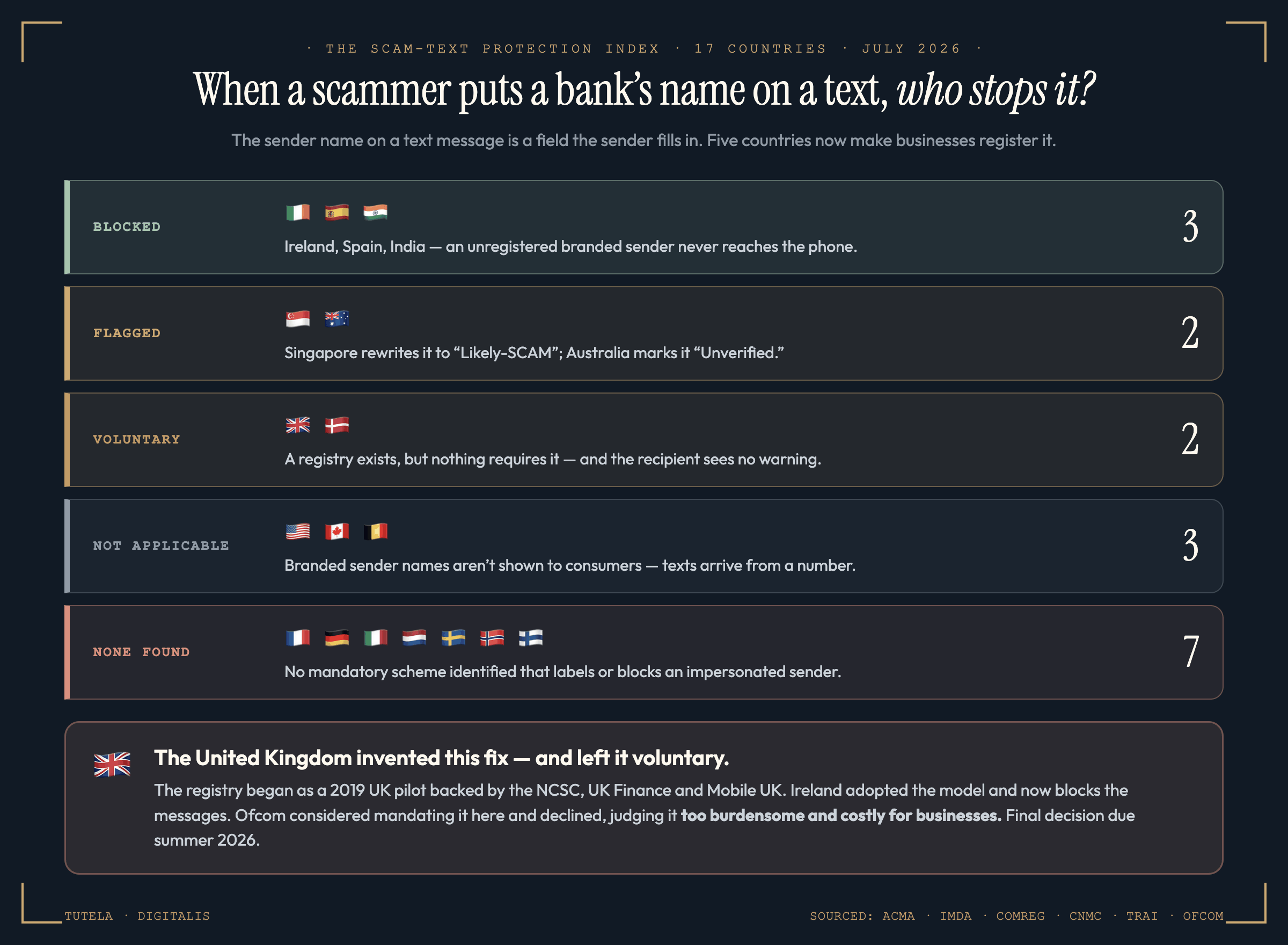
17 countries, reviewed July 2026. Tap a country for the regime, what actually happens to an impersonated text, and the source.
The fix Britain built, and did not use
The idea is not new, and it is not foreign. The SenderID Protection Registry began in Britain in 2019, as a proof-of-concept backed by the National Cyber Security Centre, UK Finance and Mobile UK. The premise is to check business sender names before delivery. Registration can reduce one route to impersonation, but its effect depends on registration checks and enforcement; it cannot authenticate every message.
Ireland adopted the model and made it law: since October 2025, an unregistered branded text is not delivered at all. Singapore made registration mandatory in January 2023 and rewrites unregistered senders to read "Likely-SCAM" — and its regulator reported a 64% fall in SMS scams after the registry went in. Spain began blocking unregistered senders in June 2026. Australia joined in July 2026, with the mildest version: a label reading "Unverified."
In Britain, it is still voluntary — and now settled. On 15 July 2026, Ofcom published its final statement, Combatting mobile messaging scams: new rules and guidance. Its decision, in its own words:
“Having considered stakeholder responses, we have decided not to take forward a centralised sender ID registry at this time.”
The reasoning matters, and it is more considered than a flat refusal. Ofcom does not dispute that the mechanism works — it states that a registry “could be an effective means to achieve our policy objective” and could be “particularly effective in preventing brand impersonation tactics used by scammers” (¶8.77). Its judgement is one of proportionality: that a centralised registry “could be onerous” to business senders and aggregators, would carry significant up-front and ongoing costs likely to fall hardest on small businesses that “are not likely to be spoofed by scammers” in the first place, and that the same objective can be reached through “other, less onerous A2P measures” (¶8.76, ¶8.78). The person-to-person measures take effect on 18 January 2027. Business-messaging measures, including those sender-ID checks, take effect on 15 July 2027.
So the finding stands, and is now a decided fact rather than a pending one: the specific mechanism Ireland used to stop the messages outright, and that Britain designed, is not the one Britain will require. Ofcom left the door ajar — the phrase is “at this time”, and it says it remains “supportive of additional industry-led initiatives” (¶8.79).
A note on sourcing, because it matters: before the statement was published this page reported Ofcom’s rationale from published legal analysis of the earlier consultation, and said so. With the statement now out, the precise attribution is visible and it differs. “Burdensome” is BT’s and techUK’s word, which Ofcom quotes from their consultation responses; Ofcom’s own word is “onerous”, and its reasoning rests on proportionality rather than on burden alone. We have corrected the wording above and now quote Ofcom directly.
What this does not say
Four honest limits, because an index that overclaims is worth less than one that doesn't.
A missing scheme is not a proven absence. Regulators publish the rules they make; they do not publish pages announcing the rules they haven't made. So for the 5 countries in the "none identified" tier, we are reporting the result of a search, not a fact about the world. If a scheme exists that we missed, we want to be told, and we will correct the row and say we did.
And we now know how that tier fails, because it has failed twice. Every row in the "none identified" tier rests on a commercial messaging aggregator's country-requirements page rather than on a regulator. Twice that source has been wrong in the same direction: Italy sat in this tier while AGCOM was in fact running a mandatory Alias register, and Finland sat in it while Traficom had already issued a regulation — in force 4 May 2026 — requiring advance approval of every sender ID. Both are now in the Blocked tier. An aggregator's matrix records what that company needs from a customer in order to route traffic, which is a different question from whether a regulator has mandated consumer-facing protection, and it can be silent on a rule that exists. Treat the remaining rows in this tier as the weakest claims on this page: they are the ones most likely to be wrong next, and we would rather say so than let them look as solid as the sourced tiers.
"Not applicable" is not a failing grade. The United States and Canada do not appear in the blocking tiers because business texts there arrive from a number, not a brand name — there is no sender name to register or to fake. That is a different network architecture, not negligence. It also means American readers should not relax: impersonation there simply moves into the body of the message and the link.
For messages received in Canada, the Canadian scam-text checker covers Interac, CRA, Canada Post and bank impersonation. Work through the request, then verify it independently; the displayed number does not settle the question.
Registration is not a cure, and the countries that did it are not claiming otherwise. Every regime here governs the branded sender name. A scammer texting from an ordinary mobile number is untouched by all of it — and so is every scam that arrives by WhatsApp, iMessage or a dating app. This mechanism kills one specific, very common trick: wearing a real institution's name. It does not kill the con.
And the best regime in the index has a hole in it. Ireland is our top tier, but the trade publication Commsrisk reported in May 2026 that organisations registering a sender name often cannot tell which of Ireland's 95 aggregator routes actually carries their traffic — so they register across all of them, which leaves their own name usable right across the ecosystem. Fraudsters have also moved to ordinary numbers and short codes, which no sender-ID registry governs. The honest reading is that a registry displaces this particular trick rather than eliminating SMS fraud, and the effectiveness of the UK-invented model has been publicly disputed. We are reporting what each country has built, not promising that any of it makes a country safe.
How this index is built
The index rests on a single factual question, applied identically to all 17 countries: when a text message arrives carrying a real organisation's name in the sender field, does the national regime block it, relabel it, or let it through unchanged? We do not score sub-factors or compute a composite rating — the reality is close to categorical, and a tier is more honest than invented precision.
Each country sits in one of five tiers. Blocked, Flagged, Voluntary and Not applicable are positive findings: each is sourced to the regulator, the named scheme, or the published network requirement, and each row links out so the claim can be checked at source. None identified is deliberately worded as a search result, not an assertion — see the limits above.
Where a regulator publishes a figure, we cite it and attribute it (Singapore's 64%). Where no figure exists, we describe the position in words rather than invent a statistic. The data was last reviewed July 2026, and several rows are in motion — Ofcom decided on 15 July 2026, and its new rules phase in through 2027. It is compiled by Tutela Digitalis, an independent fraud-education resource with no telecoms or bank funding.
For journalists
This index is free to cite, and the graphic above is free to republish, with credit (CC BY 4.0). The one-line finding: the UK invented the registry that stops impersonated texts, and is the only country in this index that built the mechanism and then declined to require it — on 15 July 2026 Ofcom confirmed it will not take forward a centralised registry "at this time", while Ireland, using the same model, now blocks the messages outright.
Two things changed on 17 July 2026, after Ofcom published its statement, and we would rather you knew than discovered them. First, the precise attribution: "too burdensome" is not Ofcom's phrase but BT's and techUK's, which Ofcom quotes from their consultation responses. Ofcom's own word is "onerous", and its reasoning is proportionality, not burden alone — before the statement we reported the rationale from published legal analysis of the consultation, and now we quote Ofcom directly. Second, Ofcom's statement names Italy among the countries with centralised registration rules; we had Italy in the "none identified" tier, sourced to an aggregator's country-requirements page rather than to a regulator. AGCOM in fact runs a mandatory Alias register, so Italy is now in the Blocked tier and the counts have moved with it. Everything in the Blocked, Flagged and Not-applicable tiers is sourced to the regulator or the published network requirement.
Updated 28 July 2026 — and it is the same mistake as Italy. Finland was in the "none identified" tier, sourced to the same aggregator page. It should not have been: Traficom issued a regulation (Order 28 L/2025) that has required advance approval of every SMS sender ID since 4 May 2026, and its own guide states that traffic using a reserved sender name outside the agreed routes "will be blocked". Finland is now in the Blocked tier, and the counts and the graphic have moved with it. Because this is the second false negative from the same class of source, we have added it to the limits above rather than just fixing the row: the remaining "none identified" countries are the weakest claims here, and we would rather you treated them that way. We would still rather be corrected than be quietly wrong — our corrections log is public.
The dataset is archived with a permanent DOI, so it stays citable and resolvable independently of this site: 10.5281/zenodo.21454132 (a concept DOI, so it always resolves to the newest version rather than pinning to one deposit). (CSV + JSON + methodology, 1.0.0). One caveat worth stating plainly: the deposited copy is version 1.0.0 and still carries Finland in the "none identified" tier, because the correction above was made on this page on 28 July 2026 and the archive has not yet been re-deposited. The table on this page is the current one. We are leaving the version number honest rather than advertising a release the DOI does not yet serve.
Suggested citation: Tutela Digitalis (2026). The Tutela Digitalis Scam-Text Protection Index (Version 1.0.0) [Data set]. Zenodo. https://doi.org/10.5281/zenodo.21454133
Need the underlying country-by-country data, a correction, or a quote? Email press@tuteladigitalis.com. We publish corrections.
How to tell a real text from a fake one
Wherever you live, the defence is the same — and it does not depend on the sender name, because in most of the world that name is worth nothing.
Go deeper
Check a specific text, or see what each company says it will never do:
Common questions
Which countries block scam texts that impersonate a company?
Of the 17 countries in this index, 7 require businesses to register the brand name that appears as the sender of a text. 5 of them — Ireland, Spain, India, Italy and Finland — block the message outright if the name is not registered, under the scheme’s rules; that is not a guarantee that every impersonation attempt is stopped. Two more — Singapore and Australia — let it through but relabel it: Singapore rewrites the sender to "Likely-SCAM", Australia marks it "Unverified" and files it in a separate thread. Other countries use different arrangements; this index compares sender-name registration, not every defence against scam texts.
Why does the UK still get scam texts that impersonate banks?
Because in the UK, registering a sender name is voluntary. The mechanism was actually invented in Britain — a 2019 pilot backed by the National Cyber Security Centre, UK Finance and Mobile UK — and Ireland and Singapore went on to adopt the model and make it law. On 15 July 2026, in its statement Combatting mobile messaging scams, Ofcom confirmed its decision: "Having considered stakeholder responses, we have decided not to take forward a centralised sender ID registry at this time" (paragraph 8.80). Ofcom accepts that such a registry could be an effective means of meeting its objective, but judged it could reach the same objective through other, less onerous measures — duties on operators instead, phasing in through 2027.
Does a sender-ID register actually reduce scams?
The strongest published evidence comes from Singapore, whose regulator (IMDA) reported a 64% fall in SMS scams after its Sender ID Registry was set up. That is the regulator's own figure and it covers the period around the registry's introduction, so it should be read as a strong indication rather than a controlled experiment. It is, however, the clearest number any regulator has put on the mechanism — which is what makes Ofcom's proportionality judgement worth scrutinising, since Ofcom accepts the mechanism could be effective and declined it on cost and onerousness rather than on doubt that it works.
Why isn't the United States on the list of countries that block them?
Because the mechanism does not apply there. In the US and Canada, business texts do not display a brand name at all — they arrive from a number (10DLC, toll-free or a short code). There is no sender name to register, and therefore none to impersonate. That closes one door and leaves another wide open: American impersonation happens in the body of the message and in the link, not in the sender field. So a US reader should not treat "no register" as "no protection needed" — the tells are simply somewhere else.
If my country has no register, how do I tell a real text from a fake?
Assume the sender name proves nothing, because in most countries it proves nothing. Judge the message by what it asks you to do: no legitimate bank, tax office or courier will text you a link to pay, "verify," or move money to a safe account. The safe move is always to ignore the message and go to the source yourself — open the official app, or type the address by hand. Our Impersonation Index lists what 27 major organisations have each published about how they really contact you.
How is this index compiled?
On a single factual axis: when a text arrives carrying a real company's name as the sender, does the country's regime block it, relabel it, or do nothing? Countries are placed in one of five tiers, each sourced to the regulator or the named scheme. Where we found no mandatory scheme, we say we found none — which is a statement about our search, not proof that no scheme exists, and we invite corrections. Last reviewed July 2026.
Got a text you're not sure about? Send us the details.
A real expert reviews every case and replies within 24 hours — whether it's genuine, what to do next, and what to report. Free, confidential, no pressure.