Sometimes — and it hinges on one distinction. If the transfer was unauthorized (someone moved your money without your permission), federal law generally requires a refund: Regulation E covers debit and bank transfers, the Fair Credit Billing Act covers credit cards, and reporting fast can cap your loss at $50. If you were deceived into authorizing the payment yourself — which describes almost every scam — federal law does not require the bank to refund it, and most banks say no. In 2023 the three big banks behind Zelle reimbursed scam victims just 12% of the time. How you paid, and how fast you report, decide the rest.
Read the image explanation
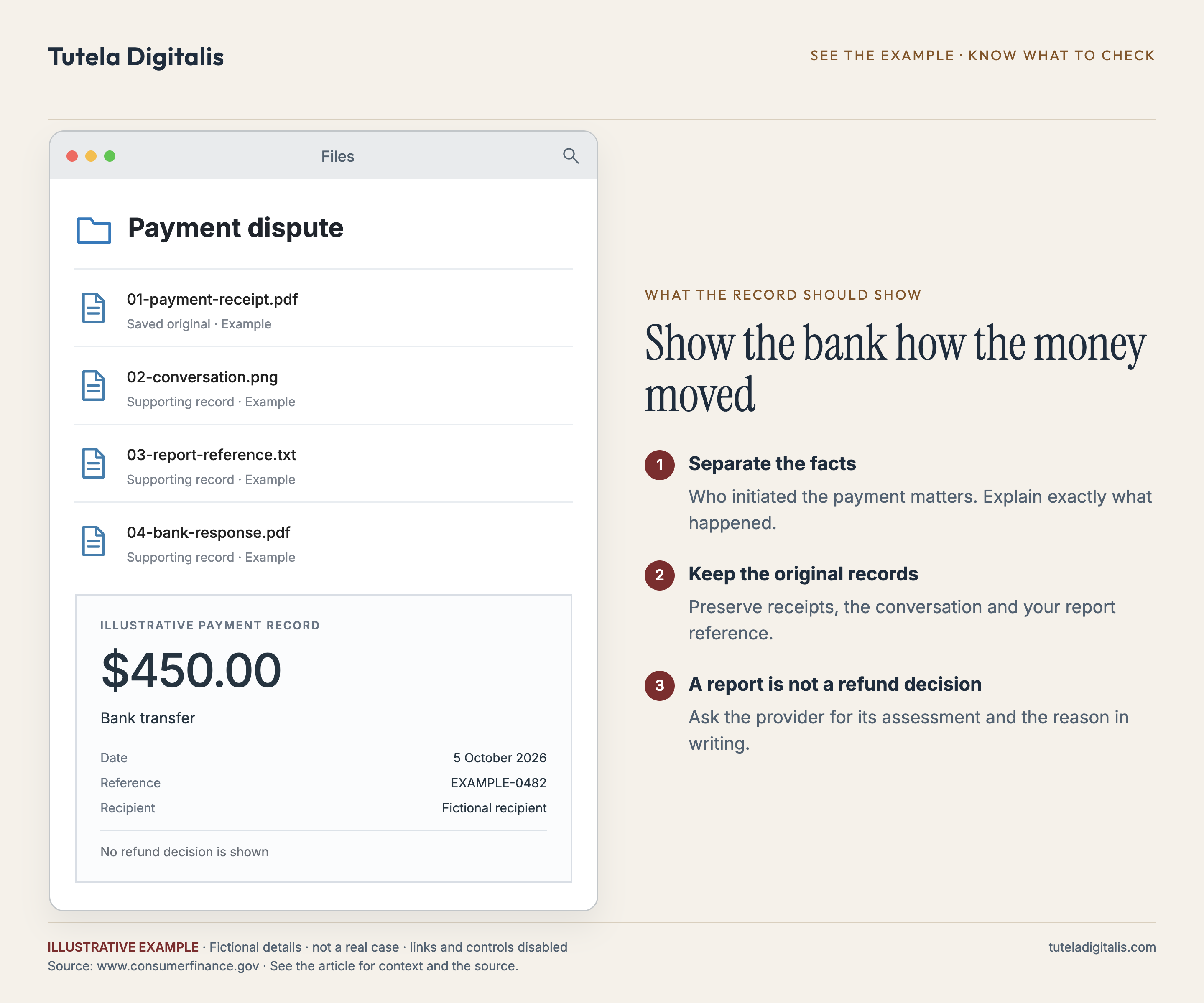
Illustrative example: Payment dispute $450.00 Bank transfer 01-payment-receipt.pdf 02-conversation.png 03-report-reference.txt 04-bank-response.pdf
- Separate the facts. Who initiated the payment matters. Explain exactly what happened.
- Keep the original records. Preserve receipts, the conversation and your report reference.
- A report is not a refund decision. Ask the provider for its assessment and the reason in writing.
"Zelle and the big banks who own it know that Zelle's speed and convenience makes it a target. They are well aware that, every single day, some of their customers will be hurt. They know this and are willing to accept the risk as the cost of doing business — the cost for their customers, that is, not for themselves."
— Sen. Richard Blumenthal, Chairman of the US Senate Permanent Subcommittee on Investigations, opening statement at the 23 July 2024 hearing on the Subcommittee's Zelle staff report. The report is the single most authoritative public source on how often banks actually refund — and almost none of the articles ranking for this question cite it.
If you have been scammed and you are searching this question, you want a real answer, not a maybe. So here is the real answer, and then the whole map underneath it.
Banks refund money that was taken from you without your permission. Banks usually do not refund money that you were tricked into sending yourself. Everything else — the payment method, the deadlines, the percentages — is detail that sits underneath that one rule. The reason this matters so much is that scammers know the rule too. The entire design of a modern scam is to get you to press Send, enter the code, or approve the transfer yourself, because the moment you do, the transaction becomes "authorized," and the bank's legal obligation to refund you mostly disappears.
The one distinction the other articles skip: unauthorized vs. authorized
This is the line everything turns on, and it is the line most of the top results name in passing and never explain. Regulation E — the federal rule that implements the Electronic Fund Transfer Act — gives you strong protection against unauthorized electronic transfers. It says almost nothing useful about transfers you authorized.
What "the bank will refund you" actually means, by payment method
The friendly version of this article is a table that says credit cards are safest and crypto is hopeless. That part is true. What those articles leave out is which law does the work in each row, because the law is what you cite when you are arguing with a bank that has already said no. Here is the table with the mechanism named.
| Payment method | The law that does the work | Refund odds |
|---|---|---|
| Credit card | Fair Credit Billing Act ($50 cap) + chargeback | Strongest — covers fraud and bad purchases |
| Debit card / bank transfer | Regulation E ($50–$500 if reported fast) | Moderate — but money leaves your real balance |
| ACH transfer | Nacha network rules (unauthorized only) | Low — short reversal window |
| Wire transfer | No consumer-refund law; recall only | Very low — act within 24–72 hours |
| Zelle / Venmo / Cash App | Reg E gap; Zelle June-2023 imposter policy | Low — unless genuinely unauthorized |
| Gift card / crypto | No chargeback, no Reg E, no reversal | Effectively none once handed over |
What the banks' own numbers say, and why the subscription blogs won't tell you
Here is the part the identity-protection blogs almost never include, even though it is public and it is the most important context a scam victim could have: we know, in hard numbers, how often the biggest banks actually refund — because the US Senate made them report it.
In July 2024, the Senate Permanent Subcommittee on Investigations released a staff report on Zelle and its three largest owner banks — JPMorgan Chase, Bank of America, and Wells Fargo. The findings are blunt. In 2023, those three banks reimbursed customers who reported unauthorized transactions only 38% of the time — down from 62% in 2019. For scams — the authorized-but-deceived payments — they reimbursed victims just 12% of the time. The Subcommittee also documented that in 2020, JPMorgan reimbursed 3 of 41,390 scam disputes, and Wells Fargo reimbursed none of its 25,061.
"The nation's largest banks felt threatened by competing payment apps, so they rushed to put out Zelle. By their failing to put in place proper safeguards, Zelle became a gold mine for fraudsters, while often leaving victims to fend for themselves."
— Rohit Chopra, then-Director of the Consumer Financial Protection Bureau, prepared remarks announcing the CFPB's lawsuit against Early Warning Services and the three banks, 20 December 2024. The detail that completes the picture: the CFPB withdrew that lawsuit in March 2025, before it was ever tested in court — but in August 2025, New York Attorney General Letitia James revived the core claims, suing Zelle's operator Early Warning Services over the more than $1 billion the office says scammers stole from New Yorkers between 2017 and 2023. The fight moved; it did not end.
I am naming the banks because the Senate named them, on the record, with the banks' own data. That is the line this site holds: we question institutions by their verifiable conduct, never individuals, and never with numbers we cannot source. The articles that rank above this one tend not to mention any of it — and it is worth asking why. Many are published by companies that sell a subscription, a $5-million-insurance plan, or a fraud-resolution service. The recovery question is the headline; the product is the ask. There is nothing illegal about that, but it shapes what gets said: a page funded by a security product has little incentive to dwell on the fact that the strongest protections are free, that the law has a gap the size of every scam, and that the banks reimburse scam victims one time in eight.
The 72-hour playbook: how to actually claim a refund
None of the above means you should give up. It means you should move fast, use the right words, and pursue every parallel path at once. This is the sequence.
What the UK does that the US doesn't
It is worth knowing that the gap you are standing in is a policy choice, not a law of nature — because another major market closed it. Since 7 October 2024, the UK's Payment Systems Regulator requires banks to reimburse most authorized push payment scam victims, up to £85,000 per claim, generally within five business days, with the cost split 50/50 between the sending and receiving banks. That is the precise scenario — you were deceived into authorizing the payment — that US law generally leaves uncovered.
The US has no national equivalent. The Zelle network's June 2023 imposter-scam reimbursement policy is the closest thing, and it is narrow and voluntary by comparison. If you are reading this from the UK, the path runs through the UK reporting and reimbursement route; if you are in the US, the honest framing is that you are arguing inside a gap your own banking system has chosen not to close.
So, do banks refund scammed money?
Sometimes. They refund unauthorized transfers far more often than authorized ones, they refund credit cards far more often than wires or crypto, and they refund fast reporters far more often than slow ones. They reimburse outright scams — the authorized-but-deceived payments that make up most of modern fraud — only a small fraction of the time, and the most-cited figure for the biggest banks is 12%.
The pages that rank for this question will tell you to "act fast" and "contact your bank," and that is not wrong. What they tend to leave out is the one distinction that actually decides your case, the law you cite to make your argument, the public numbers on how rarely banks pay, and the fact that every genuinely useful recovery channel costs nothing. Those omissions are convenient for a page that exists to sell a subscription. They are not convenient for you, which is why they are the spine of this one.
If you take one rule from this whole piece, take this: the bank's answer turns on whether the money was taken from you or sent by you — so report it fast, say 'unauthorized' when it is true, run the card chargeback in parallel, and escalate to the CFPB the moment you hear no. The law has a gap, but a documented, persistent victim is the one who lands in the share that gets paid.
A bank already told you no? Let's look at the angle they didn't.
Tell us how you paid, how fast you reported, and the reason the bank gave. A real expert reviews every case and replies within 24 hours. Free, confidential, no pressure, nothing to sell.
Common questions about bank refunds after a scam
Do banks have to refund scammed money?
It depends on one thing: whether the transfer was unauthorized or authorized. If someone moved money out of your account without your permission — a stolen card, a hacked login, a transaction you never made — that is an 'unauthorized' transfer, and federal law generally requires the bank to refund it. Regulation E covers debit and bank transfers; the Fair Credit Billing Act covers credit cards. But if you were tricked into sending the money yourself — you approved the payment because someone lied to you — that is treated as an 'authorized' transfer, and federal law does not require the bank to refund it. Almost every scam is engineered to land in that second category, which is why so many victims are told no.
How long do I have to report scammed money to my bank?
Report it immediately — the clock is the single biggest factor you control. For an unauthorized debit-card or bank transfer under Regulation E, reporting within two business days of learning about a lost or stolen card caps your liability at $50; waiting up to 60 days can raise it to $500; and for unauthorized transfers that don't involve a lost or stolen card, you generally owe nothing if you report within 60 days of the statement that shows the transfer. For credit cards under the Fair Credit Billing Act, you have 60 days from the statement date to dispute, and your liability for unauthorized use is capped at $50. After 60 days the protections weaken sharply. Do not wait for the scammer to respond or for the situation to 'resolve' — report the moment you suspect fraud.
Will my bank refund money if I authorized the payment myself?
Usually not, and this is the hardest truth for scam victims to hear. If you pressed Send, entered your PIN, or approved a transfer — even though you only did it because you were deceived — the bank classifies the payment as 'authorized,' and Regulation E does not require a refund for authorized payments. This is the exact gap banks point to when they deny scam claims. There are still things worth trying: argue the transaction was procured by fraud, dispute the underlying card if one funded it, and file a CFPB complaint. Some banks reimburse anyway as a goodwill or policy matter (and for Zelle imposter scams, a June 2023 network policy now requires it in qualifying cases). But the default legal answer for an authorized-but-deceived payment is that the bank does not have to give it back.
Which payment method gives the best chance of a refund?
Credit cards, by a wide margin. The Fair Credit Billing Act caps your liability for unauthorized charges at $50, and the chargeback system lets you dispute charges for goods that never arrived or weren't as described — protection that exists for authorized purchases too, not just outright fraud. Debit cards and bank transfers come next, covered by Regulation E but with weaker practical outcomes. After that the odds fall off a cliff: ACH transfers are hard to reverse, wire transfers are nearly impossible once sent, and gift cards and cryptocurrency are effectively gone the moment you hand over the code or hit confirm. The rule of thumb: the more a payment method resembles handing over cash, the less any bank can do for you afterward.
Do banks refund Zelle, Venmo, or Cash App scams?
Rarely, unless the transaction was genuinely unauthorized. Peer-to-peer transfers you approved are treated as authorized, so the same Regulation E gap applies. The US Senate's Permanent Subcommittee on Investigations found that in 2023 the three big banks that own Zelle reimbursed scam victims only 12% of the time. There is one real change: since June 2023, Zelle's network operator requires participating banks to reimburse qualifying imposter-scam victims, which is why some Zelle claims now succeed. Venmo and Cash App offer purchase protection only when you tag a payment as Goods and Services. The honest summary: P2P scam refunds are the exception, not the rule, and they depend on the specific scam type and the bank.
What can I do if the bank refuses to refund me?
You are not out of options. First, escalate inside the bank in writing and ask for the denial reason and the regulation it relied on. Then dispute the underlying funding source — if a credit or debit card paid for the transfer, the card issuer's chargeback process is separate from the bank's scam decision. File a complaint with the Consumer Financial Protection Bureau at consumerfinance.gov/complaint; banks must respond, and the complaint becomes part of the regulatory record that has driven recent enforcement. Report to the FBI at ic3.gov and the FTC at reportfraud.ftc.gov. For larger losses, a written demand, a state attorney general complaint, or small-claims court can move a stalled case. None of these are guaranteed, but a documented, persistent victim recovers more often than one who accepts the first no.
Sources & further reading
Every figure in this piece is drawn from these authorities. Click any of them to verify.