PayPal is a legitimate, regulated payment company with about 436 million active accounts, and for Goods and Services purchases it offers the strongest buyer protection of any US payment app — a 180-day window to dispute an order. But that protection has two holes. Send money as Friends and Family and you get zero protection, which is exactly why almost every PayPal scam pushes you there. And PayPal can hold or freeze your own balance for up to 180 days. The rule that protects you: never send Friends and Family to anyone you wouldn't hand cash, pay for everything you buy as Goods and Services, and don't keep a balance you can't afford to lose access to.
Read the image explanation
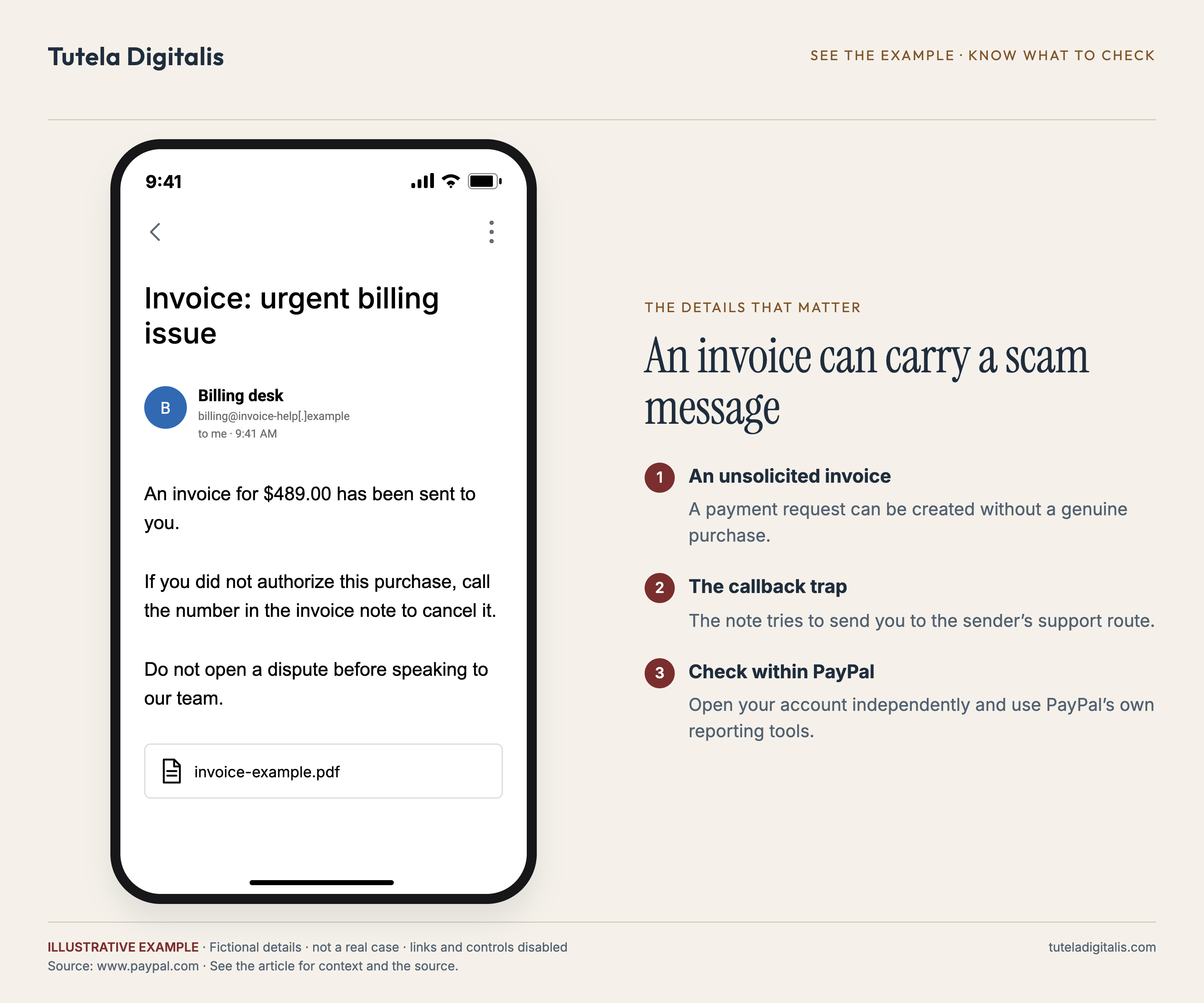
Illustrative example: Billing desk billing@invoice-help[.]example Invoice: urgent billing issue An invoice for $489.00 has been sent to you. If you did not authorize this purchase, call the number in the invoice note to cancel it. Do not open a dispute before speaking to our team. invoice-example.pdf
- An unsolicited invoice. A payment request can be created without a genuine purchase.
- The callback trap. The note tries to send you to the sender’s support route.
- Check within PayPal. Open your account independently and use PayPal’s own reporting tools.
"As scammers attempt to coerce people into sending payments that may not be eligible for refunds, including scams that originate on social media, we believe putting more information directly into customers' hands will empower them to help stop scams in their tracks."
— PayPal, 21 July 2025, announcing AI-powered scam alerts for Friends and Family payments. Read that first clause again: PayPal, in its own press release, describes Friends-and-Family payments as ones "that may not be eligible for refunds." That is the company confirming the exact structural gap this piece is about. The alerts are a real improvement. They do not change the underlying fact that once a Friends-and-Family payment is sent, PayPal's protection does not apply.
I recommend PayPal. For buying things from people you don't know, it is the safest of the mainstream US payment apps — the Purchase Protection program is genuinely strong, the 180-day dispute window is the most generous in the category, and the company is regulated and publicly traded. None of what follows changes that.
What I want every PayPal user to understand is that PayPal's safety is conditional. It is unlocked by one choice on each payment — Goods and Services rather than Friends and Family — and it is undercut by one risk most people never hear about until it happens to them: PayPal can freeze your own money. Almost every PayPal scam in the inbox in 2026 exploits the first gap. The second one isn't a scam at all, but it can leave you just as stuck. Here is the whole map.
Three different "is PayPal safe" questions, three different answers
The single phrase hides three separate concerns. Each has its own answer.
The protection is real, and it is gated behind one choice
This is the structural fact that decides whether you get your money back when a PayPal purchase goes wrong. Every payment to another person gives you two options, and only one of them carries protection.
Here is how the four big US payment apps actually compare on buyer protection — the thing that decides whether you get your money back:
| Payment app | Buyer protection | Dispute window |
|---|---|---|
| PayPal | Strongest — Purchase Protection on Goods & Services | 180 days |
| Venmo (PayPal-owned) | Comparable, but only on Goods & Services tag | Limited (from transaction date) |
| Cash App | None — no buyer-protection program | No standard window |
| Zelle | None — banks reimbursed scams ~12% of the time (US Senate, 2023) | No standard window |
The ranking only holds if you actually use Goods and Services. A PayPal user who sends every stranger payment as Friends and Family has the same protection as a Zelle user — almost none.
The first trap: Friends and Family has zero protection, and PayPal says so
The most important sentence in this whole piece is not mine. It is PayPal's, from the July 2025 press release announcing its new scam alerts: scammers "coerce people into sending payments that may not be eligible for refunds." That is the company describing its own Friends-and-Family product. The new AI alerts that flag suspicious F&F payments are a real, welcome improvement — but they exist precisely because the F&F payment, once sent, is gone.
The scam playbook is built around this. A Marketplace seller who seems friendly explains that Goods and Services "charges them a fee," so could you just send Friends and Family. A "buyer" overpays with a real-looking transfer and asks you to refund the difference as F&F. A romance contact needs an emergency payment and it has to be F&F. In each case the request to use Friends and Family is not incidental — it is the entire mechanism. The deception exists to move you from the protected payment type to the unprotected one before you notice the difference.
Once an F&F payment has settled, PayPal's Resolution Center will not help you. What remains is the underlying funding source. If the F&F payment was funded by a credit or debit card or a bank account, that charge still carries federal protection, and you can dispute it with the issuer under the Fair Credit Billing Act or Regulation E — the same escalation path that runs through the 72-hour recovery playbook. It is slower and less certain than a PayPal dispute, and it is the price of having used the wrong button.
The second trap nobody warns you about: PayPal can freeze your own money
The Friends-and-Family gap is well-covered. This one is not, and it catches honest people who never went near a scammer. PayPal can place a hold on your incoming funds — commonly 21 days for newer or higher-volume sellers — and in some cases limit or freeze an account for up to 180 days while it reviews activity its automated systems flag as risky.
This stopped being just a seller grievance in 2026. In March 2026, the FTC sent warning letters to PayPal and other payment companies about debanking — abruptly cutting consumers off from their own accounts and funds. You do not have to agree with every framing of that debate to take the practical signal: a federal regulator now treats sudden loss of account access as a consumer-protection problem worth a warning letter. Account-access risk is real, it is on the regulators' radar, and you should manage your balance accordingly.
The PayPal scams dominating 2026
The list below covers almost everything I see in the inbox. The unifying mechanic is one of two moves: convince you to pay Friends and Family, or convince you that you are talking to PayPal when you are not.
The 8-step playbook for using PayPal safely
This is the sequence I would follow myself. None of it is exotic. It is the set of habits that closes both gaps — the Friends-and-Family protection hole and the frozen-balance risk — that PayPal's design leaves open by default.
So, is PayPal safe?
Yes. The company is legitimate, the technology is sound, and for buying things from people you don't know it is the safest mainstream payment app in the United States — the 180-day Purchase Protection window is the best in its class. That is the honest verdict, and it is not the whole story.
PayPal's safety is conditional on two habits the default settings do not enforce for you. Choose Goods and Services on every purchase, or the strongest buyer protection in the category simply does not apply. And keep your balance moving, or the same company that protects your purchases can lock up your own funds for up to 180 days. PayPal told its own customers in 2025 that Friends-and-Family payments "may not be eligible for refunds," and a federal regulator told PayPal in 2026 that cutting people off from their accounts is a problem worth a warning letter. Both of those are the company and the government confirming, on the record, the two gaps you have to manage yourself.
If you take two rules from this whole piece, take these: never pay for a purchase as Friends and Family, no matter how the fee is explained to you — and never keep money in PayPal you can't afford to lose access to. The best protection in the category is real, but it is yours to switch on, and yours to keep within reach.
Sent Friends and Family to a stranger, or had your balance frozen? Let's look at the path forward together.
Tell us the amount, how you paid (Friends and Family or Goods and Services, and the funding source), and the timeline. A real expert reviews every case and replies within 24 hours. Free, confidential, no pressure.
Common questions about PayPal safety
Is PayPal itself a scam?
No. PayPal Holdings, Inc. (NASDAQ: PYPL) is a legitimate, regulated, publicly-traded payment company. PayPal reported about 436 million active accounts in its Q1 2025 SEC filings and processes well over a trillion dollars in payment volume a year. The infrastructure works: money you send reaches the account you addressed it to, the dispute system functions when it is activated, and the company is audited and regulated. PayPal is not the scam. The scams are run by other people using PayPal as the rail — and, in 2025, McAfee reported a 600% rise in PayPal-themed scam emails, which tells you how attractive the brand is to impersonators, not that the company is fraudulent.
Can I get my money back if I was scammed on PayPal?
It depends almost entirely on how you paid. If you paid for Goods and Services, PayPal's Purchase Protection may cover you and you can open a dispute in the Resolution Center within 180 days of the payment — for items that never arrived or were significantly not as described. This is the strongest buyer-protection program of any US payment app. If you paid Friends and Family, you generally have no recourse through PayPal; the payment is treated as cash between people who trust each other and cannot be reversed by PayPal support. Your only remaining path is to dispute the underlying card or bank transfer that funded the payment, under the Fair Credit Billing Act (credit) or Regulation E (debit/bank), and to escalate to the CFPB.
What is the difference between PayPal Friends and Family and Goods and Services?
Friends and Family is for sending money to people you already know and trust — splitting a bill, repaying a loan, a gift. It is usually free when funded from a balance or bank account, carries no buyer protection, and cannot be reversed. Goods and Services is for buying something. The seller pays a fee (roughly 2.99% + a fixed amount for most US transactions in 2026), and in exchange the buyer gets Purchase Protection and the right to open a dispute. Almost every PayPal purchase scam in the wild is engineered to convince you to send Friends and Family — because the moment you do, the protection is gone and PayPal has no obligation to help you recover.
Why does PayPal freeze accounts and hold money for 180 days?
This is the second risk most people don't know about until it happens to them. PayPal can place a hold on incoming funds — commonly 21 days for newer or higher-risk sellers — and in some cases limit or freeze an account for up to 180 days while it reviews activity it considers risky. Triggers include a sudden spike in sales, high-value transactions, chargebacks, selling in high-risk categories, or activity that trips its automated risk models. During a freeze you typically cannot send or receive, and depending on the case you may not be able to withdraw until the review clears. In March 2026 the FTC sent warning letters to PayPal and others about debanking — abruptly cutting off consumers' access to their accounts — which shows the regulators now treat account-access risk as a real consumer-protection issue, not just a seller annoyance.
Is PayPal safer than Venmo, Cash App, or Zelle?
For Goods and Services purchases, yes — PayPal's Purchase Protection is the strongest buyer-protection program of the group, and the only one with a 180-day dispute window. Venmo (which PayPal owns) has comparable protection but only on payments tagged Goods and Services. Cash App has no equivalent buyer-protection program at all. Zelle is the most unforgiving: no protection layer, and the US Senate found the big three banks reimbursed only about 12% of Zelle scam claims in 2023. But that ranking only holds if you actually use Goods and Services. A PayPal user who sends every stranger payment as Friends and Family has roughly the same protection as a Zelle user — which is to say, almost none.
How do I tell a fake PayPal email from a real one?
Assume any email or text that creates urgency about your account is fake until proven otherwise. Real PayPal notifications address you by your full name, not 'Dear Customer.' PayPal will never ask for your password, full card number, or a two-factor code by email or phone. The safest habit: never click links in a PayPal email. Open a browser, type paypal.com yourself, and log in directly — if there is a real issue, it will be in your account. Fake invoices and money requests are a special case because they can be sent through PayPal's genuine system; if you get an invoice for something you didn't buy, do not pay it and do not call the phone number in it — just decline it. Forward suspicious messages to phishing@paypal.com.
Is PayPal safe for online payments in 2026?
For buying things online, PayPal is the safest of the mainstream US payment apps in 2026 — but only when you pay for the purchase as Goods and Services. That setting activates Purchase Protection, giving you a 180-day window to open a dispute in the Resolution Center if an item never arrives or is significantly not as described — the strongest and longest buyer-protection window of any US payment app. The safety collapses the instant you send a stranger a Friends-and-Family payment, which carries no protection and cannot be reversed. So the precise answer to 'is PayPal safe for online payments' is: yes for Goods and Services, no for Friends and Family. The other 2026 risk to plan around is on the receiving side — PayPal can hold incoming funds for around 21 days and limit an account for up to 180 days, so treat a PayPal balance as money in transit, not money in storage.
Is PayPal safe for everyday transactions?
For everyday spending, PayPal is safe when you match the payment type to who you are paying. Paying a merchant, a marketplace seller, or anyone you do not personally know? Use Goods and Services so Purchase Protection covers you. Splitting a bill or repaying a friend you actually trust? Friends and Family is fine and usually free — but never use it for a purchase, because it strips every protection. The real everyday threat is not the app itself but impersonation: McAfee reported a 600% rise in PayPal-themed scam emails in 2025, so the safe everyday habit is to never click a link in a PayPal email or text — open a browser, type paypal.com yourself, and check your account directly. PayPal will never ask for your password, full card number, or a two-factor code by email or phone.
Sources & further reading
Every figure in this piece is drawn from these authorities. Click any of them to verify.