AI can help a romance scammer create messages, images, audio or video that support a false identity. You do not need to prove a deepfake to protect yourself. Keep financial decisions separate from the relationship, verify any investment independently, and stop transfers or access requests while doubts remain.
Read the image explanation
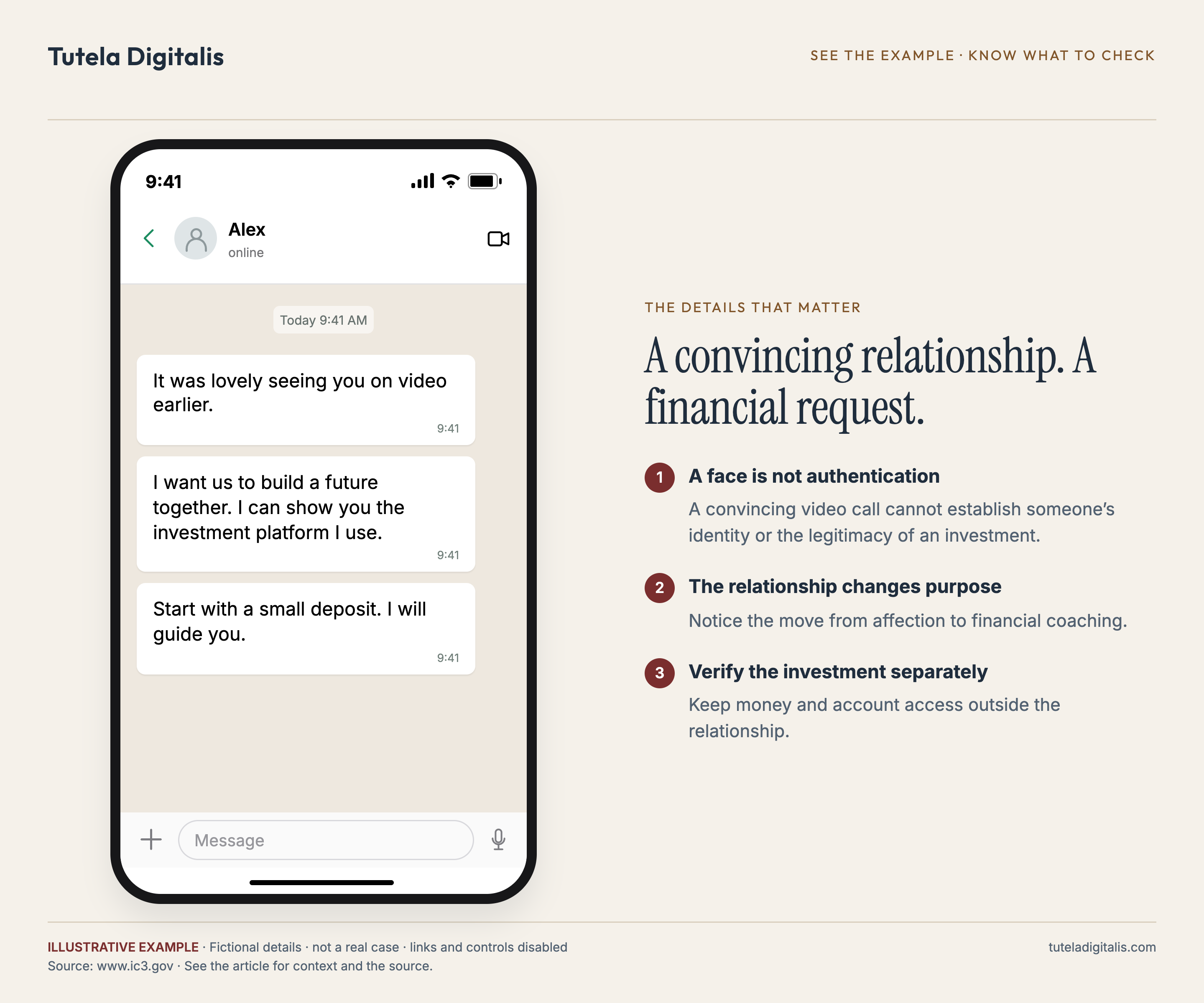
Illustrative example: It was lovely seeing you on video earlier. I want us to build a future together. I can show you the investment platform I use. Start with a small deposit. I will guide you.
- A face is not authentication. A convincing video call cannot establish someone’s identity or the legitimacy of an investment.
- The relationship changes purpose. Notice the move from affection to financial coaching.
- Verify the investment separately. Keep money and account access outside the relationship.
A video call answers a limited question: someone or something appeared on screen. Even an authentic face cannot prove the person’s intentions, employment, financial claims or control of an investment platform. That was true before generative AI; convincing synthetic media makes relying on appearances still less dependable.
The FBI’s generative-AI fraud warning describes synthetic identities and media used to support social engineering. It does not establish that every romance scam uses AI or that a particular proportion of online partners are artificial. We do not have evidence for those broader claims.
What AI changes, and what the scam still needs from you
Writing tools can support fluent, personalized conversations. Generated photographs can make a reverse-image search less informative. Cloned audio or manipulated video can support a claimed identity. These capabilities can help deception; they do not mean a warm message or polished profile is itself a warning sign.
The financial step remains observable. Someone asks you to send money, invest through their contact, receive and forward funds, share credentials or provide sensitive material. Judge that request on independent evidence, even if the relationship feels established.
The point where companionship becomes financial influence
The following sequence is an illustration of a romance-investment pattern, not a specific victim’s conversation:
For the platform and investment checks, use our investment-fraud guide. This article addresses the trust relationship; it should not be used to decide whether a financial product is authorized.
Why the popular deepfake tests are not a verdict
Asking someone to turn their head, hold an object or change apps may give you more information, but it does not reliably distinguish every manipulated call from a real one. A poor connection can create artifacts; an impersonator can also use their own face.
Reverse-image search can expose a photo reused under another name. No result does not prove authenticity: the image may be new, private, edited or generated. A professional profile, identity document or verification badge also needs context. A copied credential cannot authenticate the person who sent it.
Use these checks as clues and look for independent corroboration. More importantly, do not let an apparently successful identity check authorize a transfer to an unverified person or platform.
Financial boundaries that do not require detecting AI
Meeting in person can add information, but it is not a guarantee against financial deception. Conversely, distance or unwillingness to video chat is not proof of fraud on its own. Focus on claims you can verify and actions that put money, access or privacy at risk.
What the loss figures actually measure
The FBI’s 2025 Internet Crime Report records 23,159 confidence/romance complaints and about $929 million in reported losses. Those are combined category totals, not a count of AI romance scams. They should not be presented as evidence of how common deepfakes are in dating.
If you suspect the relationship is a scam
1. Pause money and access
Stop transfers, new investments, remote access and sharing financial credentials while you verify the situation.
2. Preserve the conversation
Save profile links, messages, payment records and wallet transaction details before reporting the account.
3. Check independently
Discuss the situation with someone you trust and verify any claimed business or investment through independent official sources.
4. Use the relevant help routes
Contact your payment provider if money moved; report the profile and suspected crime. Seek urgent local help for threats or immediate danger.
If money moved, use our payment-method guide. If a person is threatening to publish intimate material, do not send more images or assume payment will end the threat. Preserve the messages, report the account and seek appropriate police or specialist support. Immediate danger needs local emergency help.
Official reporting does not automatically turn your complaint into a public list for recovery agents. Be cautious about public posts that reveal contact details or transaction identifiers unnecessarily, and verify anyone who later approaches you with a refund promise. Our recovery-scam guide explains that second approach.
Help someone without turning the conversation into a confrontation
Start with a verifiable claim or a concrete payment request. Offer to contact the purported firm or check the official register together. Calling the entire relationship fake may feel like an attack on the person’s judgment and make it harder to discuss the next transaction.
You do not have to resolve every question about the identity to agree on a pause in payments. For the broader relationship pattern, see our romance-scam guide; for what platforms publicly disclose about safeguards, see the Dating App Safety Index.
Questions readers ask
Can a real person on video still be a romance scammer?
Yes. A person can use their own face while lying about their intentions or the investment they recommend. Authenticating a face does not authenticate a financial opportunity.
Does a reverse-image search prove a profile is safe?
No. It can expose a reused photograph, but no match may simply mean the image is new, private, edited or generated. Treat the result as one piece of information, not a verdict.
Is an AI companion the same as a romance scam?
No. An openly disclosed chatbot or entertainment service is different from a person or operation concealing its identity or intentions to obtain money. You should still review the service’s billing, privacy and data-sharing terms.
Should I confront the person to get my money back?
Avoid sending more money or sensitive details in an attempt to test or bargain with them. Preserve evidence and use your bank, platform and official reporting routes. If threatened, get appropriate local support rather than handling the pressure alone.