Whether Venmo refunds a scam depends on how the money moved. If a scammer accessed your account and sent funds without permission, that is an unauthorized transfer — the Electronic Fund Transfer Act and Regulation E require an investigation and generally a refund, with your liability capped at $50 if you report within two business days. If a scammer tricked you into sending the money yourself, that is an authorized payment, and Venmo only promises to "investigate any available options" — unless Venmo Purchase Protection applies, which covers eligible goods-and-services payments (business profile, Debit Card, in-app checkout, QR code, or the "purchases" toggle) within 180 days. A standard friends-and-family payment to a stranger has no buyer protection at all. Under the User Agreement in force since August 2026, Venmo promises to cover "the full amount" of an unauthorized transaction; it makes no promise of any kind for a payment you sent yourself, whatever you were told to send it. Move fast, classify the payment, and work the escalation in order: Venmo, then your funding bank, then the CFPB.
Read the image explanation
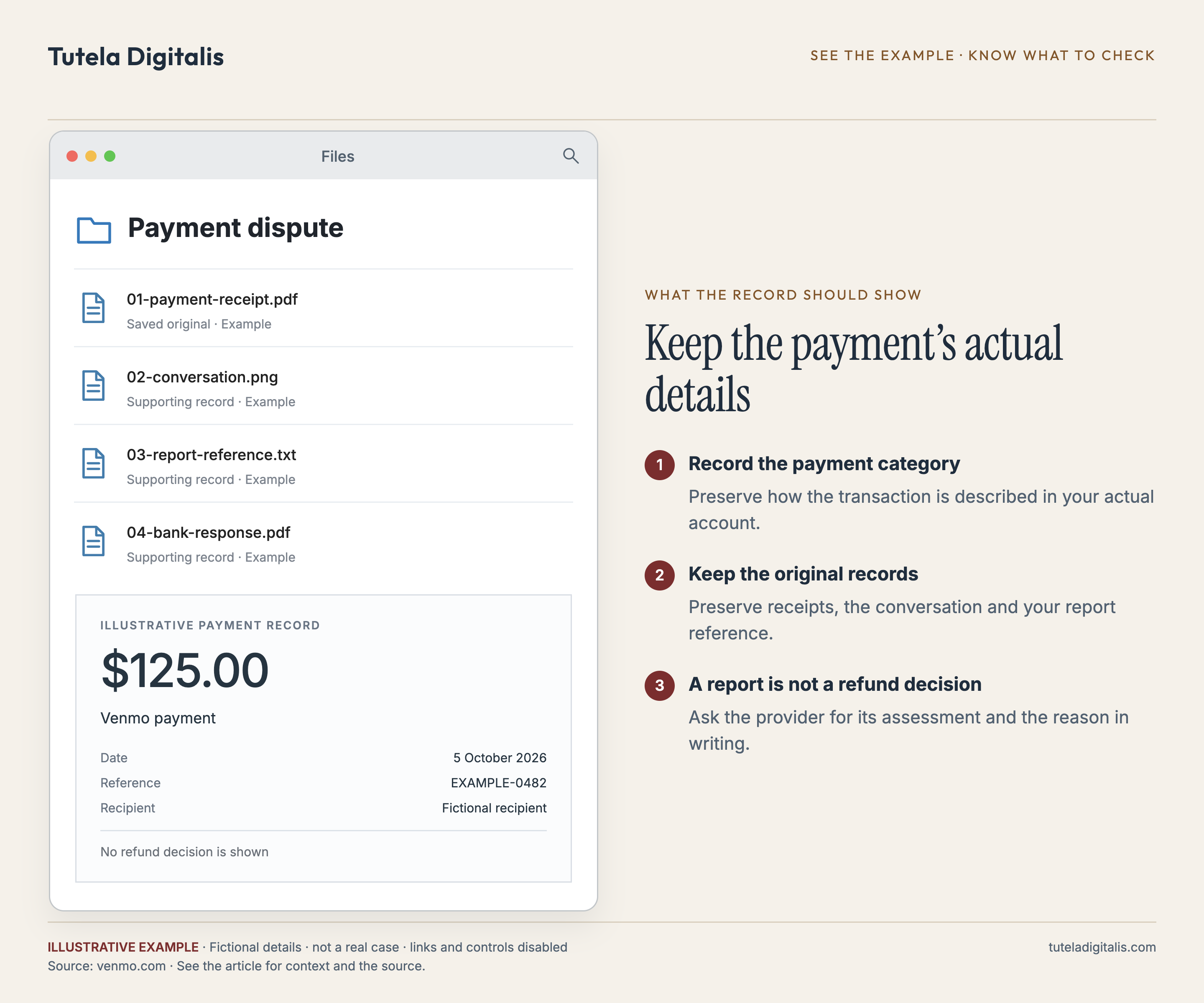
Illustrative example: Payment dispute $125.00 Venmo payment 01-payment-receipt.pdf 02-conversation.png 03-report-reference.txt 04-bank-response.pdf
- Record the payment category. Preserve how the transaction is described in your actual account.
- Keep the original records. Preserve receipts, the conversation and your report reference.
- A report is not a refund decision. Ask the provider for its assessment and the reason in writing.
"Digital payments have gone from novelty to necessity and our oversight must reflect this reality."
— Rohit Chopra, then-Director of the CFPB, on finalizing the December 2024 rule to put the largest payment apps — including Venmo — under routine federal examination. The rule took effect 9 January 2025. Four months later, on 9 May 2025, Congress repealed it under the Congressional Review Act and the President signed the repeal — ending routine CFPB supervision of Venmo before a single examination took place.
I want to start with the part most "how to get your Venmo money back" articles skip, because it is the part that actually decides the outcome: there is no single answer to "will Venmo refund me." There are two completely different situations wearing the same clothes, and which one you are in was determined the moment the money moved — before you noticed anything was wrong, before you opened the app to complain. Tell those two situations apart and the rest of this is just doing the steps in order. Get them confused and you will spend days pushing on a door that was never going to open.
The two situations are unauthorized and authorized-but-deceived. Unauthorized means a scammer moved money out of your account without your permission — they phished your login, hijacked your SIM, got into your phone. Authorized means you pressed Send yourself, because someone lied to you well enough that sending felt like the right thing to do. The law treats these almost oppositely, and Venmo's refund behaviour follows the law. Everything below hangs off that distinction, so we start there.
First: which kind of Venmo problem do you actually have?
What Venmo Purchase Protection does and doesn't cover
Purchase Protection is real, and it is free to the buyer — but it covers a much narrower slice of payments than most people assume. It applies to a payment only when it is a genuine goods-and-services transaction, flagged as such.
The law behind an unauthorized Venmo transfer
If your case is unauthorized, you are standing on the strongest consumer-protection ground in US payments law, and it is worth knowing the specific levers by name when you talk to Venmo or your bank.
The CFPB rule that would have supervised Venmo, and the repeal
Here is the institutional piece I think consumers deserve to know, because it changed who was watching Venmo and almost nobody noticed. In November 2024 the CFPB finalized a rule defining "larger participants" in digital consumer payment apps — any nonbank handling at least 50 million transactions a year. That swept in the seven biggest players, Venmo and PayPal among them, covering roughly 98% of the nonbank payments market, and for the first time it let the CFPB conduct routine examinations of them, not just react after something broke.
The rule took effect on 9 January 2025. Then Congress used the Congressional Review Act to overturn it — the House passed the disapproval resolution on 9 April 2025 along party lines, and the President signed it on 9 May 2025. The rule now, in the words of the resolution, has "no force or effect." Routine federal examination of Venmo ended before a single exam was conducted.
What this means for you, practically: the CFPB still has enforcement authority — it can still investigate and sue Venmo for breaking the law — but it lost the power to look over Venmo's shoulder on a schedule. The supervisory regime that might have caught error-resolution failures before they hit thousands of consumers was switched off. It is one more reason the burden of getting a refund still falls on you, moving fast, citing the right statute. (The private bar has not gone quiet either: a class action, Al-Ramahi v. PayPal, alleging EFTA error-resolution failures around Venmo, survived a motion to dismiss in the Northern District of California in January 2025.)
What changed by September 2026, and what did not
Three things moved since this page was written, and one thing that everyone keeps asking about did not. Read in that order.
Because the question people put to AI assistants is almost always comparative, here is the comparison in one place, each line from the provider's own published terms as read on this site's pages:
The 8-step Venmo refund playbook
This is the sequence to work, in order. The early steps cost nothing and close fast-moving windows; the later ones build the paper trail that forces a response.
So, can you get a Venmo scam refund or not?
If it was unauthorized, yes, usually — the law requires it, and your job is to report fast and cite Regulation E. If you were deceived into an eligible goods-and-services payment, often yes, through Purchase Protection inside the 180-day window. If you were deceived into a friends-and-family payment to a stranger, honestly, the odds are poor, and the most useful thing this page can do is tell you that plainly so you stop chasing the channels that will not help and go straight to your funding bank and the CFPB instead.
And believe the structural point, because it is the one that protects you next time: the protection lives in the payment type, not in the platform. Venmo did not fail you by being Venmo. The default payment removed your protection, the scammer steered you to it on purpose, and the regulator that might have been routinely watching had its supervision switched off in May 2025. None of that is in your control. The payment type is.
If you take one rule from this whole piece, take this: on Venmo the protection is in the payment type, not the platform — pay goods-and-services for anything you buy from someone you don't already know, and never send "friends and family" to a stranger, because that one toggle is the entire difference between a refund and a loss.
Lost money on Venmo and not sure which path is yours? Let's work out what's still recoverable.
Tell us how you paid, the date, the amount, and what the other person told you. A real expert reviews every case and replies within 24 hours. Free, confidential, no pressure.
Common questions about Venmo scam refunds
Will Venmo refund money I sent to a scammer?
It depends entirely on how the payment happened. If a scammer accessed your account without permission and sent money (an unauthorized transfer), Venmo must investigate under the Electronic Fund Transfer Act and Regulation E, and you are generally entitled to a refund of unauthorized charges. If you were tricked into sending the money yourself (an authorized payment made under deception), Venmo treats it like handing someone cash — and it makes no promise to refund, only to 'investigate any available options.' The one exception is Venmo Purchase Protection, which can refund an eligible goods-and-services payment, but only if you paid a business profile, used the Venmo Debit Card, checked out in-app, scanned a QR code at a store, or toggled 'Turn on for purchases' before sending. A standard friends-and-family payment to a stranger has no buyer protection at all.
Does Venmo have buyer protection?
Yes, but only on eligible goods-and-services payments — not on the standard friends-and-family transfers most people use by default. Venmo Purchase Protection covers a payment when you pay a Venmo business profile, use the Venmo Debit Card, check out through the Venmo app, scan a QR code at a checkout, or turn on 'purchases' before sending. The seller pays a 2.99% fee on those payments, which is the trade for the protection. It does not cover vehicles, real estate, financial products or investments, gambling, person-to-person reimbursements (like splitting a bill), or items you collect in person other than via QR code. You must open a Purchase Protection dispute within 180 days of the payment.
What's the difference between a friends-and-family and a goods-and-services payment on Venmo?
It is the single most important distinction on the platform. A friends-and-family (F&F) payment is the default — it is designed for paying back a friend, splitting rent, or sending a gift, and it carries no buyer protection. A goods-and-services (G&S) payment is the one you flag as a purchase (or that goes to a business profile, Debit Card, in-app checkout, or QR code), it costs the seller a 2.99% fee, and it is the only kind covered by Venmo Purchase Protection. Scammers always push you toward friends-and-family precisely because it strips away your protection. If you are buying something from someone you do not know and trust, paying friends-and-family is the mistake the scam is engineered to produce.
Can I do a chargeback on a Venmo payment?
Sometimes — through your funding source, not through Venmo directly. If you funded the Venmo payment with a linked credit card, you may be able to dispute it with the card issuer under the Fair Credit Billing Act. If you funded it with a linked debit card or bank account, the dispute falls under the Electronic Fund Transfer Act and Regulation E. Card issuers and banks often ask for a police report before processing a fraud chargeback, so file one. Note that a chargeback against a Venmo-funded payment can get your Venmo account frozen or closed while it is investigated, and chargebacks work best for unauthorized transactions — an 'I was tricked into paying' authorized payment is much harder to claw back on any rail.
Someone hacked my Venmo and sent money — am I covered?
This is the strongest position you can be in, because an unauthorized transfer is exactly what federal law protects. Under the Electronic Fund Transfer Act and Regulation E, you must report the unauthorized transfer promptly — your liability is capped at $50 if you report within two business days of learning about it, and the protection weakens the longer you wait (report within 60 days of the statement showing the transfer to preserve your rights). Report it to Venmo immediately as unauthorized, change your password, turn on two-factor authentication, and sign out of all devices. Then file the dispute and, if Venmo stalls, escalate to the CFPB and your funding bank. Keep every screenshot and the timeline — the date you discovered it is the clock that matters.
How long do I have to dispute a Venmo payment?
For a Purchase Protection (goods-and-services) dispute, you have 180 days from the date you sent the payment. For an unauthorized transfer, the Electronic Fund Transfer Act sets the clock by your statement: report within two business days to cap liability at $50, and within 60 days of the statement that shows the error to keep the bank or app on the hook for investigating it. The practical rule across both: report the moment you realize something is wrong. Every protection in this space is time-gated, and the difference between a refund and a loss is often measured in days, not weeks.
What evidence do I need to supply for a Venmo scam reimbursement claim?
Less than most people expect, and that is the problem rather than the relief. Venmo's own dispute article does not publish an evidence checklist for buyers. It asks you to open the dispute in the app (Me tab, select the transaction, Need Help?, pick the statement that fits, then Add any additional information before submitting) and to “answer every question with as much detail as possible.” The one documentation article it links from that page is written for sellers, not buyers. So gather what you would expect to need, meaning the listing or advert, the full message thread, the seller's handle, screenshots of what you were promised and any tracking, but understand that evidence is rarely what decides a Venmo claim. Eligibility is. Purchase Protection covers eligible payments made with the Venmo Debit Card, through a business profile, through in-app checkout or a QR code at checkout, or when you told Venmo you were paying for a good or service before you sent the money. That last condition is decided at the moment you pay, and no amount of evidence afterwards can retro-fit it, which is why a friends-and-family payment to a stranger is the single most expensive tap in the app. Two further routing traps sit on the same page: Venmo Debit Card transactions and online purchases cannot be disputed in the app at all and have to go through Venmo Support, and Venmo Credit Card transactions are disputed with Synchrony Bank rather than with Venmo. If your payment was funded partly from a linked bank and partly from your Venmo balance, the balance portion is filed directly with Venmo.
Sources & further reading
Every figure and rule in this piece is drawn from these authorities. Click any of them to verify.