AFTER A BANK DENIAL · US CONSUMER ACCOUNTS
By Peter · Published 25 May 2026 · Updated 7 October 2026
Zelle scam refund: what to check after your bank says no.
A useful challenge to a denial starts with the facts the bank used. Who initiated the transfer? What did the impersonator obtain? Which reimbursement route did the bank actually consider? A stronger letter makes those questions answerable.
A Zelle scam refund depends on how the transfer happened. Report it to your bank or credit union immediately. A payment made by an intruder and one you sent after deception need different explanations; certain impostor scams can qualify for reimbursement. If the bank denies your claim, obtain its reason, preserve the evidence and challenge the specific finding. No phrase or complaint guarantees a refund.
Start with Zelle’s reporting guidance and the legal definition of an unauthorized transfer. Already denied? Build the review request. Still dealing with the scammer? Use the immediate response guide.
Read the image explanation
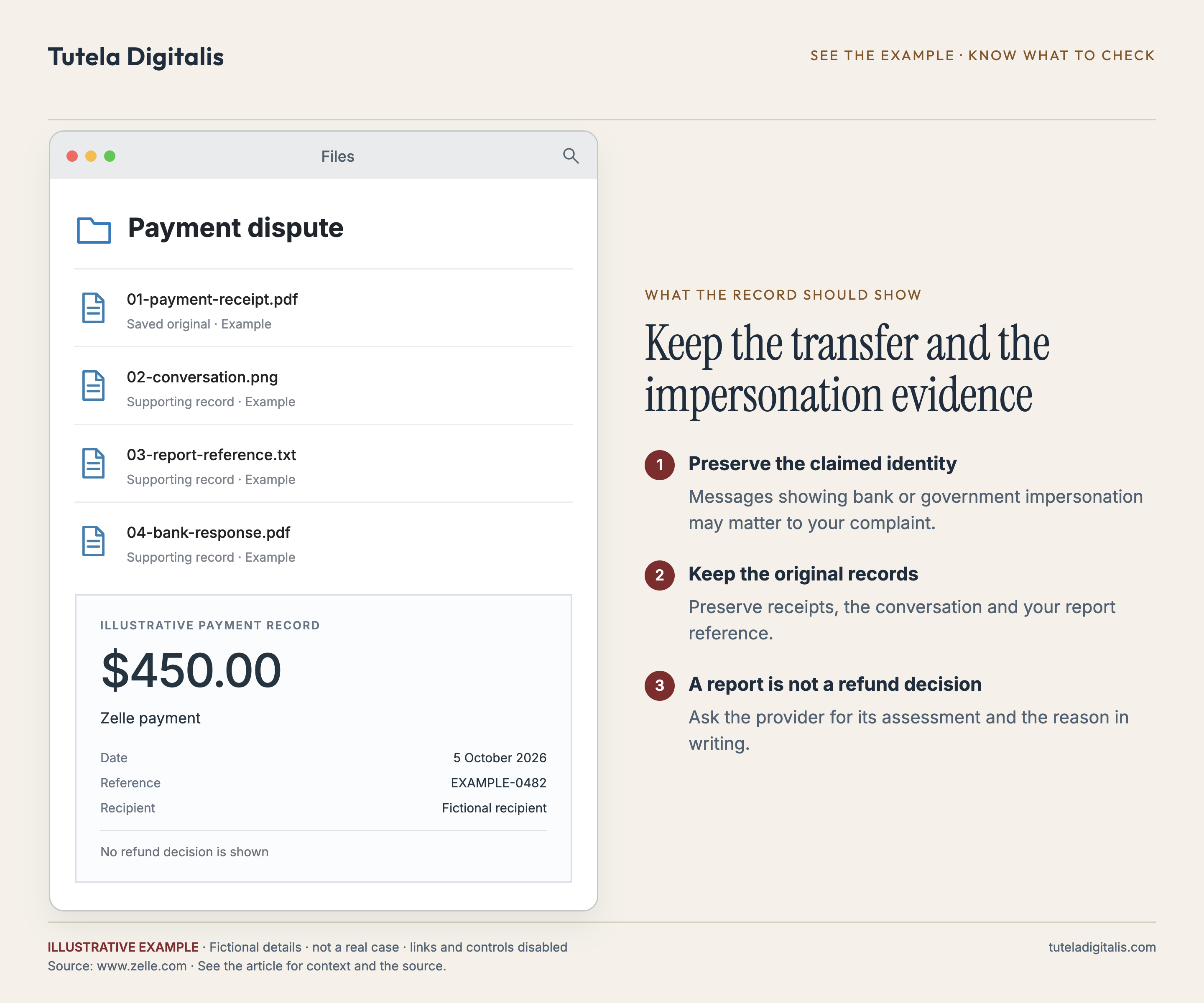
Illustrative example: Payment dispute $450.00 Zelle payment 01-payment-receipt.pdf 02-conversation.png 03-report-reference.txt 04-bank-response.pdf
- Preserve the claimed identity. Messages showing bank or government impersonation may matter to your complaint.
- Keep the original records. Preserve receipts, the conversation and your report reference.
- A report is not a refund decision. Ask the provider for its assessment and the reason in writing.
Which refund route matches what happened?
The word “scam” is not a complete transaction history. Write down what happened before deciding which rule to cite.
| What happened | What to ask the bank |
|---|---|
| Someone else made the transfer without your authority | Ask it to investigate an unauthorized EFT under Regulation E. |
| An impersonator deceived you into sending the payment | Ask for assessment under the bank’s Zelle impostor-scam reimbursement policy. Eligibility is not automatic. |
| You knowingly paid a seller who did not deliver | Explain the scam accurately and ask what recovery options exist. Zelle does not provide purchase protection for goods or services you buy. Check whether your bank offers separate protection. |
If you gave someone a code or login, say so. The CFPB’s unauthorized-EFT FAQs, questions 5–7, explain that fraudulently obtaining account access and then initiating a transfer can qualify as unauthorized. Consumer negligence does not itself expand liability beyond Regulation E. That is different from you knowingly initiating the payment to a recipient after being lied to.
Do not rewrite the history as “I never sent it” if you did. If remote access or several transfers were involved and you cannot tell who acted, describe that uncertainty and ask the bank to examine its records. Consider qualified legal advice for a disputed classification or substantial loss; this guide provides general US consumer information.
Where do you report a Zelle scam now?
Zelle’s September 2026 access guide says there is no standalone Zelle app. Use the participating bank’s app or online banking, and contact that bank’s fraud team through a number you independently verify. Instructions to open a separate Zelle app to file a second dispute are outdated.
Ask immediately whether anything can still be stopped. Zelle’s cancellation guidance distinguishes a payment to someone not yet enrolled from a completed payment. Do not interpret “cannot cancel” as the answer to a separate fraud-reimbursement claim.
Regulation E §1005.6 makes reporting time relevant to liability. Loss or theft of an access device can trigger a two-business-day rule; statement-based reporting also matters. Report promptly, even if time has passed, and ask which deadlines apply to your facts. There is no universal “after 24 hours you have no claim” rule.
How do you challenge a denied Zelle claim?
Make the follow-up easy to investigate. The original transfer record, the claimed identity and the denial reason matter more than an aggressive subject line. Use these five steps:
- Contact the bank that sent the payment. Use your banking app or the number on your card. Report the payment immediately, ask what can still be stopped, and get a case reference. Do not wait until you have assembled every document.
- Record who actually initiated each transfer. Separate payments you personally sent from payments someone else made after obtaining access. Record any shared code, remote access or impersonation honestly. Say when you do not know.
- Assemble the evidence around the disputed facts. Save transaction IDs, amounts, dates, the recipient details displayed by your bank, original messages, account alerts and the denial letter. Keep a dated contact log and copies of what you submit.
- Ask for a review under the applicable route. For an unauthorized electronic transfer, raise the Regulation E error. If you sent money to an impersonator, also ask the bank to assess its Zelle impostor-scam reimbursement policy. Ask for its reasoning in writing.
- Escalate an unresolved complaint. Submit an accurate CFPB complaint with the bank's case number, denial and supporting evidence. Explain what the bank overlooked and the resolution requested. A complaint is not a guarantee of reimbursement.
What your review request should contain
- The payment: date, amount, transaction reference and recipient as shown in your bank records.
- The sequence: who contacted you, what they claimed, what you shared and who initiated each payment.
- The disagreement: quote the bank’s actual denial reason and identify the record it appears to have missed.
- The request: ask for review under the relevant route, an explanation of the decision and the records relied on where applicable.
Keep a copy and send it through the bank’s verified dispute channel. Do not put passwords, live codes or full account credentials in a complaint.
If you were selling an item and sent a supposed overpayment back, include the original payment status and the separate outgoing transfer. The fake-payment screenshot guide explains why those are two different records.
What do the 10, 45 and 60-day timelines actually mean?
They are not interchangeable refund deadlines. For covered errors, Regulation E §1005.11 generally provides:
- Notice within 60 days after the bank sends the statement first showing the error. Report immediately rather than waiting.
- A determination within 10 business days, or generally up to 45 days when extension conditions, including provisional credit, are met. Exceptions include certain new accounts and transactions.
- Possible loss of provisional credit if requested written confirmation of an oral notice is not supplied within 10 business days.
- A written explanation when no error, or a different error, is found; you can request the documents relied on.
Ask whether a credit is temporary. Keep the decision and any notice of its removal; provisional credit is not a final win.
The CFPB complaint process has a separate clock: companies generally respond in 15 days and may provide a final response in 60 days. That is a response process, not a promise that the money will return.
What if the review still ends in a denial?
A further complaint should add a specific unresolved issue, not merely repeat the same demand. Keep the final response with your records and consider independent legal advice about your circumstances. Report the scam through the appropriate official reporting channel as well; a crime report and a bank dispute serve different purposes.
Do not wait for a rumored settlement to report your loss. Our Zelle settlement guide addresses claim-site offers separately. If the payment went through another service, use its rules: see Venmo refunds or the payment-method recovery guide.
Common questions about Zelle scam refunds
Does Zelle refund money if I was scammed?
A refund depends on what happened and the applicable protection. Zelle directs customers to their bank or credit union and says certain impostor scams qualify for reimbursement. An unauthorized transfer also raises different legal issues from a payment you personally sent after being deceived. Report both promptly; do not assume either automatic payment or automatic rejection.
I shared a security code. Does that make the transfer authorized?
Not necessarily. The CFPB explains that a transfer a fraudster initiates using account access obtained through deception can be an unauthorized electronic fund transfer. Tell the bank exactly what you shared and who initiated the payment. Sharing a code and personally sending a payment are different facts.
Can I cancel a pending Zelle payment?
Zelle says cancellation is possible when the recipient has not yet enrolled. Check the payment in your bank's Zelle activity and contact the bank if unsure. A completed payment to an enrolled recipient cannot simply be cancelled. The separate question is whether fraud or scam reimbursement applies.
Does the bank have to refund me within 10 business days?
No blanket ten-day refund promise applies. Regulation E has an investigation timetable for covered errors, with conditional extensions and provisional-credit rules. The details depend on the account and transaction. Ask the bank which rule it is applying and read the investigation section above.
What should I send after my bank denies the claim?
Send the case reference, disputed transactions, denial reason and the evidence addressing that reason. Identify whether you made the payment or someone else did. Ask what records supported the decision and whether the bank assessed any relevant impostor-scam policy. Do not use a template that changes the facts to fit a preferred legal category.
Will a CFPB complaint get my money back?
It can obtain a company response to an unresolved complaint; it does not promise a refund. The CFPB says companies generally respond within 15 days, with some final responses taking 60 days. Attach the existing bank dispute and explain the specific unresolved issue.
Need help organizing what happened? Request a free, confidential case review. Contact your bank first for an active unauthorized payment. Omit passwords, verification codes and full account details.
Sources and corrections
Primary sources checked 7 October 2026. This revision corrects standalone-app instructions, overbroad refund claims and the investigation/complaint timelines. It removes an unsupported annual-loss estimate and advice to label every scam payment unauthorized. See the corrections log.