As of 2026 there is no Zelle settlement fund and no claim portal. New York Attorney General Letitia James sued Zelle's operator, Early Warning Services, in 2025 over more than $1 billion in fraud between 2017 and 2023; the federal CFPB filed a similar suit in December 2024 alleging over $870 million in losses, then dropped it in March 2025; and several private class actions are still being certified. None has produced a payout. Anyone telling you to pay a fee or share bank details to "claim your Zelle settlement" is running a recovery scam. The real route to money back runs through your bank under Regulation E — not a settlement check.
Read the image explanation
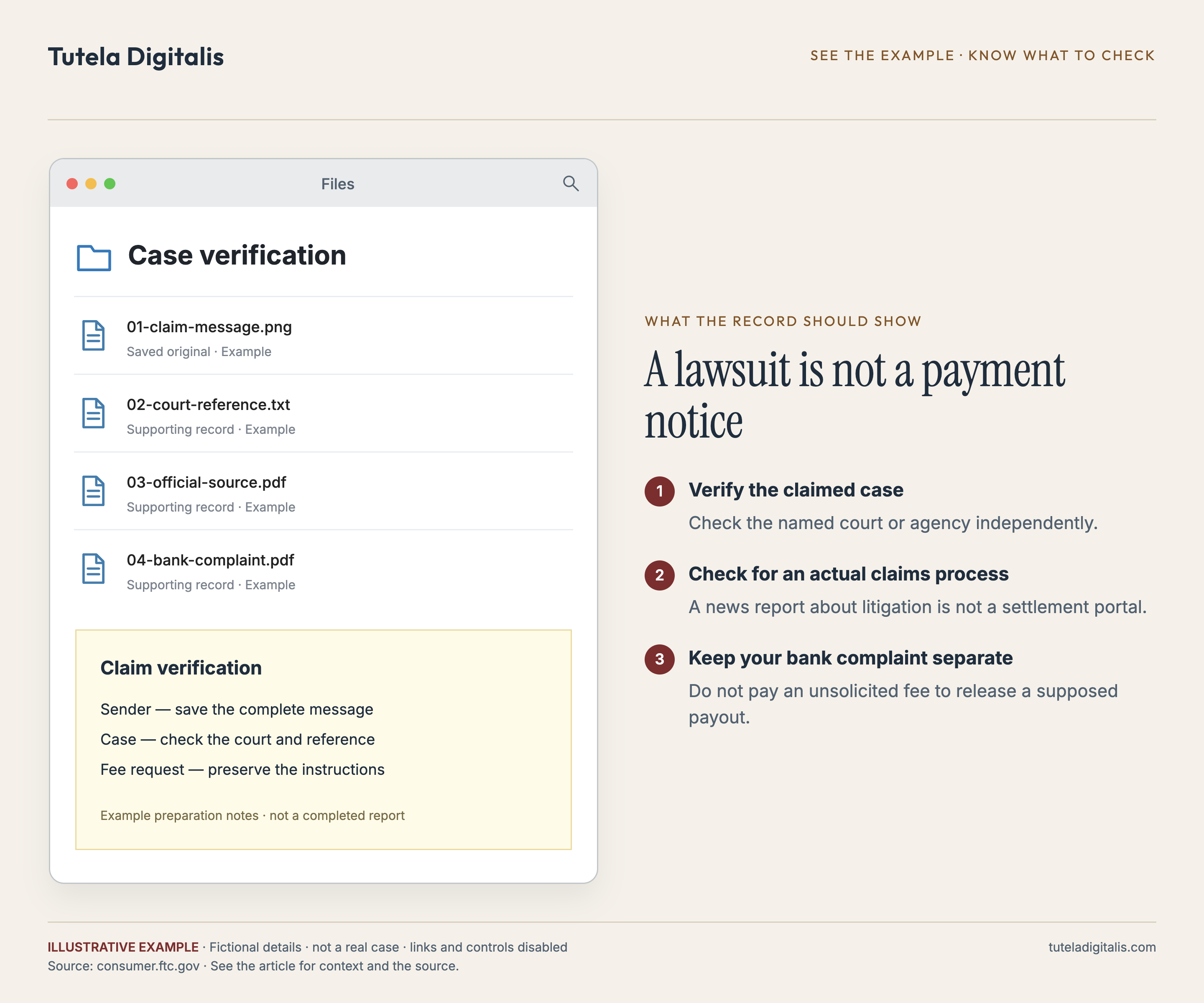
Illustrative example: Case verification 01-claim-message.png 02-court-reference.txt 03-official-source.pdf 04-bank-complaint.pdf Claim verification Sender — save the complete message Case — check the court and reference Fee request — preserve the instructions
- Verify the claimed case. Check the named court or agency independently.
- Check for an actual claims process. A news report about litigation is not a settlement portal.
- Keep your bank complaint separate. Do not pay an unsolicited fee to release a supposed payout.
"No one should be left to fend for themselves after falling victim to a scam."
— Letitia James, New York Attorney General, announcing the 2025 lawsuit against Early Warning Services (Zelle's operator). The suit is the strongest action yet — but it is an enforcement case, not a settlement that pays victims today.
If you searched "Zelle settlement," you almost certainly fall into one of two groups: you lost money to a Zelle scam and you are hoping for the kind of payout you have seen from data-breach class actions, or you got a message promising you a Zelle settlement and you are checking whether it is real. This piece is for both. The short version is the same for each: there is no money to claim right now, and the offers that say otherwise are scams.
If you have already lost money on Zelle, skip to the real route to a refund. It does not run through a settlement.
What people mean when they search "Zelle settlement"
The phrase has surged because the litigation around Zelle has been enormous and widely reported — and because scammers move fast to occupy any search term that smells like free money.
The actual lawsuits, and why none is a check in your mailbox
Three separate things get blurred together under the word "settlement." Here is what each one actually is.
What the lawsuits are really about: the 12% problem
Strip away the legal procedure and every one of these cases is arguing about a single number. A US Senate investigation found that in 2023 the three largest banks on Zelle reimbursed about 38% of unauthorised fraud — but only about 12% of scam claims, where the customer was tricked into sending the money themselves.
That gap is not an accident; it is the law. As we explain in the piece on whether Zelle is legit, US consumer-payment law (Regulation E) requires refunds for transfers you did not authorise, but not for transfers you were deceived into authorising yourself. The lawsuits are an attempt to force the banks to close that gap voluntarily. Until one succeeds or the law changes, the gap is exactly where most Zelle scam losses fall — the same authorised-versus-unauthorised distinction we cover in do banks refund scammed money.
If you actually lost money on Zelle: the real route to a refund
This is where your energy should go, because it is the path that can actually return funds. It runs through your bank and the regulators, not a settlement site.
So is any money ever coming? The honest answer
Maybe, eventually, for some people — but not on the timeline or in the form most searchers are picturing. If the New York case wins or settles, restitution would likely be limited and probably tied to New York residents. If a private class action survives certification and settles, there would be a real, free, court-administered claim process — and you would hear about it through the court, a named administrator, or your state Attorney General, never through a site that found you first and asked for money.
The practical move today is not to wait for a settlement. It is to work your bank claim under Regulation E, get every refusal in writing, file the FTC, IC3 and CFPB reports, and — if you are in New York — get your loss onto the Attorney General's record. That is the version of "claiming" that actually exists.
One rule, end to end
If you take one thing from this piece, take this: there is no Zelle settlement to claim in 2026, and anyone who contacts you offering one — for a fee, a login, or "verification" — is the second scam. Your money-back path runs through your bank and the CFPB, not a claim site.
Lost money on Zelle, or got a "settlement" message? Let's look at it together.
Forward the message, or describe the transaction. A real expert reviews every case and replies within 24 hours. Free, confidential, no pressure — and we will never charge to "recover" anything.
Common questions about the Zelle settlement
Is there a Zelle settlement I can claim in 2026?
No. As of 2026 there is no Zelle settlement fund and no official claim portal. There are major lawsuits — New York's Attorney General sued Zelle's operator, Early Warning Services, in 2025 over more than $1 billion in fraud; the federal CFPB filed a similar case in December 2024 and then dropped it in March 2025; and several private class actions are still being certified — but none has produced a settlement or a payout. Any website or message telling you to pay a fee or hand over bank details to 'claim your Zelle settlement' is a scam.
Did the CFPB win its Zelle lawsuit?
No. The Consumer Financial Protection Bureau sued JPMorgan Chase, Bank of America, Wells Fargo and Early Warning Services (Zelle's operator) on December 20, 2024, alleging customers lost more than $870 million to fraud since Zelle launched in 2017. The CFPB voluntarily dismissed the case in March 2025, so it produced no findings, no penalties and no consumer payout. The New York Attorney General's 2025 suit covers similar ground but is a separate action.
Is the New York lawsuit going to send victims a check?
Not automatically. New York Attorney General Letitia James sued Early Warning Services in 2025, alleging Zelle was built without basic safety features and that scammers stole over $1 billion from users between 2017 and 2023. This is a state enforcement action, not a class-action settlement. Even if New York wins or settles, the remedy is typically penalties and required changes, and any consumer restitution would most likely be limited to New York residents — not a nationwide payout. Zelle's operator has called the suit a 'political stunt' and a 'copycat' of the dismissed CFPB case.
How do I actually get my money back after a Zelle scam?
Through your bank, not a settlement. Under the Electronic Fund Transfer Act and Regulation E, an unauthorised transfer (someone accessed your account without permission) is generally refundable; a transfer you were tricked into authorising yourself usually is not — that distinction is the whole game. Report it to your bank immediately and in writing, file complaints with the FTC and the FBI's IC3, and submit a complaint to the CFPB. We walk through the full escalation in the Zelle scam refund playbook. Move fast: a same-day recall is often the only thing that works.
Are 'Zelle settlement claim' websites real?
Almost always no. Because so many people are searching for a Zelle payout, scammers have set up fake 'settlement claim' pages and send texts and emails promising compensation. They exist to harvest your bank login, card number or an upfront 'processing fee.' A genuine class-action settlement is administered by a court-appointed administrator, is free to claim, finds you (it does not require a fee), and is announced on official court or government channels. Anyone who contacts you first and asks for money or banking details is running a recovery scam.
Will Zelle refund scams now because of the lawsuits?
Not as a rule. The lawsuits argue Zelle should reimburse more victims, but there is no US law forcing banks to refund authorised-push-payment fraud — the kind where you were deceived into sending the money yourself. The banks behind Zelle have expanded reimbursement for certain imposter scams under pressure, but coverage is inconsistent. A US Senate investigation found the three biggest Zelle banks reimbursed about 38% of unauthorised fraud but only about 12% of scam claims in 2023. Until the law changes, assume you are not automatically covered.
Sources & further reading
Every figure in this piece is drawn from these authorities. Click any of them to verify.