Zelle is a legitimate, US-regulated payments network owned by Early Warning Services and operated by seven of the largest US banks. 151 million Americans use it; more than a trillion dollars moved on it in 2024. The platform itself is not the problem. The problem is the refund record: a US Senate investigation in July 2024 found that customers of Zelle's three biggest owner banks were reimbursed for only about 12% of scam claims in 2023, and the CFPB sued those banks plus Early Warning Services in December 2024 alleging $870 million+ in fraud losses since launch. That lawsuit was dropped in March 2025 under a new CFPB administration. The underlying gap — that Regulation E does not cover transfers you authorized yourself, even under deception — is still federal law.
Read the image explanation
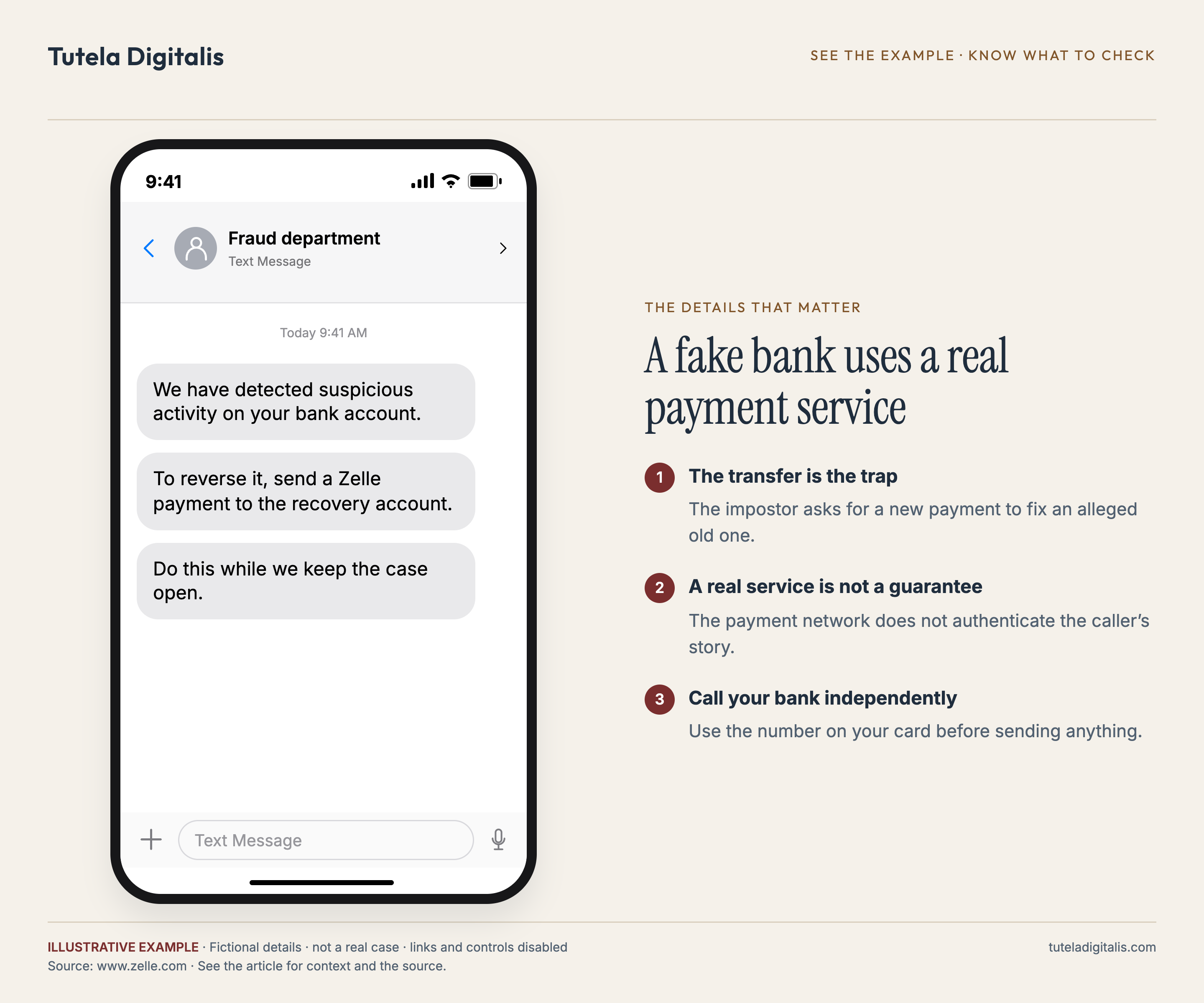
Illustrative example: We have detected suspicious activity on your bank account. To reverse it, send a Zelle payment to the recovery account. Do this while we keep the case open.
- The transfer is the trap. The impostor asks for a new payment to fix an alleged old one.
- A real service is not a guarantee. The payment network does not authenticate the caller’s story.
- Call your bank independently. Use the number on your card before sending anything.
"For too long, Big Banks have made it impossibly difficult for scammed customers to be made whole. The result of these unreasonable processes is that, year after year, Zelle scam victims have been left high and dry."
— Senator Richard Blumenthal, Chairman, US Senate Permanent Subcommittee on Investigations, releasing the majority staff report "A Failure to Help Customers Scammed Over Zelle" on July 23, 2024. The report documented that the three banks reimbursed only about 12% of disputed scam claims in 2023.
Most "is X legit?" questions come back yes or no. Zelle is a more honest question — and the honest answer has two halves. The first half: yes, the platform is real, the company behind it is real, and your transfers do reach real bank accounts in seconds. The second half: when something goes wrong, the recovery path is one of the worst in US consumer finance, and the legal and political situation around that has been moving in conflicting directions for two years now. To use Zelle wisely in 2026 you need to know both halves.
If you are reading this with a Zelle transaction you regret in another tab, skip to If you have already been scammed. The next 60 minutes matter more than the next 60 days.
What "is Zelle legit?" actually answers
The question splits into four sub-questions, each with a clean answer:
The Senate's 12%: what the 2024 report actually says
In July 2024 the US Senate Permanent Subcommittee on Investigations published a majority staff report titled "A Failure to Help Customers Scammed Over Zelle." It is the most authoritative public document on Zelle's refund behaviour, and the headline numbers are worth carrying in your head:
The CFPB lawsuit: what happened, and what was left behind
On December 20, 2024, the Consumer Financial Protection Bureau sued Early Warning Services, Bank of America, JPMorgan Chase, and Wells Fargo. The complaint alleged that the defendants had "rushed Zelle to market" in 2017 to compete with Cash App and Venmo, did not build adequate fraud protections, and over the platform's first seven years allowed more than $870 million in consumer losses. The remedy sought included full restitution for affected consumers and structural changes to fraud handling.
On March 4, 2025 — about ten weeks later, under a new CFPB administration — the Bureau filed a notice voluntarily dismissing the case with prejudice. The court entered the dismissal on March 5. The federal case is over and cannot be refiled. The underlying facts and the Senate report it was built on are unchanged; the federal vehicle for pursuing those facts is gone.
What was left behind matters. The New York Attorney General filed a separate state-level case in 2025 covering similar conduct under New York law. The CFPB complaint portal at consumerfinance.gov/complaint is still operating; complaints filed there feed state AG enforcement and any future federal action. The Senate's investigation continues to be a reference document in proposed federal legislation, including the Protecting Consumers from Payment Scams Act introduced by Senators Blumenthal, Warren, and Waters in August 2024. None of those mechanisms gives you a guaranteed refund in 2026 — but each one increases the value of documenting a case formally.
The Regulation E gap: the same trap that lives under every P2P scam
Almost every Zelle scam is engineered around one specific feature of US consumer-protection law. Understanding it is the most useful single thing in this entire piece.
Regulation E, the federal rule implementing the Electronic Fund Transfer Act, separates electronic-funds disputes into two clean buckets. The buckets are not equally protected, and which bucket a transaction lands in is decided by one question: did the consumer authorize the transfer?
Every Zelle scam playbook you will ever see is built to land in the second bucket. The fake "bank fraud department" who calls and walks you through sending the money to a "secure account." The marketplace seller who insists on Zelle. The grandparent caller who needs bail money fast. The romantic partner who needs help. In every one of those, the victim is the person who pressed Send, and that is the legal hook the refund denials rest on.
Cash App has the exact same gap and was fined $175 million by the CFPB in January 2025 for failing to investigate even the unauthorized cases properly — we covered that in the Cash App legitimacy post. What makes Zelle distinctive is the scale (it is the dominant US bank-rail P2P service) and the ownership structure (the platform's operator is owned by the very banks that decide on refunds). The conflict of interest is intrinsic to the design.
The Zelle scams you will actually see in 2026
The platform name on the rail is incidental. The scam playbooks are universal. These are the patterns that land on Zelle most often:
The habits that protect you upstream
Because the refund path is broken, the prevention path is what matters. Five small habits make a disproportionate difference:
If you have already been scammed on Zelle
Move quickly. The next 60 minutes are the only window where a Zelle reversal has any meaningful chance. After that, recovery becomes a dispute, which is the 12%-success-rate path the Senate documented.
So, is Zelle legit?
Yes. It is a legitimate, regulated, bank-owned, US payments network used by 151 million Americans, moving more than a trillion dollars a year. Your money will reach the account you sent it to, in seconds. There is no Zelle-the-company scam.
What the platform is not, in 2026, is generous about scam refunds. The Senate documented why; the CFPB tried to fix it and was reversed; state AGs are continuing where the federal case stopped; the underlying federal law has not changed. Until it does, the difference between a safe Zelle payment and a permanent loss is upstream of the rail — in habits you bring to the app before you press Send.
If you take one rule from this entire piece, take this: Zelle is for people you already know. The speed that makes Zelle good for them is the same speed that makes it dangerous with strangers.
Got a Zelle request you're not sure about? Let's look at it together.
Forward the message, paste the conversation, describe the call. A real expert reviews every case and replies within 24 hours. Free, confidential, no pressure.
Common questions about Zelle legitimacy & refunds
Is Zelle itself a scam?
No. Zelle is a legitimate, US-regulated peer-to-peer payments network operated by Early Warning Services, LLC, which is jointly owned by seven of the largest US banks — Bank of America, Capital One, JPMorgan Chase, PNC, Truist, US Bank, and Wells Fargo. Zelle reached 151 million enrolled users in 2024, processed 3.6 billion transactions, and moved more than $1 trillion in a single year — the most ever by a person-to-person payments service. The platform itself is real. The problem is what happens when a scammer uses it as the rail: a US Senate report in July 2024 found that the three biggest Zelle banks reimbursed only about 12% of scam disputes in 2023.
Is Zelle safer than Cash App or Venmo?
It depends on the threat model. For unauthorized transfers (someone took over your account), Zelle has bank-grade fraud monitoring and runs through your bank's existing controls — that side is generally stronger than standalone payment apps. For scams where you press Send yourself under deception (the imposter scam, the marketplace scam, the romance scam), Zelle has been the hardest of the three to recover from. The Senate found Zelle's reimbursement rate to be roughly half what bank credit card chargebacks deliver. Cash App's parent was fined $175 million by the CFPB in January 2025 for its own fraud-handling failures. None of the three closes the underlying Regulation E gap on authorized-under-deception transfers; that requires federal law to change.
Will I get my money back if I'm scammed on Zelle?
Probability is low unless your case fits a narrow category. The clearest path is unauthorized: someone hacked your account or your bank session and sent money without your knowledge — that is covered by Regulation E and your bank must investigate. If you sent the money yourself, your only protected path is the June 2023 Early Warning Services 'imposter scam' policy, which covers scams where the scammer impersonated a government agency, a bank, or an existing service provider. The Senate found that policy covered fewer than 20% of victims in its first six months. For romance, investment, marketplace, and most other scams, the rule is harsh: legally you authorized the transfer, so the bank is not required to refund. Our /blog/zelle-scam-refund piece breaks down the escalation paths that occasionally work.
Did the CFPB really drop its Zelle lawsuit?
Yes. The Consumer Financial Protection Bureau sued Early Warning Services, Bank of America, JPMorgan Chase, and Wells Fargo on December 20, 2024, alleging that consumers lost more than $870 million to fraud on Zelle since the platform launched in 2017 and that the defendants 'rushed Zelle to market' without adequate fraud protections. On March 4, 2025, under a new CFPB administration, the Bureau voluntarily dismissed the case with prejudice — meaning it cannot be refiled. The New York Attorney General filed a separate state-level case in 2025 to pursue similar claims under New York law. The underlying allegations are unchanged; the federal vehicle for them is gone.
Does Zelle reverse fraudulent payments?
Almost never, once the transaction is complete. Zelle transfers are designed to settle in minutes between US bank accounts, which is part of why scammers prefer the rail. The only realistic reversal window is the first hour or two, and only when the receiving bank can freeze the funds before the scammer moves them out. Call your bank's dedicated fraud line — not general customer service — the moment you realize. Speed is the entire game. Once the money has left the receiving account, recovery shifts from 'reversal' to 'dispute,' which is the 12%-success-rate path the Senate documented.
Should I use Zelle at all?
For trusted recipients you know personally — splitting bills, paying a family member, paying a vendor you have used many times — Zelle is fast, free, and functional. The platform's underlying technology is sound. The risk is concentrated entirely in the moment you press Send to someone new or under any kind of pressure. Treat any Zelle request from a stranger, an unexpected caller, a 'bank fraud department' on the phone, or a marketplace counterparty as hostile. Verify on a known channel, use small test transfers before larger ones, and never authorize a Zelle transfer based on a phone call you did not initiate.
Sources & further reading
Every figure in this piece is drawn from these authorities. Click any of them to verify.
Got a Zelle, bank or IRS text you’re not sure about? Use our free US scam-text checker — answer two questions and get the official fact that gives the scam away, plus exactly how to report it.