Cash App is a legitimate, publicly-traded payment service. It is also the rail under a very large scam economy, and the platform has historically refunded a thin slice of what victims lose — which is why the CFPB ordered Block to pay $175 million in January 2025 for failing fraud victims. The single most important thing to understand: under Regulation E, an unauthorized transaction (someone hacked you) is generally refundable; an authorized transaction made under deception (you pressed Send because you were lied to) is not. Almost every Cash App scam in the wild is engineered to land in the second category. Real customer support is in-app only — any phone number you find on Google is almost certainly a scam.
Read the image explanation
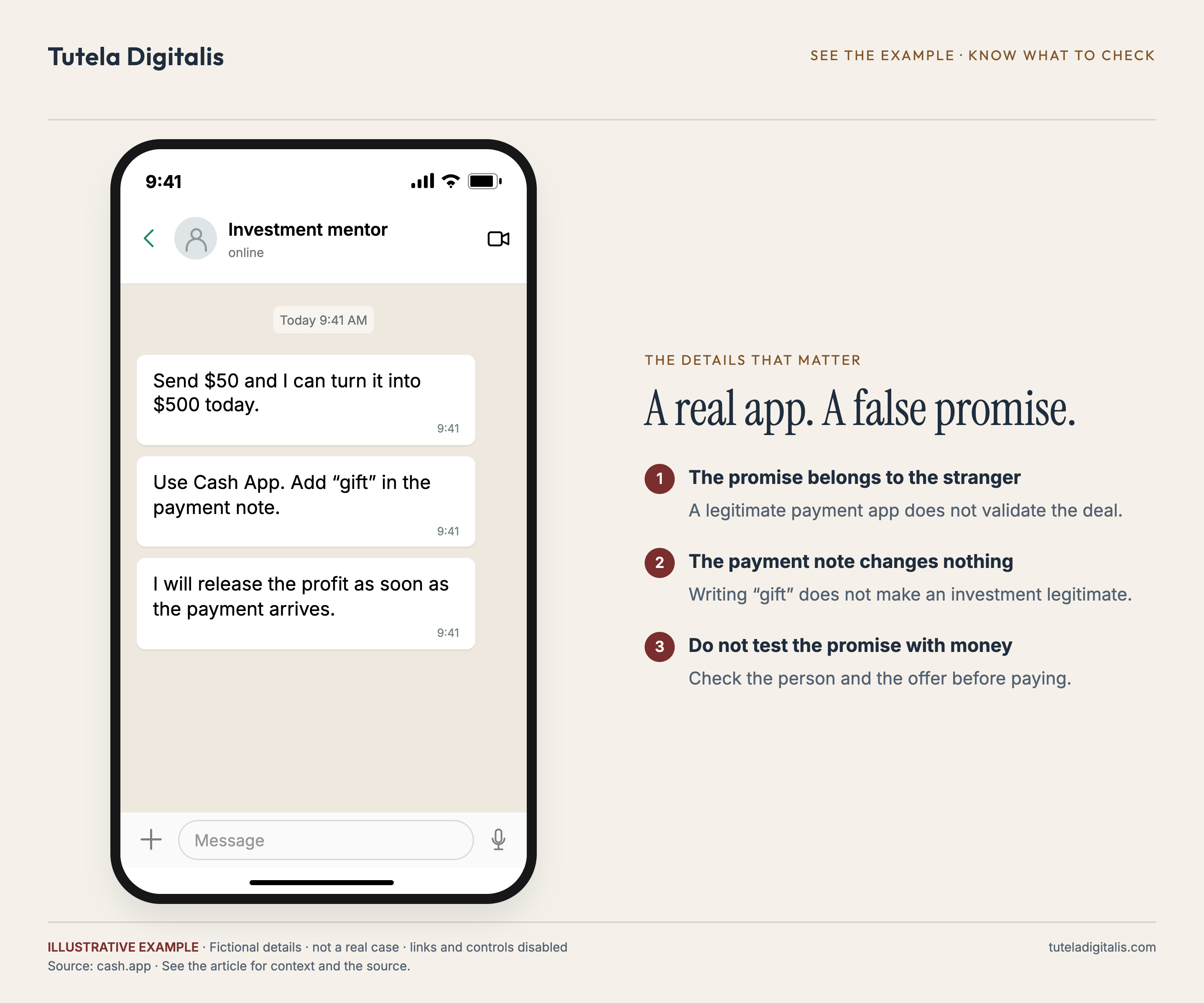
Illustrative example: Send $50 and I can turn it into $500 today. Use Cash App. Add “gift” in the payment note. I will release the profit as soon as the payment arrives.
- The promise belongs to the stranger. A legitimate payment app does not validate the deal.
- The payment note changes nothing. Writing “gift” does not make an investment legitimate.
- Do not test the promise with money. Check the person and the offer before paying.
"Cash App created the conditions for fraud to proliferate on its popular payment platform. When things went wrong, Cash App flouted its responsibilities and even burdened local banks with problems that the company caused."
— Rohit Chopra, Director, Consumer Financial Protection Bureau, announcing the $175 million consent order against Block, Inc. on 16 January 2025. The order requires Block to pay up to $120 million in consumer redress and a $55 million civil penalty into the CFPB's victims-relief fund.
Most "is X legit?" questions land in one of two buckets: either the brand is a fake (a domain bought last week pretending to be a real company), or the brand is real but the operator is hostile. Cash App is the second kind. The platform is genuinely Block, Inc.'s — a US public company co-founded by Jack Dorsey, with 56 million monthly transacting users as of the December 2024 SEC filing, and a Cash App Card product carried by 23 million of them. None of that is an open question. The open question is what happens when something goes wrong.
Until January 2025, the answer was — for years — mostly nothing. Cash App did not run a live phone support line. Its in-app dispute process, the CFPB found, routinely misused card-network chargebacks instead of performing the investigation the federal Electronic Fund Transfer Act actually requires. In some cases, when a user's bank tried to reverse a fraudulent transfer, Cash App blocked the reversal. That is not a one-off complaint; that is the CFPB's formal finding, in the consent order Block is now operating under.
If you are reading this with a Cash App transaction you regret in another tab, skip to If you have already been scammed. The first 24–48 hours matter more than the last few weeks.
What "is Cash App legit?" actually answers
It is worth being precise about what people mean when they Google the question, because the honest answer depends on which version of it you are asking.
The CFPB's $175 million order: what it actually says
This is the single most important document in the Cash App fraud story, and almost nobody reads it. The short version, with the technical pieces translated:
On 16 January 2025 the Consumer Financial Protection Bureau issued a consent order finding that Block, Inc. had violated both the Consumer Financial Protection Act and the Electronic Fund Transfer Act (and its implementing rule, Regulation E). The order requires Block to pay up to $120 million directly to harmed consumers and a $55 million civil money penalty to the CFPB's victims-relief fund. The total of $175 million is the second-largest Cash App-related regulatory action in the platform's history; a separate, earlier settlement with 48 state regulators added roughly $80 million more for related anti-money-laundering failures.
The CFPB's specific findings, drawn directly from the published action, are blunt:
The Regulation E gap: the legal line every Cash App scam hides behind
Almost every Cash App scam you will read about exploits one specific gap in US consumer-protection law. Understanding it is the single most useful thing this whole piece can give you.
The Electronic Fund Transfer Act, implemented through Regulation E, separates electronic-funds disputes into two clean buckets. The buckets are not equally protected, and which bucket a transaction lands in is determined by one question: did the consumer authorize the transfer?
The entire Cash App scam economy is engineered around one objective: get the victim to press Send themselves. A "Cash App Friday winner" asking for a $50 verification fee. A "sugar daddy" clearing a fake debt by sending you $200 from a stolen card and asking for $150 back. A fake landlord taking a security deposit on an apartment that does not exist. In every one of those, the victim is the person pressing Send — and that puts the transaction outside the strongest layer of Regulation E protection.
This is not a Cash App peculiarity. Zelle has the same gap; we wrote about how that gap plays out for bank-mediated transfers in the Zelle scam-refund piece. What makes Cash App distinct is the documented pattern, now in a federal consent order, of the platform not even running the proper Reg E investigation on the cases that do qualify as unauthorized. That is the gap on top of the gap.
The Cash App scams that actually show up in 2026
The platform name on the rail is incidental. The scam playbooks are universal. These are the ones that land on Cash App most often in 2026:
You will notice every single one of those puts the victim in the position of pressing Send themselves. That is by design. That is what aligns them with the Regulation E gap and what makes recovery so much harder than it should be. Our 72-hour recovery playbook covers the honest odds by payment method, and Cash App is one of the harder rails to reverse.
Quick checks before you send to anyone new on Cash App
The platform is fine. Your habits around it are what protect you. Five small ones make a disproportionate difference:
If you have already been scammed on Cash App
Move quickly — and do not waste a second on shame. The scams in the list above are built by professionals to land on careful people. The next steps work better the sooner you take them:
What the 2025 consent order changes, and what it doesn't
The fine matters. The operating rules attached to the fine matter more. From 16 January 2025 onward, Block is required to: run 24-hour live-person customer service for Cash App, perform full Regulation E investigations into unauthorized-transaction reports, and refund customers in a timely manner when investigations support them. Compliance is being monitored by the CFPB and progress is reportable.
What the order does not do is change the underlying Regulation E gap between "unauthorized" and "authorized under deception." That is federal law, not Cash App policy, and the CFPB cannot rewrite it through a consent order. The trap most scams build remains the same. The most useful change for users in 2026 is probably the requirement that real investigations happen on the unauthorized cases — which means it is genuinely worth filing the in-app dispute, and worth escalating to the CFPB if Cash App rules against you on facts that look unauthorized.
So, is Cash App legit?
Yes. The platform is a legitimate, publicly-disclosed, federally-regulated payment service used by 56 million people every month, and most of those transactions complete cleanly. If your question is whether Cash App will steal your money, the answer is no.
If your question is whether Cash App will protect you from the scams that use it — the giveaways, the cash-flipping, the fake support, the romance pivot — the honest answer in 2026 is: more than it used to, but not as much as it should, and only in the narrow band the law actually covers. The CFPB's January 2025 order improved the floor. The Regulation E gap above that floor is the same trap every P2P scam economy is built on. The defences are upstream of the platform: send $1 first, verify the $cashtag, treat unsolicited Cash App contacts as hostile, never share your sign-in code, never search Google for "Cash App support number."
If you take one rule from this whole piece, take this: the platform is fine, the friction it removes is the danger, and the small habits that put a few seconds back in are what protect you.
Got a Cash App message you're not sure about? Let's look at it together.
Send the $cashtag, the conversation, the screenshot. A real expert reviews every case and replies within 24 hours. Free, confidential, no pressure.
Common questions about Cash App legitimacy & refunds
Is Cash App itself a scam?
No. Cash App is a legitimate peer-to-peer payments service operated by Block, Inc., a publicly-traded company (NYSE: XYZ) co-founded by Jack Dorsey. It had 56 million monthly transacting users as of December 2024 according to Block's SEC filings. What is not legitimate is the scam ecosystem that surrounds the platform — sugar-daddy approaches, cash-flipping promises, fake giveaway accounts, impersonation of Cash App's own support, and the simple fact that the platform was designed for fast, mostly-irreversible transfers between strangers. The CFPB ordered Block to pay $175 million in January 2025 specifically because Cash App failed to protect users from that ecosystem.
Can I get my money back if I'm scammed on Cash App?
Sometimes, but the odds depend entirely on one legal distinction. Under Regulation E (the federal rule that protects electronic funds transfers), an unauthorized transaction — someone hacked your account and sent money without your permission — must be investigated by Cash App and is generally refundable. An authorized transaction that turned out to be a scam — you sent the money willingly, even if you were deceived — is not covered by the same protection, and Cash App's own terms make refunds discretionary. This is the trap most scams are built around: they steer you into pressing Send yourself. If you were genuinely hacked, file the dispute and escalate through CFPB at consumerfinance.gov/complaint. If you authorized the payment under deception, recovery is harder but not impossible — see our 72-hour playbook.
Does Cash App have real customer support? What's the number?
Cash App's only official support channels are in-app (Profile → Support) and at cash.app/help. As of the CFPB's January 2025 order, Block is now required to operate 24-hour live-person customer service — a requirement imposed precisely because Cash App did not offer phone support for years. Any phone number you find by Googling 'Cash App customer service' is almost certainly a scam. Real Cash App support will never call you, never ask for your sign-in code, your PIN, or remote-access to your device. If a 'Cash App representative' contacts you out of the blue, hang up.
Why does Cash App show $0 fraud protection on so many disputes?
Because the platform leans on the legal distinction between 'unauthorized' and 'authorized' transactions. Block's own terms describe authorized payments as final and non-refundable, even when fraudulently induced. The CFPB found in January 2025 that Block went further and routinely misused card-network chargeback processes instead of doing the EFTA-required investigation when users reported fraud, then in some cases blocked the user's bank from reversing the transaction. That is the specific behaviour Block was fined $175 million for. The current Cash App is operating under a consent order that mandates real investigations going forward; results in 2026 are still being measured.
Are 'Cash App Friday' or celebrity Cash App giveaways real?
No. Cash App ran a legitimate weekly promotion called #CashAppFriday in the past, where the official @CashApp Twitter / X account boosts selected $cashtags. The scam version copies the format exactly — fake accounts using the Cash App logo announce 'winners' and direct-message them asking for a 'verification fee' or 'tax payment' to release the prize. There is no winning amount that requires you to send money first. There has never been. Any 'giveaway' that asks for an upfront payment is the same scam wearing a different costume.
I sent money to the wrong Cash App $cashtag. Can I get it back?
Open Cash App, find the transaction in Activity, tap it, then tap '...' → 'Refund' to send a refund request to the recipient. That request has no force — it depends entirely on the recipient agreeing. If they refuse or do not respond, your options are limited: you can report it as a scam through Cash App support if you were deliberately misdirected, but a genuine accidental send to a real user is not generally recoverable. The lesson is upstream: always confirm a $cashtag (the @-handle) or phone number before sending, and use the small-amount-first habit when paying anyone new.
Sources & further reading
Every figure in this piece is drawn from these authorities. Click any of them to verify.