Venmo is a legitimate PayPal-owned payment service. About 95 million US users move over $300 billion through it each year. The platform is not the problem. The problem is that every payment has a binary tag — Friends and Family or Goods and Services — and the Friends-and-Family side has zero buyer protection, no chargebacks, and effectively no recovery path. Almost every Venmo scam in the wild is engineered to land in that box. The rule that protects you: never tag a stranger transaction Friends and Family, no matter the dollar amount and no matter what the seller asks.
Read the image explanation
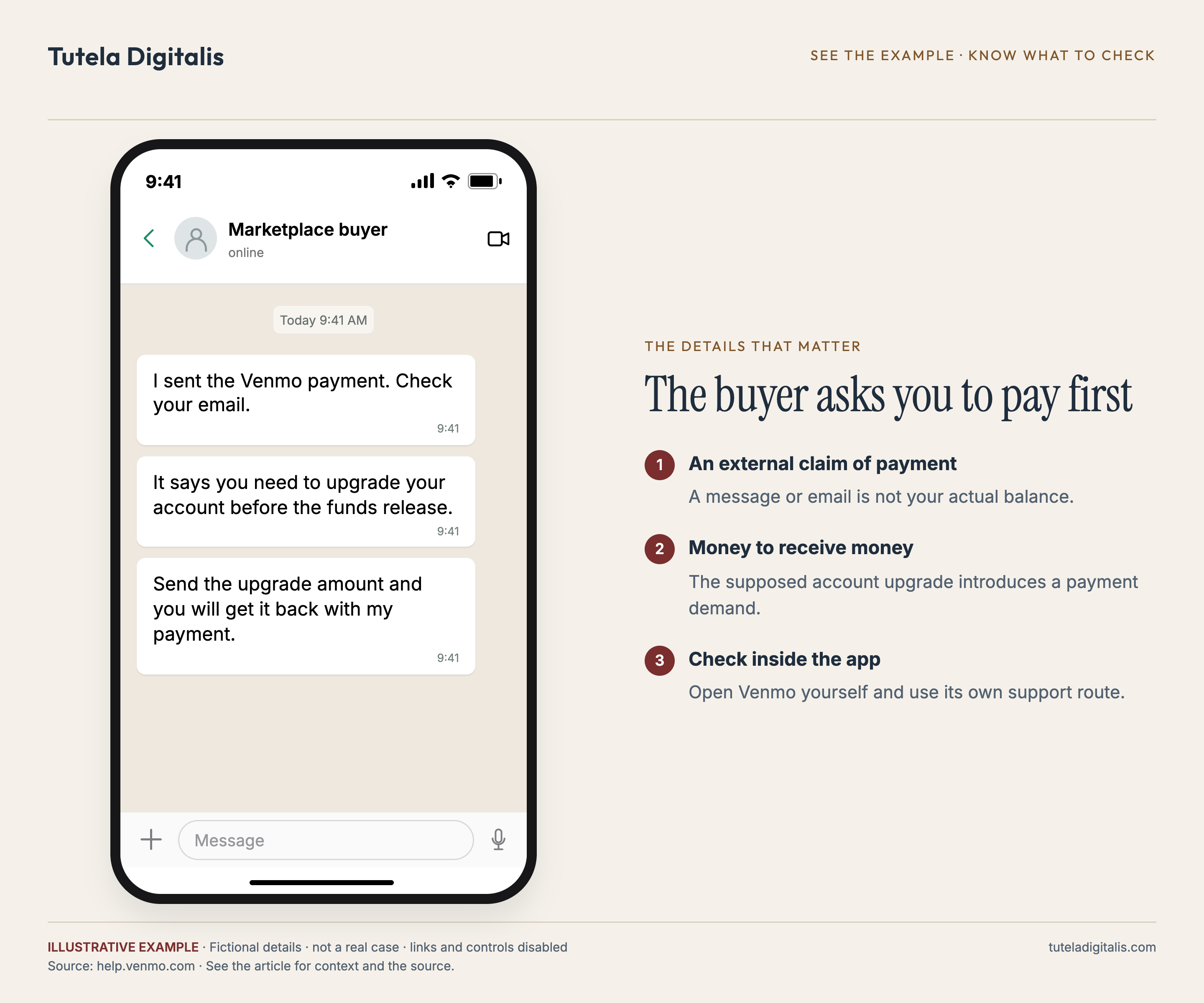
Illustrative example: I sent the Venmo payment. Check your email. It says you need to upgrade your account before the funds release. Send the upgrade amount and you will get it back with my payment.
- An external claim of payment. A message or email is not your actual balance.
- Money to receive money. The supposed account upgrade introduces a payment demand.
- Check inside the app. Open Venmo yourself and use its own support route.
"Consumers suffered real harm when Venmo did not live up to the promises it made to users about the availability of their money. This case sends a strong message that financial institutions like Venmo need to focus on privacy and security from day one."
— Maureen K. Ohlhausen, FTC Acting Chair, February 2018, announcing the original FTC settlement with Venmo. Eight years on, the company has grown to 95 million US accounts and over $300 billion in annual volume. The structural choice the buyer-side protections still hinge on — Friends and Family versus Goods and Services — was not, and is not, part of any settlement. Tag the wrong button, and the consumer protection the FTC fought for in 2018 does not apply.
I think Venmo is one of the best-built payment apps in the United States. The infrastructure is reliable, the UX is years ahead of the bank-issued equivalents, and the Goods-and-Services side genuinely does protect buyers — better than Zelle, better than Cash App, comparable to PayPal's broader buyer protection. I use Venmo myself. I recommend it to family members. None of what I am about to write changes any of that.
What I do think every Venmo user should understand is that Venmo's protections are not given to you by default. They are unlocked by one specific button at the bottom of the payment screen — the Goods and Services toggle. The default behaviour for a personal-account payment is Friends and Family, which has no buyer protection, cannot be reversed by Venmo support, and treats the transaction as if you handed cash to someone you trusted. Almost every scam I see in the inbox in 2026 is engineered to make sure you press the F&F button. Here is the map.
Three different "is Venmo safe" questions, three different answers
The single phrase hides three different concerns. Each has its own answer.
The Friends-and-Family vs Goods-and-Services divide: the entire post in one diagram
This is the structural fact that determines whether you will get your money back if a Venmo payment goes wrong. Both options exist on every Venmo personal-account payment. The default is the unsafe one.
What the FTC has already told Venmo, and what is still not fixed
I want to put one piece of institutional history on the table, because the voice-experiment scope of this piece allows me to. In February 2018, the FTC settled with PayPal over Venmo's failure to disclose information to users about the availability of their funds and how to keep transactions private. The FTC Acting Chair at the time, Maureen Ohlhausen, said in the press release that Venmo needed to "focus on privacy and security from day one." The settlement covered disclosures and the Gramm-Leach-Bliley Act. It did not cover the F&F-vs-G&S buyer-protection architecture. That architecture has been in place since long before the settlement and remains in place today.
In 2024, the FTC counted 90,571 reports of payment-app fraud and $391 million in reported losses across the category. The median individual loss for payment-app scams in 2024 was $380 — higher than the median for credit cards ($136) or debit cards ($110). Venmo was named in 9% of the consumer reports the FTC analyzed in 2023, with PayPal at 28%, Cash App at 24%, Zelle at 20%. Each of those numbers represents a real person whose money disappeared inside a system designed in part to make recovery hard.
The active legal pressure is also real. In January 2025, the Northern District of California denied PayPal's motion to dismiss an unauthorized-transaction class action in Al-Ramahi v. PayPal, with the judge finding that plaintiffs had adequately alleged Electronic Fund Transfer Act violations. The case is now in discovery. Multiple other class actions allege PayPal-Venmo failures to reimburse fraud victims, freezing funds without explanation, and hidden credit-card fees.
None of this makes Venmo unusable. It does mean that the company that processed over $300 billion in 2025 has been told publicly, in writing, by federal courts and federal regulators, that its fraud-handling and dispute systems are insufficient — and the structural choice that produces most of the harm, the F&F default for stranger payments, has not changed since 2018.
The ten dominant Venmo scam patterns in 2026
The list below covers almost everything I see in the inbox. The unifying mechanic underneath all of them is the same: get the buyer to tag the payment Friends and Family, or get the seller to release goods on the basis of a fake payment confirmation.
The 8-step playbook for using Venmo safely
This is the sequence I would follow myself. None of it is exotic. All of it is what the Venmo design has externalized onto you because the default settings do not protect you by themselves.
So, is Venmo safe?
Yes. The platform is legitimate, the technology is sound, the Goods-and-Services protection is real, the parent company is regulated. None of that is the actual question.
What Venmo is not, structurally, is a place where you can send money to a stranger with the same confidence you have when you swipe a credit card. The buyer-side protection is gated behind one toggle, the default of that toggle is the unprotected one, and the scammers running on the platform have built their entire business model around getting you to leave the toggle in its default position. The FTC told Venmo in 2018 to focus on user protection "from day one." Eight years later, the F&F-vs-G&S architecture that produces most of the consumer harm is unchanged, the volume of complaints has multiplied, and the courts have started telling PayPal that the systems it built to handle the resulting disputes are inadequate.
If you take one rule from this whole piece, take this: never tag a stranger payment as Friends and Family on Venmo — not for $20, not for $2,000, not because the seller asks nicely, not because they say it is just a fee thing. The fee is theirs. The risk is yours. The toggle is one button. Press it correctly every time.
Already F&F'd a stranger and now they've vanished? Let's look at the recovery path together.
Tell us the amount, the funding source (bank, card, Venmo balance), and the timeline. A real expert reviews every case and replies within 24 hours. Free, confidential, no pressure.
Common questions about Venmo safety
Is Venmo itself a scam?
No. Venmo is a legitimate, regulated, US payment service owned by PayPal Holdings, Inc. (NASDAQ: PYPL). PayPal acquired Venmo's parent Braintree in 2013 and Venmo has been part of the PayPal group ever since. Venmo had about 95 million active US user accounts in 2025 and processed over $300 billion in annual payment volume — these are real numbers from PayPal's SEC filings. The infrastructure works. The matching of usernames to payments is correct. Money you send to the username you typed reaches that account. The platform itself is not the scam. The scams are run by other Venmo users using Venmo as the rail.
Can I get my money back if I was scammed on Venmo?
It depends almost entirely on which box you tagged when you sent the payment. If you tagged Goods and Services, Venmo's Purchase Protection program may cover you and you can file a dispute in the app — Venmo will investigate, often refund, and recover from the seller. If you tagged Friends and Family, you generally have no recourse through Venmo itself; the transaction is treated as irreversible. Your only real options at that point are: dispute the underlying card or bank transfer (if Venmo was funded that way) with your card issuer under the Fair Credit Billing Act or Regulation E, or escalate to the CFPB. Federal protections still attach to the underlying card transaction, but Venmo's own protection program does not.
What's the difference between Venmo's Friends and Family and Goods and Services?
Friends and Family payments are designed for splitting dinner, rent, and personal transfers between people who already know each other. They carry no buyer protection, cannot be reversed by Venmo support, and assume both sides trust each other. Goods and Services payments (or payments to a Business Profile) are designed for purchases. They cost the seller a fee (about 1.9% + $0.10 per transaction as of 2026), but in exchange they activate Venmo's Purchase Protection. Almost every Venmo scam in the wild is engineered to convince you to tag a stranger transaction as Friends and Family — because once you do, the protection is gone and Venmo has no obligation to help you.
Why don't sellers want Goods and Services payments?
Two reasons, both worth understanding. Sellers pay a fee on G&S payments (~1.9% + $0.10), so legitimate small sellers may genuinely prefer F&F to keep more of the sale. The second reason is the one to watch: if a seller is running a scam, they want the F&F tag because it permanently prevents the buyer from filing a Venmo dispute. The honest small seller who asks for F&F is a tax issue and a fee-shifting nuisance; the scammer who asks for F&F is engineered to disappear with your money. You cannot tell the difference from the conversation. The rule that protects you: never F&F a stranger, even if they sound legitimate. If they will not accept G&S, they are not your seller.
Is Venmo safer than Cash App or Zelle?
Marginally, in one specific way. Venmo's Purchase Protection program for G&S payments is real and works, similar to PayPal's broader buyer protection. Cash App has no equivalent buyer protection program — every Cash App payment behaves like a Venmo F&F payment. Zelle is even more unforgiving: there is no tag, no buyer-protection layer, and the US Senate found that the big three banks reimbursed only about 12% of Zelle scam claims in 2023. So in a strict structural sense: Venmo G&S > Cash App > Venmo F&F ≈ Zelle. But that ranking only matters if you actually use G&S. A Venmo user who tags every stranger payment as F&F has the same protection as a Zelle user — which is to say, almost none.
What scams should I watch out for on Venmo in 2026?
Ten patterns dominate, but the structure is consistent: a stranger needs you to tag the payment as Friends and Family. The top three patterns in 2025-2026 are the Facebook Marketplace overpayment scam (fake cashier's check covers the asking price plus a 'shipping fee,' you Venmo-F&F the overage, the check bounces), the fake-payment-screenshot scam (a scammer sends a doctored confirmation image so the seller releases goods before checking the real account), and the sugar-daddy verification-fee scam (the 'benefactor' will send $500 but needs a $50 'account verification' first, paid F&F). Romance scams, sextortion, the 'I sent it twice by mistake' refund scam, the fake-customer-service phishing call, and stolen-credit-card overpayments all run on the same rails.
Can you get scammed on Venmo?
Yes — but not by Venmo. The platform is legitimate and the infrastructure is sound; the scams are run by other Venmo users who use it as a payment rail. The single feature almost all of them exploit is the Friends and Family tag, which carries no buyer protection and cannot be reversed by Venmo support. If you only ever send Friends and Family to people you actually know, and tag every purchase from a stranger as Goods and Services, the large majority of Venmo scams simply cannot reach you. The danger is not using Venmo; it is sending Friends and Family to someone you have never met.
Why is Venmo showing me a scam warning before I pay?
Because Venmo's systems flagged something about the payment — most often that you are paying a recipient you have never paid before, or that the pattern matches a known scam type. Venmo shows an in-app caution when you pay a first-time recipient, and additional warnings on payments it considers risky. Treat that banner as a stop sign, not a formality. It appears at exactly the moment most scams need you to keep going anyway — a stranger insisting you pay right now. If Venmo is warning you and the person on the other end is rushing you, those two facts together are the scam. Close the app and verify who you are paying through a channel you chose, not one they gave you.
Is a 'Venmo business account' scam real, and how does it work?
Yes, and it is a common 2026 pattern. A 'buyer' tells a seller they can only pay a Venmo business account, then sends a fake email dressed up to look like Venmo saying the payment is 'on hold' and the seller must upgrade to a business profile — or send a fee — to 'release' it. No payment is ever on hold; Venmo never asks you to send money in order to receive money. The reverse also happens: a fake employer or client asks you to accept a large payment into a business profile and forward part of it, which quietly turns you into a money mule for stolen funds. The rule is the same as everywhere else on Venmo — you never have to pay to get paid, and a real Venmo payment lands in your activity feed on its own. Venmo's own common-scams guidance describes these business-profile variants.
How do I tell a real Venmo email or text from a Venmo scam email?
Real Venmo notifications come from venmo.com, never ask for your password, PIN, or two-factor code, and never send you a link to 'verify,' 'reactivate,' or 'release' money. Scam emails and texts imitate Venmo's branding and push urgency — 'your account is suspended,' 'confirm this payment,' 'claim your refund' — with a link to a login page that harvests your credentials. Two tells give them away almost every time: the sending domain is a near-lookalike (something like noreply@venmo-confirm.com rather than venmo.com), and the message needs you to click rather than open the app. When in doubt, ignore the message entirely and open the Venmo app directly — anything real will be waiting for you there.
Does Venmo ever call you? Are Venmo scam calls real?
Venmo will not call you to ask for your sign-in code, password, or two-factor code, and it will not call to tell you to 'move' or 'verify' your money. A phone call or text claiming to be Venmo support about 'suspicious activity' — especially one that reads you a code and asks you to repeat it, tells you to install an app, or asks you to send a payment 'to secure your account' — is a scam harvesting your account so the caller can log in and drain it. The only real Venmo support lives inside the app and at help.venmo.com. If you get such a call, hang up; if you are worried, open the app yourself and check your activity feed.
Are Facebook Marketplace Venmo scams common?
Very. Facebook Marketplace is the single most common place the Venmo Friends-and-Family trap is set. The dominant versions are the overpayment scam (a 'buyer' sends — or claims to send — more than the price and asks you to Venmo the difference back, and the original payment later bounces or reverses), the fake-payment-screenshot scam (a doctored 'I paid you' image that convinces a seller to hand over goods before the money is real), and the 'my Venmo is having issues, pay a deposit first' variation aimed at buyers. On both sides the fix is the same: meet in person for cash when you can, accept only Goods and Services or a Business-profile payment, and never release an item — or refund an overage — until real funds show in your own Venmo activity feed. A screenshot is not a payment.
Sources & further reading
Every figure in this piece is drawn from these authorities. Click any of them to verify.