DATING APP SAFETY · VERIFICATION AND ITS LIMITS
By Peter · Published 26 May 2026 · Updated 6 October 2026 · 7 min read
Are Tinder, Bumble and Hinge safe? Know what verification actually proves.
Tinder, Bumble and Hinge offer safety and verification tools, but a verified profile does not guarantee honest intentions. Features and requirements differ by region. Use the app’s own verification process, keep control of your personal information, and do not send money or enter card details because a match says it is necessary to prove trust.
Read the image explanation
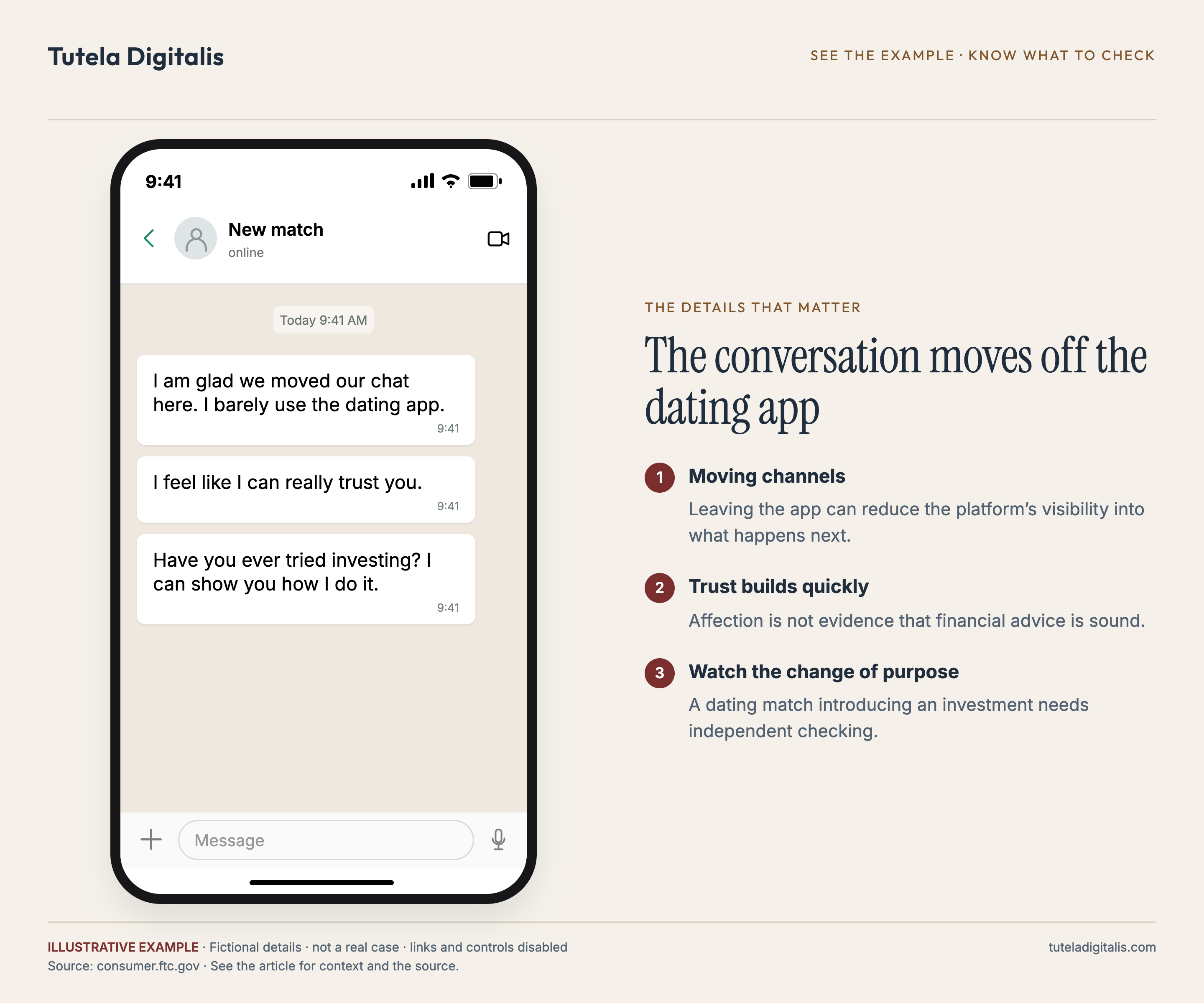
Illustrative example: I am glad we moved our chat here. I barely use the dating app. I feel like I can really trust you. Have you ever tried investing? I can show you how I do it.
- Moving channels. Leaving the app can reduce the platform’s visibility into what happens next.
- Trust builds quickly. Affection is not evidence that financial advice is sound.
- Watch the change of purpose. A dating match introducing an investment needs independent checking.
This guide was revised on 30 September 2026 to correct regional verification claims and remove unsupported rankings and improvised video “tests.” Looking at a match’s payment link? Use the dating verification ID scam guide.
A real platform cannot vouch for every person using it
Tinder, Bumble and Hinge publish verification and reporting tools. Those tools can help identify some misleading accounts. They do not make a conversation, investment proposal or request for money safe. A person can use their own face and still deceive you.
That is why the practical question is what each check establishes. A photo comparison, an age check, an identity-document check and a criminal-record search answer different questions. Do not infer the last three from the presence of a photo badge.
What each app says its verification does
Tinder: Photo Verification compares a video selfie with profile photos and includes a liveness check. Tinder explicitly says it does not guarantee identity or safety. Its separate ID + Photo Verification and region-specific Face Check should not be treated as interchangeable with a basic photo badge.
Bumble: ID verification uses a government-issued document and a live selfie, reached from the profile’s verification options. Its published safety features also include photo verification, in-app voice and video calls, and reporting. These are useful options, not evidence that Bumble has the lowest scam rate.
Hinge: Face Check checks liveness, compares profile photos and helps detect duplicate accounts. Hinge describes a phased rollout across regions where permitted and says the feature does not guarantee a user’s identity or safety. It would be inaccurate to call it universally mandatory for every account everywhere.
Our dating-app safety index organizes published measures for comparison. Feature counts do not establish which app is safest: that would require comparable evidence about actual harm, detection and reporting across the services.
Requests that deserve a stop and an independent check
The FTC’s romance-scam guidance describes people building trust before asking for money, sometimes for a supposed emergency or travel. A variation introduces an investment opportunity. Do not send money, cryptocurrency or gifts to an online love interest you have not met, and do not let a match choose where you invest.
A payment to prove you are safe: the FBI’s April 2024 warning describes supposed dating verification sites that collect card details and lead to recurring subscription charges. Use the app’s own documented process, reached independently. Our verification-scam breakdown explains the card, cancellation and reporting steps.
A push to leave the app: moving to another messenger can remove you from the dating service’s reporting context. It is a reason for caution, especially alongside pressure, secrecy or payment demands. A request to use WhatsApp is not by itself proof of fraud, and there is no reliable seven-day threshold that separates genuine matches from criminals.
An emergency that requires your money: urgency can make you feel responsible for resolving a stranger’s crisis. Pause, tell someone you trust and check the story independently. You do not have to prove affection with a transfer.
A threat involving intimate material: stop sending more material or money, preserve relevant messages and report the account. A threat is a reason to seek help, not a reason to meet the person. If someone is in immediate danger, contact local emergency services.
Video calls can help a conversation; they cannot certify honesty
Bumble offers in-app voice and video calls, which let you talk without first sharing a phone number. That can be useful. A successful call still does not prove a person’s history, the ownership of an account they show you, or the legitimacy of a financial request.
We no longer recommend asking someone to turn their head, move a hand across their face, or switch calling apps as a reliable fraud test. A person passing such a challenge has not demonstrated honest intentions. Nor does a poor connection or an awkward call establish fraud.
A reverse-image search may reveal a photo reused elsewhere. Treat a conflicting name or backstory as something to investigate. Finding no match is not clearance; finding the same photo twice is not automatically proof of a stolen identity. Context matters.
Practical boundaries before money, documents or a meeting
- Use verification through the app you opened yourself. Read what it checks and the privacy explanation. Do not upload documents or enter a card on a link supplied by a match merely to satisfy their demand.
- Keep control of personal information. Avoid sharing your address, financial details or sensitive identity documents with someone you have just met online. Do not share sign-in codes.
- Separate dating from financial decisions. Refuse requests to fund a stranger’s emergency or try their trading platform. Ask a trusted person for a second view before acting under emotional pressure.
- Use the report and block options when needed. Save the relevant profile and messages first where possible. You do not need to finish an argument or persuade the other person that your concern is justified.
- If you choose to meet, plan for physical safety. Meet in a public place, tell someone your plans and arrange your own transport. Leave if uncomfortable. Meeting in person is not a guarantee against fraud and should never be forced as a verification exercise.
The meeting precautions follow Tinder’s published safety guidance. You can decline or postpone a meeting for any reason. A genuine-looking profile does not create an obligation to continue.
Already sent money or shared account details?
Contact the bank, card issuer or payment service promptly using its official contact route. Explain exactly how you paid and ask whether the transaction can be reversed or disputed. The FTC’s recovery guidance separates actions by payment method; a card purchase and a cryptocurrency transfer have different recovery routes.
If you shared a password, change it through the real service and anywhere you reused it, then enable two-factor authentication. Report the dating profile. Keep relevant messages, usernames, receipts and transaction references. For local reporting routes, use our scam-reporting guide.
Someone offering to recover everything for an advance fee may be targeting you again. Read the recovery-scam warning signs before sharing more information. Recovery is never guaranteed by a badge, testimonial or confident promise.
Questions readers ask
Are Tinder, Bumble and Hinge safe to use?
They provide real verification and reporting tools, but no app can guarantee that every match is honest or safe. Check the purpose of each feature, protect personal information and refuse financial pressure. This guide does not rank the apps by scam rate because comparable evidence is not available here.
Can you trust Hinge Face Check?
It can help with liveness, matching profile photos and detecting duplicate accounts. Hinge describes a phased regional rollout and explicitly says it does not guarantee identity or safety. Do not extend a face-check result into trust in a financial proposal.
Are Bumble profiles authentic if they have a badge?
A badge indicates completion of a particular verification process. Bumble distinguishes photo verification from ID verification. Neither establishes good intentions; check the person’s behavior and the actual request instead of relying on the badge alone.
Should I use a video call to verify a match?
An in-app call can help you talk without sharing your phone number. It does not establish honest intentions or validate an investment. Improvised tests involving head movements or switching apps should not be treated as proof of safety.
Does moving to WhatsApp mean it is a scam?
Not by itself. Moving off the dating app can reduce the context available to its safety tools. Consider the surrounding behavior, especially pressure, secrecy, requests for money and refusal to respect your boundaries.
Should I pay for a dating verification ID a match sends me?
Do not enter card details on a match’s link to prove that you are safe. The FBI documented a scheme in which supposedly free verification led to subscription charges. Open the dating app independently and check its official verification instructions.
Unsure which part of an encounter needs reporting? Request a free case review with a short account of what happened. Do not send passwords, full card details or identity documents. If money or account access is at risk, contact your bank or the affected service first. We cannot guarantee recovery.
Sources and review notes
Primary sources checked on 30 September 2026. Platform features vary by region and can change. The FBI verification warning dates from April 2024; it establishes the scam pattern, not its current prevalence. The explanations of pressure and trust in this guide are Tutela Digitalis analysis.