ESCALATION PLAYBOOKMay 26, 202611 min read

Cash App scam refund — the 2026 playbook, from the in-app dispute to the CFPB.

Two things changed in the last 18 months that most online "how to dispute on Cash App" guides have not caught up to. The CFPB hit Block with a $175 million consent order on 16 January 2025 specifically for Cash App's fraud-handling failures, imposing real operating obligations on how disputes get investigated. And the Regulation E framework that has always quietly determined refund outcomes is now being enforced more directly. If you have lost money on Cash App in 2026, here is the actual step-by-step escalation — what to file, what to cite, and where to escalate when Cash App says no.

$175M
CFPB consent order vs Block, 16 Jan 2025
60 days
Reg E §1005.11 dispute window
$50
Liability cap if reported within 2 business days
24/7
Cash App live phone support (now required)
The short answer

To dispute a Cash App scam: open Cash App → Activity → tap the transaction → (…) → Need Help & Cash App Support → Dispute This Transaction. In parallel, call Cash App's required 24-hour line at 1-800-969-1940 and your card issuer or bank to open a chargeback under the Fair Credit Billing Act (credit) or Regulation E (debit). Cite Regulation E §§1005.6 and 1005.11 in writing. If denied, escalate to the CFPB at consumerfinance.gov/complaint — Block has been operating under a January 2025 consent order specifically for Cash App fraud-handling failures, so documented complaints have unusual weight. Then file with the FBI IC3 and the FTC. Throughout: act inside 60 days for federal Reg E protection, and ignore anyone offering to "recover" your money for an upfront fee — that is the second scam.

"Cash App created the conditions for fraud to proliferate on its popular payment platform. When things went wrong, Cash App flouted its responsibilities and even burdened local banks with problems that the company caused."

— Rohit Chopra, Director, Consumer Financial Protection Bureau, announcing the $175 million consent order against Block, Inc. on 16 January 2025. The order requires Block to pay up to $120 million in consumer redress and a $55 million civil penalty, and to fully investigate unauthorized transactions under the Electronic Fund Transfer Act going forward.

The first thing to understand before you take any step is which of two buckets your case lands in, because the answer determines almost everything else.

The single legal question: was the transfer authorized?

Regulation E — the federal rule that implements the Electronic Fund Transfer Act — splits electronic-funds disputes into two clean categories, and the protections each gets are very different.

Unauthorized transfer (§1005.6). Someone accessed your Cash App account or your card without your permission and moved money. The platform must investigate, and if the transfer was indeed unauthorized, the consumer is generally made whole. Your liability is capped at $50 if you report within 2 business days of discovering the loss; up to $500 if you delay; and you can be on the hook for the full amount if you wait more than 60 days. This is the textbook protected category.
Authorized transfer made under deception. You pressed Send yourself — even though you were tricked into doing so by a scammer. Legally, this is an authorized transfer, and Reg E does not require a refund. Cash App's terms describe these payments as final. The federal law does not protect this category, which is exactly what every Cash App scam playbook is engineered to produce.
The legal classification determines the strategy. If your case is unauthorized, Cash App is now under a January 2025 CFPB consent order to investigate properly under EFTA — that is a meaningfully different posture than victims faced a year ago, and unauthorized disputes have real teeth in 2026. If your case is authorized-under-deception, refund discretion sits with Cash App and the path is harder, but not closed — the card-chargeback parallel path and the CFPB escalation route still apply.

Knowing which bucket you are in tells you how aggressively to push on each step below, and where to focus the written record. Most scam scenarios that land authorized-under-deception still benefit from the full process — Cash App's investigation under the consent order sometimes finds elements of unauthorized activity even in cases that started as authorized.

The 8-step Cash App refund playbook

Work through these in order. Steps 1-3 are time-critical; steps 4-8 are the escalation ladder.

1. Open the in-app dispute immediately

Open Cash App, tap Activity, find the transaction, tap the (…) menu, then Need Help & Cash App Support, then Dispute This Transaction. Pick the closest reason from the dropdown — "Don't recognize this transaction" if unauthorized, or the scam-related options if you pressed Send under deception. Submission triggers Cash App's Regulation E error-resolution clock under §1005.11; they are required to investigate and respond.

Cash App may issue a provisional credit during the investigation. Treat the provisional credit as temporary — if Cash App ultimately denies the dispute, the credit reverses and the original loss reappears. Do not spend the provisional balance until the investigation closes in your favour.

2. Call Cash App's required 24-hour live support

1-800-969-1940. This phone line exists because the CFPB's January 2025 consent order requires Block to run live-person customer service round the clock — a requirement imposed precisely because Cash App did not offer phone support for years before the order. Use it to escalate inside the platform, get a verbal case reference, and create a parallel record alongside the in-app dispute.

Note: this is the only Cash App support number that is real. Any phone number you find by Googling "Cash App customer service" is almost certainly a scam phone bank. Use only the number above, or the support paths inside the app at Profile → Support and at cash.app/help.

3. Call your card issuer or bank within the first business day

The Cash App dispute is one path. The other path — and often the faster one — runs through the funding source.

If Cash App was funded from a credit card. Call the card issuer and request a chargeback under the Fair Credit Billing Act. Credit-card chargebacks are the strongest consumer-protection mechanism in US payments — typically 75-80% successful when the underlying claim is valid.
If Cash App was funded from a bank account. Call your bank's fraud line — the number on the back of your debit card. Your bank's own Regulation E obligations on the originating debit transaction may apply, separate from Cash App's obligations on the resulting transfer. Say 'fraud' explicitly and ask about a reversal.
If Cash App was funded from a Cash App balance. The bank/card parallel path does not apply; the in-app dispute and CFPB escalation are your routes.

The CFPB's 2025 order specifically found that Cash App had been routing customer fraud reports back through the card-network chargeback process instead of performing its own Reg E investigation. In 2026, run both paths in parallel — the chargeback often resolves first.

4. Build a contemporaneous record

One document. Today. Memory deteriorates fast and scammer evidence vanishes within hours of a successful scam.

Timestamps of every interaction with the scammer. Times you exchanged messages, times you sent payments, times you tried to withdraw.
Screenshots of the conversation, profile, and any URLs. Including the recipient $cashtag exactly as it appears in your Activity, the scammer's profile photo, and any platforms or websites involved.
The amounts, dates, and recipients of every transaction. Even small amounts. A pattern of small transfers escalating to large ones strengthens the case.
Any names, phone numbers, or email addresses the scammer used. Whether real or fake, they are evidence.
The story the scammer told you, in your own words. What did they say they needed the money for? What identity did they claim? This is the deception evidence.

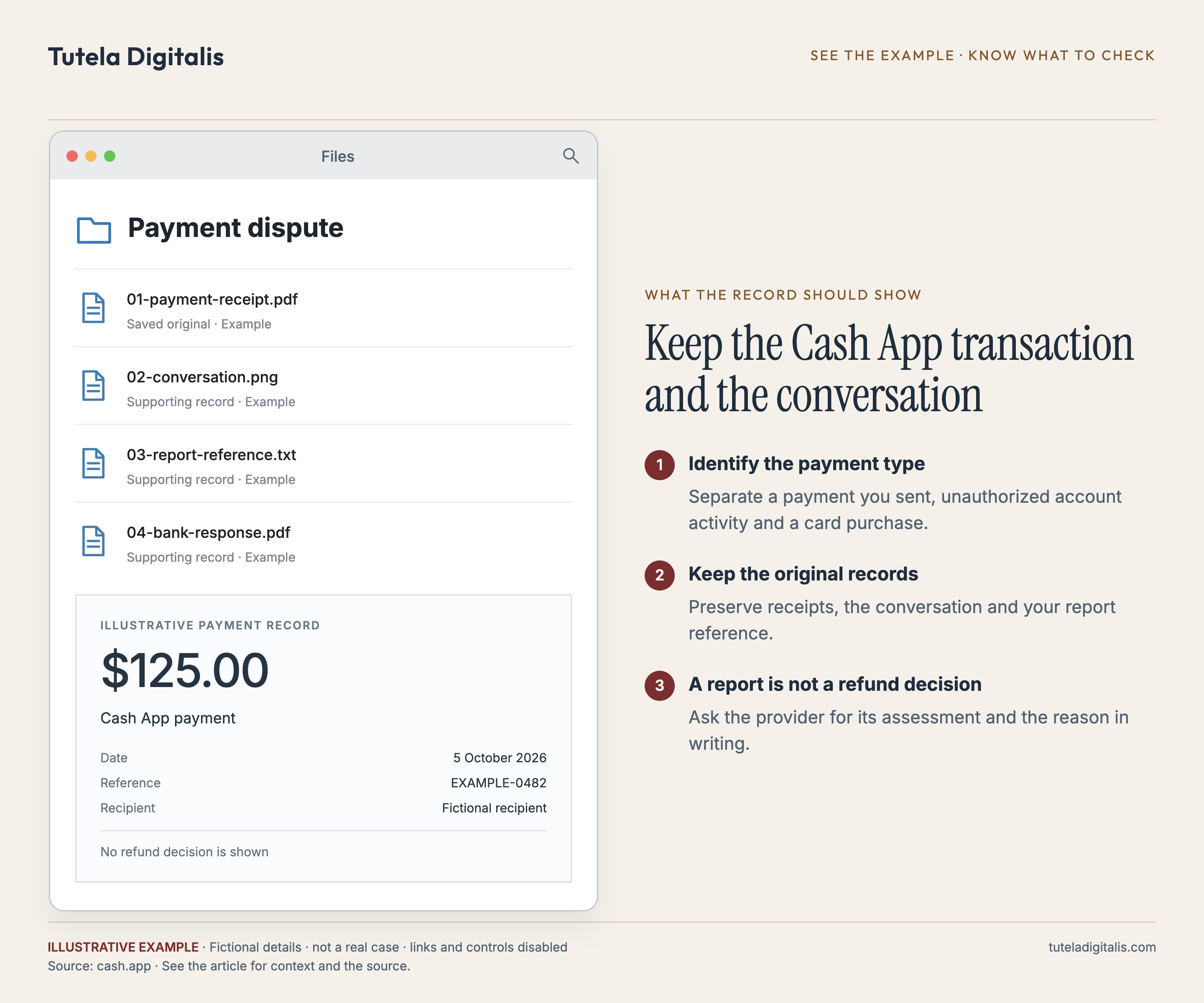
Save it as a single PDF or document. You will reference this file at every subsequent step.

5. Cite Regulation E in writing

Within 48 hours of the in-app dispute, send a written follow-up through Cash App's messaging that cites the federal law by section. Use this language:

"I am formally disputing this transaction under Regulation E §1005.6 (unauthorized transfer liability) and §1005.11 (error resolution procedures). Per §1005.11, I am requesting that Cash App provide its determination on this dispute within the statutory timeframe. Please provide a written explanation of any denial including the specific reasoning and the basis under EFTA."

The citations matter. They elevate the dispute from a customer-service request into a regulated investigation Cash App is on the hook to perform — and create a paper trail useful at every escalation step that follows.

6. File a CFPB complaint if Cash App stalls or denies

Go to consumerfinance.gov/complaint. Select "Money transfer or money service" → "Mobile or digital wallet." In the narrative, reference Block's January 2025 consent order by name (it is the highest-visibility recent CFPB action against the company) and the Regulation E sections you have already cited. Attach all evidence: screenshots, Cash App's denial response, the Reg E written follow-up.

Block is operating under active CFPB monitoring through 2026 and beyond. Documented complaints feed directly into that oversight, which is why CFPB complaints against Cash App carry unusual weight right now compared to complaints against most other US payment platforms. The platform must respond substantively within 15 days.

7. File with the FBI IC3 and the FTC

File at ic3.gov (FBI Internet Crime Complaint Center) and reportfraud.ftc.gov (FTC). For larger losses (typically $1,000+) where money moved through wire transfer or where the scam involved international counterparties, the FBI's Financial Fraud Kill Chain process may be triggered by an IC3 report filed within 72 hours. For everything else, these reports build the federal fraud database that future enforcement actions and consumer-redress mechanisms draw from.

8. Ignore recovery scams

Within days of any public report or social-media post about your loss, "recovery agents" will find you. They will know specific details — the amount, the platform, sometimes the recipient name — because your information was sold to them on the dark web. They will claim to be from a law firm, a recovery service, a government agency, or even Cash App itself. They will offer to retrieve your money for an upfront fee.

Every real recovery channel — Cash App's dispute process under the CFPB order, your bank, the CFPB, the FBI, the FTC — is free. Anyone asking for an upfront fee is running the second scam. The pattern is so common that we covered it in detail in the recovery scams piece.

What the 2025 consent order changed in practice

The CFPB's $175 million action against Block on 16 January 2025 is the load-bearing fact under most of this playbook. The headline numbers — $120 million in consumer redress, $55 million civil penalty — matter, but the ongoing operating requirements matter more for your case in 2026:

24-hour live-person customer service. Required, going forward. The phone line at 1-800-969-1940 is the direct result. Before the order, Cash App did not run public phone support at all.
Full Regulation E investigations on unauthorized transactions. Required, with reporting back to the CFPB. The previous practice of pushing fraud reports through card-network chargebacks instead of doing the Reg E investigation is no longer allowed.
Timely refunds when investigations support them. The order imposes operating timelines on when refunds must be issued in qualifying cases, eliminating the indefinite-investigation delay tactic.
No blocking of bank-initiated reversals. Cash App can no longer prevent customers' banks from clawing back fraudulent transfers — a practice the CFPB found and the order explicitly prohibits.

What the order does NOT do is change the underlying Regulation E gap between "unauthorized" and "authorized under deception." That is federal statute, and the CFPB cannot rewrite it through a consent order. The Senate's Protecting Consumers from Payment Scams Act, introduced in August 2024, would close that gap — it has not passed as of mid-2026. Until it does, the legal classification of your transfer remains the structural fact your refund odds rest on.

From the field. The two case archetypes we see most often in 2026 produce very different outcomes. The first is a user whose Cash App was actually compromised — SIM-swapped, sign-in code phished, account taken over. Those cases are textbook unauthorized transactions, and since the January 2025 order they are running closer to what the law intended. The second is a user who pressed Send themselves — the giveaway, the sugar daddy, the fake support agent, the marketplace seller. Those cases are legally authorized, and recovery is genuinely hard. The single difference between them is one click of consent — and every Cash App scam playbook is engineered around producing that click. If you find yourself in the second category, all eight steps above still matter: the chargeback path can recover credit-funded transactions, the CFPB pressure on Block is real, and a fraction of authorized-under-deception cases still produce refunds.

If the dispute fails and the chargeback fails

Sometimes both paths close. The federal Reg E classification rules against you; the credit-card chargeback gets reversed at the issuer; Cash App's investigation upholds the original transaction. At that point your remaining options are smaller, but they are not zero:

Small claims court. If you can identify a US-based counterparty (rare in scams, but it happens — particularly in marketplace fraud), small claims is a low-cost civil route. The threshold varies by state ($5,000-$10,000 in most), filing fees are typically $30-$100, and you do not need a lawyer.
State Attorney General complaint. Particularly New York, California, Massachusetts, and Washington, where AG offices have active financial-fraud teams. Even when individual recovery fails, AG complaints contribute to broader enforcement records and occasionally produce class-action eligibility.
Tax deduction for theft loss. Under current US tax law, certain theft losses on for-profit transactions may be deductible. This is narrow and changed substantially under the 2017 Tax Cuts and Jobs Act — consult a tax professional, but for some scam categories (particularly investment-related), partial recovery via the tax route is possible.
Block's restitution program from the 2025 order. If your Cash App loss occurred before January 2025, you may be eligible for compensation through the $120 million consumer-redress fund the CFPB order required Block to establish. Check the order's redress eligibility criteria at consumerfinance.gov.
Throughout all of this: do not pay anyone offering to recover the money for a fee. The recovery scam preys specifically on victims at the moment when official channels have closed. "Cash App fund recovery experts," "cybercrime law firms," "blockchain forensics services" that contact you out of nowhere are running the second scam. Every real recovery route — the in-app dispute, the bank chargeback, the CFPB, the FBI IC3, the FTC, your state AG — is free. See the recovery scams piece for the full pattern.

Prevention: the habits that keep you out of this entire process

The escalation playbook above works as well as it can be made to work in 2026, but the best outcome is never needing it. Three small habits prevent the majority of Cash App scams:

Send $1 first to anyone new on Cash App. Confirm out loud or on a known channel that they received the $1 from your $cashtag. Then send the real amount. The $1 is the cheapest fraud insurance available.
Treat any unsolicited Cash App contact as hostile. Real friends don't message you for the first time on Cash App. Real businesses don't first reach out about a refund on Cash App. Real employers don't pay sign-on bonuses on Cash App.
Never share your sign-in code, PIN, or screenshots showing balances. Cash App will never ask. The 24-hour support line at 1-800-969-1940 will never ask. Anyone asking for these is, by definition, a scammer or someone Cash App would discipline.

The upstream framing for all of this lives in our "is Cash App legit" piece, which covers the platform and its ecosystem more broadly. For by-payment-method recovery across cards, Zelle, wires, crypto, and gift cards, the 72-hour recovery playbook covers the horizontal view. For the Zelle-specific equivalent of this Cash App playbook, see the Zelle scam refund piece.

One sentence to carry forward

If you take one thing from this entire piece, take this: file the in-app dispute and the parallel card chargeback today, cite Regulation E by section in writing, and escalate to the CFPB if Cash App denies — the legal levers under the 2025 consent order are real, and they only work if you pull them inside 60 days.

Cash App denied your dispute and you don't know what to file next? Let's look at it together.

Forward the denial, the transaction, the conversation. A real expert reviews every case and replies within 24 hours. Free, confidential, no pressure.

Submit a free case review →Try the Scam Checker

Common questions about Cash App scam refunds

Will Cash App refund a scam payment?

Sometimes — and the odds depend on one legal distinction. If your account was accessed without your permission (an unauthorized transfer), Cash App is required by federal law to investigate and, in most cases, refund the loss. If you pressed Send yourself under deception (an 'authorized' transfer), Cash App's terms describe these payments as final and the platform's refund discretion is limited. The CFPB's January 2025 $175 million consent order against Block specifically targets Cash App's handling of unauthorized cases — meaning if your dispute is for unauthorized activity in 2026, you have stronger standing than victims had a year earlier.

How long do I have to dispute a Cash App charge?

Under Regulation E §1005.11, you generally have 60 days from the date the statement showing the transaction was sent to you to report an unauthorized transfer. If you report within 2 business days of discovering the loss, your liability is capped at $50. Acting faster matters: between 2 and 60 days, your liability can rise to $500 for unauthorized transactions if you delayed unreasonably. After 60 days, federal protections largely end. Open the Cash App app the moment you notice a problem — Profile → Support → Report a Payment Issue.

What's the difference between disputing on Cash App vs disputing with my bank or card?

Both routes exist and serve different purposes. The Cash App dispute (in-app or at cash.app/help) is the Regulation E pathway — it triggers Cash App's federal obligation to investigate. The bank/card dispute is the chargeback pathway — it applies when the Cash App payment was funded from a credit card (Fair Credit Billing Act chargeback) or, for debit-funded payments, when your bank itself has separate Reg E obligations on the originating transaction. The CFPB's 2025 order specifically penalized Cash App for misusing card-network chargebacks instead of doing the Reg E investigation. So in 2026: file the Cash App dispute as the primary path, and also call your card issuer / bank to open a parallel chargeback if the payment was funded from a card.

Can I cancel a Cash App payment after I sent it?

Only if its status is still 'pending,' which typically means the recipient has not yet accepted it. Most Cash App payments to existing users complete in seconds, so the cancel window is usually closed before you realize. Open the app, find the transaction in Activity, and look for a 'Cancel Payment' option — if it's not there, the payment is already complete and you need to file a dispute instead, not a cancellation.

What if Cash App denies my dispute?

Three escalation steps. First, ask Cash App in writing (through in-app messaging) for the specific reason for denial and the basis under Regulation E — they must respond. Second, file a CFPB complaint at consumerfinance.gov/complaint, selecting 'Money transfer or money service' → 'Mobile or digital wallet.' Block is operating under the CFPB's January 2025 consent order, and Cash App complaints are a known compliance risk for them. Third, if the payment was funded from a credit card, file the chargeback directly with the card issuer — this is a separate process from the Cash App dispute and operates under the Fair Credit Billing Act for credit cards.

Does the 2025 CFPB order against Cash App help me get my money back?

Yes — indirectly but materially. The January 16, 2025 consent order requires Block to: run 24-hour live-person customer service, fully investigate unauthorized transactions under EFTA, and provide timely refunds where investigations support them. The order also imposes ongoing monitoring. In practice this means a 2026 unauthorized-transaction dispute that would have been rubber-stamped a year ago is now being investigated under regulatory pressure. The order also set aside up to $120 million for consumer redress for past harm — if you were affected before the order, you may already be eligible for compensation through Block's restitution process.

Sources & further reading

Every figure in this piece is drawn from these authorities. Click any of them to verify.

CFPB — Block, Inc. Consent OrderCFPB — Press Release on Block OrderCFPB — Submit a ComplaintCash App Help — Dispute a TransactionCash App Help CenterRegulation E (12 CFR Part 1005)FTC — Report FraudFBI — IC3 Complaint CenterFTC — Consumer Sentinel 2024

Keep reading