The UK's official reporting routes in 2026 are: Report Fraud at reportfraud.police.uk or 0300 123 2040 (replaced Action Fraud on 4 December 2025); the National Cyber Security Centre for phishing emails (report@phishing.gov.uk) and suspicious texts (forward to 7726); the FCA's ScamSmart for investment fraud; Police Scotland on 101 if you are in Scotland; and 999 if you are in immediate danger. Crucially, since 7 October 2024 UK banks are required under the PSR's mandatory reimbursement rule to refund APP fraud victims up to £85,000 per claim — usually within five business days. That is the single biggest improvement in UK scam recovery in a decade, and the recovery odds in the UK are now meaningfully better than they are in the US.
Read the image explanation
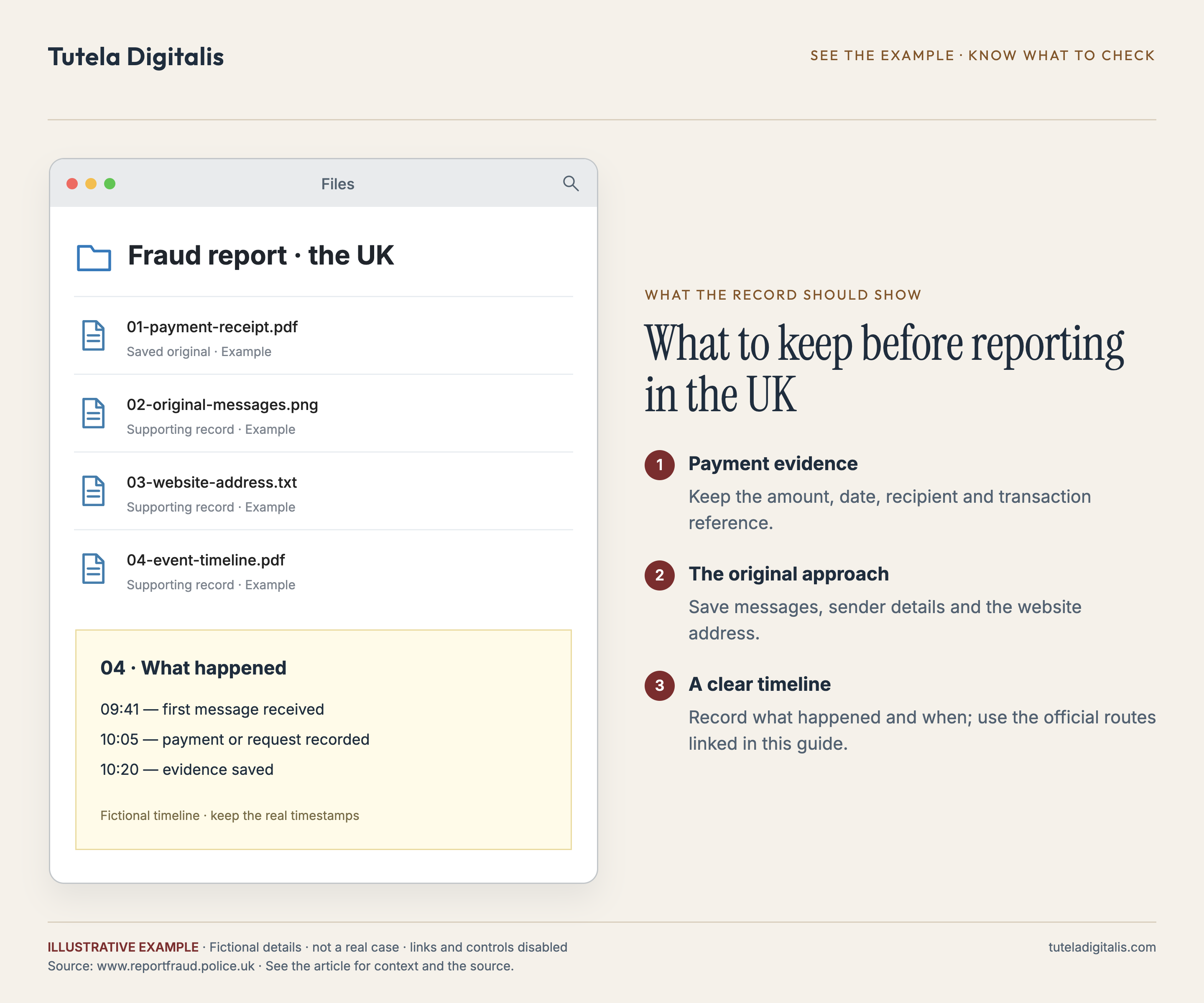
Illustrative example: Fraud report · the UK 01-payment-receipt.pdf 02-original-messages.png 03-website-address.txt 04-event-timeline.pdf
- Payment evidence. Keep the amount, date, recipient and transaction reference.
- The original approach. Save messages, sender details and the website address.
- A clear timeline. Record what happened and when; use the official routes linked in this guide.
"Report Fraud is a complete redesign of the way the public report fraud and cyber crime to the police. The new service will deliver an improved experience for victims and provide our investigators with the intelligence they need to bring offenders to justice."
— City of London Police, announcing the launch of Report Fraud as the replacement for Action Fraud, 4 December 2025. Action Fraud had faced years of public criticism, including reports that the vast majority of cases were closed without police follow-up.
If you have been scammed in the UK, two things matter most in the first 24 hours: stopping any further loss and creating a contemporaneous record. The reporting and refund machinery downstream of that point has been substantially redesigned in 2024-2025, and using the right route at the right time is the difference between a refund and a "case closed without action" email a fortnight later. Here is the actual current map.
If you are reading this with a recent transaction you regret, skip to If money has already moved. The first hour is the only window where bank-side reversals reliably work.
The big change: PSR mandatory reimbursement (since 7 October 2024)
This is the most important paragraph in this entire piece, so read it twice.
On 7 October 2024 the UK Payment Systems Regulator's mandatory reimbursement rule came into force. The rule requires UK payment service providers — your bank or building society — to reimburse victims of Authorised Push Payment fraud (the formal name for "you sent the money yourself because the scammer deceived you") on transfers made over Faster Payments or CHAPS. The cost is shared 50/50 between the sending and receiving banks, which is the structural innovation that finally makes the receiving bank care about scam accounts.
The new front door: Report Fraud (since 4 December 2025)
Action Fraud was the UK's national fraud-reporting service for over a decade. It was also widely criticised. A Times investigation found that the vast majority of reports were closed without any police follow-up. It was, as one parliamentary committee put it, "not fit for purpose." On 4 December 2025 it was retired.
The replacement is called Report Fraud, run by City of London Police (the national lead force for fraud), with a public-facing launch in January 2026. The new service has:
Whether Report Fraud actually delivers on the redesign promise will be measurable over 2026. Critics of Action Fraud point out that the underlying problem — police forces lacking capacity to investigate volume fraud — has not been fundamentally solved by renaming the front door. What is unambiguously true is that the reporting URL has changed, and any guide telling you to use "actionfraud.police.uk" is out of date.
The full UK reporting directory, by scam type
Different scam types route to different agencies. Using the right one matters more than reporting to all of them.
If money has already moved: the first 24 hours
Speed is the entire game. Bank-side reversals only work in the first hour or two; the PSR rule kicks in once the bank is formally notified. The sequence below is the maximum-recovery order:
The UK numbers, for context
UK Finance's Annual Fraud Report 2025 covers the most recent complete year. The headline figures, all from named-agency data:
The PSR's mandatory reimbursement rule means a larger share of the £450.7 million APP figure will be returned to victims going forward than was returned in previous years. That makes the UK, for now, the rare jurisdiction where the consumer-protection floor on P2P scams is meaningfully higher than the equivalent floor in the US.
The habits that keep you out of the reporting machinery entirely
Reporting is downstream. Prevention is upstream, and three small habits stop most UK scams cold:
If you have already started down a path and you are unsure whether it is a scam, the cheapest and fastest second opinion is the Scam Checker on this site, or our free case review. Both are read by a human and respond within 24 hours.
One rule, end to end
If you take one habit from this piece, take this: any unsolicited phone call, text, or message asking you to move money is a scam until you have verified it by calling the institution back on a number you already trust. Everything else is detail.
UK-based and not sure where to start? Let's look at it together.
Describe the message, the call, the transaction. A real expert reviews every case and replies within 24 hours. Free, confidential, no pressure.
Common questions about reporting a UK scam
What replaced Action Fraud in the UK?
Report Fraud. From 4 December 2025, City of London Police's new service replaced Action Fraud as the national fraud and cybercrime reporting platform for England, Wales, and Northern Ireland. The full public launch happened in January 2026. The new service operates at reportfraud.police.uk and on 0300 123 2040. Anyone going to the old Action Fraud URL is now redirected to the new service. The replacement followed years of public criticism of Action Fraud, including reports that 96% of cases received no police follow-up. Report Fraud includes a new contact centre, a new online reporting tool, and the Report Fraud National Crime Analysis Service (N-CAS) replacing Action Fraud's backend.
What is the PSR mandatory reimbursement rule, and does it apply to me?
The Payment Systems Regulator's mandatory reimbursement requirement for Authorised Push Payment (APP) fraud came into force on 7 October 2024. It requires UK payment service providers to refund consumers, micro-enterprises, and charities who fall victim to APP fraud over Faster Payments and CHAPS — even when the consumer authorized the transfer under deception. The maximum reimbursement is capped at £85,000 per claim, refunds are due within five business days (35 if investigation is needed), and sending firms may charge an excess of up to £100 (no excess for vulnerable customers). This is the UK's structural fix for the same Regulation E gap that still leaves US Zelle and Cash App victims stranded.
Should I report to Report Fraud or to my local police?
Both, in most cases. Report Fraud handles the national intelligence picture and routes serious cases to local police forces. Your local police force handles immediate safety issues, ongoing crime in progress, or when you can identify the suspect or local circumstances. For online scams with no in-person threat, Report Fraud is the primary route. If you are in immediate danger, call 999. For non-emergencies in Scotland, call Police Scotland on 101 — Scotland does not use Report Fraud.
What should I do about a suspicious email or text?
For emails: forward to report@phishing.gov.uk, run by the National Cyber Security Centre (NCSC). For texts: forward to 7726 (this spells SPAM on a keypad) — your mobile network operator routes these reports to NCSC and works to block the sender. Both services are free, both feed real investigations, and the NCSC's takedown service has removed millions of malicious URLs. If you also clicked a link or entered any information, treat it as a successful phishing attempt and report the broader scam to Report Fraud as well.
I lost money to a UK scam. Can I get it back under the new rules?
If the scam involved an Authorised Push Payment (Faster Payments or CHAPS) made on or after 7 October 2024, the PSR mandatory reimbursement rule applies and your payment service provider is required to refund you up to £85,000 — usually within five business days of your claim. Tell your bank explicitly that you are making an APP fraud claim under the PSR rule, give them the date, amount, and recipient sort code/account, and document the deception. If your bank refuses, escalate to the Financial Ombudsman Service. Card-based scams have separate Section 75 (£100+) or chargeback protections.
What if the scammer is overseas?
You still report to Report Fraud — they coordinate cross-border investigation through partner agencies. Reports involving European or international payment fraud are also shared with Europol and Interpol's relevant units. The PSR mandatory reimbursement rule applies to the UK payment service provider regardless of where the scammer is located, as long as the original payment came from a UK PSP via Faster Payments or CHAPS. Overseas card transactions can usually still be charged back through your card issuer.
Sources & further reading
Every figure in this piece is drawn from these authorities. Click any of them to verify.