Germany's official routes in 2026: file a criminal complaint (Strafanzeige) at your federal state's online police station (Online-Wache), or call 110 in an emergency; forward phishing emails to the Verbraucherzentrale's Phishing-Radar at phishing@verbraucherzentrale.nrw; check and report investment firms via BaFin's company database; report nuisance calls and fraudulent SMS to the Bundesnetzagentur; block a compromised card free on 116 116; and get free victim support from Weisser Ring on 116 006. Crucially, unlike the UK there is no mandatory-reimbursement rule: under §675u BGB your bank must refund an unauthorized transaction, but money you transferred yourself under deception is generally not refundable — which is why speed and documentation matter so much.
Read the image explanation
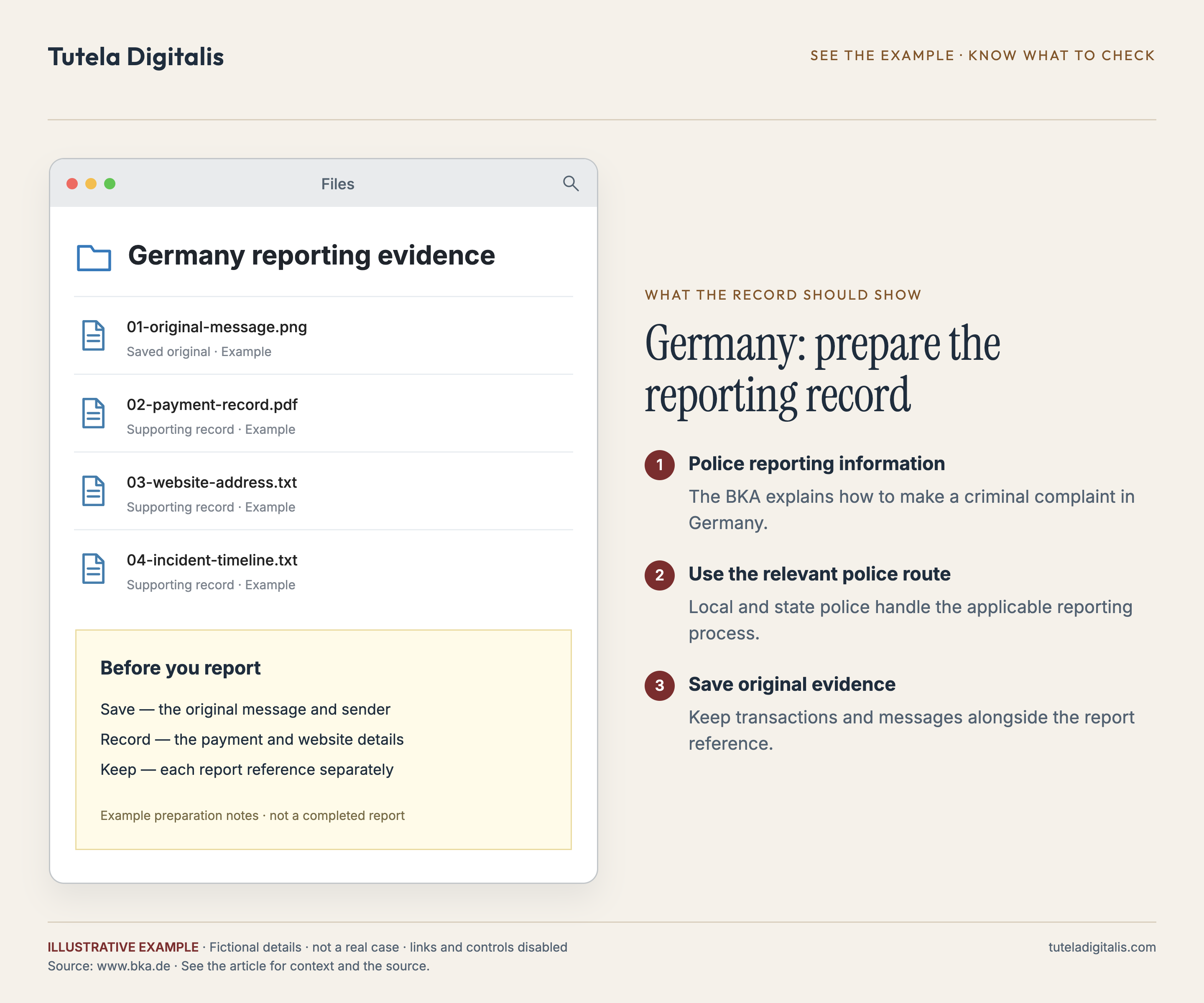
Illustrative example: 01-original-message.png 02-payment-record.pdf 03-website-address.txt 04-incident-timeline.txt Before you report Save — the original message and sender Record — the payment and website details Keep — each report reference separately
- Police reporting information. The BKA explains how to make a criminal complaint in Germany.
- Use the relevant police route. Local and state police handle the applicable reporting process.
- Save original evidence. Keep transactions and messages alongside the report reference.
"Cyberangriffe besitzen ein enormes Schadenspotenzial und sind eine Bedrohung für Wirtschaft, Staat und Gesellschaft."
"Cyberattacks carry an enormous damage potential and are a threat to the economy, the state and society." — Alexander Dobrindt, German Federal Interior Minister, on the BKA Bundeslagebild Cybercrime 2024, 3 June 2025. That €178.6 billion of damage lands, in the end, on individual people — and Germany makes them knock on several different doors to report it.
If you have been scammed in Germany, two things matter most in the first 24 hours: stopping any further loss and creating a record while the evidence still exists. Everything downstream of that — which agency, which form, which refund argument — depends on getting those two right. The complication unique to Germany is that there is no single place to report, so the order below is built to be the fastest path through a deliberately decentralised system.
If you are reading this with a recent transaction you regret, skip to if money has already moved. The first hour is the only window where a bank-side recall reliably works.
The hard truth first: Germany refunds the hack, not the con
This is the most important section, because it sets your expectations correctly before you spend a week chasing the wrong outcome.
German law draws a sharp line between two kinds of loss. Under §675u of the German Civil Code (BGB), an unauthorized payment — someone used your card or got into your account without permission — must be refunded by your bank, and §675v generally caps your own liability at €50 unless you were grossly negligent. That is the German implementation of the EU Payment Services Directive, and it works reasonably well.
But if you authorized the payment yourself because you were deceived — you logged in and sent the transfer because a convincing "bank officer" or "investment adviser" told you to — that is legally an authorized transaction, and §675u does not apply. There is no German equivalent of the UK rule that forces banks to reimburse this kind of authorised-push-payment fraud.
There is no single front door, start at your state's Online-Wache
Because Germany polices through its 16 federal states, a criminal complaint (Strafanzeige) goes to your state's police, not to a national hotline. Most states let you file online through an "Online-Wache" or "Internetwache" — an online police station that accepts fraud, theft, and property-crime reports without a trip to a station.
The full German reporting directory, by scam type
Different scams route to different specialist bodies. Using the right one matters more than carpet-bombing all of them.
If money has already moved: the first 24 hours
Speed is the whole game, especially in Germany where there is no automatic refund to fall back on. A same-day bank recall is sometimes the only thing that works. This is the maximum-recovery order:
The German numbers, for context
The BKA's Bundeslagebild Cybercrime 2025, published on 12 May 2026, is the most recent national picture, and it moved every figure from the 2024 report upward. The headline numbers, all from the BKA's own release:
The habits that keep you out of the reporting machinery entirely
Reporting is downstream. Prevention is upstream, and three habits stop most German scams cold:
If you are unsure whether something is a scam before any money moves, the fastest second opinion is the Scam Checker on this site, or our free case review. Both are read by a human and answered within 24 hours.
One rule, end to end
If you take one habit from this piece, take this: any unsolicited call, message, or email that pressures you to move money or share a code is a scam until you have hung up and verified it by calling the institution back on a number you already trust. In a country with no automatic refund, that one pause is worth more than the entire reporting machinery downstream of it.
In Germany and not sure where to start? Let's look at it together.
Describe the message, the call, the transaction. A real expert reviews every case and replies within 24 hours. Free, confidential, no pressure.
Common questions about reporting a scam in Germany
Is there one place to report all scams in Germany?
No — and this is the single most confusing thing about reporting fraud in Germany. There is no national equivalent of the UK's Report Fraud or America's IC3. Policing is organised by the 16 federal states (Länder), so a criminal complaint (Strafanzeige) goes to your state police, in most states through an online police station (Online-Wache). On top of that, specific scam types route to specialist federal bodies: phishing to the Verbraucherzentrale, investment fraud to BaFin, nuisance calls and SMS to the Bundesnetzagentur. The practical rule: file the Strafanzeige at your state's Online-Wache first, then add the specialist report that matches the scam type.
Will my German bank refund money I lost to a scam?
It depends entirely on one distinction. Under §675u of the German Civil Code (BGB), if the transaction was unauthorized — someone used your card or accessed your account without permission — your bank must refund it, and §675v generally caps your own liability at €50 unless you acted with gross negligence. But if you authorized the payment yourself because you were deceived (you logged in and sent the transfer), that is legally an authorized transaction and §675u does not apply. Germany has no equivalent to the UK's mandatory APP-fraud reimbursement rule, so for deception-based transfers you are largely reliant on the bank's goodwill, the banking ombudsman, or a civil claim. Report it anyway — speed still matters for any chance of a recall.
How do I report a phishing email or fake SMS in Germany?
Forward the suspicious email, unchanged, to phishing@verbraucherzentrale.nrw — the Verbraucherzentrale NRW runs the national Phishing-Radar, evaluates incoming reports (anonymising your personal data), and publishes daily warnings about live scams. If the phishing impersonated your bank, also tell your bank directly so they can flag the campaign. The BSI (Federal Office for Information Security) publishes consumer warnings via its Bürger-CERT service. If you actually entered any data or clicked through and lost money, treat it as a successful attack and file a Strafanzeige at your state's Online-Wache as well.
How do I check whether an investment platform is legitimate in Germany?
Use BaFin, the Federal Financial Supervisory Authority. Before you send any money, search BaFin's company database (Unternehmensdatenbank) to confirm the firm is actually licensed to offer financial services in Germany, and check BaFin's warning list of unauthorized providers. If a platform is operating without a licence, you can report it to BaFin as an 'unerlaubtes Geschäft' (unauthorized business). BaFin cannot recover your money, but its warnings are how a lot of fake-broker and crypto-platform operations get publicly flagged. Fake cryptocurrency platforms, cloned versions of real brokers, and 'guaranteed return' tips are the dominant German investment-fraud patterns.
What number do I call to block a stolen or compromised card in Germany?
116 116 — the central card-blocking hotline (Sperr-Notruf). It is free, runs around the clock, and blocks German bank cards, credit cards, and more in one call. From outside Germany, dial +49 116 116. Do this first if your card details or online-banking access may have been compromised, before you do anything else — blocking the card is the one action that reliably stops further loss. Note that blocking the card does not by itself reverse transactions that already happened; for those you still raise an unauthorized-transaction claim with the bank.
Where can a scam victim get free human help in Germany?
Weisser Ring is Germany's only nationwide victim-support organisation, founded in 1976, with around 3,200 trained volunteers across 420 local branches. Its free victims helpline is 116 006, open daily from 7am to 10pm, and it offers support in English. Weisser Ring helps with the emotional aftermath, points you to the right reporting channel, and can accompany victims through the process. For consumer and contract questions — chargebacks, disputed subscriptions, dodgy online shops — the Verbraucherzentrale in your state provides paid and free advice. Neither will ever charge an upfront fee to 'recover' your money.
Sources & further reading
Every figure in this piece is drawn from these authorities. Click any of them to verify.