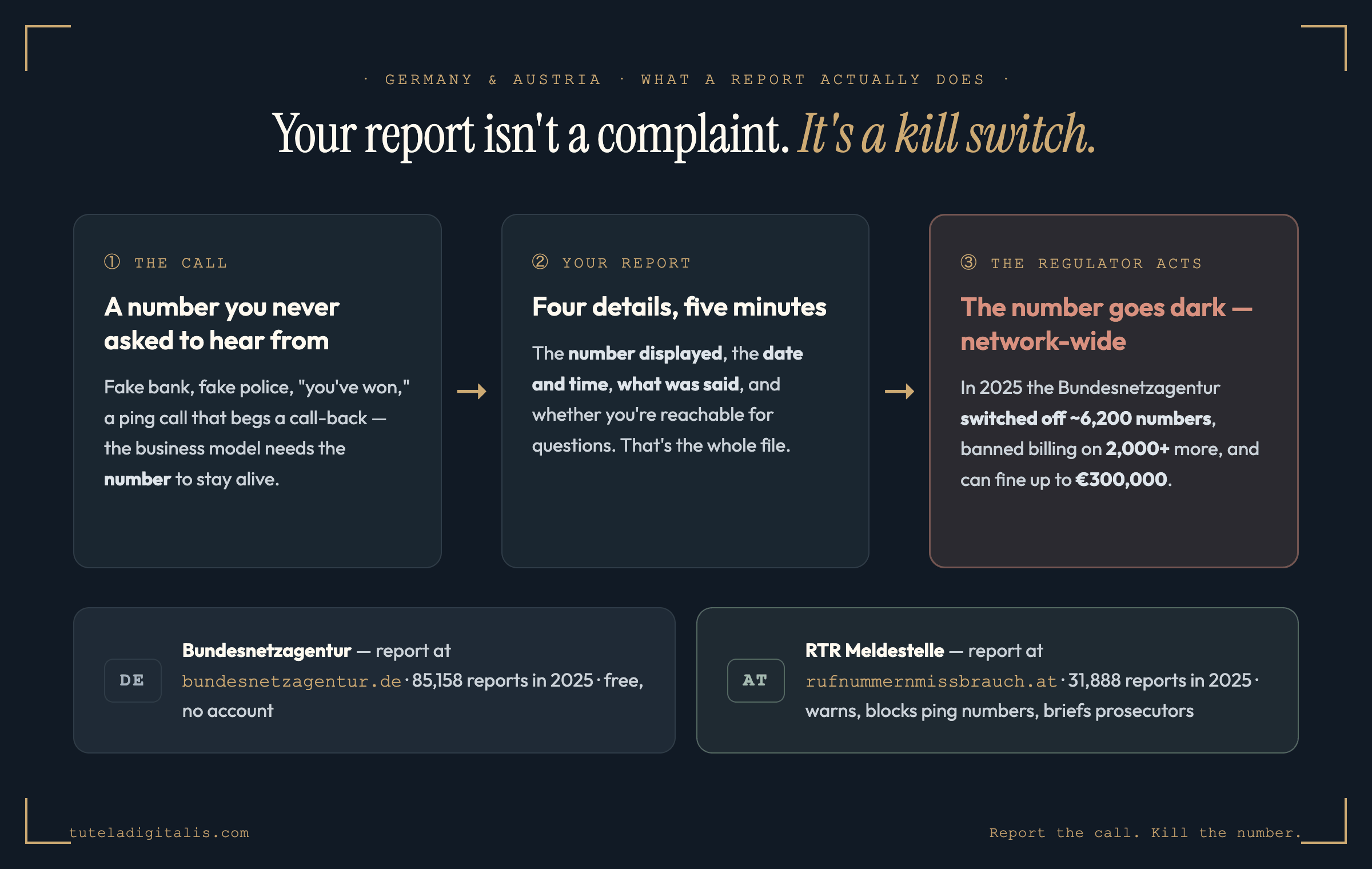
In Germany, report spam and scam calls to the Bundesnetzagentur — free online forms on its complaint hub at bundesnetzagentur.de cover unauthorized telemarketing, ping calls, SMS spam, and spoofed caller-IDs. It can switch numbers off (~6,200 in 2025), ban billing on them, and fine up to €300,000. In Austria, report to the RTR's Meldestelle für Rufnummernmissbrauch at rufnummernmissbrauch.at — it warns the public, can block ping-call numbers, and forwards cases to prosecutors; the form also takes scam SMS and WhatsApp messages. Give four details: the number displayed, date and time, what was said, your own number. If you lost money, that's a police matter first — Online-Wache or 110 in Germany, 133 in Austria — and your bank before anyone.
One clarification before the doors, because it decides which door you need: what kind of number just called you?
Your report is a kill switch, not a complaint
Here's the fact that changes how the whole chore feels. In 2025, the Bundesnetzagentur — Germany's Federal Network Agency, the regulator that owns the country's phone-number space — received 85,158 complaints about number misuse. It didn't file them. Based on those reports, it switched off around 6,200 phone numbers, network-wide, and imposed billing-and-collection bans covering more than 2,000 numbers — meaning the operators behind premium-number tricks were legally barred from collecting the money the scheme existed to generate. Unauthorized telemarketing on top carries fines of up to €300,000 under the UWG, Germany's unfair-competition law.
Do the arithmetic from the scammer's side of the table. A working number — one that dials out at volume without being blocked — is operating infrastructure. Every switched-off number is replacement cost, burned routing, dead campaigns mid-flight. A country where thirteen reports, statistically, retire a number is a country where the phone channel gets expensive. That is what your five-minute form actually does: it isn't a gesture, it's a line item in someone's losses.
First, one question: is the number the business, or a mask?
Every unwanted call falls on one side of this line, and the line decides where your report has power.
Germany: the Bundesnetzagentur's doors
The regulator keeps one complaint hub — the Ärger mit Rufnummern und Anrufen page at bundesnetzagentur.de — with a separate short form for each situation. The four you're most likely to need:
Two German quirks worth knowing. First, 7726 — the international forward-a-spam-text shortcode — is not the official channel here: Deutsche Telekom supports it and asks its customers to use it, but support varies by carrier, and the Bundesnetzagentur's own SMS-spam guidance routes you to its web form instead. Use 7726 as a bonus if you're on Telekom; use the form to reach the regulator. Second, since 1 December 2022, German law (§120 Abs. 4 TKG) requires networks to suppress the caller-ID of calls handed over from foreign networks that display a German number — such calls arrive as "unknown" instead, with an exemption for genuine mobile roaming. That's why the foreign call center wearing a Düsseldorf office number as a costume got rarer — and why a call that still does display a trustworthy German number deserves no trust on that basis alone. The display is an assertion, never a fact. The police, for one, never call out from 110 — and as polizei-beratung.de puts it about shock calls: hang up immediately, and call 110 yourself.
Austria: the RTR's Meldestelle, and its honest fine print
Austria concentrates everything in one place: the RTR's Meldestelle für Rufnummernmissbrauch at rufnummernmissbrauch.at. One form covers harassing calls, scam SMS, misuse of your own number as a spoofed sender — and, since autumn 2025, scam WhatsApp messages too. In 2025 the Meldestelle logged 31,888 reports, up 5% on the year before; more than 10,200 of them were about scam SMS.
What happens next is a different machine from Germany's, and the RTR is admirably straight about it. Reports primarily feed a public warning system — the RTR publishes the suspicious numbers people are reporting, which is the list every other Austrian can check. Against ping-call numbers it can take direct countermeasures, including free warning announcements played before a call to certain numbers connects, and outright number blocks. Case material goes onward to prosecutors and administrative-penalty authorities. And the fine print, in the RTR's own telling: because scammers spoof numbers, your report doesn't guarantee your particular harassment ends. That honesty is worth more than a false promise — it tells you what the report is for. You're not filing to fix your own phone; you're feeding the warning system, the same way the person who reported the number you just looked up fed it for you.
When the regulator is the wrong door
The three habits that keep your number cheap
A last piece of adversary logic. Scam operations price phone numbers by responsiveness — a number that answers, calls back, or presses keys is worth more on the lists they trade than one that doesn't react. Three habits keep yours cheap: never call an unknown one-ring number back (that's the entire ping-call business model); never press a key a robocall asks you to press, not even "to be removed from the list" — it's a liveness probe; and don't argue with telemarketers — a two-minute indignant conversation marks the number as engaged and human. Hang up, file the form, block the number. Quiet is the punishment that scales.
Got a suspicious German or Austrian text instead? Check it in sixty seconds.
Our free checker sorts a text by who it claims to be from — Post, Zoll, your bank — and answers with each institution's own published rule.
Common questions about reporting spam calls in Germany and Austria
How do I report spam calls in Germany?
Report the number to the Bundesnetzagentur (the Federal Network Agency) — it runs a set of free online complaint forms on its 'Ärger mit Rufnummern und Anrufen' page at bundesnetzagentur.de, with a separate form for each situation: unauthorized telemarketing (unerlaubte Telefonwerbung), ping calls (a one-ring call fishing for an expensive call-back), SMS spam, and caller-ID manipulation. No account is needed. Give the four details that make a report actionable: the number displayed on your screen, the date and time of the call, what was said or claimed, and your own number. This is not a complaint that disappears into a database — the Bundesnetzagentur can switch abusive numbers off network-wide, ban operators from billing or collecting on them, and fine unauthorized telemarketing with up to €300,000.
Does reporting a spam call in Germany actually do anything?
Yes — Germany is one of the few countries where the paper trail visibly turns into action. In 2025, the Bundesnetzagentur received 85,158 complaints about number misuse and, based on them, switched off around 6,200 phone numbers and imposed billing-and-collection bans covering more than 2,000 numbers, on top of fines for unauthorized telemarketing of up to €300,000 under the UWG. A switched-off number is dead for everyone at once, and a billing ban means the operator behind a premium-number trick cannot legally collect the money. Your single report is the raw material for all of it.
How do I report scam calls in Austria?
Report the number to the RTR's Meldestelle für Rufnummernmissbrauch at rufnummernmissbrauch.at — a free online form that takes abusive calls, scam SMS, misuse of your own number, and (since autumn 2025) scam WhatsApp messages. The RTR uses reports to publish warnings about suspicious numbers, can order countermeasures against ping-call numbers — including free warning announcements played before a call connects, and number blocks — and forwards case material to prosecutors and administrative-penalty authorities. The RTR is honest about the limit: because scammers spoof numbers, a report doesn't guarantee your specific harassment stops — but it feeds the warning system every other Austrian checks. In 2025 the Meldestelle logged 31,888 reports, more than 10,200 of them about scam SMS.
The caller ID showed a real German number — how is that possible?
Because caller ID is an assertion, not a fact — scammers can transmit almost any number, a trick called spoofing. Germany closed part of this hole in law: since 1 December 2022, under §120 of the Telekommunikationsgesetz, a call handed over from a foreign network that displays a German number must have that caller-ID suppressed by the network (it then shows as 'unknown' or 'anonymous'), with an exemption for genuine mobile roaming. So a scam call center abroad has a much harder time wearing a German landline or office number as a mask. The practical rule stands anyway: treat what your screen says as unverified. A displayed number is never proof of who is calling — the police in particular never call from 110.
Can I forward spam texts to 7726 in Germany or Austria?
Not reliably — 7726, the international spam-reporting shortcode, is not the official channel in either country. In Germany, Deutsche Telekom supports it and asks its customers to forward suspicious texts to 7726, but support varies by carrier, and the Bundesnetzagentur's own SMS-spam guidance doesn't use it at all — the channel that actually reaches the German regulator is its online SMS-spam complaint form. Austria has no 7726-style shortcode; the official route is the RTR form at rufnummernmissbrauch.at, which accepts scam SMS and WhatsApp messages directly. If you're on Telekom in Germany, 7726 is a fine extra signal — just don't let it replace the regulator's form.
What if I already lost money to a phone scammer?
Then the regulator is your second call, not your first. Call your bank immediately and try to stop or recall the payment — speed decides more than anything else. Then report the crime to the police: in Germany via your federal state's Online-Wache (online police station) or 110 in an emergency; in Austria via any police station or 133. File the regulator report as well — Bundesnetzagentur or RTR — so the number itself gets processed. And treat anyone who contacts you afterwards promising to recover the lost money for a fee as the next scam: recovery fraud deliberately targets people who just lost money.
Sources & further reading
Every figure and reporting channel in this piece links to the primary source. Click any to verify.