If you paid a scammer with a gift card, your money is not automatically gone — but the only thing that can save it is speed. A gift card has no chargeback and no reversal, so recovery depends entirely on the card company freezing the balance before the scammer drains it. Call the issuer's fraud line immediately (Apple and Google can freeze unspent funds), keep the physical card and the receipt, ask directly for a refund, and report it at ReportFraud.ftc.gov. Hours matter; days usually mean the balance is already spent.
Read the image explanation
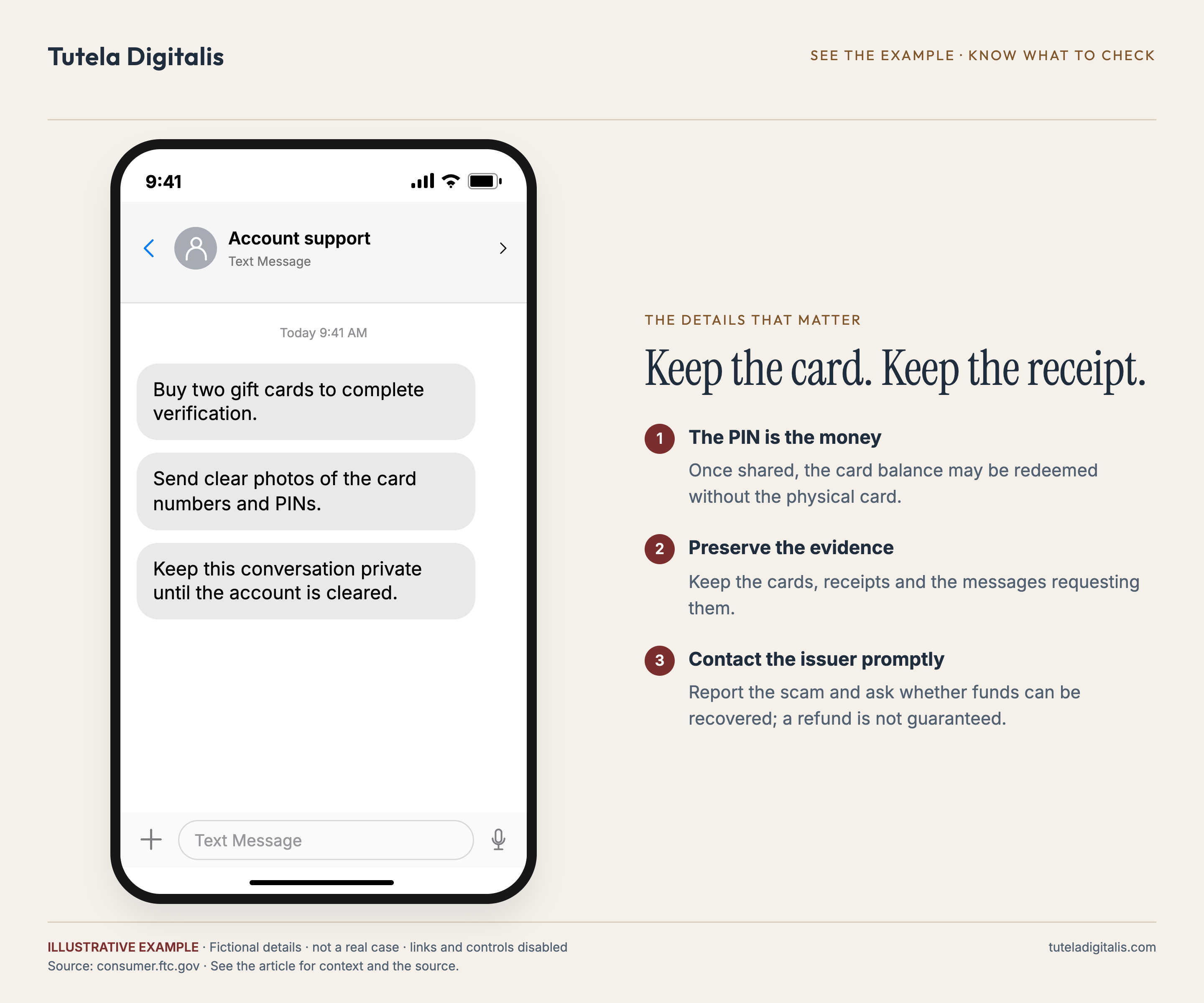
Illustrative example: Buy two gift cards to complete verification. Send clear photos of the card numbers and PINs. Keep this conversation private until the account is cleared.
- The PIN is the money. Once shared, the card balance may be redeemed without the physical card.
- Preserve the evidence. Keep the cards, receipts and the messages requesting them.
- Contact the issuer promptly. Report the scam and ask whether funds can be recovered; a refund is not guaranteed.
"Report the gift card scam to the gift card company right away. No matter how long ago the scam happened, report it. Ask for your money back — some companies are helping stop gift card scams and might give your money back."
— Federal Trade Commission, "Avoiding and Reporting Gift Card Scams." The instruction most victims never follow, because they assume gift-card money is unrecoverable — and that assumption is exactly what guarantees the loss.
Almost everyone who pays a scammer with a gift card believes the same thing the moment they realize what happened: the money is gone, there is nothing to be done, and reporting it is pointless. That belief is the single most expensive mistake in the whole scam — because it stops the one action that can still work. Gift-card money is sometimes recoverable. Not often, not for long, and never guaranteed — but the window exists, and it closes in hours.
This is the gift-card version of the same recovery question that runs under every scam where money has already moved. With a bank transfer or a card payment there are reversal and dispute mechanics. With a gift card there is exactly one mechanism — the issuer's freeze — and it is unforgiving about time. Understanding why is what tells you how to act.
Why a gift card has no undo button
A credit card payment can be disputed. A debit-card or ACH transaction has error-resolution rights under Regulation E. Even a wire can sometimes be recalled in the first 24 to 72 hours. A gift card has none of that — and that is precisely why scammers prefer it.
The one thing that can still save your money: speed
The FTC's own guidance changed a few years ago from "your money is gone" to a more honest "maybe not" — because the major gift-card companies began flagging fraudulent transactions and freezing stolen balances so scammers cannot cash them out. That cooperation is real, but it only helps people who call before the balance is spent. The companies cannot freeze money that has already left the card.
So the recovery playbook is not complicated. It is just urgent. The full eight steps are below; the first two are the ones that actually decide the outcome.
If you just paid a scammer with a gift card, do this now
Work top to bottom, but do not let any step delay the call to the gift card company. That call is the one with a clock on it.
Who to call: the gift card company fraud lines
These are the contact points the FTC publishes for reporting a card used in a scam. Have the card number and the store receipt in front of you when you call. If your card brand is not listed, look for a contact number on the card itself or the issuer's website — and if you cannot reach them, report it to the FTC.
If the money's already gone: what's actually left
If the balance was drained before you could freeze it — the common outcome when the scam is discovered the next day — the honest truth is that direct recovery is unlikely. But reporting still matters, and a few avenues remain worth pursuing.
Who is targeted, and why gift cards
Scammers reach for gift cards because they are easy to buy, instantly redeemable, and untraceable once the numbers are gone. The demand almost always rides on top of another scam — a fake government agent, a 'tech support' agent, a relative in trouble.
So, can you get gift card money back?
Sometimes, if you call the card company within hours and a balance remains to freeze. Often not, if the scammer has already spent it. The dividing line is almost never how clever the victim was — it is how fast the report reached the issuer. That is the one variable you control, which is why the only correct response to realizing you have been scammed is to stop reading and start calling.
And the deeper protection is upstream of all of it: the request to pay anyone — a business, an agency, a relative in trouble — with a gift card is itself the scam, every time, with no exceptions. There is no legitimate transaction in the world that requires you to read the numbers off the back of a gift card to a stranger on the phone.
If you take one rule from this whole piece, take this: gift-card money is only ever recovered by the company freezing the balance before it's spent — so the instant you realize you've been scammed, the receipt goes in one hand, the phone in the other, and you call the issuer before you do anything else.
Just paid a scammer with a gift card? Let's work the next steps together.
Tell us which card, how much, and when — a real expert reviews every case and replies within 24 hours. Free, confidential, no judgment, nothing to sell.
Common questions about gift card scam refunds
Can you get your money back after paying a scammer with a gift card?
Sometimes — but only if you move fast. A gift card has no chargeback and no transaction reversal, so the only way to recover the money is for the card company to freeze the unspent balance before the scammer drains it. Companies like Apple and Google can put a freeze on funds still sitting on the card, and the FTC says some companies will refund victims who report and ask. The deciding factor is speed: a report made within hours of handing over the numbers has a real chance; a report made days later usually does not, because the balance is already gone. Report it anyway — the FTC tells victims to report no matter how long ago the scam happened.
What should I do in the first hour after I paid a scammer with a gift card?
Call the gift card company's fraud line immediately and ask them to freeze the balance — do not wait. Keep the physical card and the store receipt; the numbers on them are what let the company find the card and file your report. Then report to the FTC at ReportFraud.ftc.gov. If you bought the gift card with a credit or debit card, call that bank too and report the fraud. The single most important variable is how fast you call the issuer, because the scammer is racing to spend or resell the balance, often within minutes of getting the numbers.
Can I dispute the gift card purchase on my credit card?
Usually not, and it is important to understand why. When you bought the gift card, that purchase was authorized by you and completed correctly — the store sold you exactly what you paid for. The fraud happened afterward, when you were tricked into giving the numbers to a scammer, and that step did not involve your credit card at all. Card networks generally will not reverse a gift-card purchase on those grounds. It is still worth reporting the fraud to your card issuer, and in narrow cases (a card that was never activated, or a billing error) a dispute may apply — but do not count on a chargeback as your recovery path. The gift card company's freeze is the real lever.
Which gift cards do scammers ask for most?
Whatever is easiest to buy and hardest to trace. The FTC has reported Target, Apple/iTunes, Google Play, Amazon, and Steam cards as recurring favorites, and in one FTC data spotlight Target gift cards alone accounted for about $35 million in payments to scammers — more than twice any other brand. Scammers also tell victims where to buy, often Walmart, Target, CVS, or Walgreens, and sometimes send them to several stores so no single cashier gets suspicious. The brand does not change the rule: no real business or government agency will ever ask you to pay with a gift card, so the request itself is the scam.
Will the police or the FBI recover my gift card money?
Reporting to law enforcement matters, but it is not a fast refund channel. File with the FTC at ReportFraud.ftc.gov and, if a larger sum is involved, with the FBI's IC3 at ic3.gov; for victims 60 or over, the DOJ Elder Justice hotline at 1-833-FRAUD-11 (1-833-372-8311) will help you file. These reports feed investigations and, in some cases, asset-recovery efforts — but the realistic chance of getting your specific money back still comes down to the card company freezing the balance in time. What never works is any 'recovery service' that contacts you afterward and charges an upfront fee. That is a second scam aimed at people who have already lost money.
Sources & further reading
Every figure and instruction in this piece is drawn from these authorities. Click any of them to verify.