The OneCoin online filing portal is closed after the 30 June 2026 deadline. As checked on 5 October, the official Kroll administrator directs people who still wish to file to email their petition. That does not guarantee acceptance or payment. Existing applicants can ask Kroll for status on 1-833-421-9748. The DOJ process is free: do not pay anyone to release compensation.
Read the image explanation
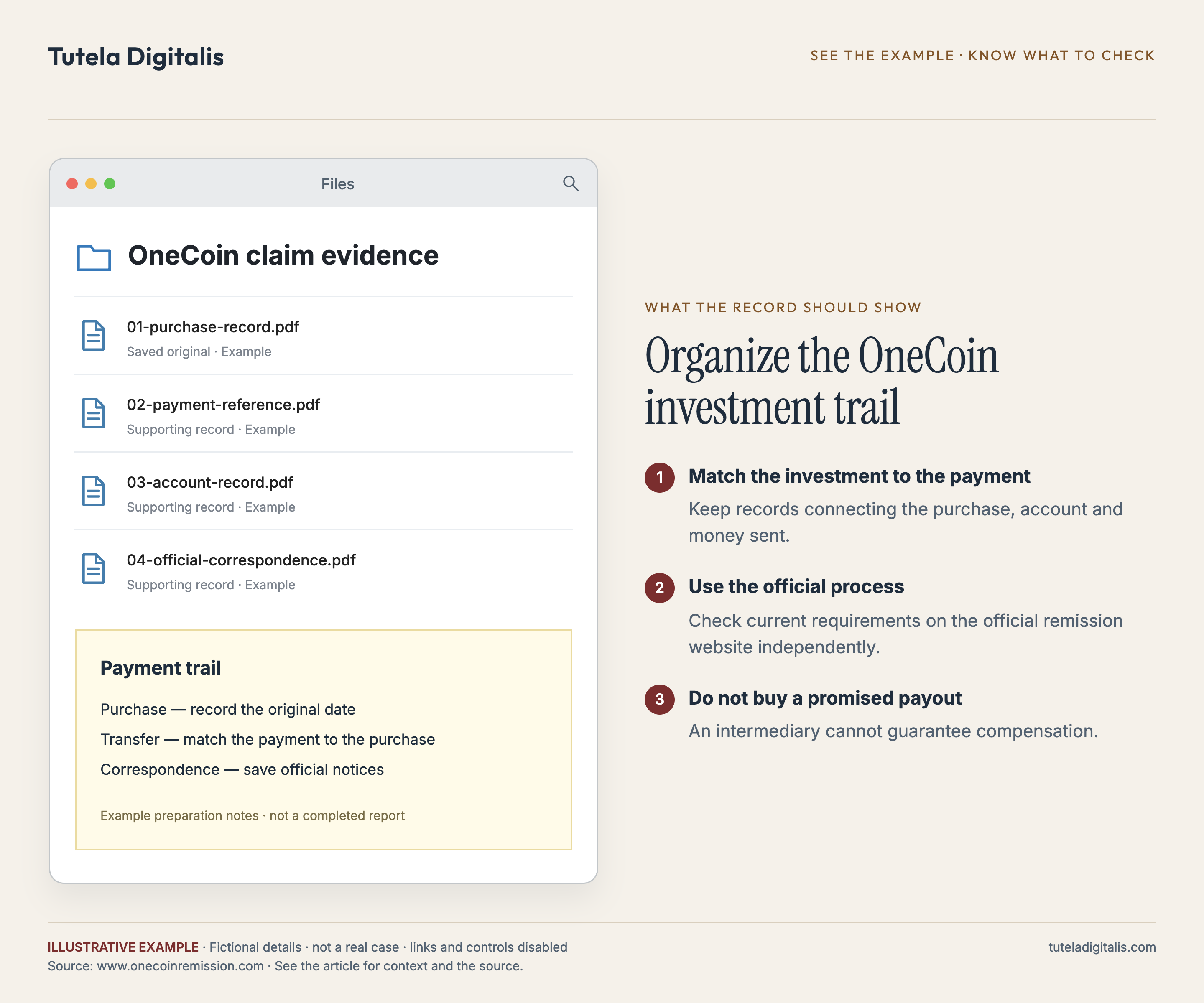
Illustrative example: OneCoin claim evidence 01-purchase-record.pdf 02-payment-reference.pdf 03-account-record.pdf 04-official-correspondence.pdf Payment trail Purchase — record the original date Transfer — match the payment to the purchase Correspondence — save official notices
- Match the investment to the payment. Keep records connecting the purchase, account and money sent.
- Use the official process. Check current requirements on the official remission website independently.
- Do not buy a promised payout. An intermediary cannot guarantee compensation.
OneCoin was sold to millions of people from 2014 as a revolutionary cryptocurrency. It was not a cryptocurrency at all — there was no real blockchain behind it — and US prosecutors have since described it as one of the largest fraud schemes ever charged, with worldwide losses they put in the billions of dollars, on the order of $4 billion. Its founder, Ruja Ignatova — the "Cryptoqueen" — vanished in October 2017 and remains on the FBI's Ten Most Wanted list. For years that left victims with nothing but a story. Now, finally, some of the money is moving — and that change is exactly what the next set of scammers is counting on.
If you lost money to OneCoin and want the practical steps, skip to what to actually do. The single most important fact is at the top of it: the real processes are free.
The official US remission: deadline, late petitions and status
The actionable process is a remission administered for the US Department of Justice. After authorities recovered funds connected to the fraud, the government opened a claims process to return money to eligible victims — and, unusually, it is open to victims anywhere in the world, not only in the United States. According to the Justice Department, the process is run by Kroll Settlement Administration, the fund available is in the region of $40 million, and the published deadline was Tuesday, 30 June 2026. As that date closed in, the FBI publicly reminded victims to file in time — FBI New York's James C. Barnacle Jr. noting that OneCoin's investors were misled by "false statements and empty promises," and that the bureau is committed to returning the stolen funds.
To qualify, you generally need to have bought OneCoin packages between 2014 and 2019 and to have a net loss — everything you paid in, minus anything you ever withdrew or received in commissions. The things that strengthen a claim are the ordinary records of having paid:
The German case: real money seized, but not a claim you can file yet
The second process is easy to misread, and the misreading is dangerous. In Germany, prosecutors in Bielefeld — in North Rhine-Westphalia — have run a long criminal investigation into OneCoin. During it, police seized roughly €28 million, and in 2025 prosecutors filed an indictment against Ruja Ignatova, partly to stop the statute of limitations from running out. More than 17,500 German victims have been registered in the case.
All of that is real. What it is not is a fund you can claim against. Ignatova has never been tried — she is still missing — so this is a criminal prosecution working its way through the courts, not a victim-compensation portal with an application form. There is no public self-service claim for the seized German money; victims there currently assert claims through private law firms, which charge fees. We map how uneven victims' rights are across the continent in our pan-European recovery-rights guide, and how reporting works in Germany specifically.
The second wave, predators feeding on the same victims
Here is the pattern worth naming, because it is the whole reason this news is double-edged. The moment real compensation becomes a headline, fraudsters use that headline as bait. OneCoin victims are now being targeted again by people posing as "compensation recovery agents", asset-recovery lawyers, or officials from a court or agency, all promising to unlock a payout — for an upfront fee.
The tell never changes. The real US process is free and you apply to it yourself; no legitimate body cold-contacts victims to offer recovery in exchange for a charge. This is not a fringe risk: Europol has warned that tens of thousands of online ads have impersonated bodies like Interpol, Europol and EU institutions, dangling "fraud refunds" specifically at people who had already lost money. The same machinery is now pointed at OneCoin's victims, and it is a close cousin of the "official-sounding EU recovery fund" cons riding this year's enforcement news.
After the deadline: what the administrator says now, and what nobody has announced
We re-read the official remission site on 5 October 2026. Under Important Dates it lists one date, the 30 June 2026 deadline, and one sentence beneath it: the deadline for filing a petition has passed, therefore the filing portal has been closed, and anyone who would still like to file should email their petition to info@OneCoinRemission.com. The phone line, 1-833-421-9748, and the Kroll postal address are unchanged. The site still describes itself, together with the Department of Justice's own page, as the only authorised website for this remission.
Read that carefully, because it is narrower than it sounds. The email route is a way to submit a late petition, not a promise that a late petition will be paid; the site's own eligibility language has not changed, and remission decisions sit with the Department of Justice under the rules the notice set out in April. And nothing on the site names a payment date, a distribution schedule, or a per-victim figure. As of this reading, the administrator’s homepage does not publish a payment schedule. That gap is exactly the material the second scam is made from: any message that gives you a payout date, a case number you never received, or a fee to release funds is supplying a fact the administrator itself has not supplied.
What to actually do
The US filing window has closed. What's left is still concrete — and the risk has changed shape:
If you're not sure whether something you've received is genuine — a "recovery" email, a "lawyer" you didn't hire, a site that looks like the official one — send it through the Scam Checker or our free case review. A real person reads every one and replies within 24 hours.
Got a "OneCoin recovery" offer, or not sure a site is real? Send it to us first.
Paste the email, the website, the "agent" who contacted you. A real expert reviews every case and replies within 24 hours. Free, confidential, no pressure.
Common questions about OneCoin compensation
Is the OneCoin compensation real?
Yes. The US Department of Justice appointed Kroll Settlement Administration to administer the OneCoin remission process. The June 30, 2026 filing deadline has passed and the online portal is closed. The official administrator now directs people who still wish to file to email their petition. That route does not guarantee acceptance or payment. The DOJ process is free; independently verify any message through the official administrator.
How do I file a OneCoin compensation claim?
The online filing portal is closed. As checked on October 5, 2026, onecoinremission.com directs people who still wish to file to email their petition to info@OneCoinRemission.com. Start at the official site, read its current instructions and obtain the petition form there. For an existing petition, contact Kroll on 1-833-421-9748. Do not pay a release fee or assume a late petition will be accepted or paid.
Is there a fee to claim OneCoin compensation?
No. The US remission process is free, and the Justice Department's notice is explicit that neither the DOJ nor its claims administrator will ever ask you to pay a fee to participate or to receive a payment. This is the single most reliable test you have. If anyone — a website, a caller, an email, a 'recovery agent', a 'lawyer' you didn't hire — asks for a release fee, a tax, an admin charge, or any payment to unlock your compensation, it is fraud. Real compensation costs nothing to claim.
Can German victims claim the €28 million that was seized?
Not as a direct, self-service claim — at least not yet. The roughly €28 million seized by police in North Rhine-Westphalia went into the proceeds of the German criminal case against Ruja Ignatova, which prosecutors in Bielefeld advanced with a 2025 indictment partly to stop the statute of limitations from expiring. There is no public claims portal for it, and Ignatova has still never been tried — she has been missing since 2017. German victims currently pursue claims through private lawyers, who charge fees, so vet anyone you engage carefully. Be very wary of anyone telling you that you can 'claim your share of the German €28 million today' — that is false, and it is a classic recovery-scam line.
What's the deadline to claim OneCoin compensation?
The published deadline was June 30, 2026, and the online portal is closed. The official administrator nevertheless provides an email route for people who still wish to submit a petition. This is not an announced deadline extension or a guarantee of eligibility, acceptance or payment. Check onecoinremission.com for the current instructions.
Someone contacted me offering to recover my OneCoin money — is it legitimate?
Almost certainly not. OneCoin victims are being targeted a second time by fraudsters posing as 'compensation recovery agents', 'asset-recovery lawyers', or officials from a court or agency, who promise to unlock your payout in exchange for an upfront fee. The real US process is free and you apply to it yourself; no legitimate body cold-contacts victims to offer recovery for a charge. Europol has warned that tens of thousands of online ads have impersonated agencies like Interpol and Europol promising 'fraud refunds' to people who already lost money. Treat any unsolicited recovery offer as the next scam, and run it through a scam check before you reply.
Sources & further reading
Claims in this piece are attributed to these sources. Click any of them to verify.