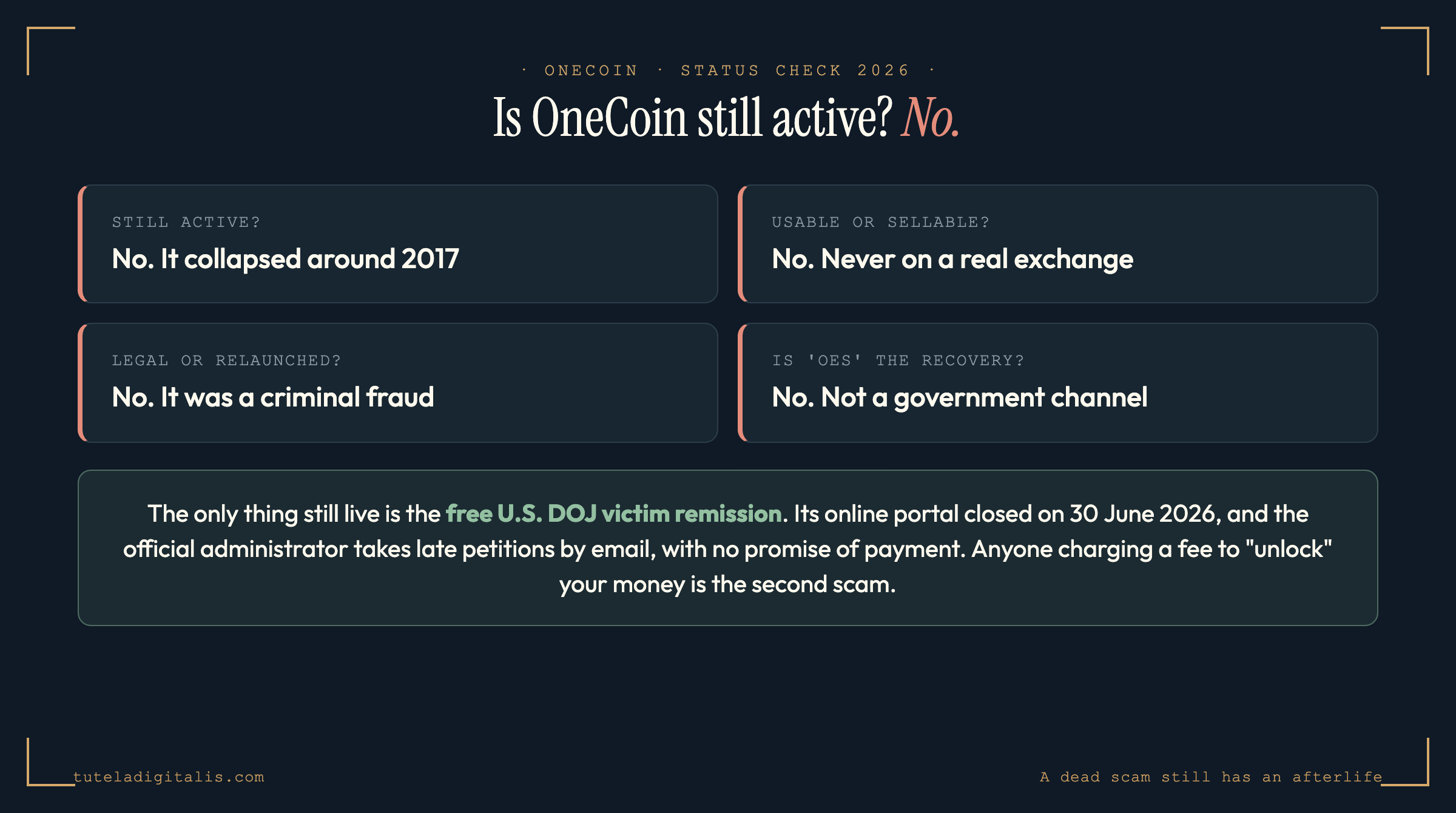
No, OneCoin is not active in 2026. Its scheme began unravelling around 2017 when founder Ruja Ignatova disappeared, though OneCoin was still sold to victims until 2019; co-founder Sebastian Greenwood was sentenced to 20 years and Ignatova remains on the FBI's Ten Most Wanted list.
OneCoin was never listed on a legitimate exchange, so it was never freely sellable, and it still isn't. What is still live is the legal aftermath: the free U.S. DOJ remission, whose online portal closed after 30 June 2026 (late petitions go by email to the official administrator), and a wave of "relaunch," "successor token" and fee-for-recovery scams aimed at former victims.
Let's take the questions people actually search for, one at a time. If you lost money and want the compensation steps, skip to what the official site says now.
"Can I still use or sell my OneCoin?"
No, and this is the part that's painful, because it was true from the start. OneCoin was never listed on any legitimate cryptocurrency exchange. A real coin trades on open markets where you can sell to a stranger at a price the market sets.
OneCoin members were kept inside a closed, company-run "exchange" that was repeatedly limited or frozen, so for most people there was never a real exit. In 2026 there is no market, no liquidity, and no legitimate platform where OneCoin can be bought, sold, or spent. If a website or a "broker" offers to cash out, unlock, or reactivate your OneCoin, that offer is the scam, not the solution.
"Is OneCoin legal now? Has it relaunched?"
No. OneCoin is not a legal, operating business anywhere. It was a criminal fraud, and that hasn't changed because the courtroom story is still being written. U.S. prosecutors call it one of the largest fraud schemes ever charged. Greenwood is serving 20 years. The lawyer who laundered the money is serving 10. Ignatova is a wanted fugitive.
There is no version of those facts in which OneCoin is "now approved" or "back and trading." Claims of a relaunch are a tactic: they're designed to reawaken hope in people who lost money, so they'll buy in again or pay to "reactivate" old holdings.
"Did OneCoin become 'One Ecosystem' / OES?"
This one comes up a lot, so it's worth answering carefully. After OneCoin collapsed, a separate venture sometimes branded One Ecosystem (with a token referred to as "OES") emerged from the same community. Fraud researchers and reporters who track multi-level schemes have widely described it as a continuation or rebrand of the OneCoin playbook rather than a legitimate new project. We take OES apart in detail (what changed, what stayed exactly the same, and the one test that cuts through it) in our full explainer on OES coin.
So what IS still happening with OneCoin?
Only the aftermath, and one piece of it can actually help victims. After authorities recovered funds tied to the fraud, the U.S. Department of Justice opened a remission process to return money to eligible victims. It is free, it runs through the official site onecoinremission.com, and its filing deadline was 30 June 2026. It has nothing to do with reactivating coins or buying anything.
“Misled by falsified statements and empty promises, many unknowingly depleted their savings for a fraudulent investment scheme in an emerging financial ecosystem that would never pay out.”
OneCoin compensation after the 30 June deadline: what the official site says now
We read the official remission site again on 26 October 2026. Under Important Dates it still lists one date, Tuesday 30 June 2026, and one sentence beneath it: the deadline for filing a petition has passed, the filing portal has been closed, and anyone who would still like to file should email their petition to info@OneCoinRemission.com. The site says it is authorized by the Department of Justice and controlled by Kroll Settlement Administration, and that it and the DOJ's own website are the only authorized websites for the case. The phone line is 1-833-421-9748.
Eligibility has not changed. You may be a potential victim if you bought OneCoin between 2014 and 2019 and had a net loss once any completed withdrawals are taken into account. In practice that means what you paid in, minus anything you took out, so keep the records that prove both: bank and wire statements, package receipts, account screenshots, and any record of withdrawals.
What the site does not say matters as much. It publishes no payment date, no distribution schedule and no per-victim amount. It says the net proceeds of the forfeited assets will be available to compensate victims once a final order of forfeiture is issued. When it opened the process, the Justice Department said more than $40 million in forfeited assets was available, against victim losses it put at over $4 billion. A late petition sent by email is a way to be considered, not a promise of payment.
The German case: €28 million seized, but no claim you can file
Germany is the other half of the story, and the easiest to misread. Prosecutors in Bielefeld, in North Rhine-Westphalia, indicted Ruja Ignatova in 2025, partly to stop the statute of limitations from running out, and state police said assets worth about €28 million were confiscated during the investigation. She has never been tried, and she has been missing since 2017. That money sits inside a criminal case. It is not a compensation fund, and we found no public claims portal for it. How reporting works there is in our guide to reporting a scam in Germany.
If you want the full background (what OneCoin actually was, why it had no blockchain, and who ran it), we break the whole scheme down here.
Someone says your OneCoin can be unlocked, converted, or recovered? Check it first.
Paste the message, the website, or the "agent." A real expert reviews every case and replies within 24 to 48 hours. Free, confidential, no pressure.
Common questions
Is OneCoin still active in 2026?
No. OneCoin's core scheme collapsed around 2017 after its founder, Ruja Ignatova, disappeared, and U.S. prosecutors have since secured guilty pleas and long prison sentences against its leadership. There is no functioning OneCoin company, exchange, or coin to use. The only OneCoin process still genuinely 'active' in 2026 is the legal aftermath: criminal cases and a U.S. Department of Justice victim-compensation (remission) process whose online filing portal closed after the 30 June 2026 deadline.
Can I still buy, sell, or use OneCoin?
No, and you never really could. OneCoin was never listed on any legitimate cryptocurrency exchange, so there was never an open market to sell into. Members were confined to a closed internal 'exchange' that was repeatedly restricted or frozen. Today there is no real market, no liquidity, and no legitimate platform where OneCoin can be bought, sold, or spent. Any site or person offering to 'cash out,' 'unlock,' or 'reactivate' your OneCoin is running a scam.
Is OneCoin legal now? Is it operating legally anywhere?
OneCoin is not a legal, operating business anywhere: it was a criminal fraud. The U.S. Department of Justice describes it as one of the largest fraud schemes ever charged, co-founder Sebastian Greenwood was sentenced to 20 years, and founder Ruja Ignatova remains on the FBI's Ten Most Wanted list. Any claim that OneCoin is 'now operating legally' or has been 'relaunched and approved' is false and is typically bait used to draw former victims back in.
What is 'One Ecosystem' or 'OES', and did it evolve from OneCoin?
After OneCoin's collapse, a separate venture sometimes branded 'One Ecosystem' (token 'OES') emerged from the same community. It has been widely described by fraud researchers and reporters as a continuation or rebrand of the OneCoin scheme rather than a legitimate new project, and it is not a government recovery channel or a way to get OneCoin losses back. We mention it because OneCoin victims are routinely steered toward such 'successor' projects. Treat any pitch built on the OneCoin name with extreme caution, and never send money to recover or convert old OneCoin holdings.
Can I still claim OneCoin compensation after the 30 June deadline?
The online portal is closed. As read on 26 October 2026, the official site, onecoinremission.com, says anyone who would still like to file should email their petition to info@OneCoinRemission.com. That is a route for a late petition, not a promise that it will be accepted or paid. If you filed before the deadline, the administrator, Kroll Settlement Administration, answers status questions on 1-833-421-9748. Start from the official site, never from a link in a message you received.
Is there a fee to claim OneCoin compensation?
No. The Justice Department's announcement of the remission says neither the Remission Administrator nor the Department will ask for any payment to participate, and warns people to be cautious of anyone claiming to represent them. If a website, a caller, a 'recovery agent' or a lawyer you didn't hire asks for a release fee, a tax or an admin charge to unlock your compensation, it is fraud.
When will OneCoin victims be paid?
No date has been announced. The official site says the net proceeds of the forfeited assets will be available to compensate victims once a final order of forfeiture is issued, and as of 26 October 2026 it publishes no payment date, distribution schedule or per-victim amount. When it opened the process, the Justice Department said more than $40 million in forfeited assets was available. Anyone who gives you a payout date or an amount is supplying a fact the administrator has not published.
Can German victims claim the €28 million seized in Germany?
Not through any claims portal we could find. Police in North Rhine-Westphalia said assets worth about €28 million were confiscated during the German investigation, and in 2025 prosecutors in Bielefeld indicted Ruja Ignatova, partly to stop the statute of limitations from running out. She has never been tried. That money sits inside a criminal case, not a compensation fund, so anyone offering to release your share of it for a fee is running a recovery scam.
Sources & further reading
Claims in this piece are attributed to these sources. Click any of them to verify.