OES — the “ONE” token from “ONE Ecosystem” — is the rebrand of OneCoin, the fake cryptocurrency the U.S. Department of Justice puts at more than $4 billion in losses. The packaging is new: a Polygon blockchain, an “education and lifestyle ecosystem,” a claimed 190 countries. What hasn't changed is the part that made OneCoin a fraud — by its own promoters' account OES still isn't listed on any real exchange, so you can't freely sell it, and the money still moves by recruiting other people (“Independent Marketing Associates”), not by any product. The one test that settles it: if you can't independently sell a coin for real money, on a market you don't control, and take that money out, the buzzwords don't matter.
For a few years OneCoin was everywhere — sold in hotel ballrooms and over WhatsApp, pitched by friends and relatives as the next Bitcoin you were lucky to get in on early. Then it collapsed, its founder Ruja Ignatova vanished, and the courts began handing down decades-long sentences. You'd assume the coin died with the headlines. It didn't. The same coin is being sold today, under a new name.
If you only remember one thing about OES, make it this: a scam that gets caught doesn't refund its victims — it rebrands. OES is the clearest example you will find. Same coin, new costume.
The costume change: what's new, and what's suspiciously the same
On the surface, “ONE Ecosystem” looks nothing like the OneCoin the courts dismantled. Underneath, the two things that made OneCoin a fraud are exactly where they always were.
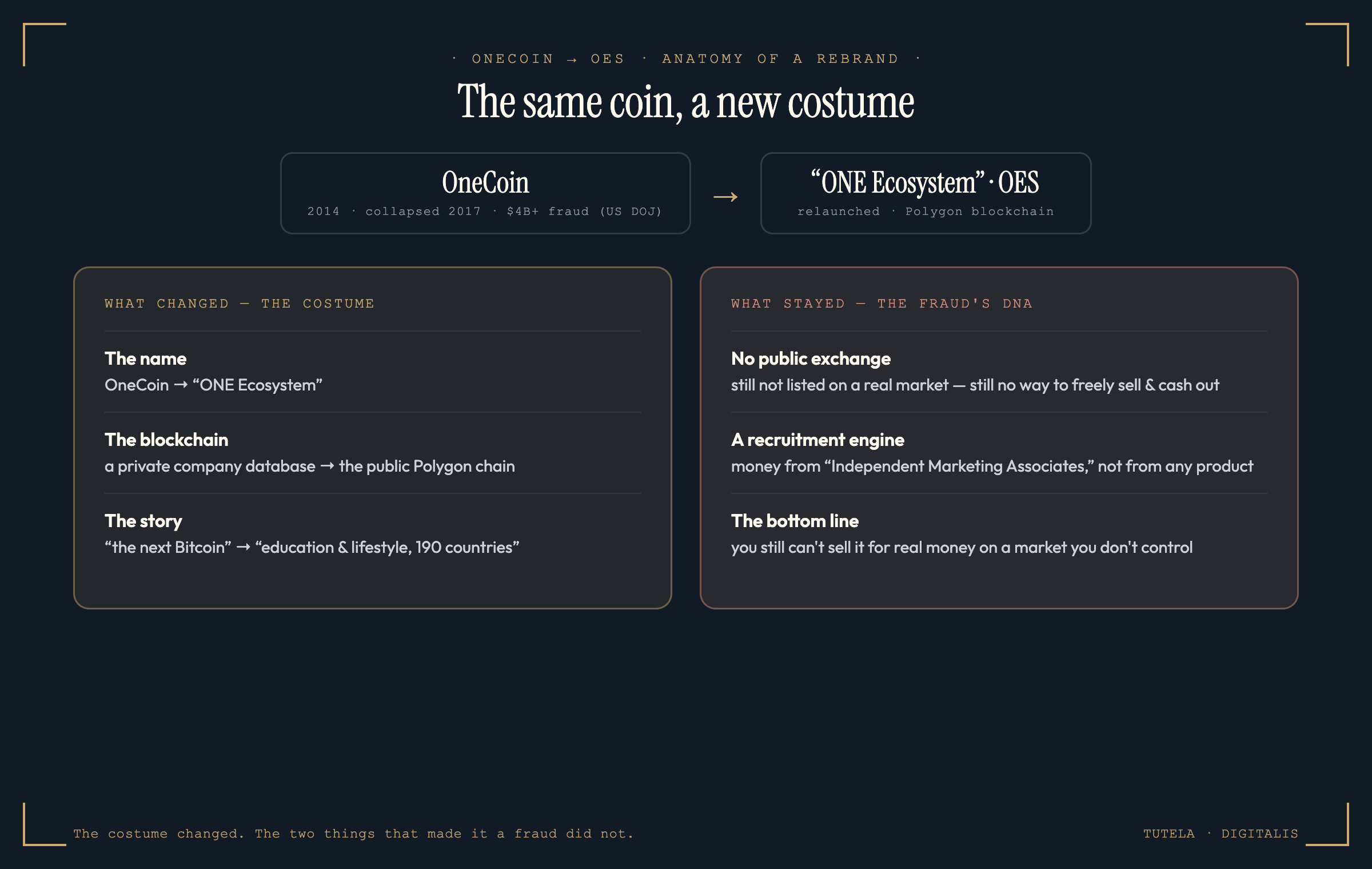
What changed — the costume:
What stayed — the fraud's DNA:
Why a dead scam comes back instead of paying you back
When a scheme like OneCoin collapses, it doesn't lose everything. It keeps three assets: a list of people who already believed once, a brand its promoters are emotionally and financially invested in, and a network of recruiters who need the story to still be true. A rebrand monetises all three at once — which is exactly why relaunching is more profitable than refunding.
That's also why “is it still active?” and “is the new coin real?” are the wrong first questions. The right one is narrower and harder to spin: has anything that made the original a fraud actually been fixed? With OES, the two load-bearing frauds — no open market to sell on, and returns funded by recruitment rather than a product — are untouched. This is the same machinery we take apart in the scammer's sales playbook: the “relaunch” is just the retention program.
If you hold OneCoin or OES
The U.S. Department of Justice ran a legitimate, free remission process for OneCoin victims worldwide; its claim deadline was 30 June 2026, so that specific window has closed. And if you're still weighing whether OneCoin is somehow “coming back” or whether OES is the real thing after all — we answer that here. If in doubt about falling for it, read this too: this was engineered, and being taken in is not a failure of intelligence.
Pitched a “reborn” coin, or a OneCoin/OES “recovery”? Check it before you act.
Paste the coin, the website, or the “agent” who contacted you. A real expert reviews every case and replies within 24 hours. Free, confidential, no pressure.
Common questions about OES coin
What is OES coin?
OES — the “ONE” token from a project called “ONE Ecosystem” — is the rebrand of OneCoin, the fake cryptocurrency U.S. prosecutors describe as one of the largest fraud schemes ever charged, with worldwide losses the Department of Justice puts at more than $4 billion. After OneCoin collapsed and its founder vanished, the same coin was relaunched under a new name, a new website (oneecosystem.eu) and a new story about “education, e-commerce, travel and beauty.” The packaging is new; the coin's origin is a $4 billion fraud.
Is OES the same as OneCoin?
Yes — OES is OneCoin rebranded. The OneCoin brand became “ONE Ecosystem,” and the coin became the “OES” (ONE) token, now issued on the public Polygon blockchain instead of the private company database OneCoin admitted to running. The link between them is openly documented, including on OneCoin's own Wikipedia entry. The name and the chain changed; the lineage did not.
Is ONE Ecosystem legit?
ONE Ecosystem markets itself as a legitimate blockchain company spanning 190 countries. But the two features that made its predecessor OneCoin a fraud are still in place. By its own promoters' description, the OES token is not listed on any public exchange — so there is no independent market and, for most holders, no straightforward way to sell and cash out. And the money is still made by recruiting other people (“Independent Marketing Associates”), the classic multi-level-marketing shape, rather than from any product. We are not calling the new packaging a new crime; we are pointing out that nothing that made the old coin a fraud has actually been fixed.
Can I sell or withdraw OES for real money?
By the account of its own promotional materials, OES is not listed on a public exchange, which means there is no open market setting its price and no simple way for ordinary holders to sell it and withdraw real money. That is the single most important test for any coin sold to you: can you independently sell it, on a market you don't control, and walk away with the cash? For OneCoin the answer was no. For OES, by its promoters' own account, the answer is still no.
I have OneCoin or OES — can I get any money back?
There was one legitimate, free route: a U.S. Department of Justice remission process that returned recovered funds to eligible OneCoin victims worldwide. Its claim deadline was 30 June 2026, so that specific window has now closed — our OneCoin compensation guide has the detail. Be very careful of the second wave of fraud that follows every compensation story: fake “recovery agents” and “asset-recovery lawyers” who promise to unlock a payout for an upfront fee. A real recovery process never charges you and never cold-calls you. Treat any unsolicited recovery offer as the next scam.
Sources & further reading
Claims in this piece are attributed to these sources. Click any of them to verify.