Smart people fall for scams because scams don't target intelligence — they target emotion. Fear, urgency, greed, love, and hope run on a faster, older part of the brain than careful reasoning, and once one is switched on it bypasses the analysis a smart person would normally do. Lab studies show that heightened emotional arousal raises susceptibility to fraud regardless of age or IQ. Fraud researchers at the FBI, FINRA, and Cambridge agree the levers are human, not intellectual — and that reducing fear and shame protects people more than simply listing red flags.
Read the image explanation
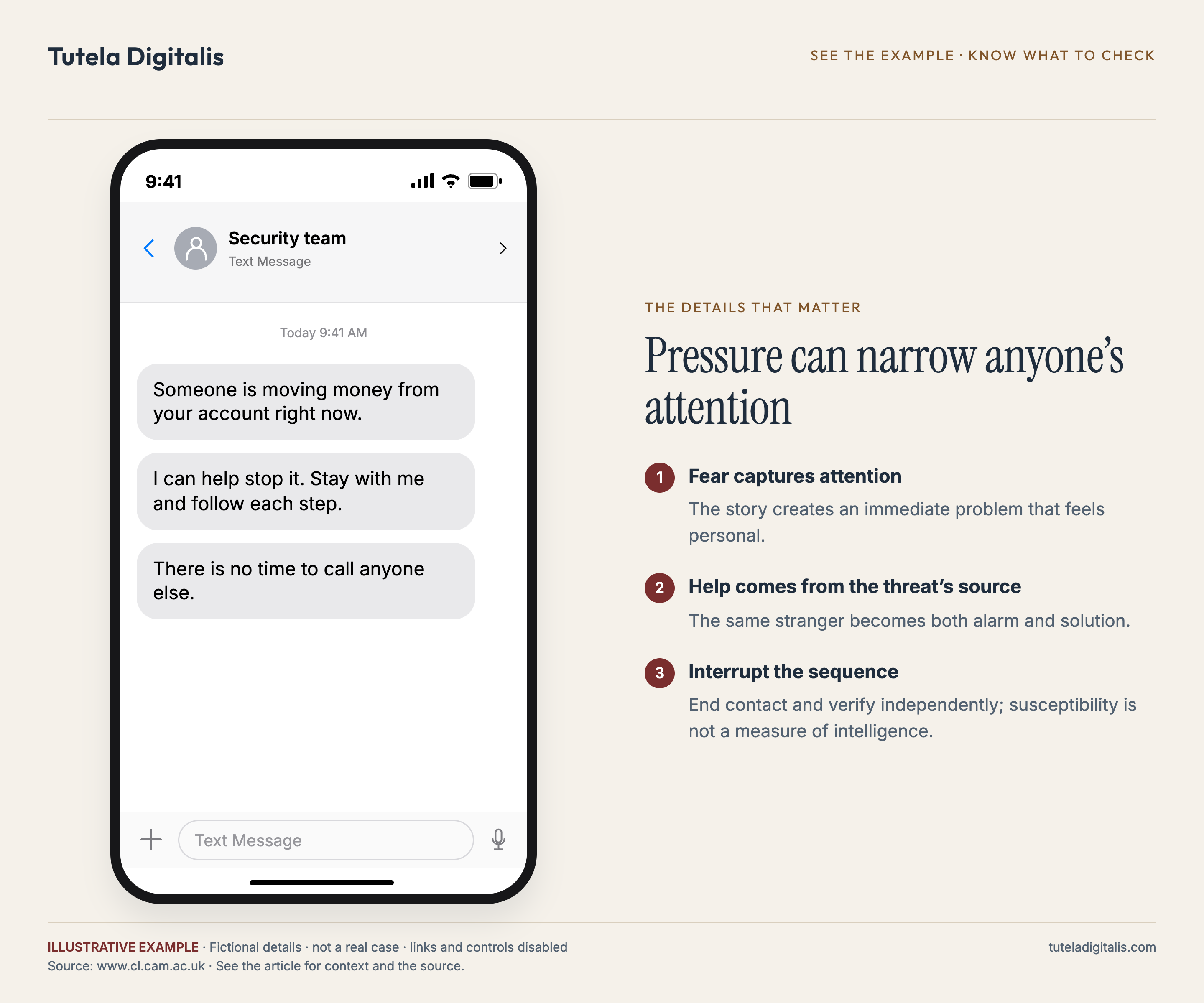
Illustrative example: Someone is moving money from your account right now. I can help stop it. Stay with me and follow each step. There is no time to call anyone else.
- Fear captures attention. The story creates an immediate problem that feels personal.
- Help comes from the threat’s source. The same stranger becomes both alarm and solution.
- Interrupt the sequence. End contact and verify independently; susceptibility is not a measure of intelligence.
"[An] understanding of these inherent 'human factors' vulnerabilities, and the necessity to take them into account during design rather than naïvely shifting the blame onto the 'gullible users', is a fundamental paradigm shift."
— Frank Stajano (University of Cambridge Computer Laboratory) and Paul Wilson, "Understanding Scam Victims: Seven Principles for Systems Security," Communications of the ACM (2011). The Cambridge study reframed scam victims as ordinary people exploited through universal human tendencies — not as careless or gullible.
Let me say the quiet part first, because the whole piece depends on it: you are not safe because you are smart. I've spent a long time studying how these operations actually work — close enough to build one, which is precisely why I write the other side of it — and the single most dangerous belief a person can hold is "I'd never fall for that." It's dangerous because it's the exact blind spot the work is designed to walk through.
The scam was never a test of your intelligence. It's a test of your attention, your emotional state, and your situation on one particular day. Get the timing right — a job you need, a relationship you want, a fear you already carry, a payoff you've been hoping for — and the cleverest person in the room presses Send like everyone else.
The comfortable lie: that only gullible people get scammed
The belief that fraud is a stupidity problem is everywhere, and it survives because it does a job: it lets the rest of us feel inoculated. If victims are careless and I am careful, then I'm fine. The research dismantles this completely. Susceptibility to scams tracks context — stress, distraction, loneliness, time pressure, a moment of hope or panic — far more reliably than it tracks IQ, income, or education.
Worse, intelligence can cut the wrong way. A smart person is exceptionally good at one thing in particular: constructing a sophisticated, satisfying reason for a decision they've already been emotionally steered toward. The same mental horsepower that solves hard problems also builds elegant justifications for a "guaranteed" return or an "urgent" transfer. The clever mind doesn't ask "is this real?" — it asks "how could this be real?" and then, being clever, finds an answer.
What scams actually target: five emotional levers
If fraud doesn't aim at intelligence, what does it aim at? The financial regulator FINRA, working with AARP, studied the persuasion behind real investment fraud and isolated five recurring levers. They are worth knowing by name, because naming the move is most of the defence.
Notice what every one of these has in common: not one of them is an argument. They don't try to convince the reasoning part of you — they try to switch it off by raising your emotional temperature until you act on feeling. And this isn't folklore. Researchers at the University of Cambridge who documented hundreds of real-world frauds concluded the underlying principles are rooted in human nature and were exploited for centuries before computers existed. In a controlled study, simply putting people into a heightened emotional state — excited or angry — measurably increased their willingness to act on misleading offers, across age groups. The lever is the emotion. The con is just the handle.
The part nobody says out loud: the second wound is shame
Here is where most articles stop, and where the truth actually lives. The money is the first wound. The second wound — the one that does the lasting damage and shapes everything that happens next — is shame.
People who've been defrauded often can't say it out loud. Not to the police, not to their family, sometimes not even to themselves. The ego cannot file the sentence "I fell for it." So the loss goes unreported: law-enforcement researchers estimate only a few percent of victims ever report, and the FTC reckons only around one scam in ten reaches it. That silence isn't a footnote — it's why the real scale of fraud stays hidden, and why the person next to you is just as unprepared as you were.
And shame doesn't just hide the crime. It sets up the next one. A person sitting in silence, desperate to undo what happened and unable to ask for help, is the perfect target for the recovery scam — the second predator who promises to get the money back for a fee. The shame is the door the recovery scammer walks through. Which means killing the shame isn't comfort. It's prevention.
Why "just be more aware" mostly fails, and what actually works
If you've ever sat through a fraud-awareness talk and thought "I already know all this," you've felt the problem with how scam prevention is usually done. Information is not the bottleneck. Study after study finds a gap between knowing the warning signs and acting on them in the moment — propped up by optimism bias, the deeply human "it won't happen to me" that lets us file every risk we understand under other people. You can recite the red flags and still freeze when the call comes, because the call doesn't arrive as a quiz. It arrives as an emotion.
So what does work? The research points somewhere specific and, honestly, somewhere most awareness campaigns avoid: reducing fear and shame, and building a person's belief that they can handle the moment. In one study of scam-prevention messaging, piling on more information did not improve people's ability to judge risk — but lowering their fear and raising their sense of "I've got this" did. People who feel capable and unashamed catch scams that people armed with a longer checklist miss.
AI didn't change the trigger, it just scaled the wrapper
Every era believes its scams are uniquely dangerous, and right now the fear is artificial intelligence — the cloned voice of your child, the deepfaked video of your CEO, the flawless phishing email with no clumsy grammar to give it away. The fear is justified: AI makes scams cheaper, faster, and far more convincing, and the losses are climbing.
But here's the part that should make you feel less helpless, not more. AI hasn't invented a new way to fool you. It has industrialised an old one. The emotional levers — fear, urgency, greed, love, authority — are the same ones the Cambridge researchers traced back through centuries of cons run with nothing but a confident voice. AI scales the wrapper: the realism, the volume, the personalisation. It does not change the trigger. Which means the defence doesn't go obsolete either — because a defence built on recognising the emotion still works no matter how perfect the voice on the other end sounds.
How to actually protect yourself, when intelligence isn't the tool
You don't beat this by being smarter than the scammer. You beat it with a few habits that work because they don't rely on you out-thinking anyone in the moment. This is the whole defence:
So, why do smart people fall for scams?
Because "smart" was never the relevant trait. Scams are built by people who understand that under the right emotional pressure — the right fear, the right hope, the right urgency, on the right bad day — the reasoning mind steps aside and the feeling mind signs the cheque. That's not a flaw in unintelligent people. It's a feature of all people. The fraudsters know it cold. The institutions are slow to admit it. And the awareness industry keeps handing out longer checklists to a problem that was never about information.
If you take one rule from this whole piece, take this: the moment a message makes you feel something strong and time-pressured, that feeling is not a reason to act — it's the alarm telling you to stop. You don't have to be the smartest person in the exchange. You just have to be the one who pauses.
Not sure about something right now? Run it past a human before you act.
If a message, call, or offer has you feeling rushed, describe it in a free case review and a real expert replies within 24 hours — no fee, no judgement, nothing to sell. The whole point is to give you the pause the scammer is trying to take away.
Common questions about why people fall for scams
Why do smart people fall for scams?
Because scams don't target intelligence — they target emotion. Fear, urgency, greed, love, and hope all run on a faster, older part of the brain than careful reasoning, and once one of them is switched on it interrupts the analysis a smart person would normally do. Lab research has shown that simply putting people into a heightened emotional state — excitement or anger — makes them more likely to act on a misleading pitch, regardless of age or education. Intelligence is not a shield because the attack never goes through the part of you that's intelligent. It goes around it.
Does being educated or wealthy protect you from scams?
No — and in some ways it works against you. Educated and high-earning people are not less likely to be defrauded; they're often targeted precisely because they have more to lose and more confidence in their own judgment. That confidence becomes a liability: a smart person is very good at building a sophisticated reason to justify a decision they've already been emotionally led toward. The belief 'I'm too smart to be scammed' is itself one of the most reliable predictors that someone will not spot the moment it's happening.
What emotions do scammers actually target?
The financial regulator FINRA, with AARP, identified five recurring persuasion levers behind fraud: phantom riches (the dangled big payoff), source credibility (a fake but convincing authority), social consensus (everyone else is doing it), reciprocity (a small gift that makes you feel you owe something back), and scarcity (act now or lose it). Every one of them is designed to raise emotional arousal so you act before you evaluate. Researchers at the University of Cambridge who catalogued hundreds of real frauds found the same thing: the levers are rooted in human nature, and were used for centuries before computers existed.
Why don't scam victims report what happened?
Shame. The financial loss is the first wound; the inability to admit it is the second, and it's often the heavier one. Estimates suggest only a small fraction of fraud is ever reported — law-enforcement researchers put it as low as a few percent of victims, and the FTC estimates only around one in ten scams reaches it. People stay silent because they're embarrassed, because they assume no one will take a small loss seriously, or because reporting means reliving it. That silence has a cost beyond the individual: it hides the true scale of fraud and leaves the next person just as unprepared.
Does scam-awareness training actually work?
Less than you'd hope, if it only delivers information. Studies repeatedly find a gap between knowing the warning signs and acting on them, driven partly by optimism bias — the 'it won't happen to me' belief that makes people discount risks they intellectually understand. What the research does find effective is different: reducing fear and shame, and building a person's sense that they can handle the moment. People who feel capable and unashamed spot and stop scams better than people who've simply been shown a longer list of red flags. That's why good fraud education works on the emotions, not just the facts.
Are older people more likely to fall for scams?
It's more complicated than the stereotype. Older adults report the largest dollar losses — the FBI found Americans over 60 lost roughly $7.7 billion in 2025 — because they often have more savings within reach. But by complaint volume, younger and working-age people report being scammed in very large numbers too, just for smaller amounts on different scam types. Vulnerability tracks life circumstance and emotional state — isolation, a job search, a health scare, a new relationship — far more reliably than it tracks age. Anyone, in the wrong moment, is a potential target.
Sources & further reading
Every claim in this piece is drawn from these authorities. Click any of them to verify.