Scam victims are not fooled so much as researched: the operation knew roughly your age, what you have, what you fear losing and what you still hope for before you knew it existed, then picked the story that fit. What it sold was not a lie but a want you already had — which is why intelligence is no defense, and why the aftermath turns into self-blame: everything on their side was manufactured, everything on yours was real. That engineered shame is why an estimated 15% of victims report the crime (Dr Elisabeth Carter, in written evidence to a UK Parliament committee) — and an unreported victim is what the industry calls a warm lead. The loop ends with one private sentence: I got it wrong — said to yourself, before anyone else.
Read the image explanation
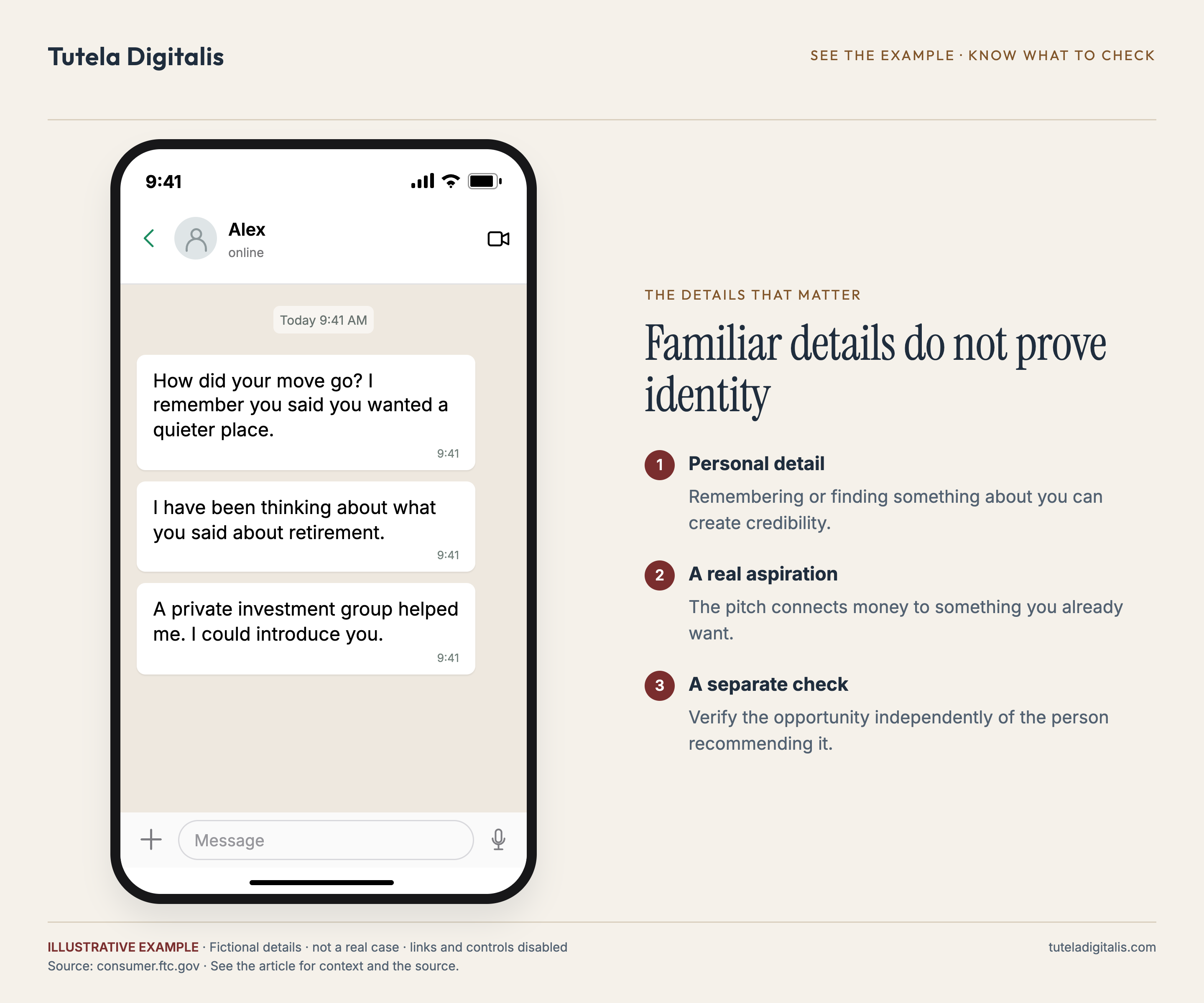
Illustrative example: How did your move go? I remember you said you wanted a quieter place. I have been thinking about what you said about retirement. A private investment group helped me. I could introduce you.
- Personal detail. Remembering or finding something about you can create credibility.
- A real aspiration. The pitch connects money to something you already want.
- A separate check. Verify the opportunity independently of the person recommending it.
What they actually sold you
Nobody wakes up wanting to be scammed.
People wake up wanting their kids to have it easier. Wanting to stop being tired at fifty-five. Wanting someone to text them good morning. Wanting to be the person their family calls when something goes wrong.
That is what got sold. Not a lie — a want you already had.
The investment scam does not sell you a token. It sells you the version of your life where money stops being the thing you stare at the ceiling about. The romance scam does not sell you a person. It sells you being understood, on an ordinary Tuesday, by someone who has time for you. The impersonation scam does not sell you a fake bank or a fake grandson. It sells you the chance to be needed by someone who matters, right now, before it is too late.
Read that list again and find the stupidity in it.
It is not there. Those are the wants of a functioning human being. That is precisely why it worked.
"Users fall prey to these principles not because they are gullible but because they are human."
— Frank Stajano (University of Cambridge Computer Laboratory) & Paul Wilson, "Understanding Scam Victims: Seven Principles for Systems Security," Communications of the ACM. They documented hundreds of real frauds and found almost all reduce to a handful of principles — exploited, in their words, for centuries before computers were invented.
Nothing was a coincidence
Here is the part nobody says out loud, and the part that will sit badly with you.
They knew something about you before you knew anything about them.
Not everything. They do not need everything. They need enough — roughly how old you are, roughly what you have, what you are afraid of losing, what you are still hoping for. Then they pick the story that fits the opening, and they run it when you are tired, or alone, or already worried about the thing they are about to mention.
I sell for a living. That is why I can tell you this flatly rather than as a theory: nobody in this business improvises. You do not manufacture wanting by getting lucky. You find out what a person already wants, and then you stand between them and it. The difference between my job and theirs is what is on the other side of the yes. The craft is identical.
"The tactics used by fraud criminals, aligned as they are with tactics of coercive control and domestic abuse, are designed to not be obvious and crucially, to not cause alarm."
"This isn't about victims being naïve — it's about fraudsters being skilled."
— Dr Elisabeth Carter, Associate Professor of Criminology and Forensic Linguist, Kingston University London. First line from her written evidence to a UK Parliament committee (FRA0075); second from an Aston University release on her romance-fraud research, April 2025.
So when you go back over it looking for the moment you should have known — stop. You are auditing your own performance in a situation that was built by someone who rehearsed.
The catch
Everything on their side was manufactured.
Everything on your side was real.
You were not robbed. You participated. You typed it in. You approved it. You may have sat across from someone who told you it smelled wrong and defended it to their face — because by then it was yours. Your read. Your call. Your decision.
That is the part that wrecks people, and it is not the money.
A mugging leaves you angry at somebody else. This leaves you looking at your own judgment and genuinely not knowing whether you can stand on it again. They did not just take what you had. They used you to take it, and then they left you holding the receipt with your own signature on it.
After that, it gets easier for them
Something load-bearing goes.
You stop trusting the one instrument you use for everything — your own read of a situation. And a person who cannot trust their own read is easy to move. Not because they got dumber. Because the thing they would normally push back with is the exact thing that just failed in public.
That is why the second call comes. Not from nowhere. From people who know precisely what state you are in, because that state is the predictable output of the first one.
The recovery man is not a new scam. He is the same business, working a warm lead.
(If you are in this right now — if money moved in the last day or two, or the "recovery" call has already come — deal with the clock first: what to do in the first hours. This page will still be here.)
Why it happened again
And here is the honest answer to the question everyone asks in the wrong tone.
You did not get hit twice because you failed to learn. You got hit twice because admitting the first one means convicting yourself. It means saying that you were wrong, out loud, about something that mattered. So instead you stay in it. You send the next payment. You take the next call. Anything that keeps the verdict open.
Silence feels like protection. It is the opposite. Every hour you cannot say it is another hour you are the most qualified lead they have.
Shame is not a side effect of this industry. It is the security system.
Dr Elisabeth Carter told a UK Parliament committee that an estimated 15% of victims report the crime. Fifteen. She names the stigma as one of the causes.
So the number you see in every headline is not the size of this thing. It is the size of the part people could bear to admit.
"There is a strong sense of shame, embarrassment and stigma associated with online fraud victimisation. The level of victim blaming that currently exists means that victims are reluctant to disclose to those around them, for fear of how they will react."
"For many, this fear is justified... This can include isolation from family and friends, and in some cases, being denied access to grandchildren (for older victims) and being disowned by family members."
— Dr Cassandra Cross, Queensland University of Technology, submission to the Victorian Law Reform Commission, 2021. In the same document: fraud victims "are not seen to be victims, and are not seen to be deserving of recognition or practical support to move forward."
That is why so little of it gets counted, and why so many of the people running it never have to be careful.
The part nobody wants to read
There is no trick for this one. No checklist. No ten warning signs. Nothing you can print and put on the fridge.
And that is not me being bleak. That is the finding.
"Most public-facing fraud campaigns are created on the foundation of the public spotting the 'red flags' and 'alarm bells' to keep themselves safe from fraud."
"There is a fundamental organisational misunderstanding of fraud... that leads officers and wider practitioners in the fraud space to inadvertently leave the public overinformed and under protected."
— Dr Elisabeth Carter, written evidence to a UK Parliament committee (FRA0075). She also states the public "are arguably the most informed they ever have been in terms of fraud," while the crime "continues to claim victims on what has been termed 'an epidemic level'."
The only thing that ends the loop is the sentence you have been walking around for months.
I got it wrong.
Not to your bank. Not to the police. Not to your children, and not to whoever told you so.
To yourself. Alone, with nobody watching, no explanation attached and no version of the story where it was mostly somebody else's fault.
That is the hardest thing in this entire subject. And every awareness campaign you have ever seen will go on treating it as the easy part, because the alternative is admitting what this was actually built out of.
The problem was never your intelligence.
You wanted something ordinary. Professionals got there first.
So say it once, out loud, to the only person who was actually in the room.
Then you stop being a warm lead.
If money moved recently, the clock matters more than the shame.
The emergency triage tool sorts what to do by how the money or information left — bank, card, app, gift card, crypto, login — in the order the first hours demand. Free, no signup, nothing stored.
Common questions about scam shame and self-blame
Why do scam victims blame themselves?
Because everything on the victim's side of a scam was real — the typing, the approving, the defending of the decision to people who doubted it — while everything on the scammer's side was manufactured. That asymmetry is engineered. Dr Elisabeth Carter, the UK's leading scholar of romance-fraud interaction, told a UK Parliament committee that fraud tactics are aligned with the tactics of coercive control and domestic abuse: designed to not be obvious and, crucially, to not cause alarm. You cannot fairly audit your own performance in a situation that was built by someone who rehearsed. The self-blame feels like accountability; in fact it is part of what was taken.
Why don't most scam victims report the crime?
Shame — and the evidence says the shame is rational, not oversensitive. Dr Elisabeth Carter told a UK Parliament committee that an estimated 15% of victims report the crime, and names the stigma around fraud victims — depicted as greedy, gullible, or unable to protect themselves — as a contributor to underreporting. Dr Cassandra Cross's submission to the Victorian Law Reform Commission documents what victims fear: victim-blaming so strong that disclosure can mean isolation from family and friends, being denied access to grandchildren, or being disowned. The headline fraud numbers you see are therefore not the size of the crime — they are the size of the part people could bear to admit.
Is it my fault I got scammed?
No — and that is a research finding, not a consolation. Cambridge researchers Frank Stajano and Paul Wilson, after documenting hundreds of real frauds, concluded that people fall prey 'not because they are gullible but because they are human.' What a scam sells is a want you already had — security for your family, being understood, being needed — and the operation researched you before you knew it existed: roughly your age, what you have, what you fear losing, what you still hope for. The story, the timing, and the voice were chosen to fit. As Carter puts it: this isn't about victims being naïve — it's about fraudsters being skilled.
Why did a second scam call come after the first one?
Because the aftermath of a first scam produces a predictable state — a person who no longer trusts their own judgment, and who may not have told anyone yet — and that state is valuable. The follow-up contact, often a 'recovery' service promising to get the money back, is not a new scam; it is the same business working a warm lead. Silence is what keeps the lead warm: every day the first scam stays unsaid is a day the second one has room to work. The single move that breaks the loop is admitting the first one — to yourself before anyone else — because a person who has said it out loud is no longer workable.
Sources & further reading
Every quote and the one statistic in this piece link to the primary source. Click any to verify.