The same complaint, to different institutions, ends differently
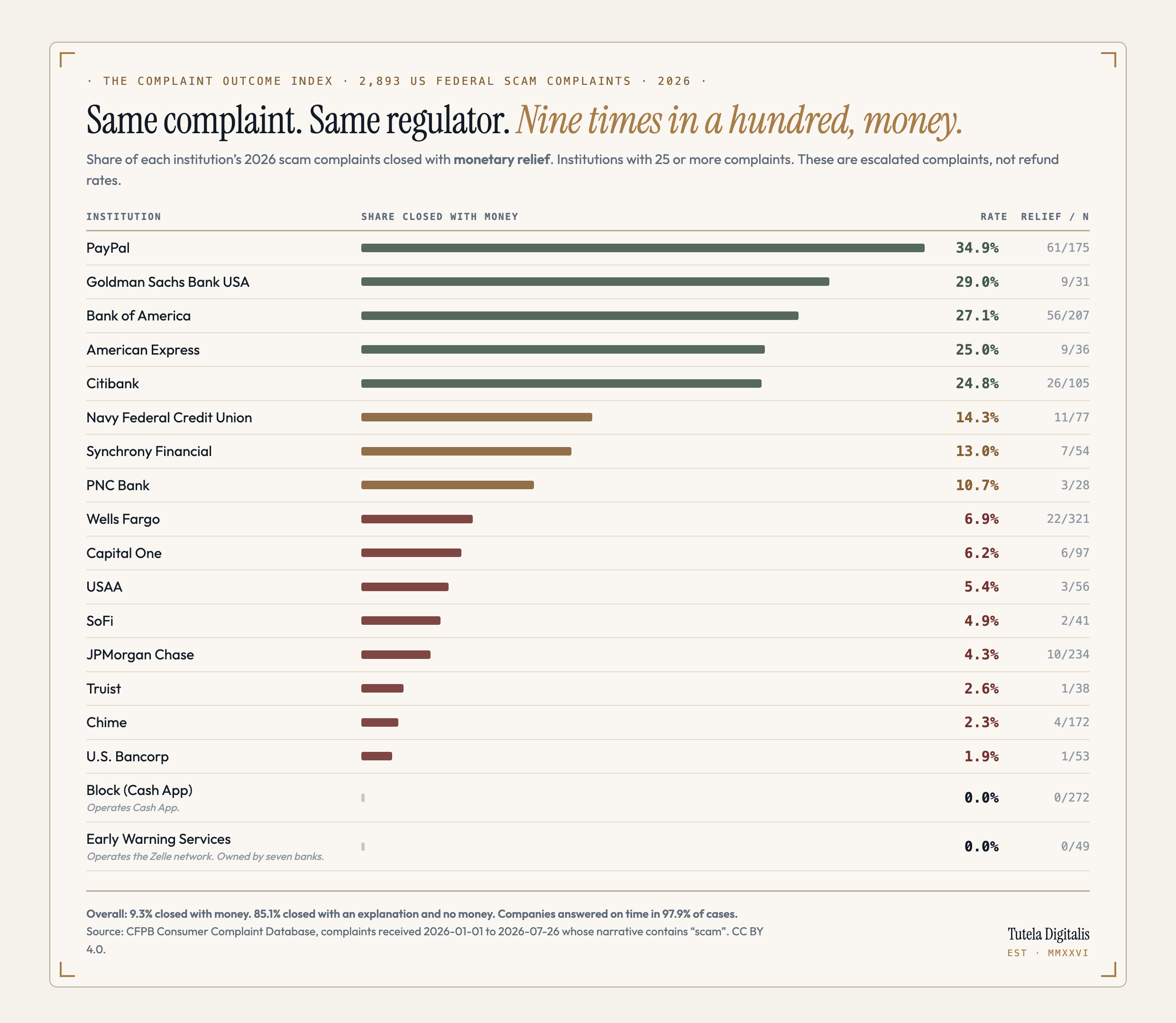
Everyone in this table is answering the same kind of complaint, through the same federal process, under the same rules. PayPal closed 34.9% of its 175 with money. Block (Cash App) closed 272 of them and recorded monetary relief in none. That gap is not a rounding difference and it is not a small-sample artefact: Block (Cash App) recorded relief in none of its 272, more complaints than the 175 at the top of the table. 2 institutions here closed no complaint with money.
| Institution | Relief rate | Relief / complaints | Answered on time |
|---|---|---|---|
| PayPal | 34.9% | 61 / 175 | 100.0% |
| Goldman Sachs Bank USA | 29.0% | 9 / 31 | 96.8% |
| Bank of America | 27.1% | 56 / 207 | 98.1% |
| American Express | 25.0% | 9 / 36 | 100.0% |
| Citibank | 24.8% | 26 / 105 | 100.0% |
| Navy Federal Credit Union | 14.3% | 11 / 77 | 100.0% |
| Synchrony Financial | 13.0% | 7 / 54 | 98.1% |
| PNC Bank | 10.7% | 3 / 28 | 100.0% |
| Wells Fargo | 6.9% | 22 / 321 | 100.0% |
| Capital One | 6.2% | 6 / 97 | 100.0% |
| USAA | 5.4% | 3 / 56 | 100.0% |
| SoFi | 4.9% | 2 / 41 | 100.0% |
| JPMorgan Chase | 4.3% | 10 / 234 | 100.0% |
| Truist | 2.6% | 1 / 38 | 100.0% |
| Chime | 2.3% | 4 / 172 | 100.0% |
| U.S. Bancorp | 1.9% | 1 / 53 | 100.0% |
| Block (Cash App)Operates Cash App. | 0.0% | 0 / 272 | 99.6% |
| Early Warning ServicesOperates the Zelle network. Owned by seven banks. | 0.0% | 0 / 49 | 100.0% |
“Relief rate” is the share of that institution’s scam complaints that the CFPB records as closed with monetary relief. It is not a refund rate. These are complaints that already escalated to a federal regulator, so people who were refunded at first contact are not in this data at all.
The obvious explanation is wrong, and we checked before publishing
Early Warning Services operates the Zelle network and is owned by seven banks. The tempting story is that those banks are the ones stiffing victims. We tested it, because it is the first thing a reader would assume, and it is false.
The owner banks sit marginally above the rest of the market, not below it. The spread between institutions is real and large, and it has nothing to do with who owns Zelle. We are publishing that because it is what the data says, not because it is the better headline.
Complaining about the network got nobody anywhere
49 people directed their complaint at Early Warning Services itself rather than at the institution holding their account. Every one was answered, 100% of them on time, and not one produced any remedy at all, monetary or otherwise.
We are not going to tell you that means the network refused to pay. Early Warning operates the rails and does not hold your account, so it may be structurally unable to issue a refund rather than declining one. This data cannot tell those apart, and we are not going to pretend it can.
What it does tell you is practical: send your complaint to the institution that holds your money. Naming the network instead produced nothing, 49 times out of 49.
For the record, and because it is the context most readers will want: the Consumer Financial Protection Bureau sued Early Warning Services, Bank of America, JPMorgan Chase and Wells Fargo on 20 December 2024 over how fraud on Zelle was handled. The Bureau moved to dismiss on 4 March 2025 and the court dismissed the case with prejudice on 5 March 2025. Every complaint in this index was received after that. We are reporting the sequence, not claiming one caused the other.
Nothing here is broken. That is the problem.
It would be easier if the complaint system were failing on paperwork. It is not. Companies answered within the required time in 97.9% of cases. Deadlines are met, responses are filed, boxes are ticked.
Responding is not the same as paying, and the process only measures the first. An explanation closes a complaint just as cleanly as a refund does. 85.1% of people got one.
The rail your money left on matters more than what you say
Split the same complaints by the product involved and the pattern is immediate.
A credit card complaint closed with money 18.7% of the time. A money transfer closed with money 9% of the time. The difference is not effort or credibility, it is law: card payments carry chargeback rights, and a transfer you were deceived into authorising generally does not carry an equivalent right. Our Scam-Refund Index covers how that line is drawn country by country.
One line in this data stopped us. 90 people could not name which product they had lost money on. Their complaints were filed under “I do not know”. Not one of them closed with money. Zero out of 90. The people least able to describe what happened to them got the least back, and no institution had to do anything wrong for that to be true.
The same shape shows up in who was affected. Complaints tagged as coming from servicemembers closed with money 7.3% of the time, the lowest of any group in the data, against 14.2% for older Americans.
One thing we will not do is tell you to file under a different category to improve your odds. The label on the complaint and the product involved are tangled together in this data and we cannot separate them, so advising you to relabel would be advice we cannot support. Describe what actually happened.
How to check every number on this page
This index is built entirely from the CFPB Consumer Complaint Database, which is public and free. We took every complaint received in 2026 whose consumer narrative contains the word scam, 2,893 records covering 2026-01-01 to 2026-07-26, and grouped them by the company_response field. Every figure here is the share equal to Closed with monetary relief.
Update, 17 September 2026: this count can no longer be re-run from the live database. On 14 August 2026 the CFPB announced it would cease publishing complaint narratives. Our pull ran on 16 August and the narrative field still answered; on 17 September the public API rejects that field as not a valid choice, for every period including the one this index covers. The Bureau says previously published narratives remain in the public domain through its FOIA Reading Room. The figures on this page, and the DOI-archived table, are therefore a fixed record of the last narrative-based count, not a live query anyone can repeat.
Two things went wrong when we did it, and both will happen to anyone who repeats it from the archived data:
- The API caps its results and silently ignores the offset parameter. Requesting successive pages returns the same records again. Partition by month and check each slice against its own reported total, or you will triple your counts without any error appearing.
- Match the response field exactly. A substring match on the word monetary also catches Closed with non-monetary relief and inflates the headline from 9.3% to 13.9%. We made that mistake first.
The index is published under CC BY 4.0. Cite it, republish the tables, or rebuild it yourself and check our work. Journalists who want the derived dataset or a cut we have not published can write to press@tuteladigitalis.com.
The derived dataset is archived with a permanent DOI, so it stays citable and resolvable independently of this site: 10.5281/zenodo.22068759 (CSV + JSON + methodology, 1.0.2). That is a concept DOI, so it always resolves to the newest version rather than pinning to one deposit. The deposit carries derived aggregates only: no complaint narratives, complaint identifiers, ZIP codes or states are republished, and the underlying records stay with the CFPB.
Suggested citation: Tutela Digitalis (2026). The Tutela Digitalis Complaint Outcome Index (Version 1.0.2) [Data set]. Zenodo. https://doi.org/10.5281/zenodo.22085035
What this index does not show
- These are not refund rates. A federal complaint is a second line of escalation. Anyone refunded when they first contacted their bank never appears in this data, so a low figure can reflect who escalates as much as who pays. The comparison between institutions holds because every one of them is measured on that same route.
- “None recorded” means none recorded here. Where an institution shows zero, it means no complaint in this set was closed with monetary relief in the public record. It does not mean that company never refunds anyone.
- We do not use complaint volume as a fraud measure. Publication volumes to this database changed substantially during 2026 for reasons unrelated to fraud, so counts over time measure the pipe rather than the crime. We report shares within the window and no trend.
- The window is 2026-01-01 to 2026-07-26. Monthly relief rates inside it move between roughly 6% and 12% with no direction we can defend as a trend.
Common questions
Which banks refund scam victims most often?
In this index of 2893 federal scam complaints, PayPal closed the highest share with monetary relief at 34.9%, followed by Goldman Sachs Bank USA, Bank of America, American Express and Citibank, all above 24%. At the other end, Block (Cash App) closed 272 scam complaints with monetary relief in none of them, and U.S. Bancorp recorded 1.9%. Important: this is not a refund rate. These are complaints that already escalated to a federal regulator after the company had been contacted, so anyone refunded at first contact never appears here.
How often do scam victims actually get their money back through a federal complaint?
Across all 2893 complaints in this index, 9.3% closed with monetary relief. 85.1% closed with an explanation and no money. The striking part is that the process itself is not breaking down: companies answered on time in 97.9% of cases. Responding on time and paying are two different things, and the complaint system only measures the first.
Does the payment method change whether you get money back?
It is the single clearest pattern in the data. Complaints about a credit card closed with monetary relief 18.7% of the time, against 9.2% for checking or savings accounts and 9% for money transfers and virtual currency. Card payments carry chargeback rights under Regulation Z. A transfer you authorised yourself generally does not carry an equivalent right. The legal category of the payment, not the honesty of the victim, does most of the work.
Do the banks that own Zelle refund less often than other companies?
No, and we checked specifically because it is the obvious assumption. The seven banks that jointly own Early Warning Services, the operator of the Zelle network, closed 10.1% of their scam complaints with monetary relief. Every other company in the index closed 9.1%. The owner banks are marginally above the rest of the market, not below it. The wide spread between institutions is real, but it is not explained by who owns Zelle.
What happened to the CFPB lawsuit over Zelle?
The Consumer Financial Protection Bureau filed suit on 20 December 2024 against Early Warning Services, Bank of America, JPMorgan Chase and Wells Fargo, alleging unfair practices and violations of the Electronic Fund Transfer Act and Regulation E in how fraud on Zelle was handled. The Bureau filed a notice of voluntary dismissal on 4 March 2025 and the court dismissed the case with prejudice on 5 March 2025, meaning it cannot be brought again. The complaints in this index were all received after that date.
How can I check these numbers myself?
Every figure comes from the CFPB Consumer Complaint Database, which is public. Take all complaints received in 2026 where the consumer narrative contains the word scam, then group by the company_response field and count the share equal to Closed with monetary relief. Two warnings from doing it ourselves: the API caps results and silently ignores the offset parameter, so partition by month and check each slice against its own reported total or you will triple your counts; and match company_response exactly, because a substring match on the word monetary also catches Closed with non-monetary relief and inflates the headline from 9.3% to 13.9%. Since 14 August 2026 the CFPB no longer publishes complaint narratives, and by 17 September its public API rejects the narrative field for every period, so this count can no longer be re-run from the live database. The archived table under the DOI is the fixed record.
If this happened to you
Nothing on this page is a reason not to complain. 9.3% is not zero, and the people in the highest rows of that table were complaining to the same regulator as everyone else. If you are working out what to do next, start here.