A scam is not a trick you failed to spot — it is a sales pipeline executed by trained people: a lead list, a scripted open, qualifying questions, an emotional pitch, rehearsed objection handling, and a hard close. The FTC logged $3.5 billion in reported imposter-scam losses in 2025 — nearly triple 2020 — and says the costliest versions open with a fake bank security alert and close by convincing you to move money "to protect it." Learn the six stages and you can name the one you're in mid-conversation — which is the moment the pipeline stops working.
"Consumers derive enormous benefits from competitive markets built on truthful information. But fraud undermines that foundation, impeding the market process and preventing markets from operating efficiently."
— Christopher Mufarrige, Director, FTC Bureau of Consumer Protection — announcing the 2025 imposter-scam data, June 15, 2026. That is the regulator's framing: fraud as a market failure. Mine is blunter — fraud is a sales organization. And you don't beat a sales organization by learning to spot typos.
Here is the question I haven't seen a single bank's fraud page answer: the FTC's own numbers say the money is now lost in conversations — an imposter on a call or in a chat, walking a person stage by stage toward a transfer — so why does nearly every awareness campaign still train you on sender addresses and spelling mistakes? Typo-spotting is defense against the 2015 threat. The 2026 threat is a trained closer with a script, and the defense against a closer is knowing the pipeline he's running. Robert Cialdini catalogued the levers — authority, scarcity, reciprocity, consistency, liking, social proof — more than forty years ago in Influence. Legitimate sales floors industrialized them. Scam floors weaponized them. Same machine, different product. So let me walk you through the machine.
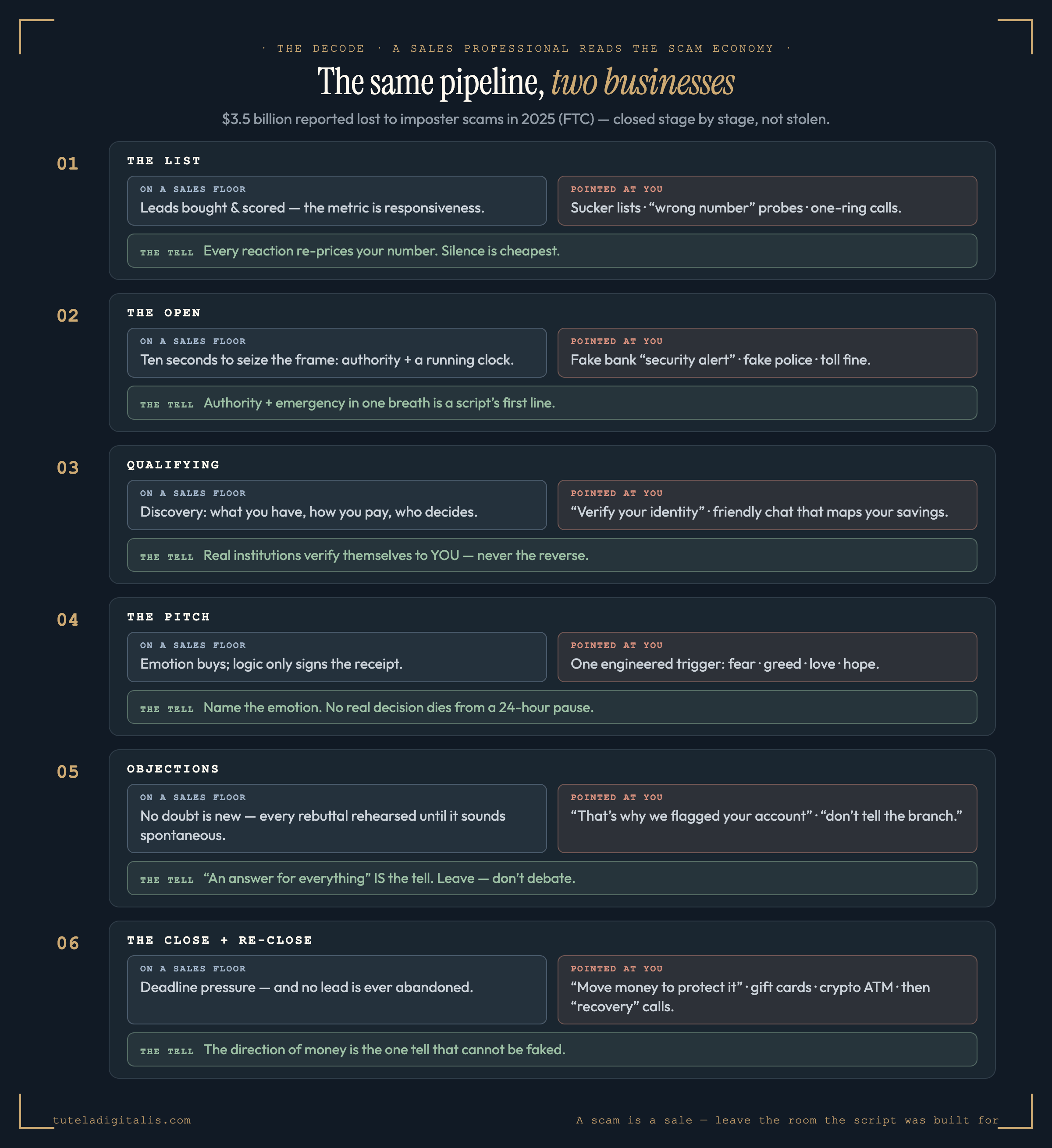
You were priced before you were contacted
No sales floor dials random numbers. Leads are bought, scored, and ranked, and the metric that matters is responsiveness — a number that answers is worth multiples of one that doesn't. Scam operations run the identical purchasing department. Victim data is packaged and resold; people who have engaged once are premium inventory. The FTC took over one million imposter-scam reports in 2025, and behind a large share of them sits a list transaction nobody saw. The infamous version is the sucker list — a roster of people who have already been scammed once, traded precisely because they responded before.
This is what the "harmless" probes are for. The wrong-number text that says "Hi, is this Anna?", the call that rings once and hangs up, the spam text with a "reply STOP" footer — none of these is the scam. They are the lead-scoring step: liveness checks that price your number for the next campaign.
The first ten seconds decide who owns the frame
Sales training is obsessive about the open, because the open decides everything: in the first ten seconds you establish who you are, why the prospect must stay in the conversation, and — the part civilians miss — whose frame the conversation happens inside. A trained open arrives carrying authority and a reason the clock is already running.
Now read the FTC's description of the costliest imposter scams of 2025: they "start with a fake security alert, often from a bank." That is a textbook open. Authority (your bank's fraud department), stakes (your money is being taken right now), and a frame you never chose (we are in an emergency, and I am the one helping you). The fake-police call runs the same open with a warrant; the toll text runs it with a fine — government-imposter reports jumped 40% in 2025, driven, per the FTC, by exactly the fake toll texts we've taken apart before. The costume rotates. The open is the same open — and I take the whole costume department apart, prop by prop, in part 3: why scammers sound official.
Friendly questions are inventory work
On a sales floor, "discovery" is the polite word for intelligence gathering. Every question maps three things: what you have, whether you can pay, and who else is involved in the decision. A rep who skips discovery pitches blind; a rep who does it well knows your objections before you raise them.
The scam version is wrapped in warmth or procedure. "To verify your identity, please confirm…" maps your accounts. The wrong-number stranger who stays to chat, the online match who asks light questions about your work and your family — over weeks, that's a discovery call in slow motion, mapping your savings, your loneliness, and crucially who might talk you out of it (I take that slow-motion build apart beat by beat in part 2: why scammers are so nice). The people most likely to interrupt the sale get engineered out early ("let's keep this between us for now").
Emotion first. Logic is only the receipt
The oldest rule on any floor: people buy on emotion and justify with logic afterwards. A pitch that moves no one closes no one. Legitimate sales aims that at desire. Scam pitches are engineered around a single trigger, chosen in the qualifying stage: fear (the frozen account, the warrant), greed (guaranteed returns), love (the partner who finally understands you), or hope (the flexible job that actually pays — at first; those early micro-payouts are reciprocity bait, the scam's free sample). AI has made the wrappers cheaper and better — cloned voices, deepfaked faces, fluent chat — but notice what it hasn't changed: the trigger set. AI scales the wrapper, never the trigger, which is why understanding the trigger doesn't go obsolete. I wrote about that machinery from the victim's side in why smart people fall for scams; this is what it looks like from the operator's side.
Why they had an answer for everything
This is the stage almost no scam-awareness material talks about, and it's the one I most want you to take away. On a professional floor, no objection is new. Every predictable doubt — "I need to think about it," "let me ask my wife," "this sounds like a scam" — has a prepared response, and reps drill those responses until they sound spontaneous. An objection isn't a wall; it's a station on the route, planned for before you raised it.
Scam floors run the same library. Say "this sounds like a scam" and a trained imposter doesn't flinch — he agrees with you: "Good — you should be suspicious, that's exactly why your account was flagged to us." Say "I want to call my bank first" and the rebuttal isolates you: "The branch staff haven't been cleared — this line is secure, they could tip off the fraudster." Mention your daughter, and she becomes a risk to the operation, so the script makes telling her feel dangerous. Afterwards, victims say the same sentence so consistently it should be printed on warning posters: "they had an answer for everything." Of course they did. The answers were written before the phone rang.
The direction of money is the last unfakeable tell
Everything before this stage exists to make one moment feel inevitable: the ask. Sales floors train closes by the dozen — the deadline close, the alternative close ("would 3 pm or 5 pm suit you better?"), the silence held after the ask until the prospect fills it. The scam close is the same pressure pointed at an absurdity the pipeline has spent an hour normalizing: move your savings to a "safe account" to protect them. Read out gift-card codes to pay a government agency. Feed cash into a crypto ATM because "the manager approved that rail." The FTC's summary of the costliest 2025 pattern is exactly this: people convinced to move money to protect it, "with their losses often limited only by their available funds."
And here is the part the industry understands better than its victims: a closed customer is not a finished customer. On legitimate floors no lead is ever abandoned; files get recycled, re-approached, upsold. In fraud, the recycled file is you on your worst day — the recovery scam, where someone who knows exactly what you lost (because your file says so) offers to get it back for a fee. It is the sector's customer-retention program, run off the same sucker lists the first sale came from. For scale: since the 2024 Impersonation Rule, the FTC's dozen enforcement actions have recovered just over $70 million — against $3.5 billion reported lost to imposters in 2025 alone. I don't quote that to mock the effort. It's the honest exchange rate between enforcement and prevention, and it means no one is coming to intercept the pipeline for you. You break it yourself, or it runs.
Break the pipeline at whatever stage you're in
You don't need to win the conversation. You need to exit the pipeline. One counter-move per stage:
In the middle of a suspicious conversation right now? Check it before you answer.
Paste the message into our free checker, or — if money already moved — use the emergency triage. No signup, no data stored.
I'll close the way a closer never would — with time and no pressure. You are not the fool in this story; you are the prospect of a trained organization, and prospects don't out-argue pipelines. A scam is a sale. You don't have to outsmart the closer — you only have to leave the room the script was built for.
Common questions about scammer sales tactics
Do scammers really use professional sales techniques?
Yes — and not loosely. Modern fraud operations are structured like sales organizations: purchased and scored lead lists, scripted openings, discovery questions that map what you have and who you talk to, rehearsed rebuttals for every doubt you might raise, and closing pressure built on deadlines. The FTC's 2025 data shows why the model works: people reported losing $3.5 billion to imposter scams alone — nearly triple the 2020 figure — and the agency notes the costliest versions open with a fake bank security alert and end with the victim moving money to 'protect' it. That arc — alert, trust, pressure, transfer — is a sales pipeline, executed stage by stage.
Why do scam calls feel so convincing?
Because the person on the line has heard your objection before — hundreds of times — and has a rehearsed answer ready. Sales floors call this objection handling: every predictable doubt ('I need to think about it,' 'this sounds like a scam,' 'I want to call my bank first') has a prepared response, drilled until it sounds spontaneous. Victims almost universally say afterwards, 'they had an answer for everything.' Of course they did — the answers were written before the phone rang. The practical lesson inverts the feeling: an answer that comes back too fast and too smooth is evidence of a script, not of truth.
Why do scammers always create urgency?
Because urgency is what removes the pause in which you would verify. Every stage of a scam survives scrutiny badly — the caller ID is spoofed, the story has holes, the payment method is absurd for the claimed situation. Time is the enemy of all of it. So the deadline is engineered in from the first sentence: your account is 'being drained right now,' the warrant is 'executed today,' the toll fine 'doubles at midnight.' A useful rule: no legitimate decision dies from a 24-hour pause, and almost every scam does. The FTC puts it flatly — it will never demand money, make threats, or tell you to transfer money.
What questions do scammers ask, and why?
The friendly questions are the qualifying stage — what a sales floor calls discovery. 'To verify your identity, can you confirm…', the wrong-number text that turns into small talk, the online friend curious about your savings or your family — each answer maps three things: what you have, how you can pay, and who might talk you out of it. Watch the direction of verification. A real institution proves itself to you and never needs your codes or balances on an inbound call; the moment a stranger's questions start mapping your money or your isolation, you are being qualified, not helped.
How can I tell which stage of a scam I'm in?
By the move being made on you. An unexpected probe (a one-ring call, a 'wrong number' text, a 'reply STOP' message) is the list stage — you're being priced. Contact that arrives already urgent, with authority and an emergency in the same breath, is the open. Friendly questions that map your money or relationships are qualifying. A story that spikes one emotion — fear, greed, love, hope — is the pitch. Suspiciously smooth answers to your doubts are the objection stage. And any request to move money, buy gift cards, or feed a crypto ATM is the close. Naming the stage breaks its momentum, because you can see the next move coming.
I already sent money. What do I do right now?
Move fast, in this order: call your bank or the payment platform immediately and ask them to stop, recall, or dispute the transaction — the first hours matter more than anything else. Then report it: in the US at ReportFraud.ftc.gov, and to IC3.gov if it happened online. Then use our free triage tool at /just-got-scammed, which sorts the exact next steps by how you paid. And know that stage six is coming: anyone who contacts you afterwards offering to recover the lost money for a fee is running the follow-up scam. Recovery fraud deliberately targets people on the day they are most desperate to undo a loss — real recovery help never charges upfront.
Sources & further reading
Every figure in this piece links to the primary source. Click any to verify.