In Europe, recovery hinges on one line in the law. If a payment was unauthorised — someone used your account or card without permission — your bank must refund it under the EU Payment Services Directive, normally by the next business day. If you authorised it yourself because you were deceived, there is no EU-wide rule forcing a refund, unlike the UK's mandatory scheme. A 2025 EU agreement will start covering bank-impersonation ("spoofing") fraud, but it is not yet in force. Act within hours: your bank can attempt a SEPA recall only while the money is still in the fraudster's account.
Read the image explanation
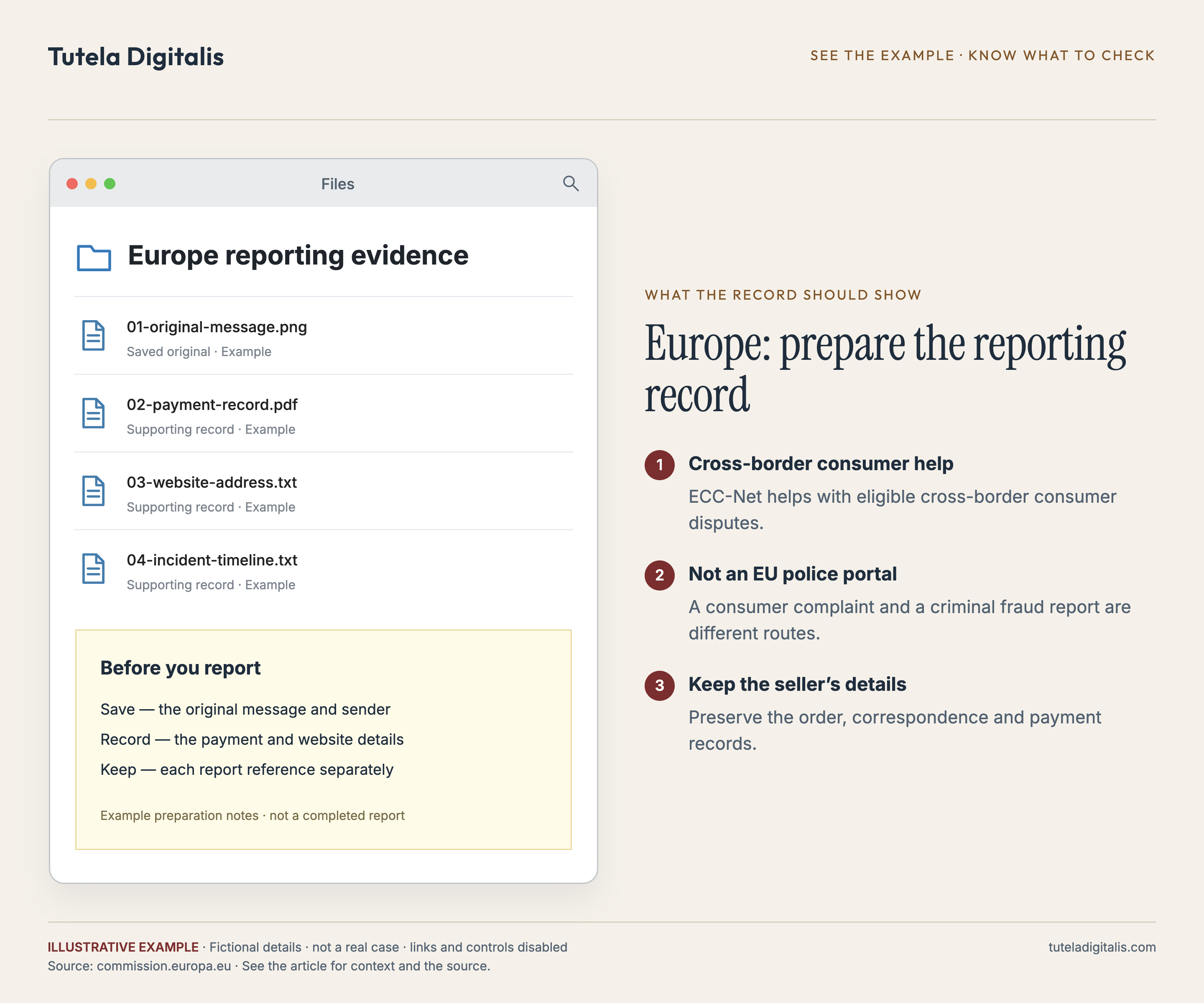
Illustrative example: 01-original-message.png 02-payment-record.pdf 03-website-address.txt 04-incident-timeline.txt Before you report Save — the original message and sender Record — the payment and website details Keep — each report reference separately
- Cross-border consumer help. ECC-Net helps with eligible cross-border consumer disputes.
- Not an EU police portal. A consumer complaint and a criminal fraud report are different routes.
- Keep the seller’s details. Preserve the order, correspondence and payment records.
"…mainly as a result of scams that tricked users into initiating fraudulent transactions."
— Joint EBA-ECB Report on Payment Fraud, 15 December 2025, explaining why payment service users — not their banks — bore roughly 85% of the EU's credit-transfer fraud losses in 2024 (€2.2 billion of a €4.2 billion total). That sentence is the whole problem in one line: European law refunds the theft, not the con.
If you have just been scammed somewhere in Europe, two things matter more than anything else in the first hours: stopping further loss and creating a record while the evidence still exists. Everything after that — which agency, which form, which refund argument — depends on getting those right. The complication is that "Europe" is not one system. Twenty-seven EU members, plus Switzerland and others, each run their own police and their own banking-dispute machinery on top of a shared EU payments rulebook. This guide gives you the shared rules first, then the country-by-country doors.
If you are reading this with a transfer you already regret, skip to if money has already moved. The first hour is the only window where a bank-side recall reliably works.
The hard line in European law: it refunds the hack, not the con
This is the most important section, because it sets your expectations correctly before you waste a week chasing the wrong outcome.
EU law draws a sharp line between two kinds of loss. Under Article 73 of the Payment Services Directive (PSD2), an unauthorised payment — someone used your card or got into your account without permission — must be refunded by your bank, immediately and no later than the end of the next business day after you report it. Your own liability for a lost or stolen instrument is capped at €50, and is zero in several defined cases, unless you acted fraudulently or with gross negligence. That part of the system works reasonably well across the bloc.
But if you authorised the payment yourself because you were deceived — you logged in and sent the transfer because a convincing "bank security officer" or "investment adviser" told you to — that is legally an authorised transaction, and PSD2 does not put the loss on the bank. This is the same gap that strands scam victims in the United States under Regulation E and in Germany under §675u BGB. It is the gap that nearly every modern scam is built to fall into.
The UK went one way; the EU has not, yet
Britain decided that this was unfair and changed it. Since 7 October 2024, the UK's Payment Systems Regulator requires banks to reimburse victims of authorised-push-payment fraud up to £85,000 per claim, normally within five business days, with the cost split 50/50 between the sending and receiving banks. We cover that regime in full in the UK reporting guide. The EU has no equivalent in force.
It is moving, though, in a narrower form. In November 2025 the European Parliament and Council reached a provisional agreement on a new Payment Services Regulation (PSR) and third Payment Services Directive (PSD3). The headline change for victims: where a fraudster impersonates your own bank — the "spoofing" scam, where the call or text appears to come from your bank's real number — the transaction would be treated as unauthorised, triggering a refund, provided you report it to the police and notify your bank.
The one new thing on your side: the name-check (Verification of Payee)
There is a genuine new safeguard worth knowing about, because it changes both your protection and your liability. Since 9 October 2025, under the EU Instant Payments Regulation, payment service providers in the euro area must offer Verification of Payee: before you confirm a euro transfer, your bank checks whether the recipient's name matches the IBAN you entered, and warns you if it does not. The service is free. It will not, however, stop a scam that gets you to send or return money willingly — like Spain's "accidental Bizum" scam, where the trap is a payment you make yourself.
If money has already moved: the first hours
Speed is the whole game, and even more so in the EU where there is no automatic refund to fall back on for a scam you authorised. A same-day bank recall is sometimes the only thing that works. This is the maximum-recovery order:
Country by country, where to report, and who pays
The EU payments rulebook is shared, but the reporting doors and the goodwill on refunds differ sharply by country. This is the hub; we are building a dedicated guide for each as we go.
For a scam that crosses borders — and most do — remember two things. Europol does not take reports from the public; it works only through national police, so your report always starts at home. And for a dispute with a legitimate-looking business in another EU/EEA country, ECC-Net is the free cross-border channel. For the wider directory beyond Europe, see where to report a scam by country.
The habits that keep you out of the machinery entirely
Reporting is downstream. Prevention is upstream, and in a continent with no automatic refund the upstream habits matter more than almost anywhere:
If you are unsure whether something is a scam before any money moves, the fastest second opinion is the Scam Checker on this site, or our free case review. Both are read by a human and answered within 24 hours.
One rule, end to end
If you take one habit from this piece, take this: any unsolicited call, message, or email that pressures you to move money or share a code is a scam until you have hung up and verified it by calling the institution back on a number you already trust. Across most of Europe there is no rule that will undo it for you afterwards — which makes that one pause worth more than the entire reporting machinery downstream of it.
Scammed in Europe and not sure where to start? Let's look at it together.
Describe the message, the call, the transaction. A real expert reviews every case and replies within 24 hours. Free, confidential, no pressure.
Common questions about getting scammed money back in Europe
Can you get scammed money back in the EU?
Sometimes — and it depends almost entirely on how the payment was made. If the transaction was unauthorised (someone used your account or card without your consent), your bank must refund it under the EU Payment Services Directive, normally by the end of the next business day. If you authorised the payment yourself because you were deceived — you logged in and sent the transfer because a convincing 'bank officer' or 'investment adviser' told you to — there is no EU-wide rule forcing your bank to refund it. The single biggest factor in recovery is speed: contact your bank within hours so it can attempt a recall while the money may still be in the fraudster's account.
Does my European bank have to refund a scam?
Only for unauthorised payments. Under Article 73 of PSD2, a payment service provider must refund an unauthorised transaction immediately, and consumer liability for a lost or stolen instrument is capped at €50 (and is zero in several defined cases) — unless you acted fraudulently or with gross negligence. But money you were tricked into transferring yourself is legally an authorised payment, and PSD2 does not put that loss on the bank. That is the gap most scams are engineered to fall into. Some countries close part of it voluntarily — Dutch banks reimburse bank-impersonation fraud, for example — but most of the EU does not.
What is Verification of Payee and does it protect me?
Verification of Payee (VoP) is a name-check on bank transfers. Since 9 October 2025, payment service providers in the euro area must check whether the recipient's name matches the IBAN you entered and warn you if it does not — free of charge. It is a genuine new safeguard against paying the wrong account, including fraudster 'mule' accounts opened in a different name. But it is a warning, not a wall: if you proceed after a 'no match' alert and send the money anyway, you generally take on the liability for it. Treat a name mismatch as a hard stop, not a formality to click past.
Is there an EU version of the UK's mandatory refund rule?
Not yet, but it is coming in narrower form. The UK's Payment Systems Regulator has, since 7 October 2024, required banks to reimburse authorised-push-payment scam victims up to £85,000. The EU has no equivalent in force. In November 2025 the European Parliament and Council reached a provisional agreement on a new Payment Services Regulation (PSR) and third Payment Services Directive (PSD3) that would treat bank-impersonation ('spoofing') fraud as unauthorised — triggering a refund — provided you report it to police and notify your bank. It is narrower than the UK rule (it targets impersonation of your own bank, not every scam) and, as of 2026, not yet applicable. Check its status before relying on it.
Who do I report a scam to in Europe?
There is no single pan-European front door. Report to your national police first (in many countries via an online crime-reporting portal), and contact your bank the same hour. Then add the specialist body for your country: FraudSMART and An Garda Síochána in Ireland; the Fraudehelpdesk and politie.nl in the Netherlands; your state Online-Wache and the Verbraucherzentrale in Germany; the NCSC in Switzerland; Watchlist Internet and the Bundeskriminalamt in Austria. If a business in another EU/EEA country is involved, the European Consumer Centres Network (ECC-Net) gives free cross-border help. Europol does not take reports from the public.
Can Europol or the EU recover my money?
No. Europol works only with national law-enforcement agencies and never takes reports or recovers funds directly for individuals — and it warns that anyone phoning, texting or emailing you while claiming to be Europol is themselves running a scam. The realistic recovery levers in Europe are your bank (a fast SEPA recall while the funds are still there), your national police complaint, your country's financial ombudsman, and — for a cross-border dispute with a legitimate-looking business — ECC-Net. Anyone who contacts you offering to 'recover' your money for an upfront fee is the second scam.
Sources & further reading
Every figure in this piece is drawn from these authorities. Click any of them to verify.