Denmark's routes in 2026: report the crime to the police on 114 or at politi.dk (112 in an emergency), and tell your bank the same hour. Check and report investment fraud through Finanstilsynet, the Danish Financial Supervisory Authority, which publishes warnings against unlicensed companies. Use the digital-security portal sikkerdigital.dk for online-fraud guidance, and the Consumer Ombudsman (Forbrugerombudsmanden) for misleading commercial practices. Escalate a bank's refusal to Det finansielle ankenævn, the Danish Financial Complaint Board. On refunds: under the Payment Act (implementing the EU Payment Services Directive), your bank must refund an unauthorised payment with your liability limited unless you were grossly negligent — but money you were deceived into authorising yourself, including with MitID, is generally not refundable, because Denmark has no UK-style mandatory-reimbursement rule.
Read the image explanation
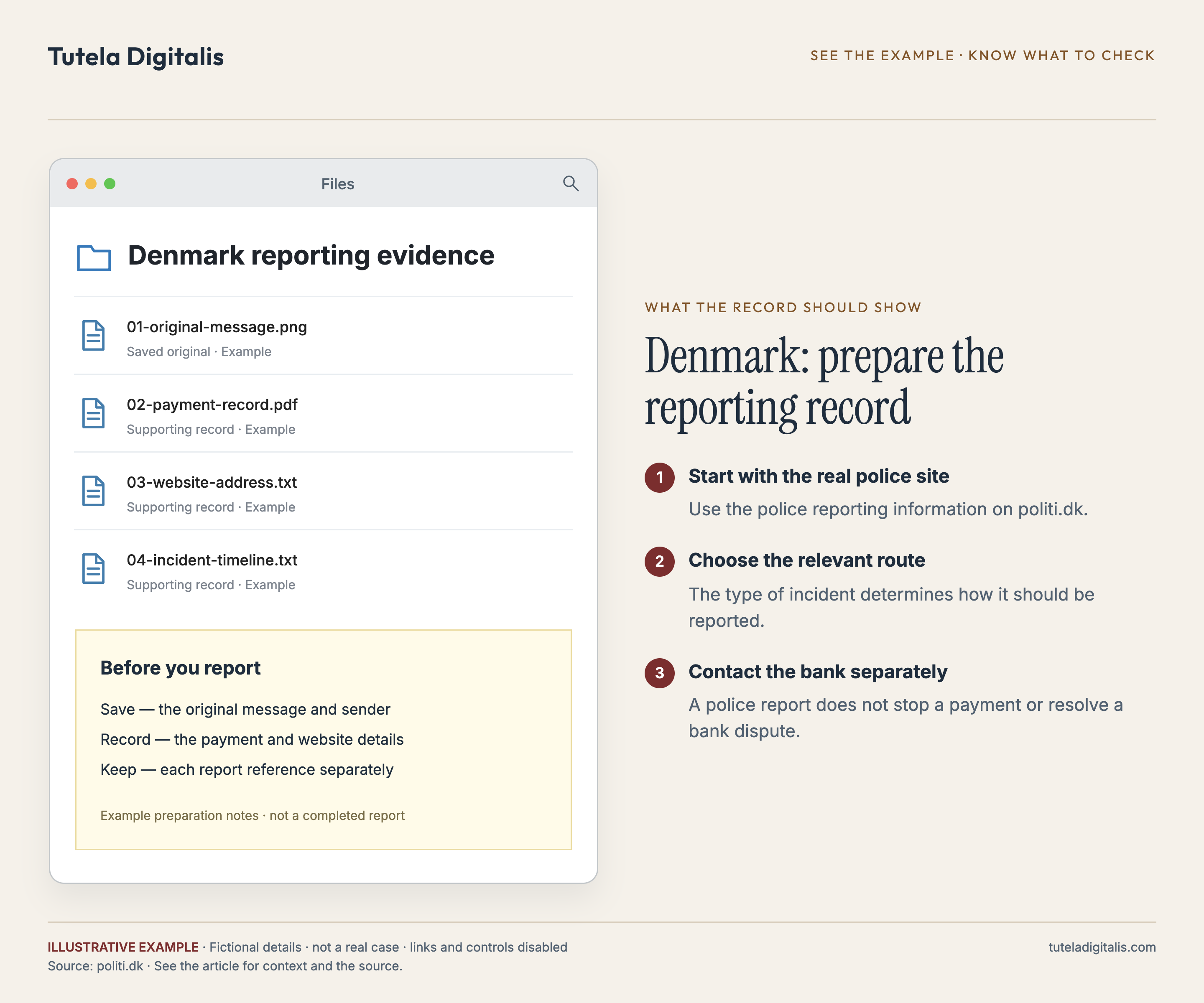
Illustrative example: 01-original-message.png 02-payment-record.pdf 03-website-address.txt 04-incident-timeline.txt Before you report Save — the original message and sender Record — the payment and website details Keep — each report reference separately
- Start with the real police site. Use the police reporting information on politi.dk.
- Choose the relevant route. The type of incident determines how it should be reported.
- Contact the bank separately. A police report does not stop a payment or resolve a bank dispute.
If you have been scammed in Denmark, two things matter most in the first 24 hours: stopping any further loss and creating a record while the evidence still exists. Everything downstream — which body, which form, which refund argument — depends on getting those two right. The complication is that Denmark has no single place to report and no automatic refund for a transfer you authorised, so the order below is built to be the fastest path through a system with several separate doors.
If you are reading this with a transaction you already regret, skip to if money has already moved. A same-day bank recall is sometimes the only thing that works.
The hard truth first: Denmark refunds the hack, not the con
This matters most, because it sets your expectations correctly before you spend a week chasing the wrong outcome.
Danish law draws a sharp line between two kinds of loss, through the Payment Act (betalingsloven), which implements the EU Payment Services Directive. If a payment was unauthorised — someone used your card or got into your account without permission — your bank must refund it, and your own liability is limited unless you acted with gross negligence.
But if you authorised the payment yourself because you were deceived — you approved it with MitID, or made the transfer because a convincing "bank adviser" or "investment platform" told you to — that is legally a valid instruction, and the refund right does not apply. There is no Danish equivalent of the UK rule that forces banks to reimburse this kind of authorised-push-payment fraud.
The Danish reporting map, police first, then the specialist
Denmark has no single consumer "report a scam" portal of the kind the US (IC3) or the UK (Report Fraud) run, but the police are the obvious front door.
The full Danish reporting directory, by scam type
Different scams route to different specialists. Using the right one matters more than reporting to all of them.
If money has already moved: the first 24 hours
Speed is the whole game, especially for a transfer you authorised, where there is no automatic refund to fall back on. This is the maximum-recovery order:
The Danish numbers, and why they jumped in 2024
Denmark's fraud figures moved sharply, and the reason is structural. A few figures, all from named sources:
The habits that keep you out of the reporting machinery entirely
Reporting is downstream. Prevention is upstream, and three habits stop most Danish scams cold:
If you are unsure whether something is a scam before any money moves, the fastest second opinion is the Scam Checker on this site, or our free case review. Both are read by a human and answered within 24 hours.
One rule, end to end
If you take one habit from this piece, take this: any unsolicited call, text, or message that pressures you to move money or confirm a MitID is a scam until you have hung up and verified it by contacting the institution on a number you already trust. In a country with no automatic refund for a transfer you authorised, that one pause is worth more than the entire reporting machinery downstream of it.
In Denmark and not sure where to start? Let's look at it together.
Describe the message, the call, the transaction. A real expert reviews every case and replies within 24 hours. Free, confidential, no pressure.
Common questions about reporting a scam in Denmark
Is there one place to report all scams in Denmark?
No single portal, but the route is clear. The criminal report goes to the police (Politi): call 114 (112 in an emergency, or while money is still moving) or report online at politi.dk, which has a dedicated section for digital crime and scams. Tell your bank in the same hour — that is what gives a recall a chance. For investment fraud, check Finanstilsynet (the Danish Financial Supervisory Authority) warnings against companies and report an unlicensed firm. The Consumer Ombudsman (Forbrugerombudsmanden) handles misleading and deceptive commercial practices. The practical order: tell your bank, file the police report, then add the specialist body that matches the scam.
Will my Danish bank refund money I lost to a scam?
It depends on one distinction the whole EU uses. Denmark implements the EU Payment Services Directive through the Payment Act (betalingsloven). If the payment was unauthorised — someone used your card or got into your account without permission — your bank must refund it, and your own liability is limited unless you acted with gross negligence. But if you authorised the payment yourself because you were deceived — you approved it with MitID or made the transfer because a convincing 'bank adviser' told you to — that is a valid instruction, and there is no Danish equivalent of the UK rule forcing banks to reimburse this kind of authorised-push-payment fraud. So Danish banks refund the hack, not the con. Report it fast anyway: the average fraudulent bank transfer in Denmark ran to roughly kr. 35,300 in 2023, against just under kr. 1,300 for the average card fraud (Danmarks Nationalbank), and speed is what gives a recall a chance.
How do I report a fake online shop, phishing message, or scam call in Denmark?
If money or card details were involved, tell your bank immediately so it can watch the account and attempt a recall, then file the report with the police on 114 or at politi.dk. Online shopping fraud is now one of the most common forms in Denmark — around 131,000 people reported being defrauded through fake shops or private trades in 2024, up from 85,000 the year before. Keep the listing, the messages and the payment details. The digital-security portal sikkerdigital.dk has step-by-step guidance, and if a message impersonated your bank the bank's fraud team will want the details.
How do I check whether an investment platform is legitimate in Denmark?
Use Finanstilsynet, the Danish Financial Supervisory Authority. Before sending money, check that the firm is authorised and read its warnings against companies — the alerts it publishes about unlicensed firms, clones and bogus platforms. Finanstilsynet cannot recover your money, but its warnings are how a large share of fake-broker and bogus-crypto operations get publicly flagged. Investment fraud is rising fast in Denmark — the amount taken nearly doubled from 2023 to 2024 — and the dominant pattern is a 'guaranteed return' platform promoted through social-media ads or a stranger who moves the conversation onto WhatsApp or Telegram.
Where can a scam victim in Denmark escalate or get help?
If your bank refuses to refund a payment you believe was unauthorised, you can take the dispute to Det finansielle ankenævn, the Danish Financial Complaint Board, an independent body that resolves consumer disputes with banks outside the courts. It absorbed the former Pengeinstitutankenævnet in 2019, so older guides still send people to a name that no longer exists. For consumer rights and deceptive-practice complaints, the Consumer Ombudsman (Forbrugerombudsmanden) and the consumer portal forbrug.dk are the places to start. None of these — your bank, the police, Finanstilsynet, or the complaint board — will ever charge an upfront fee to 'recover' your money. Anyone who does is running the second scam.
Sources & further reading
Every figure in this piece is drawn from these authorities. Click any of them to verify.