Switzerland's official routes in 2026: report the incident to the Bundesamt für Cybersicherheit (BACS) at report.ncsc.admin.ch or via antifraud.ch; file a criminal complaint (Strafanzeige) with your cantonal police (Kantonspolizei), or call 117 in an emergency; check and report investment firms via FINMA's warning list; block a compromised card through your bank's 24/7 hotline; escalate a wrongly-refused unauthorised payment to the Schweizerischer Bankenombudsman; and get free help from your cantonal victim-support office (Opferhilfe). Crucially, Switzerland is not in the EU, so there is no PSD2-style statutory refund: your bank's terms normally cover an unauthorised payment if you were not negligent, but money you were deceived into sending yourself is generally not refundable.
Read the image explanation
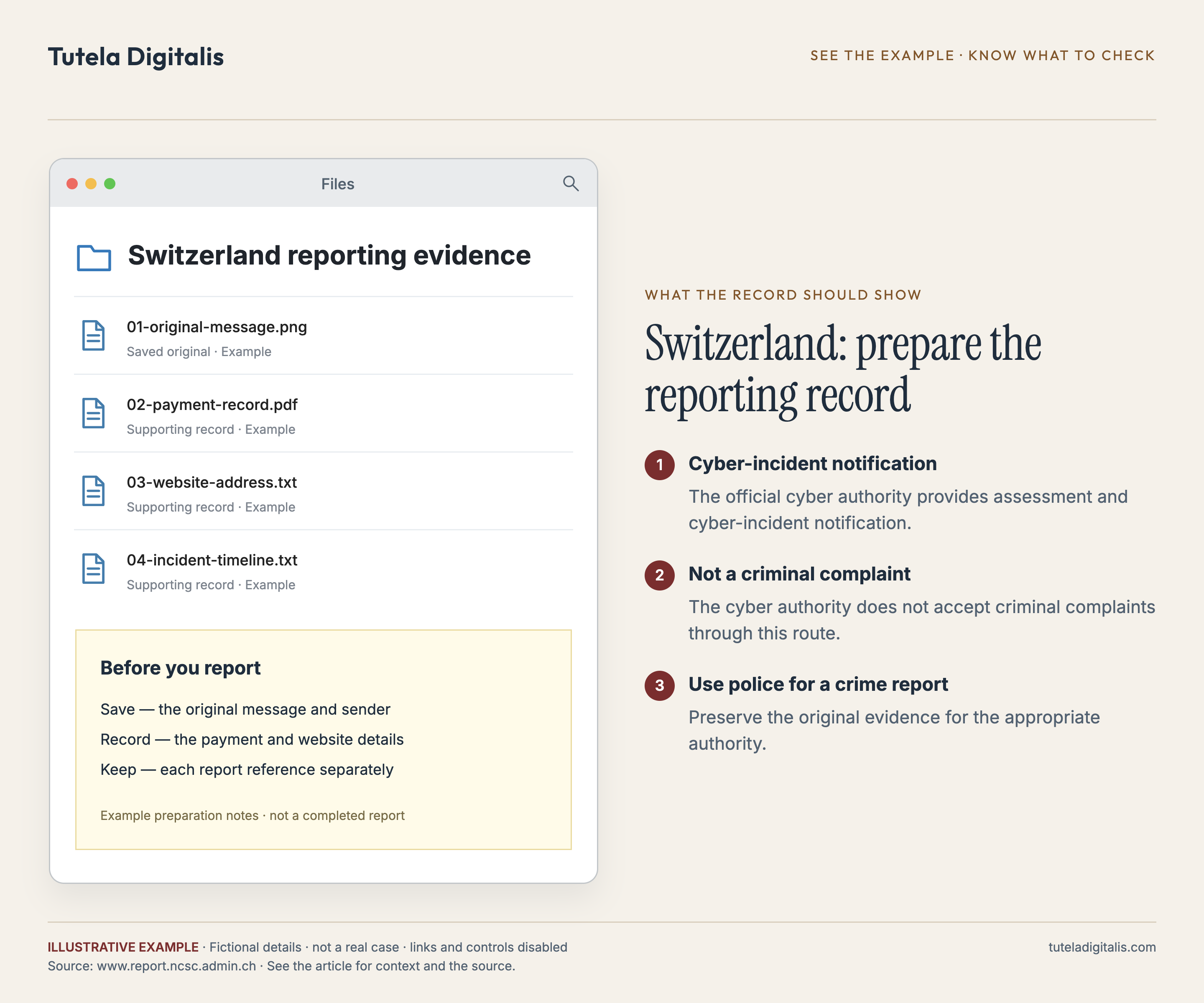
Illustrative example: 01-original-message.png 02-payment-record.pdf 03-website-address.txt 04-incident-timeline.txt Before you report Save — the original message and sender Record — the payment and website details Keep — each report reference separately
- Cyber-incident notification. The official cyber authority provides assessment and cyber-incident notification.
- Not a criminal complaint. The cyber authority does not accept criminal complaints through this route.
- Use police for a crime report. Preserve the original evidence for the appropriate authority.
"Alle 8,5 Minuten eine Meldung zu einem Cybervorfall."
"A report of a cyber incident every 8.5 minutes." — Bundesamt für Cybersicherheit (BACS), Halbjahresbericht 2024/1. BACS Director Florian Schütz described the government-impersonation calls behind much of that volume as "a business" — in the first half of 2024 alone, 13,730 reports involved fraudsters posing as officials, calling on weekdays from early morning to about 4pm.
If you have been scammed in Switzerland, two things matter most in the first 24 hours: stopping any further loss and creating a record while the evidence still exists. Everything downstream — which authority, which form, which refund argument — depends on getting those two right. The complication unique to Switzerland is that there is no single place to report and no EU safety net behind your bank, so the order below is built to be the fastest path through a deliberately federal, four-language system.
If you are reading this with a transaction you already regret, skip to if money has already moved. A same-day bank recall is sometimes the only thing that works.
The hard truth first: Switzerland refunds the hack, not the con
This matters most, because it sets your expectations before you spend a week chasing the wrong outcome — and Switzerland's position is subtly different from its EU neighbours.
In Germany or Austria, the refund rule for an unauthorised payment is statutory — it comes from the EU Payment Services Directive. Switzerland is not in the EU, so there is no such law. Instead, liability sits in your bank's general terms and conditions (Allgemeine Geschäftsbedingungen, AGB) and the Swiss Code of Obligations (Obligationenrecht, OR). In practice the outcome is similar: if your card or e-banking was used without permission and you were not negligent, Swiss banks normally bear the loss and reimburse you — provided you report it promptly, usually in writing within about 30 days of the statement.
But if you authorised the payment yourself because you were deceived — you logged in and sent the transfer because a convincing "bank security officer" or "investment adviser" told you to — that is a valid instruction. There is no Swiss equivalent of the UK rule that forces banks to reimburse this kind of authorised-push-payment fraud.
There is no single front door: the BACS report and the cantonal complaint are two different things
This trips up almost everyone. Switzerland has a national cyber-incident reporting point, but reporting an incident is not the same as filing a criminal complaint, and you usually want to do both.
The full Swiss reporting directory, by scam type
Different scams route to different bodies. Using the right one matters more than reporting to all of them.
If money has already moved: the first 24 hours
Speed is the whole game, especially in Switzerland where there is no automatic refund to fall back on. This is the maximum-recovery order:
The Swiss numbers, for context
The BACS semi-annual reports (Halbjahresberichte) for 2024 are the most recent national picture. The headline figures, all from named sources:
The habits that keep you out of the reporting machinery entirely
Reporting is downstream. Prevention is upstream, and three habits stop most Swiss scams cold:
If you are unsure whether something is a scam before any money moves, the fastest second opinion is the Scam Checker on this site, or our free case review. Both are read by a human and answered within 24 hours.
One rule, end to end
If you take one habit from this piece, take this: any unsolicited call, message, or email that pressures you to move money or share a code is a scam until you have hung up and verified it by calling the institution back on a number you already trust. In a country with no statutory refund rule, that one pause is worth more than the entire reporting system downstream of it.
In Switzerland and not sure where to start? Let's look at it together.
Describe the message, the call, the transaction. A real expert reviews every case and replies within 24 hours. Free, confidential, no pressure.
Common questions about reporting a scam in Switzerland
Is there one place to report all scams in Switzerland?
No. Switzerland has a national reporting point for cyber incidents — the Bundesamt für Cybersicherheit (BACS), at report.ncsc.admin.ch — but that is an intelligence channel, not a criminal complaint. Because policing is organised by the 26 cantons, a criminal complaint (Strafanzeige / plainte pénale) goes to your cantonal police (Kantonspolizei), in person or through the cantonal online portal; the police emergency number is 117. The practical order: report the incident to BACS so it feeds the national picture, file a Strafanzeige with your Kantonspolizei, and route investment fraud separately to FINMA. There is no single front door that does all three.
Will my Swiss bank refund money I lost to a scam?
It depends on whether the payment was unauthorised or authorised — and, crucially, Switzerland is not in the EU, so there is no PSD2-style statutory refund right. Liability is governed by your bank's general terms and conditions (Allgemeine Geschäftsbedingungen, AGB) and the Swiss Code of Obligations (Obligationenrecht, OR). In practice, if your card or e-banking was used without permission and you exercised due diligence, the bank will normally cover the loss and reimburse you — report it in writing, typically within about 30 days of the statement. But if you authorised the payment yourself because you were deceived, that is treated as a valid instruction, and Switzerland has no equivalent of the UK rule forcing banks to refund this kind of fraud. So it refunds the hack, not the con.
How do I report a phishing email or fake SMS in Switzerland?
Report it to the Bundesamt für Cybersicherheit (BACS) through its reporting form at report.ncsc.admin.ch, or via the federal anti-fraud portal antifraud.ch. Phishing — often fake parcel-delivery notices or refund claims — is one of the fastest-growing categories BACS tracks, with 6,643 reports in the first half of 2024 alone. If the message impersonated your bank, tell the bank directly so it can warn other customers. If you actually entered data or lost money, also file a Strafanzeige with your cantonal police.
How do I check whether an investment platform is legitimate in Switzerland?
Use FINMA, the Eidgenössische Finanzmarktaufsicht (Swiss Financial Market Supervisory Authority). Before sending money, check FINMA's warning list (Warnliste) of unauthorised providers and confirm the firm holds the licence it claims. FINMA cannot recover your money, but its warning list is how a large share of fake-broker, cloned-bank, and bogus crypto-platform operations get publicly flagged in Switzerland. Fake cryptocurrency platforms and 'guaranteed return' schemes that pivot the conversation onto WhatsApp or Telegram are the dominant Swiss investment-fraud pattern.
Where can a scam victim get free human help in Switzerland?
Switzerland has a statutory victim-support system under the Opferhilfegesetz (OHG). Every canton runs a free, confidential victim-support office (Opferberatungsstelle); you can find yours via opferhilfe-schweiz.ch. These offices give free advice and can help you through reporting and any aftermath. For disputes with your bank over an unauthorised payment, the Schweizerischer Bankenombudsman offers free, neutral mediation. None of these will ever charge an upfront fee to 'recover' your money — anyone who does is running the second scam.
Sources & further reading
Every figure in this piece is drawn from these authorities. Click any of them to verify.