Where to report a scam in the Netherlands: the one country in Europe that decided to refund the con, and watched the losses fall.
Across most of Europe, if a scammer talks you into transferring the money yourself, your bank is not obliged to give it back. The Netherlands made a different choice: Dutch banks voluntarily reimburse victims of bank-impersonation "spoofing" fraud — and after they did, that category of loss fell about 30% in 2024. It is the closest thing to good news in European fraud. But the safety net covers one specific scam, not all of them, and Statistics Netherlands found only about 1% of all fraud-loss victims got their money back. Here is the actual map — in English, for 2026.
€1.75B
Est. scam losses in NL 2024 (CBS)
€53M
Reported to the Fraudehelpdesk 2024 (+20%)
−30%
Fall in bank-spoofing fraud 2024 (banking sector)
0900-0101
Free victim support (Slachtofferhulp)
The short answer
The Netherlands' routes in 2026: file an aangifte (criminal report) with the politie at politie.nl or 0900-8844, and call 112 in an emergency — that aangifte is often a precondition for any bank reimbursement; report and get advice from the Fraudehelpdesk (fraudehelpdesk.nl, +31 88 786 7372); check and report investment fraud to the AFM; get consumer help from ConsuWijzer (ACM); escalate a bank's refusal to Kifid; and get free support from Slachtofferhulp Nederland on 0900-0101. Crucially, under the EU Payment Services Directive an unauthorised payment must be refunded — and uniquely in Europe, Dutch banks also voluntarily reimburse victims of bank-impersonation ("spoofing") fraud under a sector scheme. That scheme covers spoofing specifically, not every scam, so most deception transfers outside it are still not refundable.
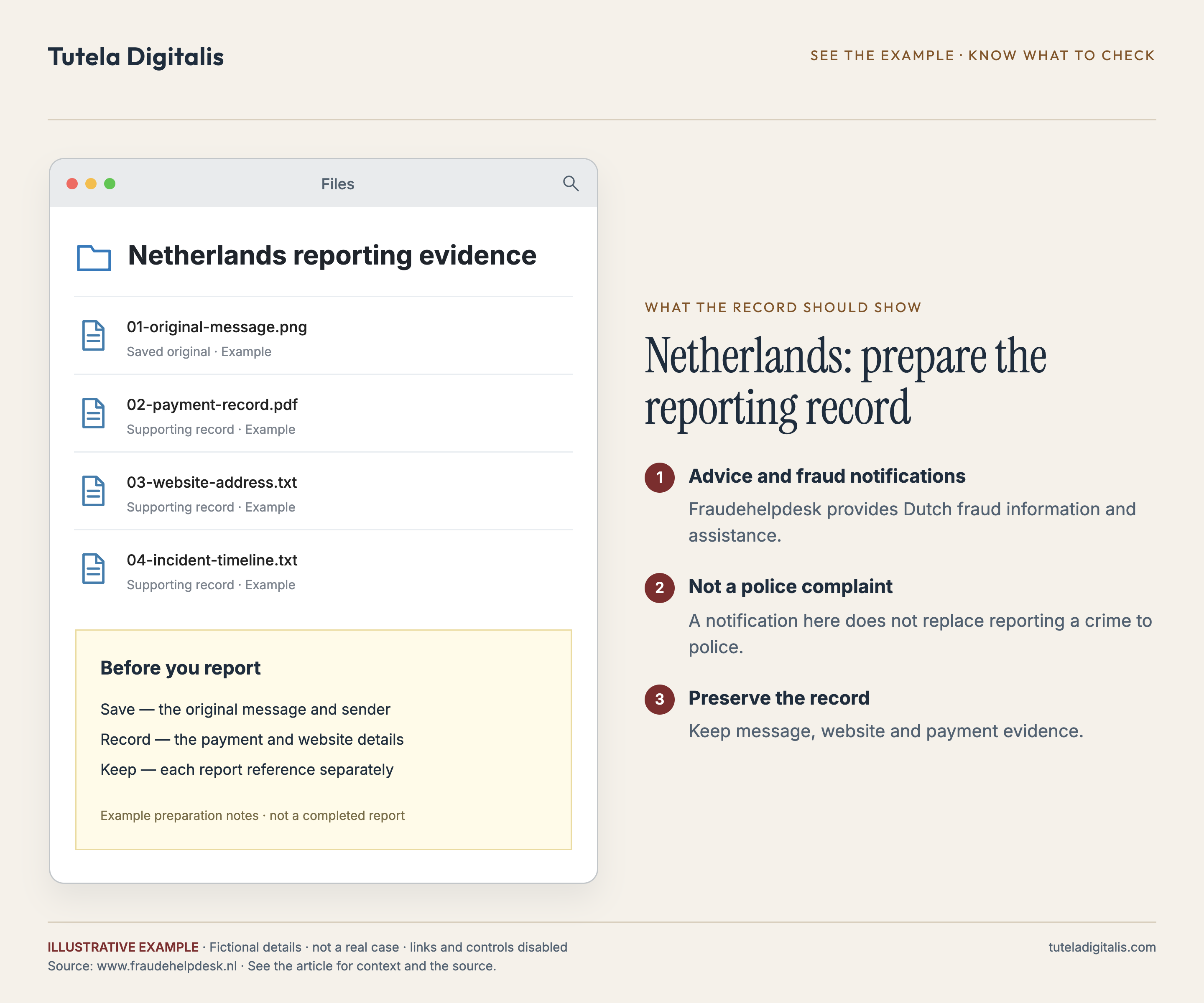
Netherlands: prepare the reporting record. Original illustrative evidence folder with fictional file names. This shows preparation for reporting, not an official website, submitted report or refund decision. View the source. Open full-size image.Illustration added 6 October 2026.Read the image explanation
Illustrative example:
01-original-message.png
02-payment-record.pdf
03-website-address.txt
04-incident-timeline.txt
Before you report
Save — the original message and sender
Record — the payment and website details
Keep — each report reference separately
Advice and fraud notifications. Fraudehelpdesk provides Dutch fraud information and assistance.
Not a police complaint. A notification here does not replace reporting a crime to police.
Preserve the record. Keep message, website and payment evidence.
If you have been scammed in the Netherlands, two things matter most in the first 24 hours: stopping any further loss and creating a record while the evidence still exists. The Dutch system rewards that second step more than most — because filing the police report (aangifte) is often what makes a bank reimbursement possible at all. The order below is built to be the fastest path through it.
If you are reading this with a transaction you already regret, skip to if money has already moved. A same-day bank recall — and a clear spoofing claim — is sometimes the only thing that works.
The hard truth, with one real exception: the Netherlands refunds some cons
This matters most, because it sets your expectations correctly before you spend a week chasing the wrong outcome.
Dutch law starts from the same EU baseline as the rest of the bloc, through the Payment Services Directive. If a payment was unauthorised — someone used your card or got into your account without permission — your bank must refund it, and your liability is generally capped at €50. If you authorised the payment yourself under deception, that is legally a valid instruction, and the EU refund right does not apply.
Here is where the Netherlands diverges from almost everyone. Dutch banks run a voluntary sector scheme that reimburses victims of bank-impersonation ("spoofing") fraud — the scam where the number on your screen is your bank's real number and a fake "fraud officer" walks you into moving money to a "safe account." Around 89% of the roughly €51 million lost to spoofing in 2022 was repaid, according to figures from the Dutch banking sector, and that scheme — alongside dispute rulings that made reimbursement easier — helped push spoofing losses down about 30% in 2024.
This is the exact gap that strands victims across the rest of the EU and the United States. Most of Europe refunds the hack, not the con; Britain went furthest the other way, with a Payment Systems Regulator rule that requires banks to refund deception transfers up to £85,000, as we covered in the UK reporting guide. The Netherlands chose a middle path — reimburse one specific, common con (spoofing) voluntarily — and the data suggests it worked. But the scheme covers spoofing, not romance scams, investment fraud, fake webshops or "friend-in-need" WhatsApp scams, and you generally need to have filed an aangifte. For everything outside it, see the pan-European recovery map.
Start with the politie, and the aangifte is what unlocks reimbursement
This is the detail that catches people out elsewhere but matters doubly in the Netherlands: the formal police report is not just a criminal-justice step, it is often the document your bank needs before it will reimburse you.
—The criminal report — an aangifte with the politie. File it online at politie.nl or by phone on 0900-8844; call 112 in an emergency or while money is moving. For many fraud reimbursements, including spoofing, the bank will ask to see that you filed it.
—The advice-and-reporting hub — the Fraudehelpdesk. fraudehelpdesk.nl (+31 88 786 7372) is the national fraud helpline. It logs scams, builds the national picture, and advises victims — but it is not the police, so file the aangifte too.
—Tell your bank the same hour. Especially for spoofing: the sooner the bank knows, the better the chance of a recall and the cleaner your reimbursement claim under the sector scheme.
—Keep the case number. Note the proces-verbaal / aangifte reference — your bank, Kifid or the Fraudehelpdesk may ask for it.
The full Dutch reporting directory, by scam type
Different scams route to different specialists. Using the right one matters more than reporting to all of them.
—Any fraud where you lost money. File an aangifte with the politie (politie.nl or 0900-8844; 112 in an emergency) and tell your bank the same hour. The aangifte is the criminal-side foundation and the key to a reimbursement claim.
—A fake webshop, phishing message, or scam call. Report it to the Fraudehelpdesk (fraudehelpdesk.nl) and tell your bank if a message impersonated it. For a purchase dispute, ConsuWijzer (the ACM consumer desk) explains your rights.
—Bank-impersonation ('spoofing') fraud. Tell your bank immediately and file the aangifte — this is the scam the Dutch banks' voluntary reimbursement scheme is built to cover, so a fast, well-documented report gives you the best chance of getting the money back.
—Investment, crypto, or fake-broker fraud. Check the AFM's warnings list before investing and report an unlicensed provider. The AFM cannot recover funds, but a warning flags the operation publicly.
—A bank or insurer that mishandled your case. Complaints about a financial firm's conduct can go to De Nederlandsche Bank (DNB); a dispute the firm refuses to resolve can be escalated free to Kifid, the financial-services complaints board.
—A WhatsApp 'friend-in-need' (vriend-in-nood) message. 'Hi, it's me, new number, can you pay this?' is one of the most common Dutch scams. Verify by calling the person on their known number; report a loss to the politie and the Fraudehelpdesk.
—A scam you spotted but did not fall for. Still report it to the Fraudehelpdesk, or the AFM for a fake investment offer. No-loss reports still build the intelligence picture.
—You need a human to talk to. Slachtofferhulp Nederland (Victim Support) on 0900-0101 — free, independent, practical, legal and emotional support.
If money has already moved: the first 24 hours
Speed is the whole game — and in the Netherlands, so is naming the scam correctly, because a spoofing case has a reimbursement route most other scams do not. This is the maximum-recovery order:
1Call your bank's 24/7 fraud line and block the card. If the payment was unauthorised, say you are disputing it and ask for a recall. If you were tricked by a fake "bank employee," say spoofing explicitly — the banks' voluntary reimbursement scheme is built for exactly that.
2File an aangifte with the politie at politie.nl or 0900-8844 (112 in an emergency). In the Netherlands this report is often required before a bank will reimburse you — keep the case number.
3Document everything in one place. Screenshot the conversation, the spoofed number or sender, the fake website, and the transaction details (date, time, amount, recipient name and IBAN). Save it as a single PDF before the accounts vanish.
4Report it to the Fraudehelpdesk (+31 88 786 7372), which logs the scam and advises on next steps.
5If it was investment fraud, check the firm against the AFM's warnings list and report an unlicensed provider. See the honest recovery odds by payment method for what realistically works.
6Block the scammer everywhere and stop engaging. Any "recovery" offer that follows — a lawyer, an agency, someone claiming to be the police, the AFM or your bank — is the second scam. We covered the pattern in the recovery-scams piece.
7If the bank wrongly refuses a valid claim — an unauthorised payment, or a spoofing case the scheme should cover — escalate free of charge to Kifid. For a deception transfer outside the spoofing scheme, a fast recall or a civil claim are the realistic routes.
8Call Slachtofferhulp Nederland on 0900-0101 for free, confidential support — practical, legal and emotional. A good first human call if the process feels overwhelming.
Within days of any public post or report about your loss, "recovery scammers" will find you. They will pose as a lawyer, a fund-recovery specialist, or even the police, the AFM or your bank, and ask for an upfront fee or your banking details. Real Dutch channels — your bank, the politie, the AFM, Kifid, Slachtofferhulp — never charge upfront to recover money, and authorities never cold-call demanding payment. See the recovery-scams piece for the full pattern.
The Dutch numbers: a rare good-news story with an asterisk
The Netherlands has unusually good fraud data, and the picture is genuinely mixed — improvement where the banks intervened, worsening almost everywhere else. The headline figures, all from named sources:
—De Nederlandsche Bank counted about 658,000 fraudulent payment transactions in 2025, up 30%, and €198 million in fraud, up 22%. DNB's first publication of these figures, 30 June 2026. The sharpest rise was in European credit transfers, up 55% to 129,000 cases: the rail a scam talks you into using.
—Statistics Netherlands (CBS) estimated scam losses of about €1.75 billion in 2024. Roughly 0.2% of national GDP, with about 2.4 million residents aged 15 and over reporting they had fallen victim to some form of online crime.
—The Fraudehelpdesk logged €53 million in reported losses in 2024, up about 20%. Across 63,469 reports (up about 10%), of which 9,146 resulted in someone actually losing money.
—Bank-impersonation ('spoofing') fraud fell about 30% in 2024. Roughly 6,900 people reported it, and the damage fell about 20% to nearly €23 million — the category the banks' voluntary reimbursement scheme directly targets, and the one place the numbers improved.
—But only about 1% of all fraud-loss victims got money back. Per CBS — a reminder that outside the spoofing scheme, reimbursement remains rare, which is why prevention matters more than the prospect of recovery.
—The WhatsApp 'friend-in-need' scam remains one of the most common. The 'it's me, new number, please pay this' message is a Dutch staple, and it sits outside the spoofing scheme — so verification, not reimbursement, is your only real defence.
The habits that keep you out of the reporting machinery entirely
Reporting is downstream. Prevention is upstream, and three habits stop most Dutch scams cold:
—Never approve a payment in your app or hand over a code because of a call you did not initiate. Real banks never phone to tell you to move money to a 'safe account' or to read out a code. Hang up and call your bank back on the number printed on your card. This single habit is what defeats the spoofing call before the scheme ever has to.
—Treat any 'new number, please pay this' message as a scam until you verify. The WhatsApp friend-in-need con relies on you not checking. Call the person on their old, known number first. It is the same voice-and-pressure playbook as the shock-call and family-imposter scams covered in the family-impersonation piece.
—Treat any money conversation that moves onto a messaging app as hostile until verified. Investment 'advisers', recruiters, and romance contacts in the Netherlands overwhelmingly pivot to WhatsApp or Telegram. The move off a verifiable platform onto a private chat is the single most reliable scam signal.
If you are unsure whether something is a scam before any money moves, the fastest second opinion is the Scam Checker on this site, or our free case review. Both are read by a human and answered within 24 hours.
From the field. The Dutch story is the one I point to when people say nothing can be done about authorised-push-payment fraud. The Netherlands decided to reimburse spoofing victims, and the losses fell — proof that the "you authorised it, so tough luck" posture is a choice, not a law of nature. But notice how narrow the win is: it covers the bank-impersonation call and nothing else, and CBS still found only about 1% of all fraud-loss victims got their money back. The WhatsApp friend-in-need message, the fake webshop, the investment group — those still leave you on your own. Which is exactly why the prevention rule below matters more than the entire reimbursement machinery downstream of it.
One rule, end to end
If you take one habit from this piece, take this: any unsolicited call, message, or "new number" text that pressures you to move money or approve a payment is a scam until you have verified it by contacting the institution or person back on a number you already trust. The Netherlands will reimburse you for one specific con — but the pause that stops the payment is still worth more than the scheme that refunds it.
In the Netherlands and not sure where to start? Let's look at it together.
Describe the message, the call, the transaction. A real expert reviews every case and replies within 24 hours. Free, confidential, no pressure.
Common questions about reporting a scam in the Netherlands
Is there one place to report all scams in the Netherlands?
Not quite. The criminal report goes to the politie (police): file an aangifte online at politie.nl or by phone on 0900-8844, and call 112 in an emergency. Filing that aangifte matters more than in most countries, because it is often a precondition for any bank reimbursement. Alongside it, the Fraudehelpdesk (fraudehelpdesk.nl, +31 88 786 7372) is the national fraud advice-and-reporting hub, the AFM handles investment fraud, ConsuWijzer (ACM) advises consumers, and Slachtofferhulp Nederland offers free victim support. The practical order: call your bank, file the aangifte, then add the body that matches the scam.
Will my Dutch bank refund money I lost to a scam?
Sometimes — and the Netherlands is genuinely the exception in Europe here. Under the EU Payment Services Directive an unauthorised payment (someone used your card or account without permission) must be refunded, with your liability capped at €50. Money you authorised under deception is normally not refundable. But Dutch banks run a voluntary sector scheme that reimburses victims of bank-impersonation ('spoofing') fraud: around 89% of the roughly €51 million lost that way in 2022 was repaid, according to figures from the Dutch banking sector, and that scheme — plus dispute rulings — helped cut spoofing losses by about 30% in 2024. The catch: it covers spoofing specifically, not every scam, and you usually need to have filed an aangifte. Statistics Netherlands found only about 1% of all fraud-loss victims in 2024 got money back.
How do I report a fake webshop or phishing message in the Netherlands?
Report it to the Fraudehelpdesk (fraudehelpdesk.nl or +31 88 786 7372), which logs scams and advises victims, and tell your bank immediately if a message impersonated it. For a purchase that went wrong, ConsuWijzer — the consumer desk of the regulator ACM — explains your rights. If you lost money, also file an aangifte with the politie at politie.nl. WhatsApp 'friend-in-need' (vriend-in-nood) messages — 'Hi, it's me, I have a new number, can you pay this for me?' — are one of the most common Dutch scams, so verify any such request by calling the person on their old number.
How do I check whether an investment platform is legitimate in the Netherlands?
Use the AFM (Autoriteit Financiële Markten), the Dutch financial-markets regulator. Before sending money, check the AFM's warnings list and confirm the firm holds the licence it needs to offer investments in the Netherlands. The AFM cannot recover your money, but its warnings are how a large share of fake-broker, cloned-firm and bogus crypto operations get flagged publicly — and the AFM reported a sharp rise in fraud reports through 2024. Reports about a bank or insurer's conduct can also go to De Nederlandsche Bank (DNB).
Where can a scam victim get free human help in the Netherlands?
Call Slachtofferhulp Nederland (Victim Support Netherlands) on 0900-0101 — a free, independent service offering practical, legal and emotional support to victims of crime, including fraud. The Fraudehelpdesk also gives free advice on what to do next. If your bank refuses a financial complaint you believe is valid, you can escalate to Kifid, the financial-services complaints board, at no cost. None of these will ever charge an upfront fee to 'recover' your money — anyone who does is running the second scam.
Sources & further reading
Every figure in this piece is drawn from these authorities. Click any of them to verify.