On 1 May 2026, at the European Anti-Financial Crime Summit in Dublin, Europol announced an EU Anti-Scam Platform — an operational hub to help EU police forces fight online fraud together, built around intelligence-sharing, swift fund recovery, operational coordination, threat monitoring and public-private partnerships, and drawing on Europol's cybercrime (EC3) and financial-crime (EFECC) centres. It is a law-enforcement coordination tool, not a consumer claims service: it does not refund victims and there is no portal you apply to. Faster cross-border coordination can improve the chance of freezing stolen money, but what still decides your outcome is how quickly you report to your bank and national authority, and how you paid. Anyone who says the "EU platform" will return your money for a fee is running a recovery scam.
Read the image explanation
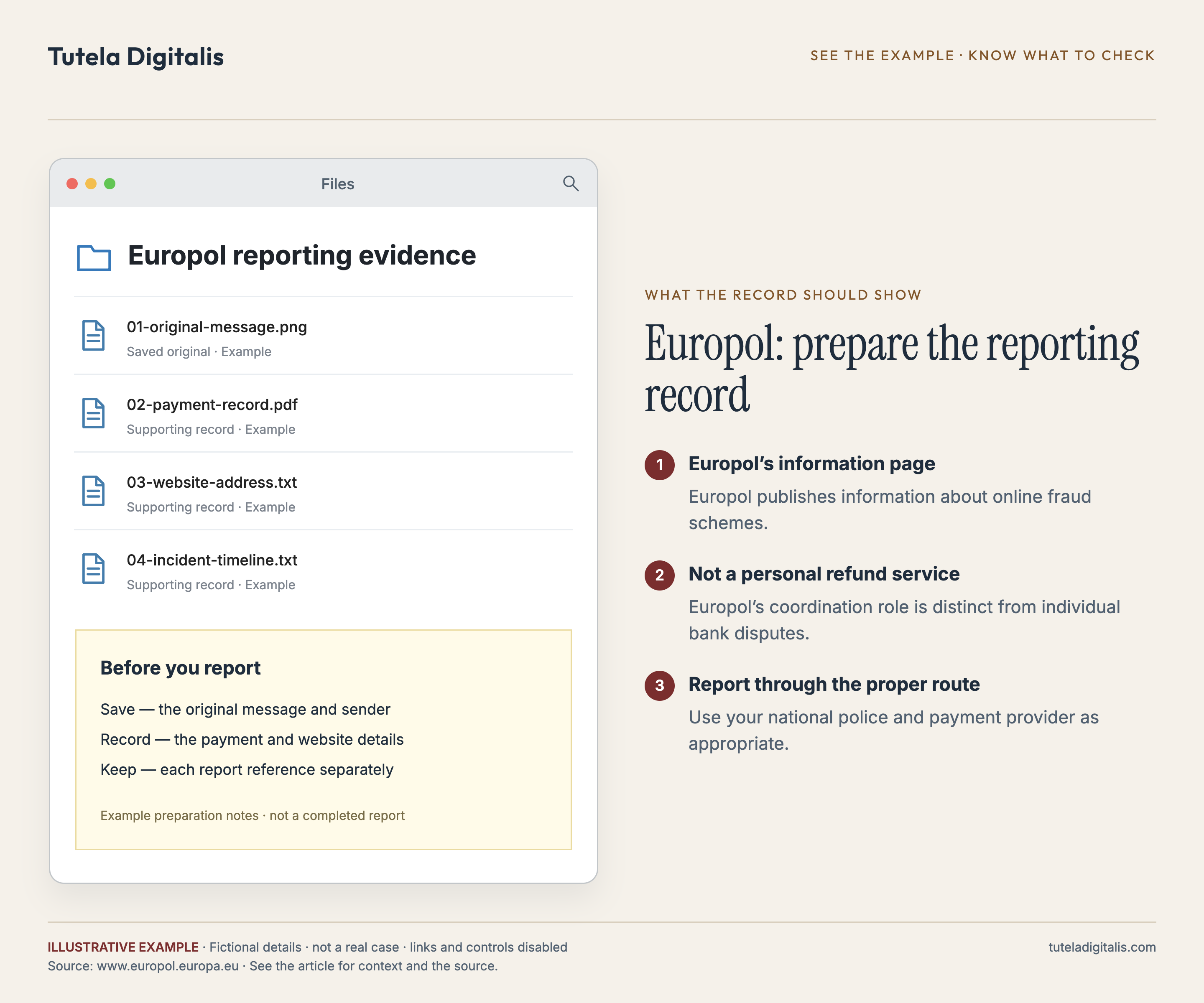
Illustrative example: 01-original-message.png 02-payment-record.pdf 03-website-address.txt 04-incident-timeline.txt Before you report Save — the original message and sender Record — the payment and website details Keep — each report reference separately
- Europol’s information page. Europol publishes information about online fraud schemes.
- Not a personal refund service. Europol’s coordination role is distinct from individual bank disputes.
- Report through the proper route. Use your national police and payment provider as appropriate.
For years, the standard advice to a scam victim in Europe has run into the same wall: the money, the website and the call centre are usually in a different country from the victim, and the police forces chasing them are not. Fraud is borderless; enforcement is not. The EU Anti-Scam Platform is Europe's attempt to close that gap — and whether it works matters to anyone who banks, shops or dates online across the continent. Here is what was actually announced, and how to read it honestly.
If you have already been scammed and want the practical steps, skip to what still protects you. The platform does not change any of them.
What Europol actually announced
Speaking in Dublin on 1 May 2026, Europol's Deputy Executive Director of Operations, Jean-Philippe Lecouffe, presented the EU Anti-Scam Platform as, in his words, "an operational hub to confront and address the industrialisation of online fraud." He framed it as a "strategic shift to more proactive disruption" — meaning Europe wants to dismantle fraud networks before more victims are hit, rather than only investigate after the fact.
According to reporting on his remarks, the platform concentrates on five things:
The platform draws on two existing Europol bodies: the European Cybercrime Centre (EC3) and the European Financial and Economic Crime Centre (EFECC). In plain terms, it is a coordination engine for law enforcement — a way to fight an industrial problem at an industrial scale. The private-sector side is admitting the same scale: Google's 2026 scams advisory put the global cost at $580 billion and named the scams riding its own products.
Why now: the industrialisation behind the announcement
The language is telling. "Industrialisation" is not a word regulators reach for lightly, but it fits. Europol has named online fraud one of the EU's top organised-crime threats in its 2026 Internet Organised Crime Threat Assessment, and the cases bear it out: these are no longer lone operators but staffed call centres, scripted in multiple languages, with their own infrastructure and money-laundering pipelines.
This is also why the announcement landed in Dublin: the European Anti-Financial Crime Summit drew law-enforcement leaders from across the continent precisely because the problem has outgrown national borders. We map how the patchwork of national rules leaves victims protected unevenly across Europe in our pan-European recovery-rights guide, and how the investment-fraud playbook works in countries like Austria.
What it does, and, honestly, what it doesn't
Here is the part worth being clear-eyed about, because the gap between what a platform like this can do and what people hope it does is exactly where false hope — and the next scam — takes root.
What it can do: make investigators faster and more joined-up. Better intelligence-sharing means a money-mule network unmasked in one country can be shut down in another before it drains more accounts. "Swift fund recovery" as a stated aim is real and worth having — the difference between freezing a transfer in hours and tracing it in months is often the difference between getting money back and not.
What still protects you
A continental platform is good news in the long run. But the things that decide whether you, personally, keep or recover your money have not changed — and they are all in your hands, today:
If you're not sure whether something you've received is genuine — a "broker," an investment platform, a recovery offer dressed up as official — send it through the Scam Checker or our free case review. A real person reads every one and replies within 24 hours.
Scammed in Europe, or not sure if an offer is real? Send it to us.
Paste the message, the platform, the "recovery" offer. A real expert reviews every case and replies within 24 hours. Free, confidential, no pressure.
Common questions about the EU Anti-Scam Platform
What is the EU Anti-Scam Platform?
It's a new operational hub set up by Europol to help police forces across the European Union fight online fraud together. Europol's Deputy Executive Director of Operations, Jean-Philippe Lecouffe, announced it on 1 May 2026 at the European Anti-Financial Crime Summit in Dublin, describing it as 'an operational hub to confront and address the industrialisation of online fraud.' According to reporting on his remarks, the platform centres on five things: maximising intelligence-sharing between countries, swift recovery of stolen funds, operational coordination, threat monitoring, and public-private partnerships. It draws on Europol's European Cybercrime Centre (EC3) and European Financial and Economic Crime Centre (EFECC). In short, it is a law-enforcement coordination tool — built to help investigators move as fast as the cross-border fraud networks they chase.
Will the EU Anti-Scam Platform help me get my money back?
Not directly, and it's important to be honest about that. The platform is a tool for police and investigators, not a consumer claims service you can apply to. One of its stated aims is faster recovery of stolen funds — and quicker cross-border coordination genuinely can improve the odds of freezing money before it disappears — but it does not refund victims, and there is no portal where you submit a claim to it. What still decides whether you see your money again are the same things as before: how fast you report to your bank and national authority, and the payment method you used. Anyone who tells you the 'EU platform' will return your funds for an upfront fee is running a recovery scam.
Does the platform cover the UK and other non-EU countries?
The platform is an EU initiative, run through Europol, so its core membership is the EU's law-enforcement community. Fraud, however, does not respect borders, and Europol routinely cooperates with non-EU partners — the UK, for instance, works with Europol on cross-border crime despite no longer being a member state. For a victim, the practical point is unchanged: report where you are. If you were scammed in the UK, use the UK's own route; if in the EU, use your national authority. Our country-by-country reporting guides cover both.
Why did Europe build this now?
Because online fraud has scaled into an organised industry. Lecouffe framed the platform as a response to 'the massive scale of online fraud schemes' and called it a 'strategic shift to more proactive disruption.' Europol has named online fraud one of the EU's top organised-crime threats in its 2026 Internet Organised Crime Threat Assessment (IOCTA). The pattern behind the headlines is industrial: in April 2026, Europol and Eurojust, working with Austrian and Albanian authorities, dismantled call centres behind a single online investment-fraud scheme that caused over €50 million in damage, arresting ten people and seizing nearly €900,000. The platform is Europe's attempt to fight that scale with coordination rather than 27 separate national efforts.
I've been scammed in Europe — what should I actually do?
Move quickly and use the channels that exist today; don't wait for any platform. First, contact your bank or payment provider immediately and ask them to try to stop or recall the payment — speed is everything. Then report to your national authority: each EU country has its own fraud-reporting route, which our European reporting guides list. Document everything — messages, screenshots, transaction references. And ignore anyone who later contacts you promising to recover your money for a fee, which is a second scam aimed squarely at people who just lost money.
Sources & further reading
Claims in this piece are attributed to these sources. Click any of them to verify.