The UK requires reimbursement for eligible authorised push payment fraud through Faster Payments or CHAPS. The cap is £85,000, subject to the rules and exceptions. Report promptly; the limit is 13 months from the final payment in the claim. Crypto and international payment routes need careful assessment. If refused, ask for the reason in writing, complain to the firm and consider the Financial Ombudsman.
Read the image explanation
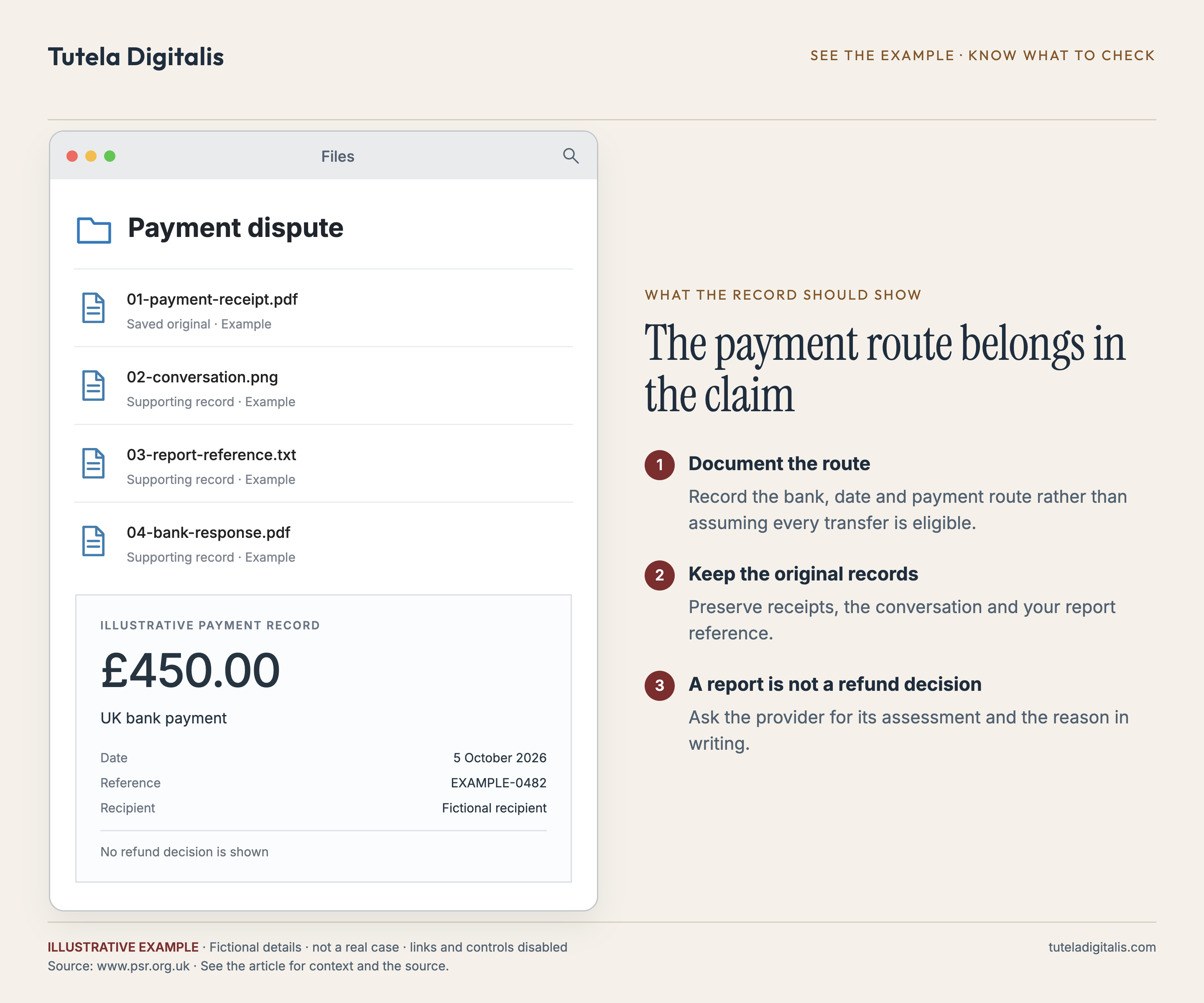
Illustrative example: Payment dispute £450.00 UK bank payment 01-payment-receipt.pdf 02-conversation.png 03-report-reference.txt 04-bank-response.pdf
- Document the route. Record the bank, date and payment route rather than assuming every transfer is eligible.
- Keep the original records. Preserve receipts, the conversation and your report reference.
- A report is not a refund decision. Ask the provider for its assessment and the reason in writing.
Updated 26 September 2026: corrected blanket statements about crypto-related claims and refusal grounds; added deadlines and clearer distinctions between the review's statistics.
Check the payment, not just the name of the scam
The PSR's consumer guidance covers eligible UK account-to-account payments from 7 October 2024. It applies to individuals, microenterprises and charities. Card payments, cash and cheques have different protections; unauthorised transactions also follow a different route. Tell the bank what actually happened, including whether you pressed send yourself.
A genuine dispute with a supplier is not automatically criminal fraud. Equally, a scam does not become a civil dispute merely because the criminal supplied an invoice or promised an investment. The PSR's civil-dispute guidance requires attention to the circumstances. Save evidence of deception, not just evidence that you are unhappy with the outcome.
Crypto is not a sufficient reason to stop asking questions
The PSR's consolidated rules distinguish payments to accounts you control from qualifying payments to someone else. They expressly address multi-step scams. A cryptocurrency transfer is outside the scheme; moving pounds to your own exchange account and then sending crypto is not the same as paying a fraudster's UK account over Faster Payments. An international payment is also outside this scheme, but a person's overseas location alone does not settle a UK-account payment's eligibility.
The cap, the clock and the exceptions
The PSR sets an £85,000 cap and permits an excess of up to £100. Reimbursement normally takes five business days; an assessment can pause for permitted information requests, but must conclude within 35 business days. These are claim-handling times, not promises about a subsequent complaint.
Gross negligence is not the only possible reason for rejection. Scope, the reporting limit, complicity and fraudulent claims also matter. For the consumer standard of caution, the bank must establish gross negligence against the relevant requirements; ordinary carelessness is not enough. The scheme protects qualifying vulnerable consumers from that exception and the excess. Explain relevant circumstances and ask the bank to assess them.
What the evidence actually says
The PSR's summary of Frontier Economics' evaluation attributes an estimated £73 million reduction in annual APP fraud losses and nearly 35,000 fewer scams to the policy. It reports reimbursement rates rising from 54% to 65% across all claims and 97% for in-scope claims. It found no evidence of market exits or reckless consumer behaviour, while warning that implementation remains inconsistent.
Do not turn that 97% figure into a personal probability of winning a claim. Nor should it be substituted for the PSR's separate first-anniversary dashboard figure: 88% of money lost and claimed was returned. One source summarises an evaluation; the other describes money reimbursed in a different reporting dataset. Claim counts, loss values, scope and periods must stay attached to their figures.
Which?'s 24 September 2026 review highlights unresolved scope disputes and calls for more transparency about rejections. Those concerns justify clearer guidance; they do not themselves change the rules. The policy's measured success and an individual refusal can both be real.
Three places a claim can go wrong
A bank may classify a claim as outside the scheme, a civil dispute, late, fraudulent or a breach of the consumer standard of caution. These are different decisions. An unexplained rejection tells you too little to assess whether the rules were applied correctly.
A crypto investment story does not tell you which payment system carried your money. A UK transfer to someone else's account, a transfer to your own exchange account, and a later cryptocurrency transfer are different steps. Do not collapse them into a single label.
A long-running investment or relationship scam can remain hidden while payments continue. Keep the date of the final payment clear and report as soon as you discover the deception; do not wait for the platform's promised withdrawal date.
If your bank refuses, make the decision specific
The Financial Ombudsman Service is free. Complain to the firm first; you can refer the matter after its final response or once its response deadline has passed. Normally you must refer within six months of the final response. Follow the deadline in that letter and contact the Ombudsman if unsure.
Keep the claim reference, transfer records, communications with the scammer, warnings you saw, your explanation of the deception and the bank's response together. Our bank-refund guide covers other routes, while the Scam Refund Index provides the international comparison. Be wary of anyone using a refusal to sell you a guaranteed recovery service.
Sent money to a scammer and your bank said no? Let’s look at the claim together.
Tell us the amount, how you paid, and what the bank said. A real expert reviews every case and replies within 24 hours. Free, confidential, no pressure.
Common questions about the UK scam refund rules
Does my UK bank have to refund a scam?
Eligible APP fraud payments made from 7 October 2024 can qualify for mandatory reimbursement. Eligibility depends on the payment route, account and claimant, the reporting deadline and the exceptions. Authorising the transfer yourself does not automatically defeat an APP claim: that is the kind of deception the scheme addresses. Ask your payment provider to assess the actual payment.
How much can I get back?
The scheme's limit is £85,000 per claim, with a possible excess of up to £100. The excess and consumer-standard-of-caution exception do not apply where the scheme's vulnerability protection applies. A larger loss is still worth reporting: ask about other complaint routes and the Financial Ombudsman, rather than treating the cap as a reason to abandon the whole claim.
My bank says I was grossly negligent. What should I do?
Request the evidence and the specific consumer-standard-of-caution requirement it says you breached. Explain how the scam worked and any relevant vulnerability. Make a formal complaint if you disagree, then consider the free Financial Ombudsman Service. A successful appeal is not guaranteed, but a refusal is a decision you can challenge.
Are cryptocurrency scams covered?
A cryptocurrency transfer itself is outside this bank-transfer scheme. Sending money to your own crypto-exchange account and then sending crypto to a fraudster is not automatically covered either. But an investment scam mentioning crypto may involve a separate qualifying UK bank transfer to a scammer-controlled account. Identify the recipient and payment route before deciding whether to claim.
Are international transfers covered?
International payments are outside the mandatory APP scheme. That does not mean every case involving someone abroad is excluded: the payment system and relevant UK accounts matter, rather than just where a person is located. Ask the provider about a recall and other available complaint or refund routes; recovery is not guaranteed.
What did the independent review find?
The PSR's summary of Frontier Economics' evaluation reports an estimated £73 million annual reduction in APP fraud losses and nearly 35,000 fewer scams attributable to the policy. It also reports higher reimbursement rates, while recognising inconsistent implementation. Those findings support the policy's effectiveness; they do not establish that every individual loss qualifies.
Sources & further reading
Every figure in this piece is drawn from these authorities. Click any of them to verify.