The fake Österreichische Post SMS claims a parcel is held at a sorting centre and demands a small "Einfuhrzoll" or "Zustellgebühr" (import or delivery fee) — usually a few euros, like €2,99 — through a link to a lookalike site such as postag.org. It is phishing: the page harvests your card details. The Post itself says it never requests payment or data by SMS and only ever uses the .at domain. It works in Austria because real customs duty on non-EU parcels genuinely exists — but a real charge is settled in the official Meine Post app or at a post office, never through an SMS link. The rule: if the link isn't on post.at, or the text asks you to pay or enter card details, it's a scam. Report it to watchlist-internet.at and rufnummernmissbrauch.at.
If you have already tapped the link and entered your card, skip to if you already paid — the first phone call to your bank is the one that matters.
Why this one is harder to dismiss than most
Smishing usually relies on a story that falls apart the moment you think about it — a bank you don't use, a parcel you never sent, a fine for a road you've never driven. The fake Post customs text is different, and more dangerous, because every part of its premise is genuinely real in Austria.
Austria is in the EU, so a parcel from another EU country arrives with nothing to pay. But order something from the UK, the US, China or anywhere outside the Union, and it can genuinely attract import VAT and customs duty — and Österreichische Post genuinely charges a handling fee when it clears that parcel through customs on your behalf. If you have ever received a real one of these, you know the feeling: a slightly confusing, slightly annoying small charge you half-expected. That memory is the scam's best friend. The criminal isn't asking you to believe a lie. They're asking you to assume this is the same dull errand you've done before.
What a real Österreichische Post charge actually looks like
The cleanest way to see the fake is to know the real process, because they diverge at exactly one point — the moment money changes hands.
When the Post clears a genuine parcel through customs, it tells you. But it tells you through its own channels: a notification in the official Meine Post app, or a physical card in your letterbox. Any charge is shown to you there, with the parcel it belongs to, and you settle it the ordinary way — in the app, or in cash or card at a post office counter. There is a real reference number tied to a real shipment. What there never is, is a text message with a link that takes you straight to a card form. The Post does not outsource the most sensitive step — your payment — to a tap on an SMS.
So the test isn't whether a customs charge can be real. It's whether the Post would ever collect it like this. And on that, the Post could not be clearer.
"Ignorieren Sie diese E-Mail und geben Sie auf keinen Fall persönliche Informationen oder Kreditkartendaten ein."
— Österreichische Post, on its "Gefahren im Internet" advisory: ignore the message and under no circumstances enter personal information or credit-card data. The Post adds that its real messages only ever come from the .at domain — anything else is not the Post.
Real versus fake, side by side
Put the two messages next to each other and the difference isn't subtle — once you know where to look.
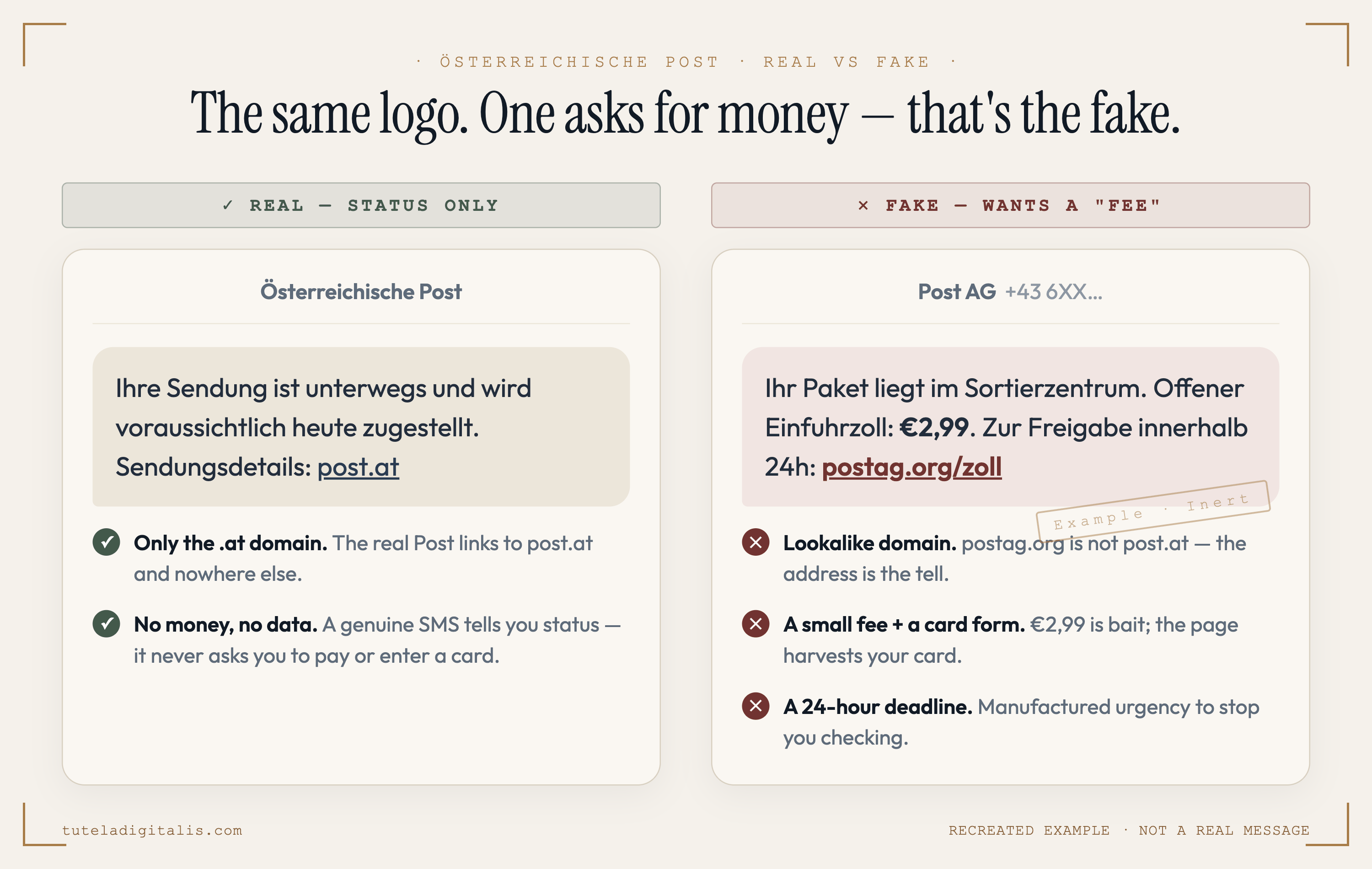
The three tells that survive every version
The wording changes — "Zustellgebühr", "Einfuhrzoll", "Zollgebühr", "Lagergebühr", a "Sortierzentrum", a different cent amount — but the structure underneath is fixed. Three tells are present in almost every one, and spotting a single one is enough.
If you already paid: the first hour
Tapping the link and entering your card is not the end of it, but speed decides how it ends. Work in this order:
Will you get the money back?
It turns on one distinction, the same one across the EU. If the charge was unauthorised — the criminals took your captured card details and spent more without your say — your bank must refund it under the Zahlungsdienstegesetz (ZaDiG), the Austrian implementation of the EU Payment Services Directive, with your own liability generally limited. If you were deceived into authorising the payment yourself, Austria, like most of the EU, has no UK-style rule forcing the bank to reimburse it — which is why the chargeback call and the speed of it matter so much.
How to protect yourself
One rule, end to end
If you take one habit from this piece, take this: the Post tells you about parcels by SMS, but it never takes your money or your data there. A real customs charge lives in the Meine Post app or at a post-office counter on post.at — never behind a link in a text. Check the domain, ignore the fee, and the most believable smishing text in Austria has nothing left to stand on.
Got a Post text you're not sure about? Let's look at it together.
Paste the message, the link, the sender. A real expert reviews every case and replies within 24 hours. Free, confidential, no pressure.
Common questions about the fake Post SMS
Does Österreichische Post send texts asking you to pay a customs or import fee?
No. The Austrian Post is explicit: its SMS only ever inform you about the status of a parcel — they never ask you to pay money or enter data. On its 'Gefahren im Internet' page the Post tells customers to ignore such messages and 'auf keinen Fall persönliche Informationen oder Kreditkartendaten' (under no circumstances enter personal information or credit-card data). A real import charge is never collected through a link in a text.
But I really did order something from outside the EU — couldn't the fee be real?
That is exactly why this scam works in Austria. Parcels from outside the EU genuinely can attract import VAT and customs duty, and Österreichische Post does charge a real handling fee when it clears a package through customs — so a small 'fee' feels completely plausible. The difference is the channel: a genuine charge is shown to you in the official 'Meine Post' app or on a notification card and paid at a post office or in the app, never by typing your card into a page that an SMS sent you to.
How can I tell the fake Post text from a real one?
Look at the web address, not the message. The Post only ever uses the .at domain — post.at and its official app. The scam links go to lookalikes such as postag.org, post-at.com, or a random shortened link; the message itself often references a 'Sortierzentrum' (sorting centre) and a tiny outstanding fee like €2,99. If the link is not on post.at, or the text asks you to pay or enter card details at all, it is a scam — the sorting-centre wording and the small amount are just set dressing.
Where do I report a scam SMS in Austria?
Three places, and they take minutes. Report the message to Watchlist Internet (watchlist-internet.at), Austria's online-fraud reporting service run by the ÖIAT, which uses reports to warn the public. Report the sender to the RTR's Meldestelle Rufnummernmissbrauch at rufnummernmissbrauch.at, the official channel for scam calls and texts. And if you lost money, report it to the police (Bundeskriminalamt). If the text impersonated the tax office, the Finance Ministry (BMF) also warns about and collects these.
I entered my card on the fake Post page — what do I do now?
Move in minutes. Call your bank or card issuer immediately, have the card blocked, and ask them to attempt a chargeback or recall any payment — the Austrian Post itself advises blocking the card and requesting a chargeback once you have paid a fake demand. Change the password of any account whose login you entered. Report the message to Watchlist Internet and rufnummernmissbrauch.at, and report the loss to the police. Then ignore anyone who later offers to 'recover' your money for a fee — that is a second scam.
Sources & further reading
Every fact in this piece is drawn from these Austrian authorities. Click any to verify.