The independent record on bunnyband.com points one way. ScamAdviser gives it a trust score of 0 out of 100 and, in a dedicated review, reports that the dashboard "earnings" are simulated numbers and that withdrawal requests are kept in a permanent "pending" state. The domain was registered only in March 2026; Trustpilot carries hundreds of reviews at roughly 1.5–2 out of 5, overwhelmingly about payouts that never arrive. No government regulator has named Bunnyband, so we state this as what the public record shows — but it is one-directional. The decisive test is structural, not reputational: try to withdraw a small amount to your own bank before you invest more time, deposit anything, or invite anyone. A clean payout is the only proof that matters — and the one thing reviewers say never happens.
"The 'earnings' you see on your dashboard are simulated numbers designed to keep you engaged. Withdrawal requests are systematically ignored or kept in a permanent 'pending' state."
— ScamAdviser, in its review "Bunnyband Review: Is It a Scam or Legit? (Withdrawals Never Work)" (2026). ScamAdviser also assigns bunnyband.com an automated trust score of 0 out of 100 and notes the domain is only months old.
Let me be straight about what this page is. It is not our own forensic accusation — we have not audited Bunnyband's servers, and pretending otherwise would be dishonest. It is the honest, useful thing instead: the verifiable public record laid out plainly and attributed to the sources that produced it, followed by a test you can run yourself in about a minute that does not depend on trusting us, ScamAdviser, or anyone else.
That matters because the name is the least durable part of this. The same question lands in my inbox in a dozen spellings every month — is bunnyband legit, is this earning app real, my balance says $4,000 but the withdrawal is stuck. The brands rotate; the machine underneath never changes. So rather than stake everything on one company's reputation, learn the structure — the version that works on Bunnyband exactly as well as on the clone that replaces it next month. We wrote the general framework up as the 8-point check for any task platform; this page points it straight at Bunnyband.
If you're reading this with the app open and a sinking feeling, skip to if you already signed up. What you do in the next few minutes matters more than the last few weeks of clicking.
What Bunnyband is, and how the "earning" works
Bunnyband presents itself as a money-earning platform: you complete simple actions — click buttons, watch ads, share your referral link — and a balance climbs. The advertised numbers, corroborated across reviewer writeups and the platform's own promotional posts, are deliberately friendly:
This shape has a name: a paid-to-click (PTC) scheme. ScamAdviser flags Bunnyband as "potentially PTC jobs." The economics never close — no legitimate business pays people meaningful money to click ads and recruit friends — because the revenue was never the point. The point is engagement, referrals, and the data you hand over on the way in.
The one lie at the center: the balance is a number, not money
Here is the single idea that dissolves the whole scam. The balance on your Bunnyband dashboard is not money. It is a number in someone else's database. It costs the operator nothing to make it climb, nothing to show a $10 bonus, nothing to add $5 for a referral, nothing to display $4,000 "ready to withdraw." Fabricating that figure is free. The only event in the entire process that costs the operator anything real is a withdrawal actually leaving their control and landing in your bank — and that is precisely the event the record says never happens.
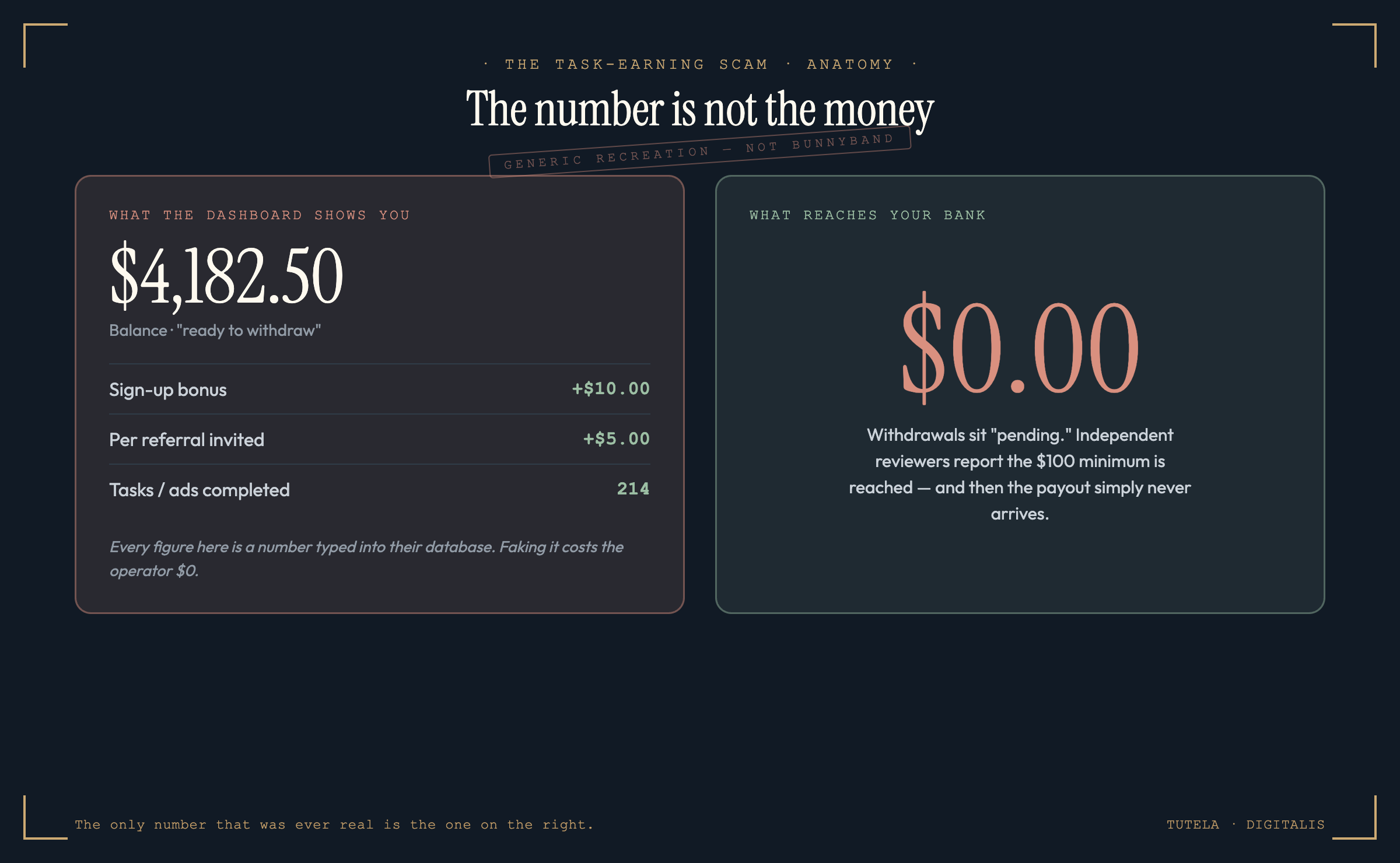
This is the same move a scammer runs with a fake trading screenshot or a doctored payment confirmation — manufactured evidence built to satisfy your instinct to check, so the checking stops. We took that whole technique apart in the piece on why scams sound official: the rule there is the rule here. Evidence that only exists on their screen is set dressing. The one number that survives leaving their stage is a withdrawal in your own account — so that is the only number worth generating.
What the public record shows about Bunnyband (2026)
Everything below is independently checkable and attributed. None of it is our own accusation; all of it points the same direction.
The 60-second test that settles it
You don't have to weigh reviews against each other or trust a trust score. You can generate the one piece of decisive evidence yourself, and it takes about a minute.
If you already signed up
Read this slowly. The good news, if there is any, is that Bunnyband's model is to withhold your payout rather than to drain your bank — so if you never deposited money or connected a wallet, your direct financial loss may be limited to your time. The exposure is elsewhere. Handle it in order:
So, is Bunnyband legit?
The most honest answer anyone can give you: the entire independent record — a 0/100 trust score, a dedicated review concluding withdrawals never work, a domain registered months ago, hundreds of negative reviews, and multiple security sites in agreement — points to a paid-to-click scheme that is built to collect effort, referrals, and data while paying nothing back. No regulator has stamped it, and we won't pretend to a certainty the outside world can't have. But you are not stuck with the outside view.
You can produce the missing proof in sixty seconds. Try to withdraw before you invest another minute or another friend. If a small amount lands cleanly in your bank, that is real evidence in Bunnyband's favour. If it doesn't — if it stalls in "pending," or demands a deposit, a fee, or more recruits first — you have your answer, and you found it before it cost you anything more.
If you're not sure, just ask
Maybe you're mid-way in and can't tell which way to lean. Maybe you already pulled friends in and feel sick about it. Either way, you don't have to work it out alone, and you don't pay anything for a straight answer.
Describe what's happening in our free, confidential case review — a real person reads every one and writes back within 24 hours. For a faster first read, run the message or link through the Scam Checker. And for the full anatomy of how these schemes are built, that's what a task scam actually looks like.
Don't take my word, and don't take a trust score's word either. Run the test yourself, and remember the line that ends this conversation every time: the balance is a number; only a withdrawal is money — and you never pay in, or recruit in, to get it out.
Looking at Bunnyband right now? Let's check it together.
Send the link, the dashboard screenshot, the message that got you in. A real expert reviews every case and replies within 24 hours. Free, confidential, no pressure.
Common questions about Bunnyband
Is Bunnyband legit or a scam?
The public record points hard one way. The scam-analysis site ScamAdviser gives bunnyband.com a trust score of 0 out of 100 and publishes a dedicated review titled 'Is It a Scam or Legit? (Withdrawals Never Work),' concluding the dashboard 'earnings' are simulated numbers and withdrawal requests are kept in a permanent 'pending' state. The domain was registered only in March 2026, and Trustpilot carries hundreds of reviews rated roughly 1.5–2 out of 5, overwhelmingly about payouts that never arrive. No government regulator has named it, so we frame this as what the independent record shows — but that record is one-directional, and the 60-second withdrawal test on this page lets you confirm it yourself before you invest another minute or a single friend.
Has anyone actually withdrawn money from Bunnyband?
Independent reviewers and Trustpilot users overwhelmingly report the same outcome: the balance climbs, you hit the $100 minimum, you request a withdrawal — and it sits in 'pending' indefinitely, or the site simply stops processing it. We have found no credible, verifiable evidence of a real cash-out reaching a user's bank. That pattern — money flows in effort and referrals, nothing flows out — is the defining signature of a 'paid-to-click' earning scam. The only proof that would change the picture is a clean withdrawal to your own bank account, and that is exactly the thing reviewers say never happens.
My Bunnyband withdrawal is stuck on 'pending' — why?
Because on a platform like this, 'pending' is not a processing delay — it is the design. ScamAdviser's review describes withdrawal requests being 'systematically ignored or kept in a permanent pending state.' The balance you watched grow was, in its words, 'simulated numbers designed to keep you engaged' — a figure in the operator's database that costs them nothing to display and nothing to freeze. If your withdrawal is stuck, stop completing tasks and stop inviting people immediately: more activity only deepens your investment in a payout the record says will not come. Save screenshots and report it (see the aftermath steps on this page).
Is Bunnyband safe to give my email and details to?
Treat anything you gave it as compromised. A site with a 0/100 ScamAdviser score and a domain registered in March 2026 has no track record for protecting data, and 'earning' sites of this type are frequently as interested in harvesting emails, phone numbers and contact lists as in the engagement itself. If you signed up, assume your email will see more scam and phishing attempts, and if you reused the password anywhere else, change it now from a device you trust and turn on two-factor authentication. Never connect a crypto wallet or hand over banking or ID details to unlock a withdrawal.
I invited friends to Bunnyband — what should I do?
Tell them now, before they invest more time or invite others. The referral engine is not a bonus feature bolted onto the earning — on a paid-to-click scam it is the point: your invites do the recruiting the operator would otherwise have to pay for, and each new person becomes both a fresh contact-data harvest and another unpaid promoter. You were used as the sales floor. There is no shame in it — the design is built to turn enthusiasm into reach — but the kind thing now is to break the chain: message the people you referred, tell them the withdrawals don't come, and point them at the withdrawal test so they can see it for themselves.
How do I tell if an 'earning app' like Bunnyband is a scam?
Run one test that beats every brand name: try to withdraw a small amount to your own bank before you invest real time, deposit anything, or recruit anyone. A legitimate platform pays out cleanly on a normal rail. A scam invents friction — a minimum you can't quite reach, a 'pending' that never clears, a demand that you invite more people or verify with a deposit first. The tells that recur across all of them: an unrealistic pay rate for trivial clicks, a domain only months old, a heavy referral push, and earnings that live inside an app you don't control. The single rule underneath it all: you never pay in, or recruit in, to get money out.
Sources & further reading
The attributed claims on this page draw on these sources. Click any to check them yourself.