If you got a call, text, or email saying you missed jury duty and a warrant is out for your arrest unless you pay — it is a scam. The FTC warns that scammers posing as U.S. Marshals or police now text or email an official-looking "arrest warrant" with an amount owed, then demand payment by gift card, crypto, payment app, or wire. Two facts end it instantly: a real court contacts jurors by mail, and a real arrest warrant is served in person — never by text or email. And no court or agency takes payment by gift card or Bitcoin. Hang up, don't pay, and verify by calling the court clerk on a number you look up.
If a "warrant" is on your screen right now and your heart is pounding, skip to what to do. The rest of this explains why the document meant to scare you is the very thing that proves it's a lie.
Start with the document
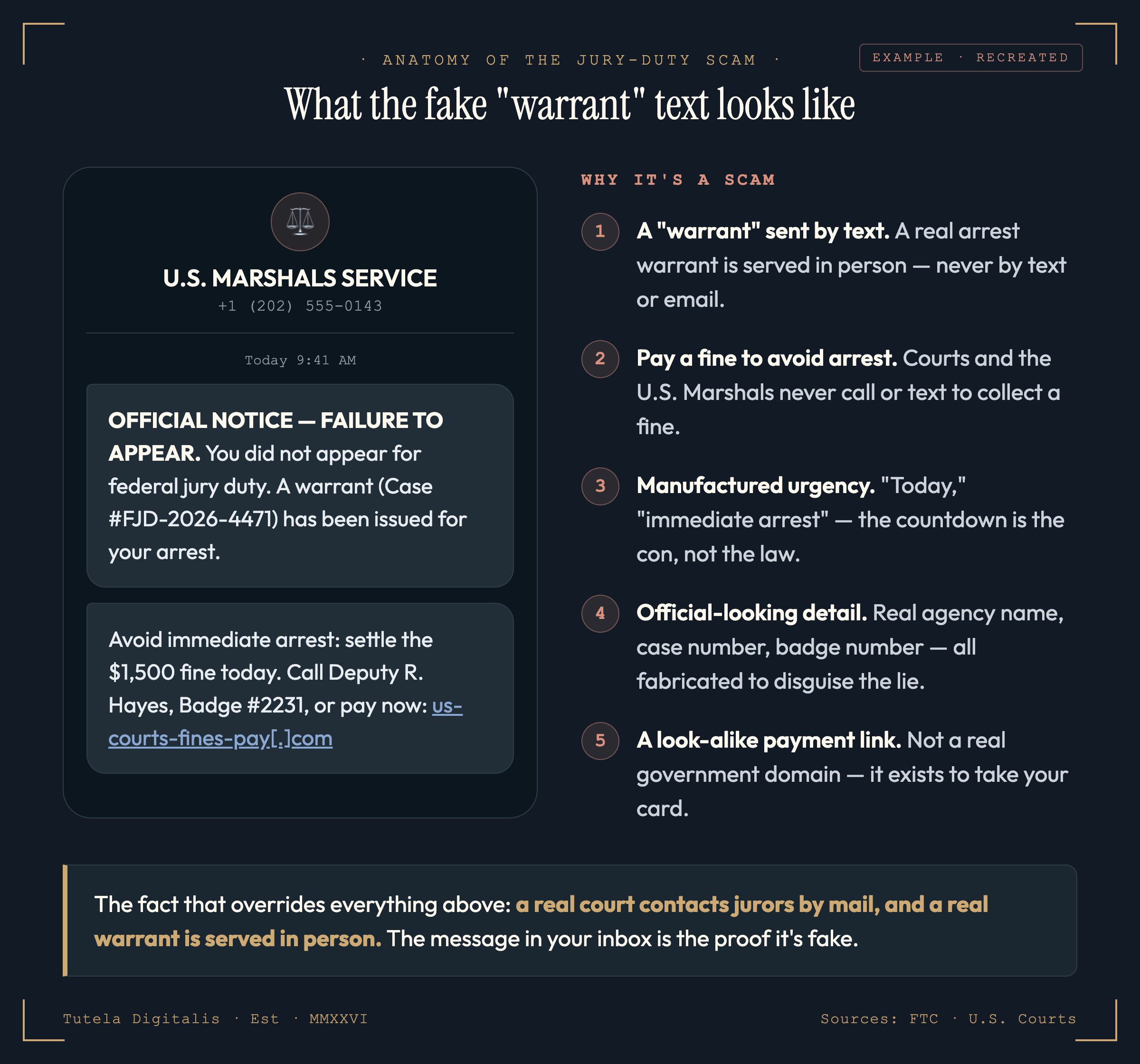
Most scam advice tells you to listen for tells in the call — the urgency, the threat, the odd payment method. All true. But this scam handed us something cleaner. In its 2026 form, described in an FTC consumer alert, the scammer doesn't just threaten a warrant: they send you one. A document, by text or email, that looks like an official arrest warrant, complete with how much you owe for missing jury duty.
That is a mistake on their part, because it collapses the whole con into a single, checkable fact. A real arrest warrant is never delivered to you by text or email. U.S. federal courts say it plainly: valid warrants are served in person by law enforcement — never by any electronic method. So the moment a warrant arrives in your inbox, you don't need to judge the wording, the logo, or the badge number. The delivery method already answered the question. The document built to panic you is the proof it's fake.
Why the fake is so convincing
People assume a scam will look obviously wrong. This one is engineered to look obviously right. According to U.S. federal courts, these jury-duty scams routinely include:
Here is the reframe worth holding onto: the detail is the disguise. The more official a cold call about an arrest feels — the more real names and numbers it throws at you — the more it should raise your guard, not lower it. A genuine court has no reason to assemble a convincing phone performance. It just mails you a notice.
What a real court actually does
Set the scam beside the real process and the gap is obvious.
The tell that never fails: how they want to be paid
If you remember nothing else, remember this. Every version of this scam — and nearly every government-impersonation scam — eventually steers you to a specific kind of payment.
This is why the payment method, not the threat, is the most reliable detector you have. Threats can be dressed up. The payment rail can't be — a real agency simply does not use these.
What to do if it happens to you
You don't have to outwit the script. You only have to refuse the two things it needs from you: your panic and your payment.
The bigger picture
This isn't a fringe scheme. The FTC reported that people lost about $920 million to government impersonators in 2025, up from $789 million the year before, inside a record $3.5 billion lost to imposter scams overall — close to one in three fraud reports. The jury-duty version works because it borrows the one institution almost everyone instinctively obeys: the court. It pairs a civic duty most people half-remember with a threat no one wants to test.
So if you take one line from this, take this: a real court reaches you by mail and a real officer reaches you in person — the warrant that arrives by text is the scammer telling on themselves.
Got a threatening "official" message? Let's check it together.
Send us the call, text, or "warrant" and where it's pushing you. A real expert reviews every case and replies within 24 hours. Free, confidential, no pressure.
Common questions about the jury-duty warrant scam
I got a text or email with an arrest warrant for missing jury duty. Is it real?
No. The FTC warns that scammers posing as U.S. Marshals or local police now send an official-looking 'arrest warrant' by text or email, showing a dollar amount you supposedly owe for missing jury duty. Real law enforcement will never text or email you an arrest warrant — a valid warrant is served in person. The document landing in your inbox is itself the proof it's fake. Don't click, don't reply, and don't pay.
How do the scammers know my name and make it look so official?
They make it convincing on purpose. According to U.S. federal courts, these scams often include real names of federal judges or court employees, actual court addresses and phone numbers, and invented case and badge numbers — and the caller ID is spoofed to display a real court or law-enforcement number. None of that detail proves the call is genuine; it's the disguise. A real court still wouldn't phone you to threaten arrest or take a payment.
How does a real court actually contact me about jury duty?
By mail. The U.S. Courts state that most contact between a federal court and a prospective juror is through the U.S. mail, and that courts do not require anyone to provide sensitive information in a phone call or email. If you're genuinely summoned and miss it, a court resolves it through official mailed notices and, if necessary, in-person process — never an urgent call demanding money to avoid arrest.
They want payment by gift card, Cash App, or Bitcoin. Does any agency take payment that way?
Never. The FTC is blunt about this: no government agency will tell you that you can only pay by gift card, cryptocurrency, a payment app, or a wire service like Western Union or MoneyGram. Courts and the U.S. Marshals Service do not call to collect fines over the phone at all. The moment someone demands payment in one of those forms to make an arrest 'go away,' you are talking to a scammer — that single detail is the tell that never fails.
I already paid. What do I do now?
Act fast and don't blame yourself — these are engineered to panic you. If you paid by card or bank transfer, call your bank or card issuer immediately and ask them to stop or reverse it. If you paid by gift card, contact the card's issuer right away with the receipt and numbers. Report it at ReportFraud.ftc.gov and to the FBI at ic3.gov. Then watch for the second hit: anyone who contacts you offering to 'recover' the money or 'clear the warrant' for a fee is running a follow-up scam aimed at people who were just hit.
Sources & further reading
Every fact in this piece is drawn from these sources. Click any to verify.