BRAZIL · PIXJune 16, 20269 min read

A stranger Pixes you by mistake and asks for it back. The polite thing to do is the scam — and it can take your money twice.

Pix moved money in Brazil at the speed of a text — and the fraud moved with it. The signature trick doesn't break into your account; it asks you, kindly, to give. A small payment lands "by accident", an apologetic message follows, and the moment you transfer it back to the account they name, you've paid a scammer with your own money. Banco Central rebuilt its refund mechanism in May 2026 to fight exactly this. So why does returning a stranger's money still cost so many people their own? Here is the trick, beat by beat — and the single button that ends it.

May 2026
MED 2.0 refund mechanism went live (Banco Central)
7 days
Banks' window to assess a fraud claim
Only what remains
What MED can actually return to you
“Devolver”
The in-app button that returns money safely
The short answer

The golpe do Pix errado (wrong-Pix scam) works like this: a stranger sends a small Pix into your account, then messages you — usually on WhatsApp — saying it was a mistake and asking you to send it back. The trap is the how: they want you to make a fresh transfer to a different account they name, instead of using your bank app's official "Devolver" (Return) button. So you send your own money; and in a crueller version, they then file a fraud claim through Banco Central's refund mechanism (MED) naming you. The one rule that defeats it: if money truly arrived by error, never transfer it back yourself — use "Devolver", which only ever returns it to the genuine original sender. Below is a recreated example, then a beat-by-beat decode.

If you use Pix — and in Brazil that is very nearly everyone — read the message below before you ever "return" a payment to a stranger. The scam doesn't rely on a fake app or a stolen password. It relies on your decency and a half-second of hurry.
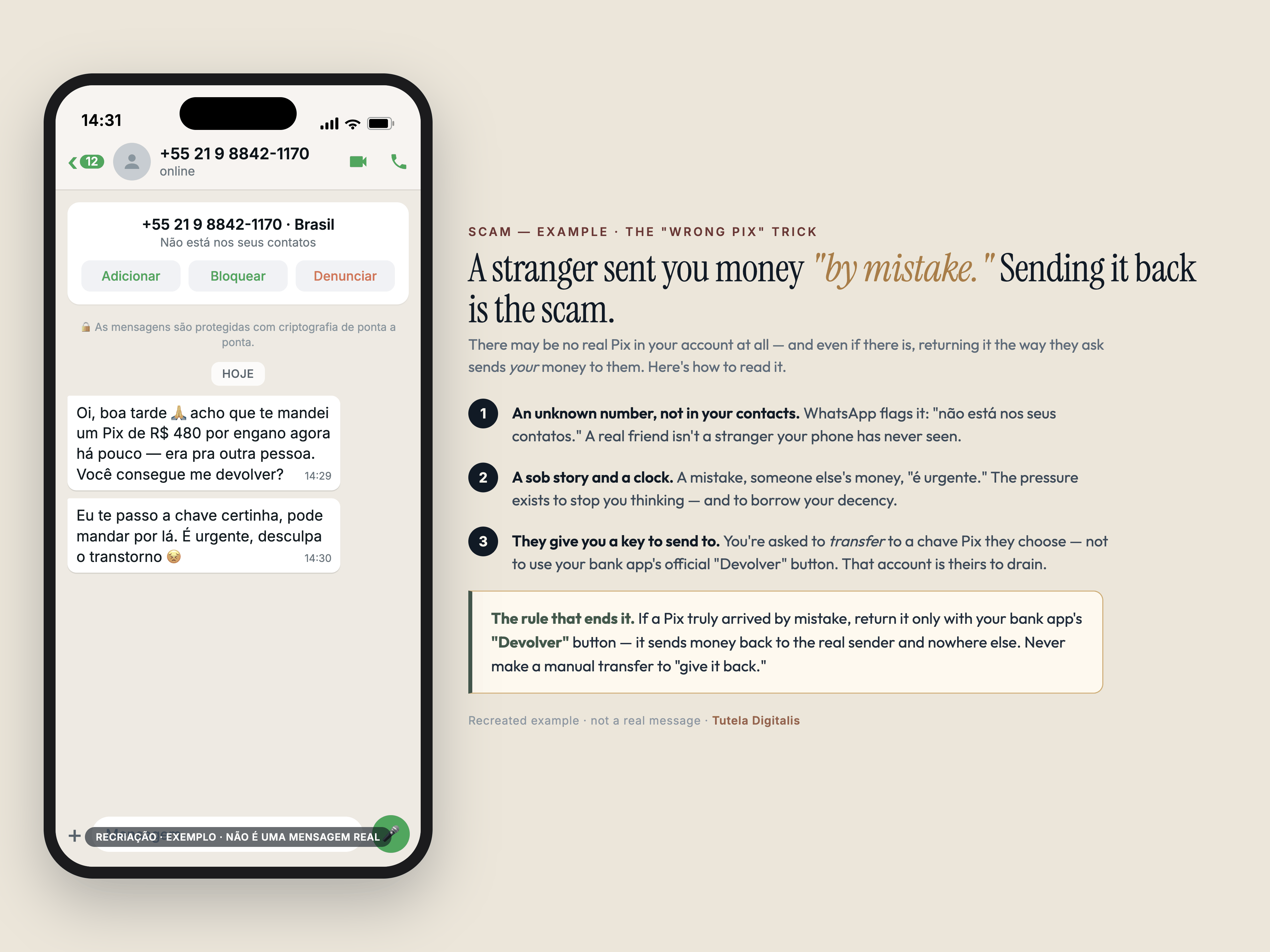
Recreated example of the 'wrong Pix' scam on a phone: a WhatsApp message from an unknown number says a Pix of R$480 was sent by mistake and asks the recipient to transfer it back to a key the sender provides, with the message decoded beside it — the unknown number, the apologetic story, the request to send to a different account, and the rule that a real error is returned with the in-app 'Devolver' button.
What the scam looks like, recreated. A genuine mistaken Pix is returned with the app's 'Devolver' button — to the real sender. A request to transfer it somewhere else is the scam. Example only, not a real chat.

Why Pix became the scammer's favourite rail

Pix is instant, free, available around the clock, and tied to something as simple as a phone number or an email. That frictionlessness is the point — and it is exactly what fraud exploits. There is no card network sitting in the middle to reverse a charge, no two-day window where a transfer can be quietly recalled. Once it confirms, it has moved. Brazilian state police forces (Polícia Civil) have repeatedly warned about the variants, and Banco Central has rebuilt its refund process twice to keep up. The scam economy simply moved to where the money is.

The wrong-Pix trick is a cousin of the "accidental Bizum" scam in Spain and the MB WAY request scam in Portugal — same family, different app. A stranger uses a real, official function (an instant transfer, a return request) and points it the wrong way. There is nothing fake to spot. The deception is which account you send to, and how fast they want you to do it.

Anatomy of the scam — decoded

The wrong-Pix scam is a short sequence built on guilt, good manners, and speed. Naming each move is what makes it visible.

1The small payment that lands 'by accident'
A Pix of R$480 arrives from a number you don't know.
The lever — Reciprocity + a clean conscience. A real amount really does land in your account, so there is nothing to disbelieve. Most people's instinct is decency: someone made a mistake, and you'd want it sorted if it were you. That instinct — not gullibility — is what the whole scam is built to borrow.
The counter — An unexpected Pix from a stranger is a setup, not a windfall and not your problem to fix manually. Don't act on it; wait for the proper channel.
2The apologetic message and the urgent ask
“Acho que te mandei um Pix por engano — era pra outra pessoa. Você consegue me devolver? Te passo a chave.”
The lever — Sympathy + manufactured urgency. A mistake, an apology, a please — it reads as human, and the urgency ('é urgente') is calibrated to stop you thinking. Critically, they tell you which key to send to — a different account from any the money came from — because that account is theirs to drain.
The counter — A genuine error is never an emergency, and never needs a different account. The moment someone hurries you or redirects the destination, it is a scam.
3You 'return' it — and pay them
You open Pix, type the amount, send it to the account they gave. Done.
The lever — The expected, virtuous action. Because returning a mistaken payment feels obviously right, the transfer doesn't trip any alarm. But the money you 'gave back' is your own — the small Pix that arrived may even be reversed later by its real owner, leaving you down twice. In the worst version, the scammer then opens a MED contestation claiming you defrauded them, and your account gets flagged.
The counter — If money truly arrived in error, use the app's 'Devolver' button — it returns funds only to the genuine original sender. Never make a manual transfer to 'give it back'.
The other Pix scam you must know: the cloned-WhatsApp relative. A scammer hijacks or spoofs a number and messages you as a family member — "mãe, troquei de número" ("mum, I changed my number") — then asks for an urgent Pix to a new account. State Polícia Civil forces have warned about it repeatedly. The defence is the same one your family used before apps existed: hang up and call the person back on their old, known number before sending a cent. And if you've already lost money, ignore anyone who then offers to "recover" it for a fee — that is the second scam.

What to do

1If a Pix arrives "by mistake", do nothing manual. Use your bank app's "Devolver" (Return) button if you genuinely want to return it — it only ever goes back to the real sender. Never transfer to an account a stranger names.
2Treat urgency and a 'different account' as proof of a scam. A real mistaken payment is not time-sensitive and is returned to its source, not somewhere new.
3For a relative's "new number" asking for money, call them back on their old, known number first. Confirm by voice before sending anything.
4If you were defrauded, open a MED contestation in your bank app immediately (both banks have up to seven days to assess), file a Boletim de Ocorrência at your state's delegacia eletrônica and the right channels, and keep every screenshot.
5Unsure about a message or a "buyer"? Run it through our Scam Checker or send it to our free case review before you act.
From the field. What makes the wrong-Pix scam so effective is that it asks you to do something good. There's no broken Portuguese, no dodgy link, no fake login — just a real transfer, a believable apology, and a clock. That's why careful, kind people fall for it: they aren't being fooled about a fact, they're being rushed into a reflex. Banco Central's MED 2.0 is a genuine improvement — it now chases money across the pass-through accounts scammers hide behind — but it can only return what hasn't yet been pulled out as cash, and that race is one the victim usually loses. The defence isn't suspicion of everyone who messages you. It's one boring habit: money that truly arrived by mistake goes back through the Return button, to the person who sent it — never by a fresh transfer to a stranger in a hurry.

Got a Pix "by mistake" and a message asking for it back? Send it to us first.

Paste the chat and the amounts. A real expert reviews every case and replies within 24 hours. Free, confidential, no pressure — before you tap anything.

Submit a free case review →Where to report a scam in Brazil

Common questions about the Pix scam

What is the 'wrong Pix' scam (golpe do Pix errado)?

It's a Pix scam that turns your honesty against you. A stranger sends a small Pix into your account, then contacts you — usually by WhatsApp or phone — claiming it was a mistake and asking you to 'send it back'. The trap is in how you return it: they ask you to make a new transfer to a different account they name, rather than using your banking app's official 'Devolver' (Return) button. You end up sending your own money, and in some versions the scammer then files a fraud claim through Banco Central's Special Refund Mechanism (MED) claiming you were the fraudster. The Banco Central's guidance is blunt: never transfer it back manually — use the in-app Return button, which always sends money to the true original sender.

How does MED (the Special Refund Mechanism) work in Brazil?

The MED (Mecanismo Especial de Devolução) is Banco Central's process to claw back a Pix sent in fraud or by error. You open a contestation in your own banking app; the claim goes immediately to the receiving bank, which can block the suspect funds while it investigates. Under MED 2.0, live since May 2026, the two banks have up to seven days to assess the claim and funds can be held for up to eleven days, and — crucially — banks must now trace money across the intermediate 'pass-through' accounts scammers use to launder it, not just the first account. But MED can only return money that is still somewhere in that chain. Once it has been withdrawn as cash, it is gone.

Will my bank refund a Pix I was tricked into sending?

Be realistic. If the transaction was unauthorised — someone accessed your account and sent the Pix without you — the bank is generally on the hook. But if you authorised the Pix yourself because you were deceived, there is no blanket legal requirement in Brazil that the bank reimburse you; MED is a recovery mechanism, not a guarantee, and it succeeds only to the extent the money still exists in the chain. Brazilian outlets, citing Banco Central data, have reported that the old version of MED returned only a small fraction of contested amounts — which is exactly why MED 2.0 was built to chase the funds further. Speed is everything: contest in-app and file a police report the same day.

Someone sent me money 'by mistake' on Pix — what should I do?

Do not transfer it back yourself, and do not send it to any account a stranger names — doing so can turn your account into a money-laundering link and can cost you your own money. If a Pix really did arrive in error, the sender's own bank can recover it through official channels, and you can use the 'Devolver' (Return) button in your app, which sends the money back to the genuine original sender and nowhere else. If anyone pressures you to act fast or to use a different account, treat it as a scam, and check it with us first.

Sources & further reading

Claims here follow Banco Central do Brasil guidance on MED 2.0 and the Pix-return button, Polícia Civil warnings on the variants, and Brazilian press reporting; the historical MED recovery rate is reported by Brazilian media citing Banco Central.

Agência Brasil — new Pix security rules / MED 2.0Senado Verifica — Pix fraud: how to recoverInfoMoney — the 'wrong Pix' scamBanco Central — MED guide (PDF)

Keep reading