Where to report a scam in Australia, and what changed when the Scams Prevention Framework became law.
Australians reported $2.18 billion in scam losses in 2025 across Scamwatch, ReportCyber, AFCX, IDCARE and ASIC — up 7.8% from 2024's $2.03 billion, even though both years remain well below the 2022 peak of $3.1 billion. In February 2025, Australia passed the world-first Scams Prevention Framework Act, which puts mandatory anti-scam obligations on banks, telcos and digital platforms. The reporting landscape is real, more coordinated than most countries — and most online guides have the agency roles wrong. This is the actual current map.
$2.18B
Reported AU scam losses 2025 (NASC)
$837M
Investment scams 2025 — top loss category
13 Feb 2025
Scams Prevention Framework Act passed
1800 595 160
IDCARE — free identity & cyber support
The short answer
Australia's official reporting routes in 2026 are: Scamwatch (ACCC) at scamwatch.gov.au for intelligence and stats; ReportCyber (ACSC) at cyber.gov.au/report-and-recover/report for the police-referred channel when you have lost money or data; IDCARE on 1800 595 160 for identity and account-compromise support; ASIC for investment fraud; AFCA at afca.org.au for bank dispute escalation; and 000 for immediate danger or 131 444 for non-emergency police. The most-misunderstood detail: Scamwatch is NOT a police report — it is the awareness and intelligence channel. ReportCyber is the police route. File both. The Scams Prevention Framework is being introduced in stages; do not confuse AFCA membership with the start of its new complaints arrangements.
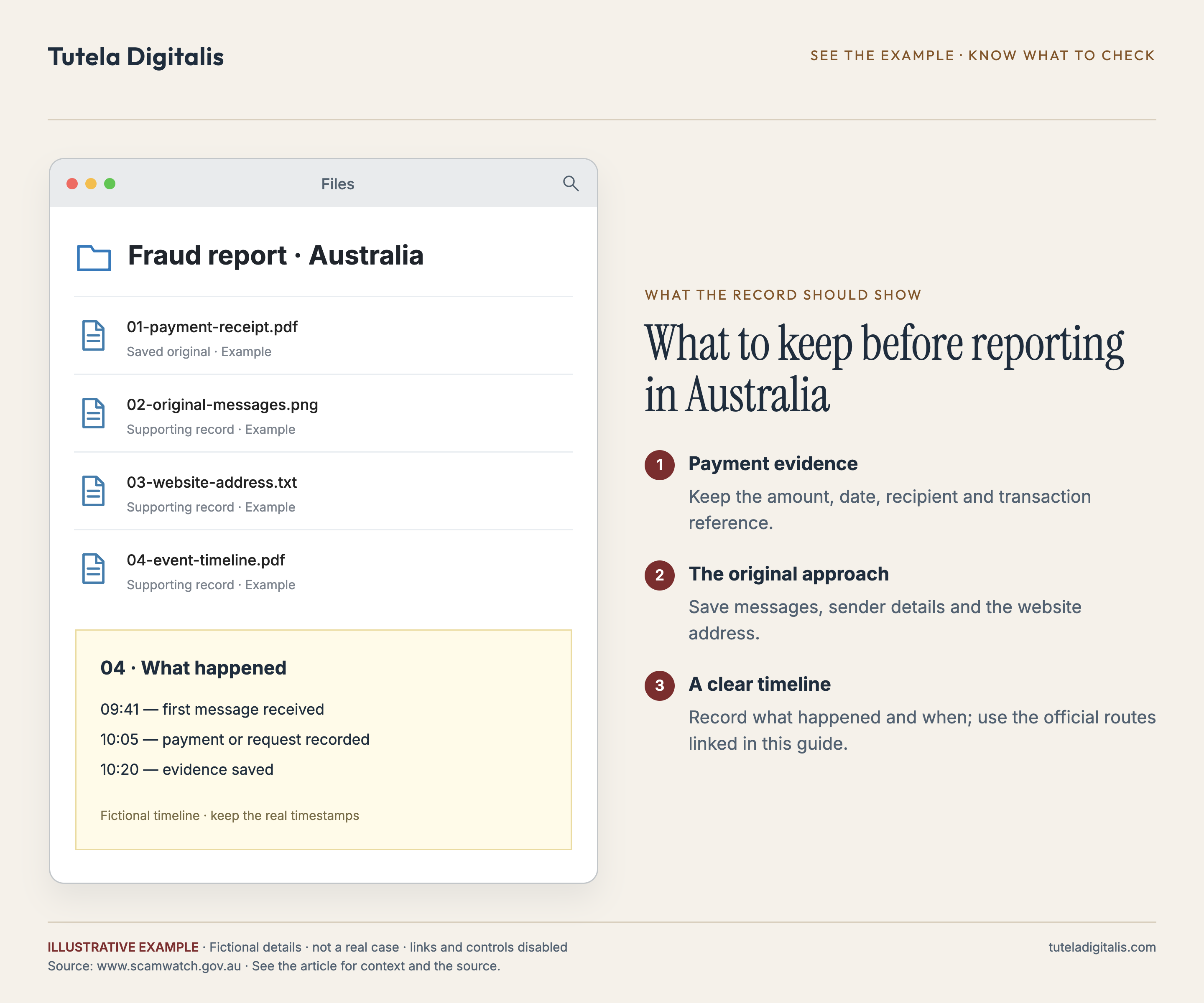
What to keep before reporting in Australia. Illustrative evidence-preparation folder with fictional files. It is not an official reporting form and does not imply that a report has been submitted. View the source. Open full-size image.Illustration added 6 October 2026.Read the image explanation
Illustrative example:
Fraud report · Australia
01-payment-receipt.pdf
02-original-messages.png
03-website-address.txt
04-event-timeline.pdf
Payment evidence. Keep the amount, date, recipient and transaction reference.
The original approach. Save messages, sender details and the website address.
A clear timeline. Record what happened and when; use the official routes linked in this guide.
Updated 27 September 2026: the ACCC's implementation timetable distinguishes September membership from the March 2027 start of most obligations and the new complaints arrangements. The earlier June 2026 and January 2027 dates in this guide were incorrect.
If money has moved, contact your bank immediately. Acting quickly can help, but there is no universal one-hour cutoff after which reporting is pointless.
Scamwatch vs ReportCyber: the distinction nobody explains
This single point causes more useless reports than anything else in the Australian system, so it is worth being precise.
—Scamwatch (scamwatch.gov.au). Run by the ACCC's National Anti-Scam Centre. A Scamwatch report is an intelligence and awareness submission — it feeds the national fraud picture, the quarterly NASC updates, and the annual Targeting Scams report. It is NOT a police report. The ACCC does not investigate individual cases and Scamwatch does not, by itself, open a criminal file. Use it when you want the system to know a scam happened — including for attempted scams where you lost nothing.
—ReportCyber (cyber.gov.au/report-and-recover/report). Run by the Australian Cyber Security Centre, within the Australian Signals Directorate. A ReportCyber submission IS the official police-routed channel. Reports are forwarded to your state or territory police, who decide whether to investigate. Use this when you have lost money or had data compromised.
—The right answer is almost always both. If you have lost money or data, file with ReportCyber and Scamwatch. The ReportCyber report gives you a police-referred case file (or at least the attempt at one); the Scamwatch report contributes to the national intelligence picture and policy work. If you only saw an attempted scam, Scamwatch alone is fine.
Scams Prevention Framework: which date means what?
—1 September 2026: membership. Businesses providing regulated banking, telecommunications and digital-platform services must belong to AFCA.
—31 March 2027: most obligations and new complaints. The ACCC identifies this as the start of most framework obligations and AFCA handling of eligible framework complaints after the business has had the chance to resolve them.
—A complaint today. Use your bank's current complaints process and check AFCA's existing complaint route. The future framework does not replace the options already available.
AFCA membership, the start of legal obligations and eligibility for a complaint are different things. A membership deadline is not a promise of reimbursement.
The full Australian reporting directory, by scam type
Different scam types route to different agencies, and the timing of who you contact first can affect whether anyone acts. The most-effective order:
—Any scam where money has left your account. Your bank's fraud line FIRST (call the number on the back of your card), then ReportCyber at cyber.gov.au/report-and-recover/report, then Scamwatch at scamwatch.gov.au/report-a-scam. The bank call is where reversals happen; the others build the record.
—A scam attempt where nothing was lost. Scamwatch alone is fine. Also report any phishing emails or texts impersonating real Australian organisations to that organisation's fraud team (use the address published on the organisation's official website).
—Identity theft or account compromise. IDCARE first on 1800 595 160 (free, government-backed, not-for-profit; idcare.org). Then ReportCyber. IDCARE walks you through credit-bureau locks, account lockdowns, and police liaison — it is the most valuable single phone call available.
—Investment fraud, fake brokers, crypto scams. ASIC at asic.gov.au plus ReportCyber. Check the ASIC Investor Alert List on Moneysmart before any investment. ASIC handles enforcement against unlicensed financial firms targeting Australian consumers.
—A bank or financial firm dispute you cannot resolve. AFCA (Australian Financial Complaints Authority) at afca.org.au or 1800 931 678. Free, independent, binding on the firm if they rule in your favour. From 2027, AFCA will hear Scams Prevention Framework complaints specifically.
—Telco-side scam (spoofed numbers, scam texts at volume). Report to your telco's spam-reporting channel — Telstra, Optus, TPG/Vodafone all have established routes. Major carriers together block billions of scam SMS per year using upstream filters. Reports help build the network-level block lists.
—Online marketplace or social-media scam. Report to the platform (Facebook Marketplace, Gumtree, eBay, Instagram), then to Scamwatch. Under the Scams Prevention Framework, digital platforms now have direct legal obligations to act.
—Tax-related scam (fake ATO calls, fake debt collection). Verify by calling the ATO directly on 1800 008 540 (scam reporting line). The ATO does not threaten arrest or demand payment in iTunes / gift cards — every version of that scam has been a fake for over a decade.
—Anything involving a child or minor. If a child is in danger or being exploited online, contact the Australian Centre to Counter Child Exploitation (accce.gov.au) and your state police. eSafety Commissioner (esafety.gov.au) handles online abuse, cyberbullying, and image-based abuse.
—Immediate danger or crime in progress. Call 000. For non-emergency police matters, call 131 444 (most states/territories use this number).
If money has already moved: the first 24 hours
Contact the bank immediately and ask whether the payment can be stopped or recalled. Fast payments can be difficult to retrieve, but there is no universal one- or two-hour recovery deadline. Report even if time has passed, and ask about the complaint options for your payment.
1Call your bank's fraud line immediately on the number on the back of your card. Not general customer service. State: "I am the victim of fraud and want to dispute the transaction." Explain any concerns about warnings or transaction monitoring and request a formal complaint review under the rules that currently apply. Get a written reference number.
3File a Scamwatch report at scamwatch.gov.au/report-a-scam. This feeds national intelligence and is also where the ACCC tracks scam-trend data.
4Call IDCARE on 1800 595 160 if any personal information, ID documents, banking credentials, or device access was exposed. Free, government-backed, not-for-profit. They walk you through the practical lockdown steps your bank will not.
5Document everything in one place. Screenshot the conversation, the scammer's number or email, the URLs, transaction details (date, time, amount, BSB/account or PayID), and any names the scammer used. Save as one PDF.
6If your bank denies the dispute after their internal investigation, escalate to AFCA at afca.org.au or 1800 931 678. Free, independent, binding. Wait for the bank's final decision letter before filing.
7If it was an investment scam, also report to ASIC at asic.gov.au and check the Moneysmart Investor Alert List. Australian investment-fraud losses are the single largest category — $837.7 million in 2025 — and ASIC actively investigates unlicensed-firm cases.
8Block, do not engage, and ignore any 'recovery' offers. Once you are visibly a recent victim, recovery scammers will find you within days. Real Australian recovery channels — your bank, ReportCyber, IDCARE, ASIC, AFCA — are all free.
Within days of any public report or social-media post about your loss, "recovery scammers" will find you. They will know details of your scam — because your data was sold. Real Australian recovery channels never charge an upfront fee. The ACCC's own warning is explicit: anyone contacting you offering to recover lost funds for a payment is running the second scam. See the recovery-scams piece for the full pattern and the honest recovery odds by payment method for what actually works.
The Australian numbers, in context
The National Anti-Scam Centre's annual Targeting Scams report aggregates losses across Scamwatch, ReportCyber, the Australian Financial Crimes Exchange (AFCX), IDCARE, and ASIC. The 2025 update (released March 2026) is the most recent complete year and shows the pattern clearly:
—Total reported losses 2025: $2.18 billion. Up 7.8% from 2024 ($2.03 billion). The 2024 figure was itself down 25.9% from 2023's $2.74 billion — so 2025 is the first uptick after a multi-year decline. Both years remain well below the 2022 peak of $3.1 billion.
—Investment scams: $837.7 million in 2025. Largest single category, including pig-butchering / romance-baiting hybrids and fake brokerage platforms. See our investment guide for the mechanics.
—Payment redirection scams: $166.8 million. Often business-email-compromise variants where invoices are intercepted and bank details swapped. See the business-fraud guide.
—Romance scams: $139.9 million. Increasingly merged with investment scams (the pig-butchering pattern). Covered in detail in the AI romance scams piece.
—Phishing scams: $97.6 million. Email, SMS, and impersonation of major Australian institutions — banks, ATO, Australia Post, MyGov. The 2026 advice is unchanged: do not click; go directly to the institution's app or website.
—Remote access scams: $69.9 million. Caller asks you to install AnyDesk, TeamViewer, or similar 'support' software, then walks you through transferring money. Do not grant remote access because an unsolicited caller asks for it; verify support independently.
The Top 5 scam categories accounted for 60% of total 2025 losses. The remaining 40% is spread across attempted classifications including hi-mum/family imposter, gift card scams, shopping scams (Facebook Marketplace, Gumtree), tax/government imposter, and emerging AI-powered variants.
From the field. One bank-impersonation pattern involves a PayID transfer made after a phone call from someone claiming to be from the victim's bank's "scam protection team." The caller knows enough about the victim — name, recent transactions, sometimes the actual bank branch — that the call feels real. The script then walks the victim through transferring money to a "secure holding account" the caller has set up. Every word is a lie, the recipient PayID is the scammer's. The defence is unchanged from a decade ago: real banks never call you and ask you to move money to protect it. Hang up. Call the number on the back of your card. Twenty seconds of friction defeats the entire script. The framework is being introduced in stages; its future obligations are not a guarantee that a bank will detect or refund a particular payment.
The habits that keep you out of the reporting machinery entirely
Reporting is downstream. Three small habits stop most Australian scams cold:
—Never authorize a PayID, OSKO, or bank transfer based on a phone call you did not initiate. Real banks, the ATO, Centrelink, Australia Post, and MyGov do not call demanding immediate transfers. Hang up and call back on the number on the back of your card or from the institution's official app.
—Use PayID name confirmation every time. When you set up a payment to a PayID, you see the registered name on that PayID before you confirm. If the name does not match what you expect, do not proceed. Scammers register PayIDs in their own names; the discrepancy is your stop signal.
—Treat any messaging-app financial conversation as hostile until verified. Hi-Mum scams, romance baiting, recruiter scams, investment scams in Australia overwhelmingly run on WhatsApp, Telegram, Instagram DMs, and Facebook Messenger. The pivot off a verifiable platform onto a messaging app is the single most reliable scam signal.
If you are not sure whether something is a scam, the fastest second opinion is the Scam Checker on this site, or our free case review. Both are read by a human and respond within 24 hours.
One rule, end to end
If you take one habit from this piece, take this: any unsolicited phone call, text, or message asking you to move money is a scam until you have verified it by calling the institution back on a number you already trust. Everything else is detail.
Based in Australia and not sure where to start? Let's look at it together.
Describe the message, the call, the transaction. A real expert reviews every case and replies within 24 hours. Free, confidential, no pressure.
Common questions about reporting an Australian scam
What is the difference between Scamwatch and ReportCyber?
Scamwatch is operated by the ACCC's National Anti-Scam Centre and is a reporting service for intelligence, awareness, and policy — NOT a police report. A Scamwatch report alone does not trigger a criminal investigation. ReportCyber is operated by the Australian Cyber Security Centre (within the Australian Signals Directorate) and IS the official channel for cybercrime reports that get routed to your state or territory police. If you have lost money or your data has been compromised, file with ReportCyber (often in addition to Scamwatch). If you just want to warn others about an attempted scam where nothing was lost, Scamwatch alone is fine.
What is the Scams Prevention Framework, and does it mean banks have to refund me?
The framework covers regulated banking, telecommunications and digital-platform services. The ACCC says AFCA membership is required from 1 September 2026, while most obligations and AFCA handling of eligible framework complaints begin on 31 March 2027. Membership does not mean the new complaints process has already started. Do not assume an automatic refund: use your bank's existing complaint process now and check AFCA's current eligibility rules if the dispute remains unresolved.
What number do I forward suspicious text messages to in Australia?
Report suspicious texts directly to your mobile carrier — Telstra, Optus, TPG/Vodafone all have spam-reporting routes — and submit a report to Scamwatch at scamwatch.gov.au with the message details. There is no single national '7726' equivalent in Australia (unlike the UK). For phishing emails impersonating real Australian organisations, also report to that organisation's fraud team directly (use the reporting address published on the organisation's official website), and to ReportCyber if you clicked anything or lost anything. Major mobile carriers in Australia together block billions of scam texts per year using upstream filtering, but reports help build the network-level block lists.
Who is IDCARE and when should I contact them?
IDCARE is Australia and New Zealand's national identity and cyber support service — a not-for-profit jointly funded by government and the financial sector. They are the right call for identity theft, online account compromise, data-breach impact, and the practical steps to lock down your accounts and credit file. Call them on 1800 595 160 or use idcare.org. Their case managers work with you free of charge, and they coordinate with banks, credit bureaus, government, and police where needed. If your problem includes ID-document misuse, account takeover, or anything where someone else now has your personal details, IDCARE is the most valuable single phone call you can make.
I lost money to an Australian scam. Will my bank refund me?
A refund depends on the payment, the facts and the rules that apply. Tell the bank who initiated the transaction and ask it to explain its decision in writing. Use its internal complaint process, then check whether AFCA can consider the unresolved dispute under its existing rules. The new Scams Prevention Framework complaints arrangements are scheduled for 31 March 2027; you do not have to wait until then to make an existing bank complaint.
Are 'Hi Mum' scams still a problem in Australia?
Yes. The 'Hi Mum' family-impersonation scam, where the scammer texts pretending to be a child with a 'new number' and an urgent money problem, was first widely documented in Australia in 2022 and the ACCC logged more than 11,000 reports that year. The scam has evolved: AI voice cloning now makes the phone-call variant more convincing, the new-number opening still works, and Australia's high WhatsApp adoption keeps the channel productive for scammers. The defence is unchanged — never send money to a new number until you have verified by calling the real person back on the number you already have. See our family-impersonation-scams piece for the full pattern.
Sources & further reading
Every figure in this piece is drawn from these authorities. Click any of them to verify.