StreamYard.com is a legitimate livestreaming studio, and it is not the scam. The scam is a phishing campaign that impersonates it: an unsolicited message invites you to a podcast, interview, or AMA, sends you to a look-alike domain that is not streamyard.com, and then tells you to “download the StreamYard app” to join — a download that is actually malware built to steal your passwords and crypto. There is one tell that ends the whole thing: on a computer, a real StreamYard guest joins in the browser and installs nothing, and the only genuine address is streamyard.com. If an invite sends you somewhere else, or asks you to install something to continue, it is not StreamYard.
Is StreamYard legit? Yes, but something is using its name
First, the reassurance, because this is the question most people are actually asking: StreamYard itself is legitimate. It is a well-established, browser-based studio that creators, journalists, and businesses use to record and broadcast podcasts, interviews, and webinars. The real service lives at streamyard.com, but its name on an invitation does not authenticate the sender or the link.
What has been spreading through 2025 and into 2026 is not a problem with StreamYard — it is a phishing scam that borrows its name and its everyday normalcy. Being asked to join a livestream on StreamYard is such an unremarkable part of modern professional life that the invitation itself never feels like an attack. The criminals aren’t breaking into StreamYard; they are impersonating the moment you say yes to it.
How the fake invite arrives
It almost always starts as an opportunity, not a threat. A direct message on X, LinkedIn, or Telegram — or a polished email — invites you onto a show: “We’d love to have you as a guest.” The outlet sounds real, sometimes it is a real outlet’s name being spoofed, and the tone is warm and professional. After a brief exchange to build rapport, they send a link to “join the studio on StreamYard.”
In one widely reported case through this wave, an Ethereum developer was approached on X to “join our podcast,” then emailed a StreamYard link tied to a look-alike domain; opening it pushed a malicious installer designed to harvest data and drain crypto wallets. The lure domains in that case were later disabled — but the pattern simply resurfaces under new look-alikes, which is why the recognisable shape matters more than any one bad address.
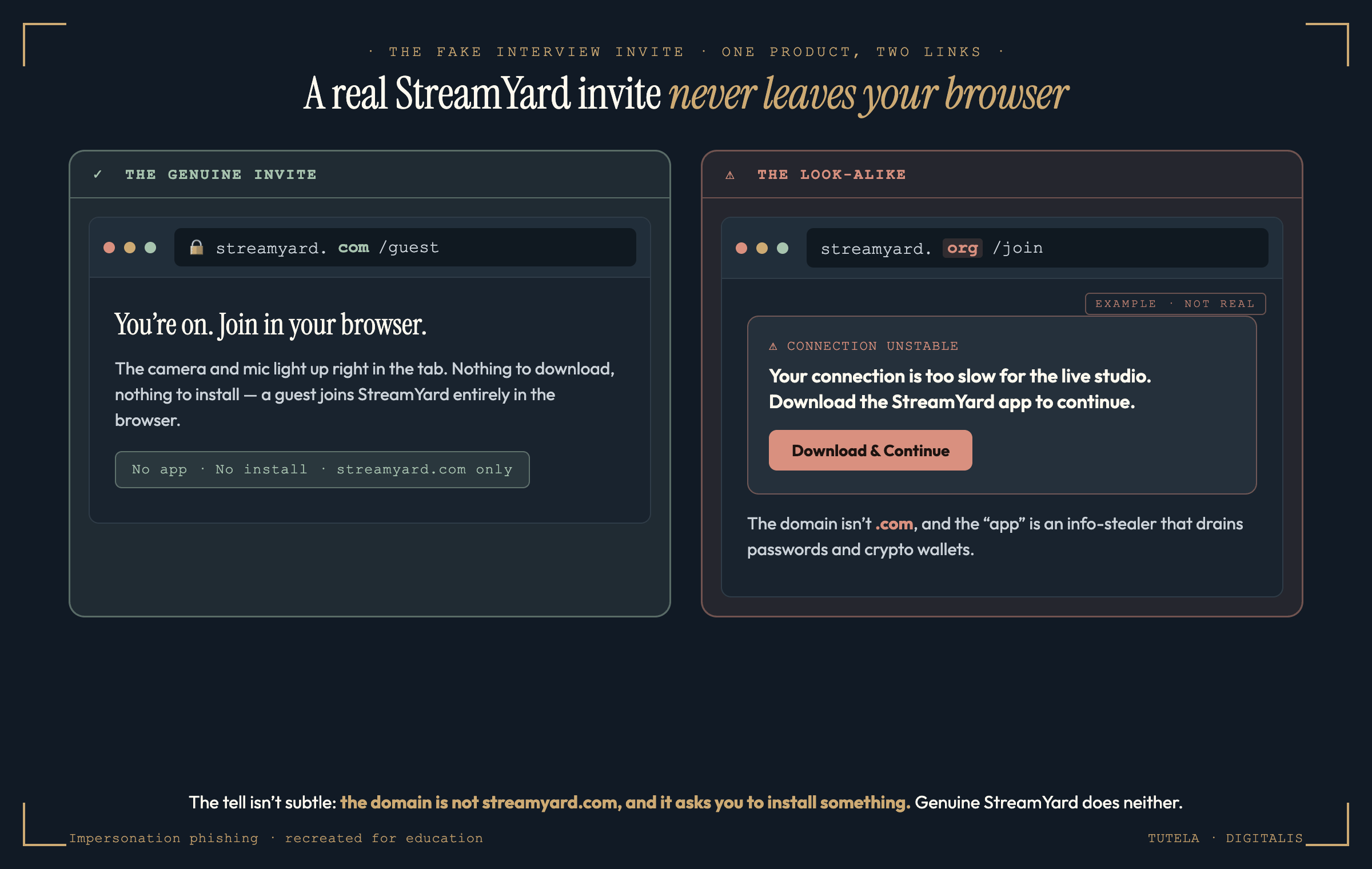
How to check a StreamYard interview invitation
You don’t have to recognise the outlet, the sender, or the malware. You only have to check three things, and any single failure is enough to walk away.
The invite sends you to a look-alike domain — streamyard.org, streamyard.chat, streamyard-studio, or a hyphenated variant — that is built to read as StreamYard at a glance. Security trackers have flagged these look-alikes as active phishing hosts. The real studio lives at one address only, and everything else is costume.
You open the link and a message claims your connection is unstable, the studio needs a plugin, or you must download the “StreamYard app” to join. That download is not StreamYard — it is an information-stealer. On a computer, a genuine StreamYard guest joins entirely in the browser and downloads nothing.
It arrives as a flattering, time-boxed opportunity — a big publication, a popular podcast, a paid AMA — with a slot that is filling up and a recording that is “about to start.” The prestige lowers your guard and the urgency removes the pause where you would have checked. Both are doing a job.
Why it’s aimed at people who say yes to interviews
This scam is pointed with unusual precision at public-facing people: crypto founders and developers, content creators, journalists, podcasters, and anyone in a community where being invited onto a livestream is routine. Those are exactly the people whose job rewards saying yes to a recording request, and — in the crypto world especially — whose devices hold wallet keys and exchange logins worth stealing. The invitation doesn’t look suspicious because, for them, it is the most normal email of the week.
What the fake “app” actually does
The download is not a video plugin. It is malware in the information-stealer and remote-access family: once run, it can harvest saved browser passwords and session cookies, read files, and hunt specifically for cryptocurrency wallet data and exchange credentials. The practical result is account takeover and drained wallets, sometimes within minutes — and because it captures active session cookies, it can bypass a password you thought was safe behind two-factor authentication. That is why, if you ran it, changing a password on the same infected machine is not enough; the device itself has to be treated as compromised.
Downloaded a fake StreamYard app? What to do next
Move by what you actually did — speed matters most when crypto or logins are involved:
The seven-step safe-invite playbook
None of this requires spotting the malware. It is the safe way to accept any StreamYard invitation, written down so a warm, plausible message can’t rewrite it in the moment.
So, is StreamYard safe?
The product is. StreamYard.com is a legitimate service used by millions, and nothing here is a reason to avoid it. What isn’t safe is an unsolicited invitation that uses its name to move you onto a look-alike domain and talk you into an install. The danger was never the studio — it’s the stranger offering you a stage and handing you the wrong door to walk through.
If you take one line from this whole piece, take this: a real StreamYard invite joins in your browser, on streamyard.com, and never asks you to install anything. The instant an invitation breaks any one of those, it is not StreamYard — it is the scam.
Got an invite you’re not sure about, or already clicked one? Let’s look at it together.
Send us the message and what happened next. A real expert reviews every case and replies within 24 hours. Free, confidential, no pressure.
Common questions about the StreamYard scam
Is StreamYard a scam?
No. StreamYard (streamyard.com) is a legitimate, widely used browser-based livestreaming studio for podcasts, interviews, and webinars. The problem people run into is a phishing scam that impersonates it — a fake interview or podcast invite that sends you to a look-alike domain and tries to make you install malware. The tool is real; the invite may not be.
Is streamyard.com safe to use?
Yes — the official service at streamyard.com is legitimate and reviewed well by real users. The safety rule is to only ever reach it by typing streamyard.com yourself, and to be suspicious of unsolicited invitations and any link that is not exactly streamyard.com.
I got a StreamYard invite to a podcast or interview — how do I know if it’s real?
Verify the outlet and host independently, not through anything they sent you. Check that the join link is on streamyard.com and nothing else. And remember the hard rule: a genuine StreamYard guest joins in the browser and is never told to download an app or plugin to continue. If any of those three fail, it’s the scam.
Does StreamYard make you download an app?
Not to join as a guest on a computer — you join in the browser. StreamYard does offer an official guest app for phones, but you only get it from the Apple App Store or Google Play, never from a link in an invitation or a “download to continue” pop-up on a web page. A website-delivered StreamYard installer is always fake.
What are streamyard.org and streamyard.chat?
They are look-alike domains impersonating StreamYard, not the real service. Security trackers have flagged them as phishing hosts used to deliver fake “app” downloads. The only genuine domain is streamyard.com; different endings such as .org or .chat are impersonations.
I downloaded the fake StreamYard app — what do I do now?
Treat the device as compromised. Disconnect it from the internet, run a full malware scan or have it professionally cleaned or reset, and then — from a different, clean device — change every important password and enable two-factor authentication. If you hold cryptocurrency, move it to a new wallet with new keys immediately and alert your exchange. Then report it at reportfraud.ftc.gov and ic3.gov.
Sources & further reading
The claims in this piece are drawn from these reports. Click any of them to verify.