If your child is under 13, they are developmentally unable to recognise this scam for what it is — and that is not a failure on your part. A "live" giveaway promising free Robux or a celebrity's crypto is almost always a recording on a loop, with bots inflating the view count and flooding the chat, run to farm gifts and funnel your child to a fake site that wants their login, a payment, or both. It is built to exploit three things a child's brain genuinely cannot do yet. Here's how the machine works, what's actually at risk, and the ten-second test you can teach tonight.
I want to be careful with how I write this, because the easy version of it is fear, and fear is not the point. Your child playing Roblox or watching YouTube is not in constant danger. Most of what they see is exactly what it looks like. This is about one specific machine — the fake live giveaway — and why it is aimed, with something close to precision, at people your child's age. Once you can see the design, it stops being frightening and becomes something you can simply switch off.
The first lie is the word "live"
Strip the scam to its frame and it is almost always the same object: a video that looks like it is happening right now, but isn't. The footage is recorded — often real clips of a famous creator, lifted and re-uploaded — and set to loop. Over the top sits the offer: enter this code for free Robux, send a small amount of crypto to this address and get ten times back, claim your prize at the link below.
The sense that it is busy and real is manufactured. Security researchers studying these streams describe bots inflating the viewer and subscriber counts and flooding the live chat so the page feels alive with other people, all of them apparently winning. Then the stream does the one thing a real giveaway never needs to: it sends the viewer off the platform — to a "verification" site, a wallet, a code entry page — where the actual theft happens.
Newer versions add an AI layer: a deepfaked clip of the celebrity appearing to speak to viewers directly. The creator MrBeast has been impersonated this way often enough that he has publicly disowned the scam himself — worth saying clearly, because the real person is a victim of it too, not a part of it.
Why your child can't fight it
Here is the part that changes how you see it. This scam is not getting past your child because they are careless. It is reverse-engineered against three specific things a developing brain cannot yet do — each one well documented, each one matched to a move the scam makes.
1. They can't see the selling
Children can tell an ad from a show surprisingly young, around five. But understanding persuasive intent — that someone is deliberately trying to get something from them — develops slowly, roughly between eight and twelve. Studies of product-focused YouTube videos found that even ten- to twelve-year-olds frequently failed to recognise them as advertising at all. So when a stream says "I'm giving this away because I love you guys," a younger child doesn't hear a pitch. They hear a gift. The scam move this enables: there is no internal alarm to trip, because the category "this person is working me" isn't fully online yet.
2. They trust the creator like a friend
Children, and tweens especially, form powerful parasocial relationships with the creators they watch — one-sided bonds that researchers find they experience much as they would a close personal friendship, trusting recommendations accordingly. A stream that breaks the fourth wall — "I'm going live just for you right now" — lands as a friend leaning in, not a stranger broadcasting. The scam move this enables: the request to enter a code or visit a link doesn't come from a faceless scammer. It comes from someone your child already loves and believes.
3. The countdown beats the brake
A child and adolescent reward system is hypersensitive to immediate rewards, while the prefrontal regions that supply impulse control are still years from finished. Neuroscience on delay of gratification describes immediate, vivid rewards as close to irresistible for the developing brain, particularly when a "hot" cue — a prize, a ticking clock, a limited number of spots — is dangled. The scam move this enables: the giveaway pairs a craved reward (Robux, the dream skin) with urgency (offer ends in 02:00), aiming straight at the gap between wanting and the brake that hasn't grown in yet.
Now read those three together. A beloved creator (trust), offering a free prize (reward), right now, for a limited time (urgency), with no visible signal that anyone is selling anything (no alarm). That is not a scam that happens to catch children. It is a scam shaped from the child's own development — which is exactly why "just teach them to be careful" was never going to be enough on its own.
The squeeze nobody talks about
There is an uncomfortable layer underneath this. The immediate-reward lever the scammer pulls is the same lever child-safety advocates say the platform itself leans on. In May 2026, a coalition led by the children's-advocacy group Fairplay and the National Center on Sexual Exploitation filed a Request for Investigation with the U.S. Federal Trade Commission, asking it to examine whether Roblox's design violates the FTC Act. Among their allegations: "false scarcity and reward mechanisms" engineered to drive children's time and spending, and a virtual-currency system that obscures what things actually cost. Roblox disputes the characterisation, saying its platform is designed to be a positive and safe experience and pointing to its parental spending controls.
We are not the regulator and this is an open question, not a verdict — the FTC has not ruled. But notice the position it leaves a child in: the same psychology of scarcity-and-reward is being pressed from two directions at once, by the platform's design and by the scammer hiding inside it. A child who has been gently trained, all day, that a ticking clock and a limited drop are normal is a child for whom the scammer's countdown feels normal too.
What is actually at risk
Parents often assume the worst case is a few pounds of Robux. Sometimes it is. Often the money is the smaller wound. What these pages are really after tends to be one of three things:
The ten-second test, and the talk to have
The good news is that the same thing that makes the scam strong also makes it fragile. It depends on the stream seeming live. So give your child a way to check that in ten seconds:
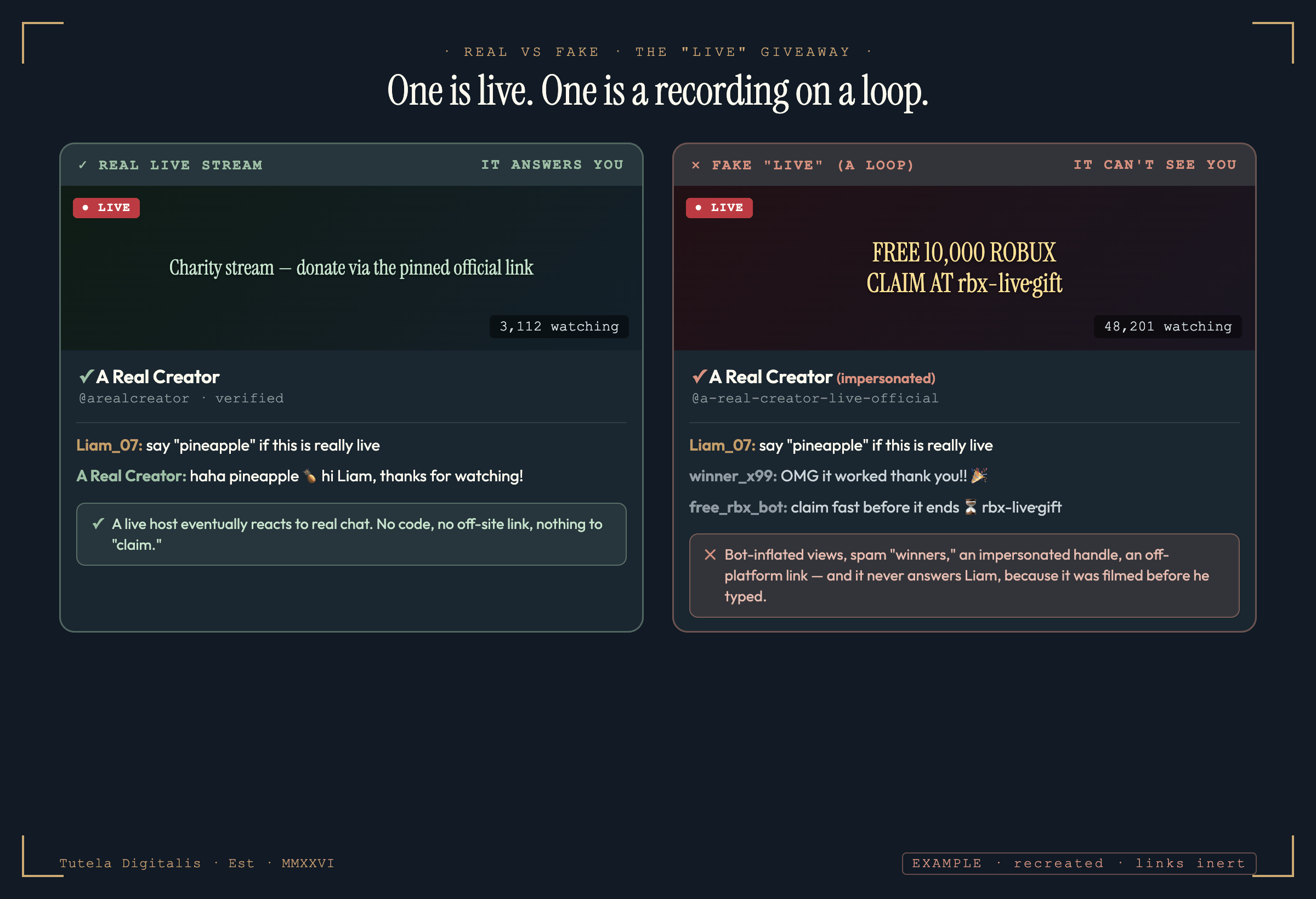
Type a specific, unusual word into the live chat and watch. A real live host eventually reacts to real chat. A recording on a loop never can — it was filmed before your message ever existed. If the "live" can't see you, it isn't live.
Pair it with one rule simple enough for a child to hold under the pull of a countdown: a real giveaway never sends you somewhere else to claim it, never needs a payment to "verify", and never needs your password. The moment any of those appears, the answer is no — close it and come tell me. And mean that last part: the reason children get caught twice is shame and secrecy. A child who knows they won't be blamed is a child who tells you in time to undo the damage.
If you want it taken down
You can report these streams, and you should — but go in clear-eyed about why it is hard, because that itself is the lesson. The scammers privatise the videos the instant a wave ends, erasing the evidence, and the sheer volume overwhelms the queues. The problem is big enough that the payments firm Ripple has sued YouTube over its struggle to contain fake giveaway streams using its branding. If a company with lawyers finds it this hard, a parent reporting one stream should expect friction — and report anyway, because volume is what eventually moves platforms.
If you take one thing from this piece, take this: your child falling for this would not mean they were foolish. It would mean the con did exactly what it was built to do. You can't install an adult's scepticism into a developing brain ahead of schedule. But you can hand them one test, one rule, and the certainty that they can come to you without being blamed. That is the part the scammer is counting on you never to give them.
Did your child get caught by one of these? Let's sort it out together.
Tell us what happened — what they entered, paid or downloaded. A real expert reviews every case and replies within 24 hours. Free, confidential, no judgement.
Common questions from parents
Is the free Robux giveaway real?
No. Roblox states plainly that any offer of free Robux, free subscriptions or free items is a scam, and that no external website, app or 'generator' can create Robux — the currency only exists on Roblox's own encrypted servers. The 'generators' and giveaway pages exist to harvest your child's login, push malware, or funnel them to a payment page. Using one also breaks Roblox's terms of service and can get the account banned. There is no legitimate version of this offer to weigh up; the answer is always no.
How can I tell if a YouTube 'live' giveaway is fake?
Two tells, and the first is decisive. One: type a specific, unusual word into the live chat and watch. A genuine live host eventually reacts to real chat; a looped recording never can, because it was filmed before your message existed. Two: the offer itself. A real creator does not need your account name, a 'verification' payment, or a code entered on another website to give you something — the moment the stream sends your child off YouTube to claim a prize, it is a scam. The polished view count and busy chat are not evidence it is real; bots manufacture both.
What do I do if my child already sent money or entered details?
Move quickly and without blame — panic and shame are what keep kids from telling a parent in the first place. If they paid by card, contact your bank or card issuer right away and ask to dispute the charge; the sooner you report it, the better the odds. If they entered a Roblox password anywhere off Roblox, change it immediately and turn on two-step verification, and change it anywhere else the same password was used. If they downloaded or ran anything, run a reputable security scan. Then report it: to Roblox, to the platform that hosted the stream, and to the FTC at reportfraud.ftc.gov (or 1-877-FTC-HELP) in the US, or your national fraud line elsewhere.
Do Robux generators actually work?
No, and Roblox says so in its own support documentation: no external website, app or 'generator' can create Robux, because the currency exists only on Roblox's own encrypted servers. Nothing outside Roblox can write to them. So a site promising to generate Robux is not a tool that might work — it is a page built for a different purpose, and the purpose is one of three things: harvest the account login the site asks for, get something downloaded, or push the child toward a payment to 'verify' or 'unlock' the balance. The counter that never expires and the fake queue exist to make you act before you think. Using one also breaks Roblox's terms of service, so the account itself is at risk even when nothing is paid.
How do Roblox scams usually reach a child?
Almost always from outside the game. The common route is a 'live' giveaway on YouTube or TikTok using a copied channel name and a creator's cloned voice, which is really a looped recording; the other routes are a message in-game or on Discord, and an ad or comment under a Roblox video. What every version has in common is the last step: it sends the child off the platform to a website to claim or verify. That is the durable rule worth teaching, because it survives every rebrand of the con — a real prize is never claimed on another site, and no legitimate offer needs a Roblox password entered anywhere except Roblox itself.
Why do these scams target children specifically?
Because children are not yet developmentally equipped to defend against them — and that is not a parenting failure, it is how the con is designed. Research shows the understanding of selling and persuasive intent develops gradually, roughly between ages eight and twelve; that children form strong one-sided 'parasocial' bonds with online creators and trust their suggestions like a friend's; and that a child's reward system is highly sensitive while the impulse-control parts of the brain are still maturing, which makes an immediate reward with a countdown almost irresistible. A scam built on a beloved creator, a free prize and a ticking clock is aimed precisely at those three gaps.
Sources & further reading
Every fact in this piece is drawn from these sources. Click any to verify.