On 4 June 2026 the FBI launched its first Most-Wanted Fraudsters list — a public roster, modelled on the Ten Most Wanted Fugitives, of eight people accused of financial crimes the bureau ties to between roughly $1.3 million and $1.2 billion in losses each. It is designed to generate public tips that lead to arrests, and you can report a sighting at tips.fbi.gov or 1-800-CALL-FBI. It is a real and overdue signal that fraud is being treated as serious crime. But be clear-eyed about what it is: a way to catch specific fugitives who fled US prosecution — not a fund that refunds victims, and not aimed at the overseas scam compounds draining most consumers today. Prevention is still your protection. And anyone who uses this news to offer you "FBI-backed recovery" for a fee is running the next scam.
Read the image explanation
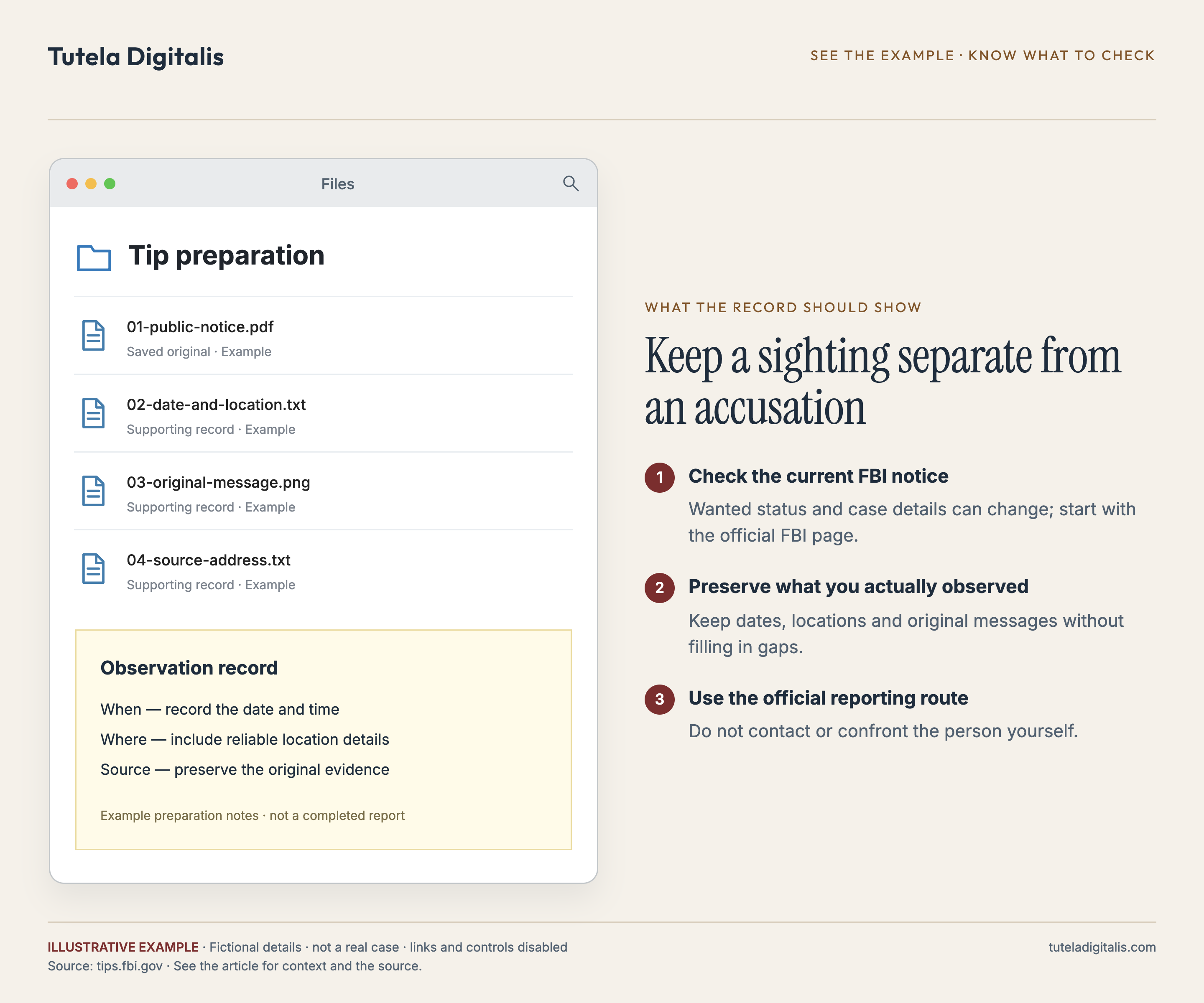
Illustrative example: Tip preparation 01-public-notice.pdf 02-date-and-location.txt 03-original-message.png 04-source-address.txt Observation record When — record the date and time Where — include reliable location details Source — preserve the original evidence
- Check the current FBI notice. Wanted status and case details can change; start with the official FBI page.
- Preserve what you actually observed. Keep dates, locations and original messages without filling in gaps.
- Use the official reporting route. Do not contact or confront the person yourself.
The FBI has had a Ten Most Wanted Fugitives list since 1950 — for murderers, bombers, and organised-crime bosses. On 4 June 2026, in Columbus, Ohio, it launched a separate one built entirely for financial fraud. The reasoning the bureau gave is simple: public recognition has helped catch fugitives on its other lists for decades, so putting fraud's biggest absconders in front of the public might do the same. The list is live on the FBI's own site, and it currently names eight people.
If you've been scammed and want the practical takeaway, skip to what this actually means for you. The short version is at the top: this catches a handful of fugitives; it does not refund victims, and it isn't pointed at the scammers most people actually meet.
What the FBI actually launched
According to the FBI, the new list spans the full range of financial crime: investment fraud, mortgage fraud, healthcare and COVID-19 relief fraud, an illegal-gambling conspiracy, and money laundering. The alleged losses attached to the eight names run from about $1.3 million at the low end to roughly $1.2 billion at the top. The bureau is offering financial rewards for information leading to arrests, and is asking the public — worldwide — to come forward with tips.
Crucially, everyone on it shares one trait: they are fugitives. These are people the US justice system has already identified and charged, who then ran. That detail is the key to understanding both what the list can do and what it can't.
Who's on it
A few of the named cases, as the FBI describes them — these are allegations, and each person is wanted, not convicted:
Why a wanted poster won't get most victims their money back
This is the part worth sitting with, because the headline invites a hopeful misreading. A most-wanted list is about catching named fugitives who fled American courtrooms. It is not a compensation process — even when a fraudster is caught, returning money to victims is a separate, slow, and often disappointing road. Catching the criminal and refunding the victim are two different things, and only one of them is what this list is for.
And there is a deeper mismatch. The fraud draining ordinary people right now — the investment "platform" a stranger online talked you into, the toll text, the romance that turned into a money request, the tech-support pop-up — is overwhelmingly run from overseas compounds, behind borrowed photos, anonymous accounts, and cryptocurrency wallets. Those operators rarely have a real name to put on a poster, and they sit far outside the reach of a US arrest warrant. The people on this list are, by definition, the ones the system already identified. The ones who took most of the money this year are exactly the ones it can't.
What this actually means for you
Strip away the headline and the practical steps are clear:
Got a call or email claiming to be the FBI about your money? Send it to us first.
Paste the message, the website, the "agent" who contacted you. A real expert reviews every case and replies within 24 hours. Free, confidential, no pressure.
Common questions about the FBI Most Wanted Fraudsters list
What is the FBI's Most Wanted Fraudsters list?
It is a new public list the FBI launched on 4 June 2026 — its first one dedicated entirely to financial-fraud fugitives, modelled on the bureau's long-running Ten Most Wanted Fugitives. It currently names eight people accused in cases the FBI ties to between roughly $1.3 million and $1.2 billion in losses each, spanning investment fraud, mortgage fraud, healthcare and COVID-19 relief fraud, illegal gambling and money laundering. The list is live on the FBI's own site at fbi.gov/wanted/most-wanted-fraudsters. Its stated purpose is to raise public awareness and generate tips, because public recognition has helped crack the bureau's other most-wanted cases.
Who is on the FBI Most Wanted Fraudsters list?
The FBI lists eight fugitives. The largest case by alleged loss is Herbert Kimble, wanted in connection with a scheme the FBI ties to around $1.2 billion. Another is Christopher W. Burns, a Georgia man the FBI says defrauded dozens of victims of at least $10 million by claiming he was running a 'peer-to-peer' lending program backed by collateral that, according to the bureau, either did not exist or was worth far less than he represented; he vanished in September 2020, one day before he was due to hand business records to the SEC, and the FBI is offering a reward of up to $150,000. Others named include Elaine Angene (wire fraud and money laundering, about $32 million) and Michael Lizaro (an illegal-gambling conspiracy, about $34 million). All of these are allegations; everyone on the list is wanted, not convicted in absentia, and is presumed innocent unless proven otherwise.
Will the FBI's list help me get my scammed money back?
Realistically, no — and it's important to be honest about that. The list is a tool to locate and arrest specific fugitives, most of whom fled prosecution inside the United States. It is not a compensation fund, and catching a fraudster is a separate, slow process from refunding victims. It also is not aimed at the operations draining most ordinary consumers today — pig-butchering investment scams, toll and package texts, romance and tech-support fraud — which are largely run from overseas compounds, behind anonymous accounts and cryptocurrency wallets, by people who rarely have a name to put on a wanted poster and who sit outside US arrest reach. If you've lost money, your fastest levers are still your bank and card issuer, acting within hours or days — not waiting on an arrest.
How do I report a tip on a most-wanted fraudster?
If you recognise someone on the list, do not approach them. Submit a tip to the FBI online at tips.fbi.gov, call 1-800-CALL-FBI (1-800-225-5324), or contact your nearest FBI field office. The bureau is offering financial rewards for information that leads to an arrest in several of these cases. If instead you are reporting that you were scammed — a different thing — file with the FBI's Internet Crime Complaint Center at ic3.gov, your national consumer agency such as the FTC, and your bank.
If most scammers never end up on a list like this, what actually protects me?
Prevention, and a healthy suspicion of anyone who contacts you. The scammers who take most consumer money are anonymous and offshore; you will almost never see them arrested. So the protection that works is the same as ever: verify any unexpected request independently using a number or website you find yourself, never one you were given, and slow down whenever something pushes urgency. Be especially wary of anyone who cites news like this list to pose as the FBI or an 'asset-recovery' service offering to get your money back — for a fee or your details. No genuine agency cold-contacts victims to charge them for recovery. When in doubt, run the message through a scam check before you respond.
Sources & further reading
Claims in this piece are attributed to these sources. Click any of them to verify.