Scammers rush you because the close only works if you don't get to think. Every scam ends on a manufactured clock built from three moves: a deadline ("act now — your account is being drained"), a takeaway ("only two spots left, the price triples at midnight"), and a lockout ("this is confidential — tell no one"). Cambridge researchers call it the Time principle: under time pressure your brain switches to a decision strategy "involving less reasoning," and hustlers steer you there on purpose. The FTC puts it plainer — honest businesses give you time; scammers don't. The tell is one line: a real opportunity survives a night's sleep. So don't race the clock — name it, set it down, tell one person, and see whether the offer is still standing in the morning. The real thing waits. The fake thing can't afford to.
Read the image explanation
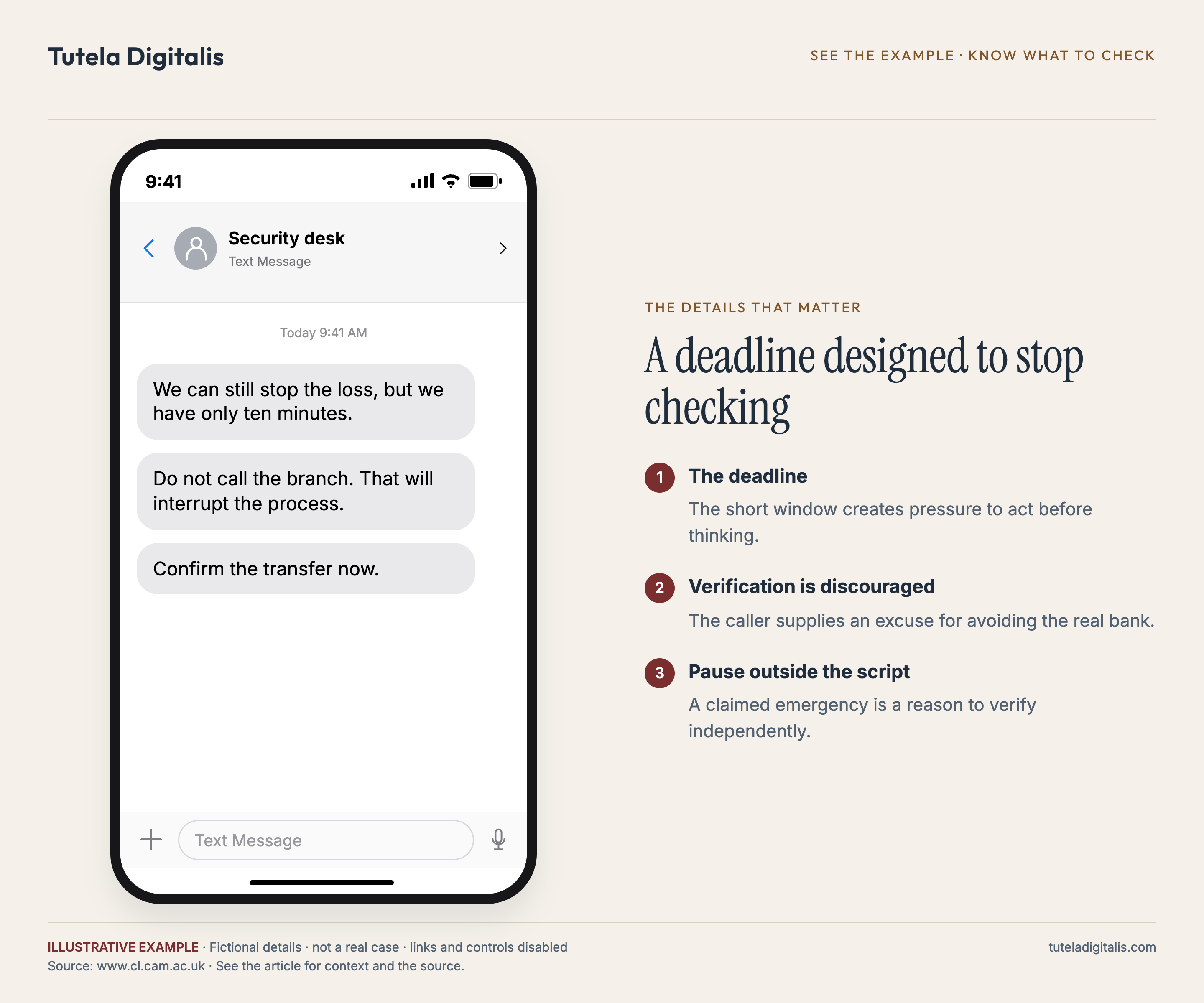
Illustrative example: We can still stop the loss, but we have only ten minutes. Do not call the branch. That will interrupt the process. Confirm the transfer now.
- The deadline. The short window creates pressure to act before thinking.
- Verification is discouraged. The caller supplies an excuse for avoiding the real bank.
- Pause outside the script. A claimed emergency is a reason to verify independently.
"When you are under time pressure to make an important choice, you use a different decision strategy. Hustlers steer you towards one involving less reasoning."
— Frank Stajano & Paul Wilson, "Understanding Scam Victims," University of Cambridge / Communications of the ACM. They call it the Time principle — and it isn't a metaphor. Rushing you isn't rudeness. It's the mechanism.
Start with the comfortable lie this piece exists to kill: "I'd never be pressured into it — I'd just slow down and check." You mean well, but you've already been trained out of it, quietly, by a thousand honest countdown timers. The checkout clock ticking down your "reserved" cart. The "sale ends tonight." The hotel page that says three other people are looking at this room. Retail runs on the same wiring the con does, and you've been buying under a clock your whole adult life. The scam close is not a stranger you'll recognize on sight. It's a familiar feeling — turned up until it does something the honest version never does.
Here's the professional's view, because closing is my trade and I've used every one of these levers to move real deals. A close is just the moment you ask for the decision, and yes — honest closers use urgency. The quarter genuinely ends. The allocation is genuinely finite. The promotional price genuinely lifts on Monday. But watch what a real close can afford: I can tell you to sleep on it and call me in the morning, and I will, because the thing behind my clock is real and still there tomorrow. A legitimate deadline is external — printed, dated, verifiable somewhere I don't control. The scam closer cannot say "sleep on it," ever, because there is nothing behind the clock. The clock is the product.
So this stage isn't an attack on your judgment. It's an attack on the time your judgment needs — the gap between impulse and reflection where every check you'd run has to live. The close destroys that gap three ways: it steals your time, it steals your patience, and it steals your witnesses. Walk through the three moves with me — how each is staged, why your brain buys it, and the one pause each cannot survive.
The deadline: manufactured urgency
The clock starts the second the pitch lands. "Your account is being drained right now." "The warrant is issued in one hour unless you resolve this." "Press 1 now to avoid disconnection." The FTC's plainest description of the tactic: scammers "want you to act before you have time to think," and on the phone "they might tell you not to hang up so you can't check out their story." The window between the ask and your answer is where all of your judgment lives — so the deadline's entire job is to flood it with panic until there's no room left to think.
Why it works is not a mystery; it's the Time principle running in one move. Stajano and Wilson's finding isn't a figure of speech: under pressure you don't just think worse on the same track — you switch tracks, to a decision strategy "involving less reasoning," and the hustler steers you there deliberately. Fear collapses the horizon to the next sixty seconds; the part of your brain that would say let me check needs minutes it isn't being given. And note the deadline never proves anything either — like the badge in part three, it exists to stop the check, not to pass it.
The honest mirror, from my side of the trade: real deadlines exist, and a real deadline is external — I can point you at the dated terms, and you can confirm them somewhere I don't control. More than that, a real deadline can afford your absence. I lose nothing by telling you to call me back tomorrow, because the offer behind it survives the night. A manufactured deadline lives only in the caller's mouth, which is why it can never let you leave the call to look.
The takeaway: scarcity and the vanishing offer
The second move doesn't push you toward something — it threatens to pull something away. "Only two allocations left." "The price triples at midnight." "Other investors are moving now; you'll miss the entry." And the sharpest version, aimed at anyone already inside: "if you don't act now, you'll lose the profit you've already made" — the profit being a number on a dashboard that, as part three showed, was never real. Sales has a name for this: the takeaway close. Make the prize look like it's leaving, and grabbing it feels like the safe, cautious move.
Robert Cialdini spent a career documenting scarcity as one of persuasion's most powerful levers, for a reason wired deep in the brain: losing something feels roughly twice as bad as gaining the same thing feels good. So the con doesn't sell you a win — it manufactures a loss you can only avoid by moving now. Bolt that onto the clock from move one and it's airtight: you're no longer deciding whether to invest, you're scrambling not to lose. Reasoning doesn't get a vote.
The honest mirror: legitimate scarcity is real and, crucially, indifferent. A genuinely limited offer is documented — you can read the terms, check the date, confirm it through a channel the seller doesn't control — and the seller doesn't need you to skip that check to honor the deal. Real scarcity survives your verification. Manufactured scarcity is destroyed by it, which is why the takeaway always arrives handcuffed to a reason you can't look into it.
The lockout: isolation
The final move isn't aimed at your reasoning at all — it's aimed at the people who would lend you theirs. "This is confidential — tell no one." "Your family will only worry." "We suspect a bank employee is involved, so don't discuss this with staff." "Keep this between us." It reaches full theatrical scale in the digital-arrest scam, where a fake officer keeps a victim on a "confidential investigation" video call for hours — for the express purpose of making sure no one else can get a word in.
Why it works: every other defense in this series can be beaten by one thing the scammer cannot script — a second person hearing the story cold. A spouse, an adult child, a bank teller, a friend who frowns and says "wait, that doesn't sound right" restores the exact pause the whole close is built to destroy. So the professional close removes them. Isolation is not cruelty for its own sake; it's insurance. It is the script admitting, in advance, that the offer cannot survive daylight — that a single outside witness is fatal to it.
The honest mirror, one last time: nothing legitimate asks for this. A real financial decision welcomes a second opinion — it's what lawyers, spouses, and accountants are for, and no honest institution has ever been harmed by you saying "let me talk to my daughter first." Secrecy is a demand only fraud makes, because only fraud is endangered by a witness.
The one law under all three moves
Line the three up and the thing underneath comes into focus. The deadline steals your time. The takeaway steals your patience. The lockout steals your witnesses. None of them is about the offer — they are all about the gap between impulse and reflection, because that gap is where every one of these offers dies. Real opportunities are indifferent to the pause: the bank is still the bank in an hour, the genuine deal is still documented tomorrow, the legitimate decision survives your daughter's opinion. So the honest version of a close can afford your pause at zero cost — and the manufactured version cannot survive it, which is why the con's entire engineering budget goes into destroying it.
So stop evaluating the offer. You will lose that game: the deadline sounds plausible, the scarcity looks real, the secrecy sounds prudent. There is exactly one thing in the whole scene the operator cannot fake, and it is not the offer — it's what happens when you insist on a pause. Real waits. Fake escalates. In part three I showed the setup's one unfakeable signal — the reaction to your verification. This is its twin at the close: the reaction to your delay. Announce that you're sleeping on it and watch. Indifference is what real looks like. Pressure is a confession.
The counter, install the pause before the call comes
You cannot out-argue a professional closer in real time; under the clock, your reasoning is already on the slower track he engineered, and every rebuttal you improvise is a move in his game, not yours. So don't try to win the moment — remove it. The counter isn't a clever comeback. It's a pause you install in advance and refuse to negotiate.
Someone's telling you to decide right now? That's the tell, so take the pause they're forbidding.
Paste the message, call, or offer into our free scam checker — it reads the pressure, names the tactic, and points you to the one channel where you can verify it safely. No signup.
One closing thought from the sales floor. In an honest close, the clock points at something real — the quarter truly ends, the seat is truly limited — and I can still let you sleep on it, because a deal that dies overnight was never a deal worth making. In a scam, the clock is the building: there is no seat behind it, no deadline, no window, nothing at all. So never race the clock. Set it down, sleep on it, tell one person — and watch whether the offer is still standing in the morning. The real thing waits. The fake thing cannot.
Common questions about scam urgency and pressure
Why do scammers create a sense of urgency?
Because the close — the moment they ask for the decision — only works if you don't get time to think. Cambridge researchers Frank Stajano and Paul Wilson call it the Time principle: “When you are under time pressure to make an important choice, you use a different decision strategy” — one, they write, “involving less reasoning.” Urgency isn't rudeness or a scammer being pushy; it's the mechanism that switches your slow, checking brain off and your fast, reacting brain on. The FTC lists “scammers pressure you to act immediately” as one of its four signs of a scam, and states plainly that honest businesses give you time to decide. The single most reliable defense is a rule you set in advance: a real opportunity survives a night's sleep, so never decide on the call.
Will a real bank or government agency ever pressure you to decide right now?
No. The FTC's guidance is explicit: honest businesses and agencies give you time to think, check their story, and get advice — anyone who pressures you to act immediately is showing you what they are. A genuine bank fraud team will still have your case when you hang up and call back on the number printed on your card. A real court or tax office puts deadlines in writing and lets you verify them independently. Real deadlines are external and checkable; a manufactured deadline exists only inside the call and dies the moment you try to confirm it elsewhere — which is exactly why you won't be allowed to.
Why do scammers tell you not to tell anyone?
Because the one thing that reliably breaks the spell is a second person. Isolation — “this is confidential,” “your family will only worry,” “a bank employee may be involved,” “don't discuss the investigation” — is the close's insurance policy: it removes the outside voice that would say “this smells wrong” and restore the pause the scammer is working to destroy. It reaches full theatrical form in the digital-arrest scam, where a fake officer keeps a victim on a “confidential” video call for hours. Treat any demand for secrecy as a red flag that outranks the story wrapped around it — legitimate institutions never need you to hide a transaction from the people who love you. Tell one trusted person out loud before you move a cent.
Is it a scam if the offer 'expires today' or there are 'only a few spots left'?
Not by itself — real sales use genuine deadlines and limited stock. Scarcity becomes a scam signal when it's paired with two things: you can't independently verify it, and you're punished for trying. Robert Cialdini documented scarcity as one of persuasion's most powerful levers precisely because losing something feels worse than gaining its equal — which is why the con often threatens to take away a “profit” you've already been shown (a number on a dashboard that was never real). The test isn't whether there's a deadline; it's whether the deadline survives a pause. A real limited offer is still documented tomorrow through a channel you chose. A manufactured one evaporates — or the pressure escalates — the instant you slow down.
How do I resist high-pressure scam tactics?
Install the pause before the call comes, so you're not negotiating it while the clock ticks. Make it a fixed personal rule: “I don't make money or account decisions on a call, text, or chat — I hang up and call back on a number I look up myself.” Then say the pressure out loud (“you're telling me I have to decide right now”), because naming a tactic strips its power. Break the isolation by telling one trusted person the whole story. And grade the reaction to your pause, not the offer: a real opportunity is indifferent to a night's sleep; escalating pressure, guilt, or an offer that “expires” the second you slow down is the offer confessing it was never real.
A caller told me not to hang up — what should I do?
Hang up. “Don't hang up” is on the FTC's own list of pressure tells — scammers say it so you can't check their story. No legitimate bank, agency, or company is harmed by you ending the call and phoning back on the number printed on your card or statement, or the official app you open yourself. If the call was real, the matter is still there and no one is offended. If hanging up “will let the fraud happen,” or the caller hands you a “direct number” to use instead of your own, the resistance is your answer. If money has already moved, go straight to our emergency triage and act by payment rail, fast.
Sources & further reading
Every figure and quote in this piece links to the primary source. Click any to verify.