You cannot detect your way out of a scam — the entire industry is engineered to defeat detection, and it beats careful, intelligent people every day. So stop trying to answer "is this a scam?" and install one move you run every time, regardless: don't decide now, verify on a channel you chose yourself, and tell one trusted person before any money or account access moves. It beats rapport, authority, and the close at once — because all three are attacks on the same two things: your pause and your reference to the outside world. Restore both and the technique collapses, and you never have to know which one you're facing. This won't make you immune. It will make you inoculated: you'll still feel the pull — but you'll feel it as a symptom, and run the move while you feel it.
Read the image explanation
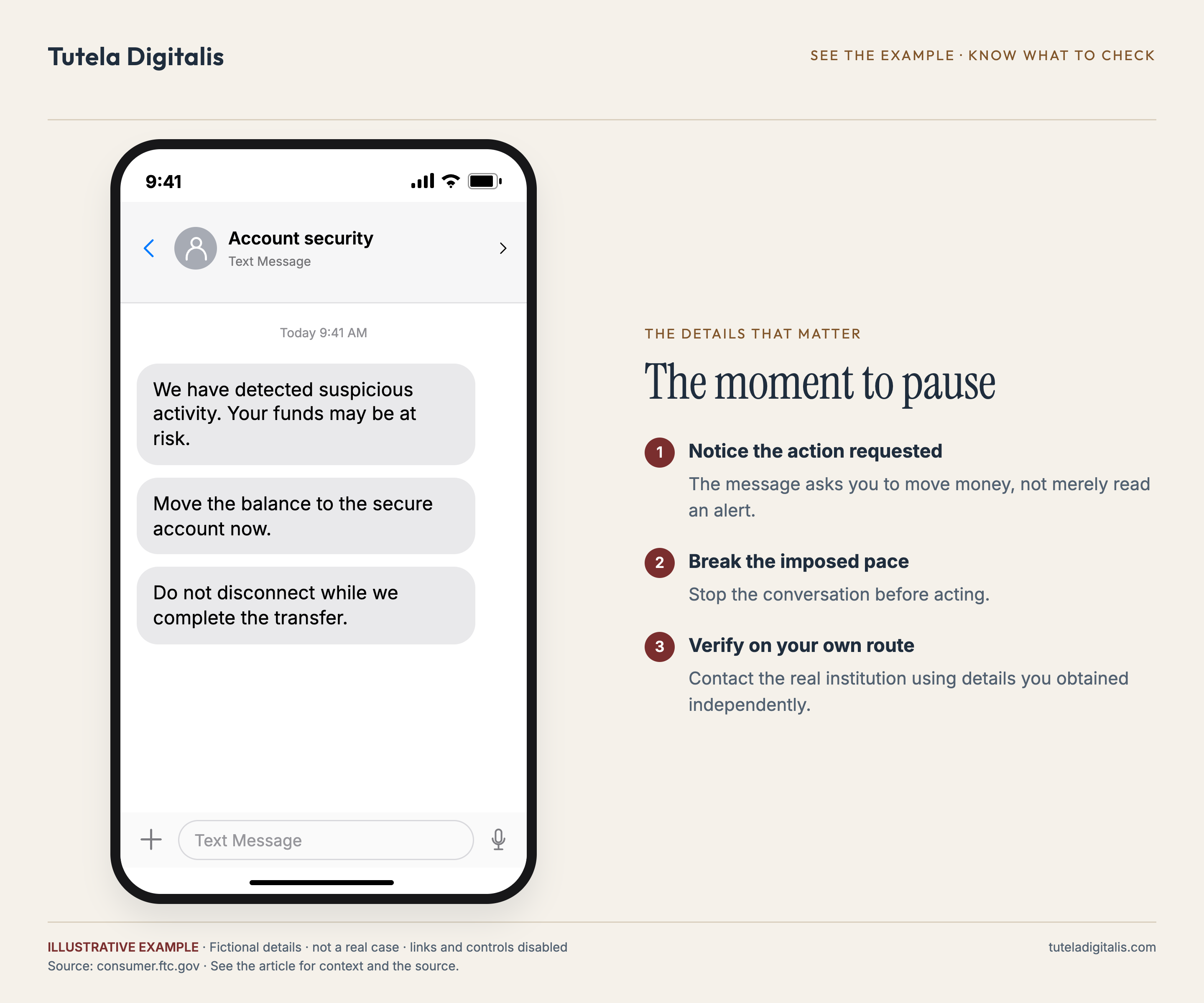
Illustrative example: We have detected suspicious activity. Your funds may be at risk. Move the balance to the secure account now. Do not disconnect while we complete the transfer.
- Notice the action requested. The message asks you to move money, not merely read an alert.
- Break the imposed pace. Stop the conversation before acting.
- Verify on your own route. Contact the real institution using details you obtained independently.
"Honest businesses will give you time to make a decision. Anyone who pressures you to pay or give them your personal information is a scammer."
— U.S. Federal Trade Commission, "How To Avoid a Scam." The whole defense hides inside that first sentence: a real decision can wait. So the move is simply to take the time the honest world already grants you — and the con cannot.
Kill the last comfortable lie — the one this series might have accidentally sold you: "now that I've seen the moves, I'll spot them." You won't, not reliably, and staking your savings on your own vigilance is exactly the bet the industry wants you to make. This work opened on the hardest finding in the field: scams defeat intelligence, not stupidity, and awareness alone barely moves the needle. Professional operators rehearse against informed, careful, skeptical people every single working day. Knowing the trick is not the same as being safe from it.
Here's the view from my side of the trade. I've watched trained buyers — people who negotiate for a living — still get moved by a good close, because in the moment the feeling arrives before the analysis does. So the real defense was never going to be a sharper detector in your head. It's a simpler thing, installed lower down: a rule that fires before your judgment is even asked to weigh in — because by the time you're weighing the offer, you're already on the slower track, playing the closer's game on the closer's clock.
So drop the question the con wants you asking. "Is this a scam?" is the wrong question, and it's one the whole performance is engineered to help you get wrong. Replace it with a question you can always answer correctly, under any pressure, without diagnosing anything: "Am I about to move money or hand over access, right now, because someone I didn't go looking for is in a hurry?" If yes, you don't need to know whether it's a scam. You run the move.
Three sentences. No expertise required, no tell to spot, no argument to win. Notice what each clause quietly restores — the very thing one stage of the con was built to take. That's not a coincidence. It's the whole reason one move is enough.
Why one move beats all three stages
Walk the series backward and the machine underneath comes apart cleanly. Every stage you met is an attack — but not on your intelligence. Each one attacks a specific defense, and the three attacks collapse into just two targets.
Three stages, three attacks — but only two targets: your pause, and your reference to a world the scammer doesn't control. The rapport isolates you so no outside voice can reach you; the props punish you for reaching outside to verify; the close steals the time in which any of that reaching would happen. The one move restores both at once — it reinstates the pause and reconnects you to the outside — which is why you never have to know which stage you're standing in. You're not diagnosing the con. You're just refusing to let anyone stand between you and a night's sleep, a number you chose, and one person who loves you.
You can't detect your way out, but you can inoculate
There's a name for what these five posts just did to you, and it comes from the science of resisting persuasion. In the 1960s the psychologist William McGuire showed you can build resistance to a persuasive attack the way a vaccine builds resistance to a virus: expose someone in advance, in a weakened and clearly-refuted form, to the very tactic that will later be used on them — and they hold up far better when the real thing arrives. He called it inoculation. The Cambridge Social Decision-Making Lab — Sander van der Linden, Jon Roozenbeek and colleagues, a few doors from the Cambridge researchers whose fraud principles anchor this series — revived it for the modern age as "prebunking."
Read that back as a description of what you just did. Parts one through four were the weakened doses: the warmth that moves too fast, the badge that punishes your check, the crowd that can only be met on its own stage, the clock that can't survive a pause — each one met on the page, named and neutralized, while you were calm. That is inoculation's two ingredients exactly: the forewarning that an attack is coming, and the defanged sample refuted in advance. This final part is the booster — the single reflex that carries the immunity off the page and into the room.
Be honest about what that buys you, though, because false confidence is its own trapdoor. Inoculation does not make you immune — nobody is, and anyone selling you "scam-proof" is running a close of their own. What it buys is recognition. The next time the warmth arrives a beat too fast, or a voice needs you to decide before you can breathe, you will feel the pull exactly as designed — and, for the first time, you'll feel it as a symptom rather than a summons. The tightening in your chest stops being the scammer's instrument and becomes your smoke alarm. You don't have to be stronger than the feeling. You have to know what it is, and run the move while you feel it.
Install it before the call comes
You can't out-argue a professional in real time, and you shouldn't try — the move only works if it's already loaded before the pressure starts. So the work is done now, in the quiet, not later, in the panic. Five steps turn three sentences into a reflex.
Put the move where your family can see it. Free, printable, one page.
Our scam-defense checklist puts the pause-and-check on paper — the kind of thing that goes on a fridge or in a wallet, so the reflex is ready before the call is. And if a message is working on you right now, paste it into the free checker instead of deciding.
One closing thought from the sales floor, and then the floor is yours. In an honest sale, the pause costs me nothing — the deal survives your night's sleep, your phone call, your second opinion, because there's something real behind it. In a scam, the pause costs the operator everything, because there is nothing behind it but the performance. That is the whole game, and now you know the one move that ends it: don't decide now, verify on a channel you chose, and tell one person before any money moves. The real thing can afford your pause. The fake thing cannot survive it.
Common questions about protecting yourself from scams
What is the one thing that protects you from every scam?
Not detection — a pause plus an outside check. You cannot reliably out-spot a professional in the moment, because by the time you feel the pressure your reasoning is already on the slower track. So the defense that actually holds is one you install in advance and run every time, regardless of whether you think it's a scam: don't decide now, verify on a channel you chose yourself, and tell one trusted person before any money or account access moves. It works because every con — rapport, authority, the close — is an attack on the same two things: your pause and your reference to the outside world. Restore both and the technique fails, and you never have to correctly diagnose which one you're facing.
Can you become immune to scams?
No — and anyone promising to make you 'scam-proof' is running a scam of their own. What you can become is inoculated. The psychologist William McGuire showed in the 1960s that forewarning people about a persuasion tactic and showing them a weakened, refuted version in advance builds real resistance — the Cambridge Social Decision-Making Lab revived it for the modern age as 'prebunking.' It doesn't switch off the feeling; it lets you recognize it. After learning the moves, you'll still feel the pull of urgency, warmth, or authority — but you'll feel it as a symptom rather than a command, which is exactly the gap you need to run your move.
How do I verify that a call, text, or email is really from my bank or the government?
Never inside the message that reached you — the channel itself is the thing you can't trust. Stop, and reach the institution through a route you chose: the number printed on your card or statement, the official app you open yourself, the address you already had. The FTC's guidance is the same — hang up and call back on a number you know is correct. If the contact was genuine, the matter is still there and no one is offended. If the caller resists — insists you stay on the line, hands you a 'direct number' to use instead of your own, or warns that hanging up will let the fraud happen — the resistance is your answer.
Is it rude to hang up or refuse to decide on the spot?
No, and the sense that it might be is the manipulation, not your manners. No legitimate bank, agency, employer, or company is harmed by you ending a call and phoning back on a number you look up, or by you saying 'I'll sleep on it.' The discomfort you feel about being 'rude' is manufactured — social pressure is a tool the con deliberately uses to keep you from doing the one thing that breaks it. Give yourself standing permission, in advance, to be as 'rude' as it takes: hang up, take the night, ask someone. A real opportunity survives all three.
Does knowing about scams actually protect you?
Knowing the facts, on its own, barely does — awareness training is famously weak, because scams defeat careful, intelligent people who 'know better' every day. What protects you is a structural reflex that doesn't depend on you correctly identifying the con in real time. That's the difference between information and inoculation: information is a list of red flags you have to remember under pressure; inoculation is a single move you've rehearsed in calm, so it fires automatically when the pressure arrives. This series was built as the second thing, not the first — the decoded moves were the weakened doses, and the pause-and-check is the reflex they were preparing you to run.
I already got scammed — is it too late for this to help?
It's not too late, and none of what happened was a failure of intelligence — under a manufactured clock, run by people who do this for a living, the brain switches to a faster, thinner decision engine. That's mechanism, not character. The move still protects you going forward, starting now: the recovery offer that may already be arriving — someone promising to get your money back for a fee — is the same con closing you a second time, so run the move on it too (don't decide now, verify independently, tell one person). Report it, tell someone today, and if money moved recently, go to our emergency triage and act by payment rail, fast.
Sources & further reading
Every claim in this piece links to its primary source. Click any to verify.