The fastest way to spot this scam is a single question: can you reach a real human? In the 2026 fake-employer job scam, everything is automated — an unsolicited recruiter message, a pre-recorded “webinar” with bot participants, and a “manager” that is really an AI chatbot. Two things get extracted. First, a task-scam deposit: your fake in-app earnings only unlock if you pay your own money (usually crypto) to “withdraw” them — the FTC says job scams took $501M in 2024. Second, and quieter, your identity: the I-9, W-4 and “background check” forms harvest your Social Security number for tax-refund fraud. If a “job” won’t put a named human on a live call and answer “how do I get paid?” in plain numbers, it isn’t a job.
“Task scams… involve promises of online work requiring people to complete a series of online tasks and end up with requests for people to invest their own money. Cryptocurrency is the payment of choice.”
— Federal Trade Commission, on the 2024 explosion in gamified job scams. Reports jumped from essentially zero in 2020 to roughly 20,000 in the first half of 2024 alone. What the FTC describes as the “invest your own money” step is where the whole automated company has been driving you the entire time.
I spent years in sales, and I’ve since spent a long time studying how scam operations run — because the best of them are just my own profession with the ethics removed. This one stopped me, because it inverts something I always took for granted. In a normal company, the people are real and only the work can be faked. In this scam it’s the reverse: the work looks real — a polished portal, tasks that tick over, a number that goes up — and the people are the fake part. Every one of them. Let me walk you through the cast.
If you already started one of these and gave up personal details, skip straight to the identity-theft playbook — the forms matter more than the money.
A company staffed entirely by bots
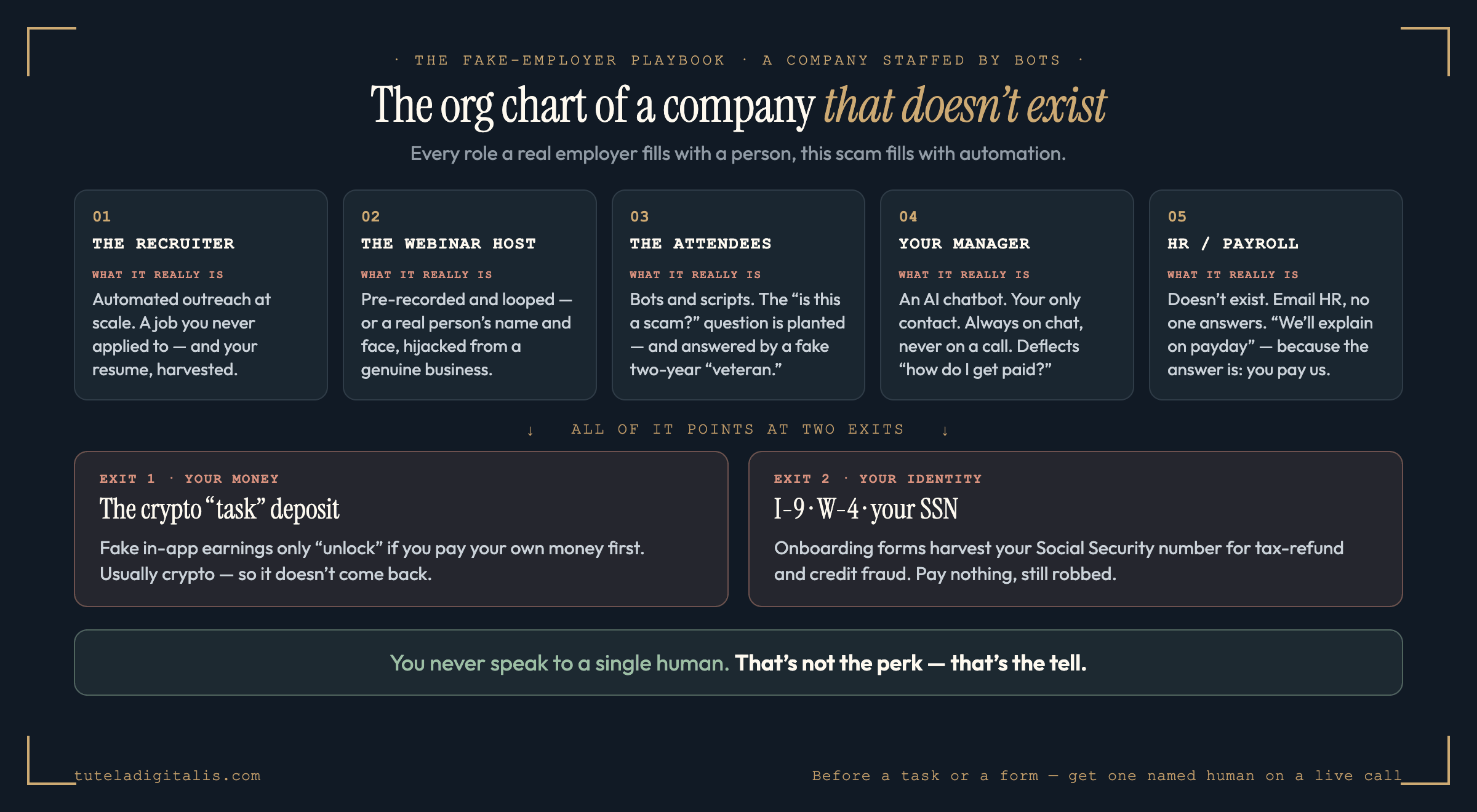
Here is the full org chart of the company that just “hired” you. Five roles. Read what each one actually is.
The webinar is theater, and the audience is code
The onboarding webinar is the trust engine, and it’s the most impressive part of the whole build, so it’s worth taking apart. It exists to answer the doubt you walked in with. That’s why the script always contains a planted skeptic: someone in the chat asks the exact question you’re thinking — “is this a scam?” — and is immediately, warmly reassured by a “colleague” who’s supposedly been there for years. You watch your own suspicion get raised and resolved by other people, and you relax. That is a technique. In sales we’d call it handling the objection before the prospect voices it. Here it’s run entirely by bots, which is why the reassurance is always instant and always unanimous.
The tells are structural, not cosmetic. The “live” session runs suspiciously on rails — no dead air, no fumbled questions, chat comments that land a second early. Your own pointed questions in the chat go unanswered while the scripted ones flow. And nothing in it can be paused for a real conversation: there is never a moment where a named human turns their camera on and talks to you. It has the shape of a company all-hands and none of the substance, because the substance — other humans — is the one thing the operation cannot cheaply fake.
Your “manager” is a chatbot. That’s the load-bearing lie.
Once you’re in, you’re handed a manager: a friendly, tireless contact in a chat window who assigns your tasks and answers your questions day and night. It is an AI chatbot, and its job is to be the human you never get. Notice the design: it’s always reachable by message and never reachable by voice or video. That asymmetry is the entire scam in miniature. A chatbot can hold a friendly text thread forever; it cannot get on a spontaneous call, so the operation makes sure a call is never on the menu.
Watch what it does when you push on the only question that matters — how and when do I actually get paid? A real manager answers in numbers: this rate, this schedule, this method, this date. The bot deflects: it’s easier to explain on payday, or it’ll walk you through “converting your crypto to dollars” later. That deflection is the seam. The reason it can’t give you a straight payroll answer is that the real answer runs backwards — on “payday” you’ll be told you must send money to unlock the earnings. This is the same objection-handling machine that runs every scam pipeline; if you want the full six-stage version, I mapped it in the scammer’s sales playbook.
What they’re really harvesting: your deposit, and your identity
Most coverage of task scams stops at the money, and the money is real. The mechanics are the ones the FTC describes: you complete simple “tasks” — rating products, “optimizing” listings, boosting apps — and a balance climbs in the company’s own portal. Then, to withdraw it, you’re told to deposit your own funds first: to “unlock the next tier,” cover a “fee,” or fix a “negative balance.” It’s almost always crypto, because crypto doesn’t come back. The displayed earnings are a number in a database; your deposit is money that’s gone. That is the task-platform pattern in full, and it’s why the FTC ties task scams to a surge in crypto job-scam losses.
But there’s a second, quieter prize, and it’s the one people miss because it wears the costume of legitimacy. Real onboarding involves real forms — so the scam asks for them too. An I-9 and W-4, a “background check,” a photo of your ID. Handing those over feels like a good sign; it’s the most normal thing an employer asks for. But between them they collect your full legal name, address, date of birth and Social Security number — the exact set needed to file a fraudulent tax return in your name and pocket your refund, or to open credit as you. For some of these operations, the crypto deposit is the bonus and your identity is the product. Which means you can “win” — never pay a cent, quit the day it feels wrong — and still have been robbed, of something slower to notice and harder to undo.
Why the company name doesn’t matter, and why we won’t print one
You probably arrived here after searching a specific company name, wanting a yes-or-no on that one. Here’s the honest answer, and it’s more useful than a verdict: the name is disposable, and it’s designed to be. The website, the LLC and the domain are cheap to create and cheaper to abandon, so one operation burns through fresh company names every few weeks — often the moment the current one starts showing up in warnings. That’s why searching the name turns up either nothing (it’s a week old) or a warning that lands just as the crew moves to the next shell.
We deliberately don’t publish the rotating names here, for a reason that’s part of the lesson: these scams frequently hijack real identities — a legitimate person’s name for the webinar host, sometimes a real dormant company’s name for the shell. Printing “X is a scam” can smear a real business or person the crew borrowed, which is a favor to no one but the crew. So learn the structure instead, because the structure is what doesn’t change: an unsolicited offer → an all-automated “company” → money in and personal data out. Match those three and you have your answer, whatever this week’s name happens to be. If you want a second opinion on a specific message, our guide to fake recruiters and deepfake interviews covers the video-call version of the same con.
If you already started: the identity-theft playbook
If you did tasks, filled out forms, or sent money before the penny dropped, work through these in order. Do them even if you never paid anything — if you handed over an I-9 or W-4, the identity risk is live regardless of your bank balance.
Not sure if a job offer is real? Get a second pair of eyes.
Send us the message, the “company,” and what they’re asking for. Our free, confidential case review will tell you what we see — before you do a task or hand over a form.
Common questions about fake-employer and task job scams
How do I know if a remote job is a scam?
The single fastest test is whether you can reach a real human. In the fake-employer scams spreading in 2026, every touchpoint is automated: an unsolicited recruiter message, a slick pre-recorded 'webinar' with bot participants in the chat, and a 'manager' who is really an AI chatbot you can never get on a call. Other hard tells: you were contacted out of the blue on WhatsApp, Telegram or text for a job you never applied to; the 'work' is vague 'optimization', 'product boosting' or 'app reviews'; the earnings climb inside the company's own app but you have to deposit your own money (usually crypto) to withdraw them; and the company's location keeps changing between the offer letter, the webinar and the app. A real employer will get you on a live call with a named human before you ever do a task.
What is a task scam?
A task scam is a job scam disguised as easy online work — 'complete these tasks and earn commission.' The FTC says reports went from essentially zero in 2020 to about 20,000 in just the first half of 2024, and that task scams made up nearly 40% of all 2024 job-scam reports. The mechanics are always the same: you do simple repetitive 'tasks' (liking, rating, 'optimizing') and watch fake earnings pile up in the app. To withdraw them, you're told to deposit your own money first — 'to unlock the next tier' or 'cover a fee' — almost always in cryptocurrency. That deposit is the scam. The earnings are numbers on a screen; your deposit is real money that is gone.
The company website and offer letter looked completely real. Could it still be a scam?
Yes, and that is the point. These operations buy aged domains, stand up a professional-looking website, register a real LLC through a mail-drop 'registered agent', and send a formatted offer letter with a real US state address on it — all in a couple of weeks. Some even use a real person's name and likeness for the 'webinar host', lifted from a genuine business, so a search of that person turns up a legitimate profile. None of it costs much or proves anything. Verification runs the other way: a real company will happily get a named employee on a live video call and answer 'how and when do I get paid?' in plain numbers. A scam deflects both — 'we'll explain on payday' is the recurring line.
They asked me to fill out an I-9 and W-4. Is that dangerous?
It can be more dangerous than losing a deposit. A real employer does need those forms — which is exactly why they make good bait. An I-9 and W-4 hand over your full legal name, address, date of birth and Social Security number: everything needed to file a fraudulent tax return in your name and steal your refund, or open credit. If you gave these to an employer you now suspect is fake, treat it as identity theft, not just a job scam: freeze your credit with all three bureaus, request an IRS Identity Protection PIN, and start a recovery plan at IdentityTheft.gov. Do it even if no money left your bank account — the forms alone are enough.
I did a week of 'work' but never paid anything. Am I safe?
You may not have lost cash, but check what information you handed over. If you completed onboarding, you likely gave a resume, contact details, and possibly tax forms with your SSN — which is the other thing these scams harvest. Assume that data is compromised: freeze your credit, watch your bank and email for unauthorized access, and if you provided your SSN, request an IRS IP PIN and file for identity-theft protection at IdentityTheft.gov. You should also report the scam to the FTC at ReportFraud.ftc.gov so the pattern is on record. The unpaid work is a sunk cost; the personal data is the live risk.
Why do these fake companies keep changing their name?
Because the name is disposable and they know it. The website, the LLC and the domain are cheap to spin up and cheap to abandon, so a single operation cycles through new company names every few weeks — often as soon as the current one gets flagged on Reddit or a scam tracker. That is why searching one specific name usually turns up almost nothing (it's days old) or a warning that appears right as the operation moves on. Don't try to memorize the fake names. Learn the structure — an unsolicited offer, an all-automated 'company', money in and personal data out — because the structure is what stays the same when the name changes.
Sources & further reading
Every figure here is the FTC’s own reported data. The recovery steps link to the official government tools. Click any to verify.