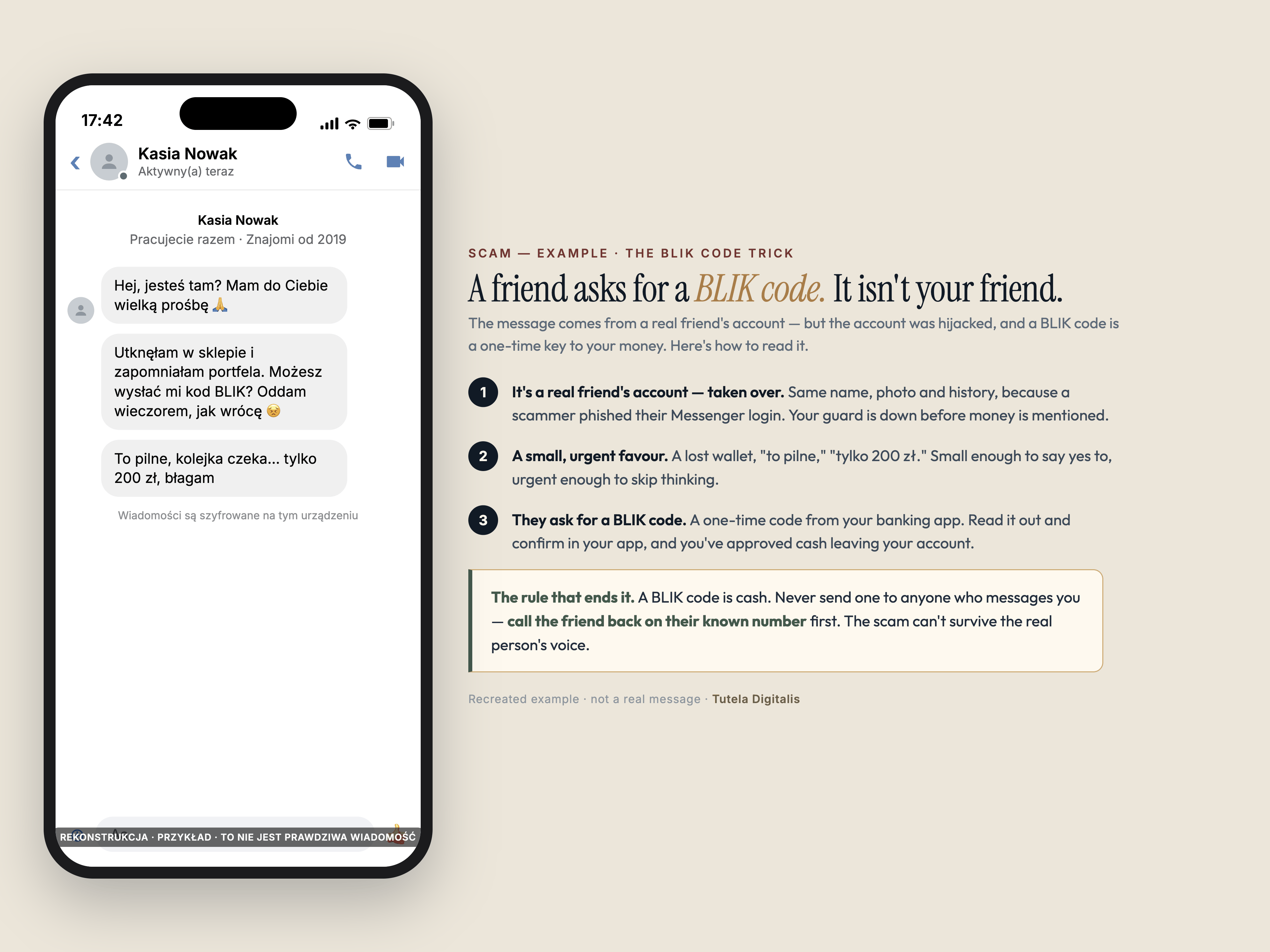
The BLIK code scam works like this: a fraudster hijacks someone's Facebook/Messenger account (usually via a phishing fake-login page), then messages that person's friends in their name — "I'm stuck, I forgot my wallet, can you lend me money? I just need a BLIK code now." A BLIK code is a one-time authorisation from your banking app; share it and confirm the amount, and you've approved a withdrawal to the scammer. CERT Polska and BLIK's operator have warned about it repeatedly. The one rule that defeats it: never send a BLIK code to anyone who messages you, and verify any urgent money request by calling the person back on a number you already have. Below is a recreated example, then a beat-by-beat decode.
If you use BLIK — and in Poland that is very nearly everyone — read the message below before you ever read a code aloud or paste it into a chat. The scam doesn't crack your bank. It borrows a face you trust and a moment of hurry.
Why BLIK became the scammer's favourite tool
BLIK is woven into daily life in Poland — pay in a shop, send money to a friend, withdraw at an ATM, all with a six-digit code generated in your banking app. That speed is the point, and it is exactly what fraud exploits. The code feels casual — a few digits you can read out — but each one authorises real money leaving your account. CERT Polska, the national CERT operated by NASK, reported a record year for fraud in 2025, with computer fraud and phishing dominating the incidents it handled — and the account-takeover that powers the BLIK scam is precisely that kind of phishing. The criminals didn't beat the technology; they moved to the person holding it.
Anatomy of the scam, decoded
The BLIK scam is a short sequence built on a borrowed identity and speed. Naming each move is what makes it visible.
What to do
A "friend" asked you for a BLIK code? Send it to us first.
Paste the chat. A real expert reviews every case and replies within 24 hours. Free, confidential, no pressure — before you send anything.
Common questions about the BLIK scam
What is the BLIK code scam in Poland?
It's a social-engineering scam, not a hack of BLIK itself. A fraudster takes over someone's Facebook or Messenger account (usually after a phishing fake-login page), then messages that person's friends pretending to be them — saying they're stuck, forgot their wallet, or have a payment to make — and asks the friend to generate a one-time BLIK code in their banking app and send it over. If you share the code and confirm the operation in your app, you have approved a withdrawal or payment to the scammer. CERT Polska, the national CERT run by NASK, and BLIK's operator have both warned about the 'friend on Messenger' version repeatedly.
If I give someone a BLIK code, can they take my money?
Yes — that is the whole danger. A BLIK code is a one-time authorisation. Once you generate it and the recipient enters it, you still have to confirm the amount in your own banking app — but scammers rely on urgency so you confirm without reading. The moment you approve, the cash withdrawal or transfer goes through. Treat a BLIK code like cash you are handing to whoever asked: never give it to anyone who contacts you, no matter who they appear to be.
Will my Polish bank refund a BLIK scam?
Usually not, and it's important to be honest about why. Under the Polish Payment Services Act (which implements the EU's PSD2), banks must refund unauthorised transactions — ones made without your consent. But if you generated a BLIK code and confirmed the payment in your app, the bank treats it as an authorised transaction, and authorised payments you were tricked into making are generally not refunded. Some victims argue the consent was procured by deception and pursue it through the Financial Ombudsman (Rzecznik Finansowy) or the courts, but there is no guarantee. Chargeback does not apply to BLIK or bank transfers.
Someone sent me a BLIK transfer 'by mistake' and wants it back — what do I do?
Don't send it back yourself, and don't send it to any account they name. The Rzecznik Finansowy (Financial Ombudsman) has warned about this 'reverse' variant: returning an unexpected transfer directly can make you a link in a money-laundering chain, or hand a scammer your money. If a transfer truly arrived in error, the sender's own bank can reclaim it through official channels — tell them to do that. If anyone pressures you to act quickly or to use a specific account, treat it as a scam and check it with us first.
Sources & further reading
Claims here follow CERT Polska (NASK), the Rzecznik Finansowy, and BLIK's operator; the 2025 figures are as reported by CERT Polska's annual report.