POLAND · 2026 GUIDEJune 16, 202611 min read

Where to report a scam in Poland — a record fraud year, and no single door to knock on.

CERT Polska called 2025 a record year for fraud, and BLIK-code and phishing scams are still climbing. Yet there is no single national portal to report it — the reporting runs through CERT Polska, the police, and the financial bodies, each doing a different job. Knock on the wrong door and you lose the hours that matter most. Here is the actual map — in English, for 2026 — and the honest odds on getting your money back.

8080
Forward a suspicious SMS here (CERT Polska)
incydent.cert.pl
Report a cyber incident to CERT Polska
No single portal
Reporting splits across CERT, police & regulators
Authorised = no refund
Approve a BLIK code and the bank can refuse
The short answer

Poland's routes in 2026: call your bank's fraud line the same hour to try to block the transfer or freeze the receiving account. Report the incident to CERT Polska (the national CERT, run by NASK) at incydent.cert.pl, and forward a scam SMS free to 8080. Report the crime to the police — call 112 or file a zawiadomienie at a local unit or prosecutor. For a bank-refund dispute, go to the Rzecznik Finansowy (Financial Ombudsman); for a suspicious investment firm, check and report it to the KNF warning list; for consumer issues, UOKiK. There is no single national portal. And the hard part: an unauthorised payment must be refunded, but a BLIK code or transfer you were deceived into approving generally is not.

If you've just been scammed in Poland, the first hours come down to two things: giving the bank a chance to stop the money, and building a record while the evidence still exists. The order below is the fastest path through a system that has no single front door.

If you're reading this with a transfer you already regret, skip to if money has already moved — a fast call to your bank is sometimes the only thing that works.
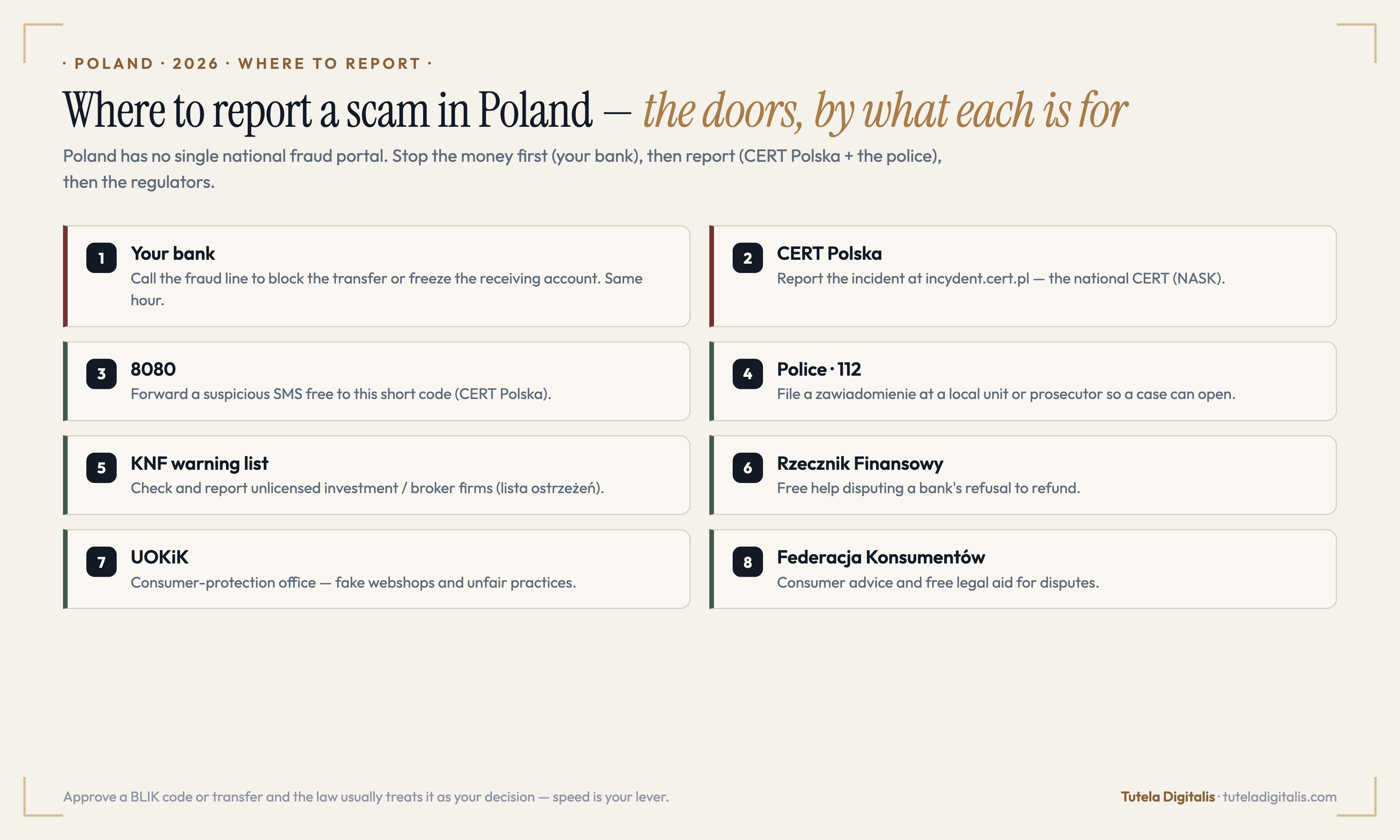
A directory card titled 'Where to report a scam in Poland' listing channels in two columns: your bank, CERT Polska (incydent.cert.pl), the 8080 SMS line, the police (112), the KNF warning list, the Rzecznik Finansowy and UOKiK, each with a short description of what it is for.
Poland has no single national portal — these are the doors, by what each one is for. Tell your bank first, then CERT Polska and the police.

The hard truth about getting your money back

This matters most, because it sets your expectations correctly before you spend a week chasing the wrong outcome.

Polish law follows the EU baseline through the Payment Services Act (the ustawa o usługach płatniczych, which implements PSD2). If a payment was unauthorised — made without your consent, like a stolen credential used without you — the bank must refund it, and you have up to 13 months from the debit to claim. If you authorised the payment yourself while being deceived — you generated and confirmed a BLIK code, or made the transfer — that counts as a valid instruction, and the automatic refund right does not apply.

This is the gap that strands scam victims across most of Europe: banks refund the hack, not the con. Some victims argue their consent was procured by deception and pursue it through the Rzecznik Finansowy or the courts — a litigable argument, not a guaranteed outcome. Chargeback does not apply to BLIK or bank transfers, so don't count on a card-style reversal. For now your real levers are speed (a fast call to block the funds), a clean report, and the Ombudsman route. See how refund rules compare across countries.

Start with your bank, CERT Polska and the police

Three reports matter most, and the order is the same every time: the bank moves on the money, CERT Polska handles the technical side, the police open the criminal case.

Your bank, the same hour. Call the fraud line, report it, and ask them to try to block the transfer or freeze the receiving account. If it was an unauthorised transaction, dispute it and demand a refund.
CERT Polska — the national CERT. Report the incident at incydent.cert.pl (or email cert@cert.pl), and forward a scam SMS free to 8080. CERT Polska runs the blocking and takedown side.
The police (Policja). Call 112, or file a zawiadomienie o przestępstwie at any local unit or prosecutor's office so a criminal case can open. Keep the reference.
Keep every record. Your bank, the Rzecznik Finansowy, or a lawyer may ask for the report references, so note them down.

The full Polish reporting directory, by scam type

Different scams route to different specialists. Using the right one matters more than reporting to all of them.

Any BLIK, transfer, or card fraud where you lost money. Call your bank immediately to try to block it, report to CERT Polska (incydent.cert.pl), and file with the police. Speed decides whether the money can be stopped.
A fake bank, parcel/InPost, court or mObywatel SMS. Classic smishing. Don't tap the link or share a BLIK code. Forward the SMS free to 8080 and open the organisation's official app yourself.
A phishing website or a cyber incident. Report malicious sites and incidents to CERT Polska at incydent.cert.pl — the national team that handles takedowns and adds domains to its warning list.
An investment, crypto, or fake-broker offer. Check the firm against the KNF's public warning list (lista ostrzeżeń publicznych) before investing, and report a suspicious operator to ostrzezenia@knf.gov.pl. KNF is Poland's financial regulator.
A bank that refused a valid claim or mishandled your case. Take it to the Rzecznik Finansowy (Financial Ombudsman), which helps free of charge in disputes with banks and payment providers.
A consumer dispute or a fake webshop. UOKiK (the competition and consumer-protection office) and the Federacja Konsumentów can advise and help you assert your rights.
A scam you spotted but didn't fall for. Still forward a scam SMS to 8080 and report a phishing site to CERT Polska. No-loss reports help get pages blocked and protect the next person.

If money has already moved — the first hours

Speed is the whole game. This is the maximum-recovery order:

1Call your bank's fraud line at once. Ask them to try to block the transfer or freeze the receiving account, and if it was unauthorised, dispute it and demand a refund.
2Report the incident to CERT Polska (incydent.cert.pl) and forward a scam SMS to 8080. Report the crime to the police on 112 or at a local unit.
3Document everything in one place. Screenshot the messages, the sender or account, and the transaction details (date, time, amount, recipient). Save it as a single PDF before accounts vanish.
4For an investment loss, check the firm against the KNF warning list and report it. See the honest recovery odds by payment method.
5If your bank wrongly refuses a valid claim, escalate to the Rzecznik Finansowy. And block the scammer — any "recovery" offer that follows is the second scam, which we take apart in the recovery-scams piece.
Within days of any public post or report about your loss, "recovery scammers" will find you. They will pose as a lawyer, a fund-recovery specialist, or even the police, your bank or KNF, and ask for an upfront fee, a "commission", or your banking details. Real Polish channels — your bank, CERT Polska, the police, the Rzecznik Finansowy, KNF — never charge upfront to recover money. See the recovery-scams piece for the full pattern.

The habits that keep you out of the reporting machinery entirely

Reporting is downstream. Prevention is upstream, and three habits stop most Polish scams cold:

Never share a BLIK code or approve a payment because someone asked. A BLIK code is a one-time key to your money. A "friend" on Messenger asking for one is running the BLIK code scam — verify by calling them on their known number.
Treat every bank, parcel or court SMS with a link as a scam until proven otherwise. Don't tap it. Open the organisation's official app or type its address yourself, and forward the message to 8080. The link is the whole trap.
Treat any money conversation that moves onto WhatsApp, Messenger or Telegram as hostile. Investment "advisers", recruiters and romance contacts overwhelmingly pivot to private chat. The move off a verifiable platform is the single most reliable scam signal — the same playbook as the family-impersonation scams.

If you're unsure whether something is a scam before any money moves, the fastest second opinion is the Scam Checker on this site, or our free case review. Both are read by a human and answered within 24 hours.

From the field. Poland built genuinely good machinery — CERT Polska is fast and capable, the 8080 line works, KNF publishes its warnings openly. The problem is that a frightened victim has to play switchboard between the bank, CERT and the police at the worst possible moment. So simplify it: your bank first to stop the money, CERT Polska and the police to report, the Ombudsman and KNF after. And hold the hard truth in view — once you've approved a BLIK code or a transfer, the law usually treats it as your decision, so the pause that stops the payment is worth more than the entire directory above.

One rule, end to end

If you take one habit from this piece, take this: any unsolicited call, message, or "friend" that pressures you to move money, approve a payment, or share a BLIK code is a scam until you have verified it by contacting the person or your bank back on a number you already trust. Poland will help you report it after the fact — but the pause that stops the transfer is still worth more than every authority downstream of it.

In Poland and not sure where to start? Let's look at it together.

Describe the message, the call, the transaction. A real expert reviews every case and replies within 24 hours. Free, confidential, no pressure.

Submit a free case review →Full international reporting directory

Common questions about reporting a scam in Poland

Where do I report a scam in Poland?

Move on two fronts in the same hour. First, your money: call your bank's fraud line to try to block the transfer or freeze the receiving account. Second, the report: file the incident with CERT Polska — the national CERT run by NASK — at incydent.cert.pl, and report the crime to the police (call 112, or file a zawiadomienie o przestępstwie at any local unit or prosecutor's office). You can forward a suspicious SMS free to the short code 8080. There is no single national 'report cybercrime online' portal like the UK's, so reporting runs through CERT Polska plus the police in parallel.

Will a Polish bank refund a BLIK or transfer scam?

It turns on one distinction. Under the Polish Payment Services Act (the ustawa o usługach płatniczych, which implements the EU's PSD2), banks must refund unauthorised transactions — payments made without your consent, like a stolen credential used without you. But if you authorised the payment yourself — you generated a BLIK code and confirmed it, or made the transfer — banks treat it as a valid instruction, and authorised payments you were deceived into are generally not refunded. You have up to 13 months from the debit to raise an unauthorised-transaction claim. Chargeback does not apply to BLIK or bank transfers, so be wary of anyone who promises an easy reversal.

What is the difference between CERT Polska, the police, and KNF?

They do different jobs. CERT Polska (NASK) is the national cyber-incident team — report phishing sites, malicious domains and incidents at incydent.cert.pl, and forward scam SMS to 8080; it handles the technical side and blocking, not your money. The police (Policja) investigate the crime — file a report so a criminal case can open. KNF, the financial regulator, publishes a public warning list (lista ostrzeżeń publicznych) of suspected illegal financial and investment operators — check it before investing, and report a suspicious firm to ostrzezenia@knf.gov.pl. For a refund dispute with your bank, the Rzecznik Finansowy (Financial Ombudsman) is the body that helps.

Someone is offering to recover my lost money for a fee — is that legitimate?

No — that is the second scam, and it targets people who have just lost money. Fake 'recovery' agents, bogus lawyers, and people impersonating the police, your bank or KNF will promise to get your money back for an upfront fee, a 'commission', or your banking details. No genuine Polish authority or service charges you upfront to recover funds. Block them, and check anything you are unsure about with your bank or with us first.

I got a fake bank or parcel SMS in Poland — what do I do?

Treat it as a scam and don't tap the link. Fake bank 'security' texts, fake parcel and InPost delivery messages, and fake court or mObywatel notices are among the most common in Poland. Open your bank's official app yourself rather than any link, and never approve a payment or share a BLIK code because a message told you to. Forward the suspicious SMS free to 8080 (run by CERT Polska), and report a phishing site at incydent.cert.pl. If money was lost, call your bank and report to the police.

Sources & further reading

Claims in this piece follow CERT Polska (NASK), KNF, and the Rzecznik Finansowy, with reporting channels as published by the authorities. Click any to verify.

CERT Polska — report an incidentgov.pl / NASK — report SMS to 8080KNF — public warning listRzecznik Finansowy — Financial OmbudsmanUOKiK — consumer protection

Keep reading