A real EnFact text wants one word back. A text with a link is not one.
A text arrives about a suspicious charge on your debit card, from a company called EnFact that you have never heard of and that is not the name on your card. You search the name, and the results are a scatter of individual bank pages that each describe their own version. Nobody answers the actual question.
The answer is unusually clean, because a genuine EnFact text is allowed to do very few things.
EnFact is real. It is a debit-card fraud-detection service from Fiserv, used by many US banks and credit unions. The banks that publish their rules describe a narrow signature for a genuine EnFact text: it comes from a five-digit short code, it never contains a link, it names the suspect transaction, and it asks you to reply with a single short word such as yes, no, help or stop. It never asks for your PIN, your full card number, your password, or a one-time passcode. A text that breaks those rules is not a real EnFact text, whatever it says at the top. Genuine follow-ups do exist, such as a call from your bank’s fraud centre, so verify anything beyond the text through the number on your card.
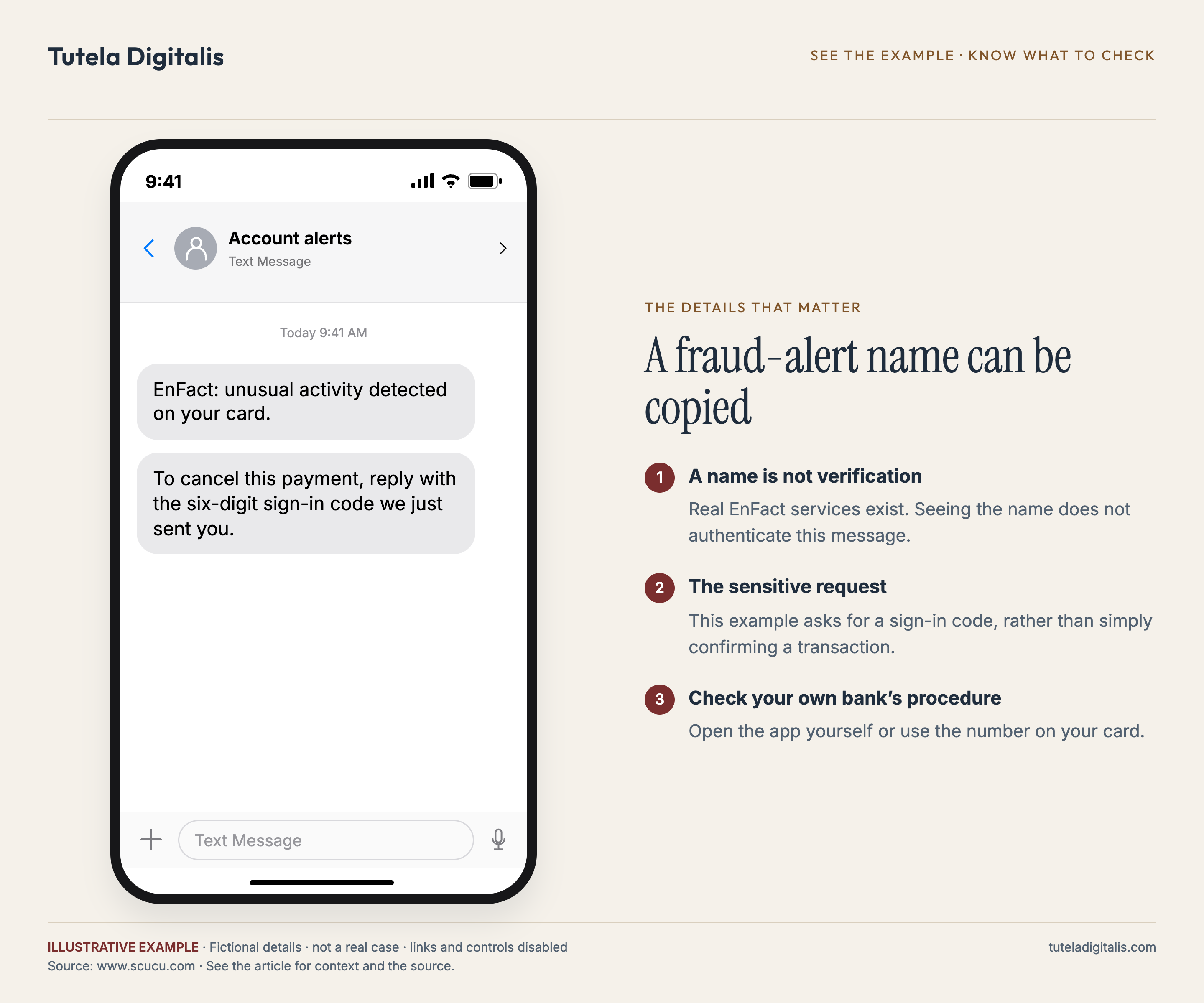
Read the image explanation
Illustrative example: EnFact: unusual activity detected on your card. To cancel this payment, reply with the six-digit sign-in code we just sent you.
- A name is not verification. Real EnFact services exist. Seeing the name does not authenticate this message.
- The sensitive request. This example asks for a sign-in code, rather than simply confirming a transaction.
- Check your own bank’s procedure. Open the app yourself or use the number on your card.
What EnFact actually is
EnFact is a card-risk product from Fiserv, one of the large payment processors that runs card infrastructure behind the scenes for smaller banks and credit unions. Fiserv's own Card Risk Mitigation brochure describes EnFact as a sophisticated, real-time, neural network solution that assesses fraud risk for card transactions without delaying or inconveniencing cardholders. In plain terms, it watches your card and flags the transactions that do not fit your pattern. The same document notes that its supported notification channels include text, email and letters, which is why an alert can reach you more than one way.
That is the whole reason the name is unfamiliar. You never signed up for EnFact and it is not printed on your card, because your relationship is with your bank and your bank's relationship is with Fiserv. Pinnacle Bank, one of the institutions that publishes how it uses the service, describes the sequence: an email first, then a text message, and a phone call if there is no response within fifteen minutes. So an unexpected contact from a name you do not recognise is genuinely how the real system behaves, which is exactly why an imitation of it works so well.
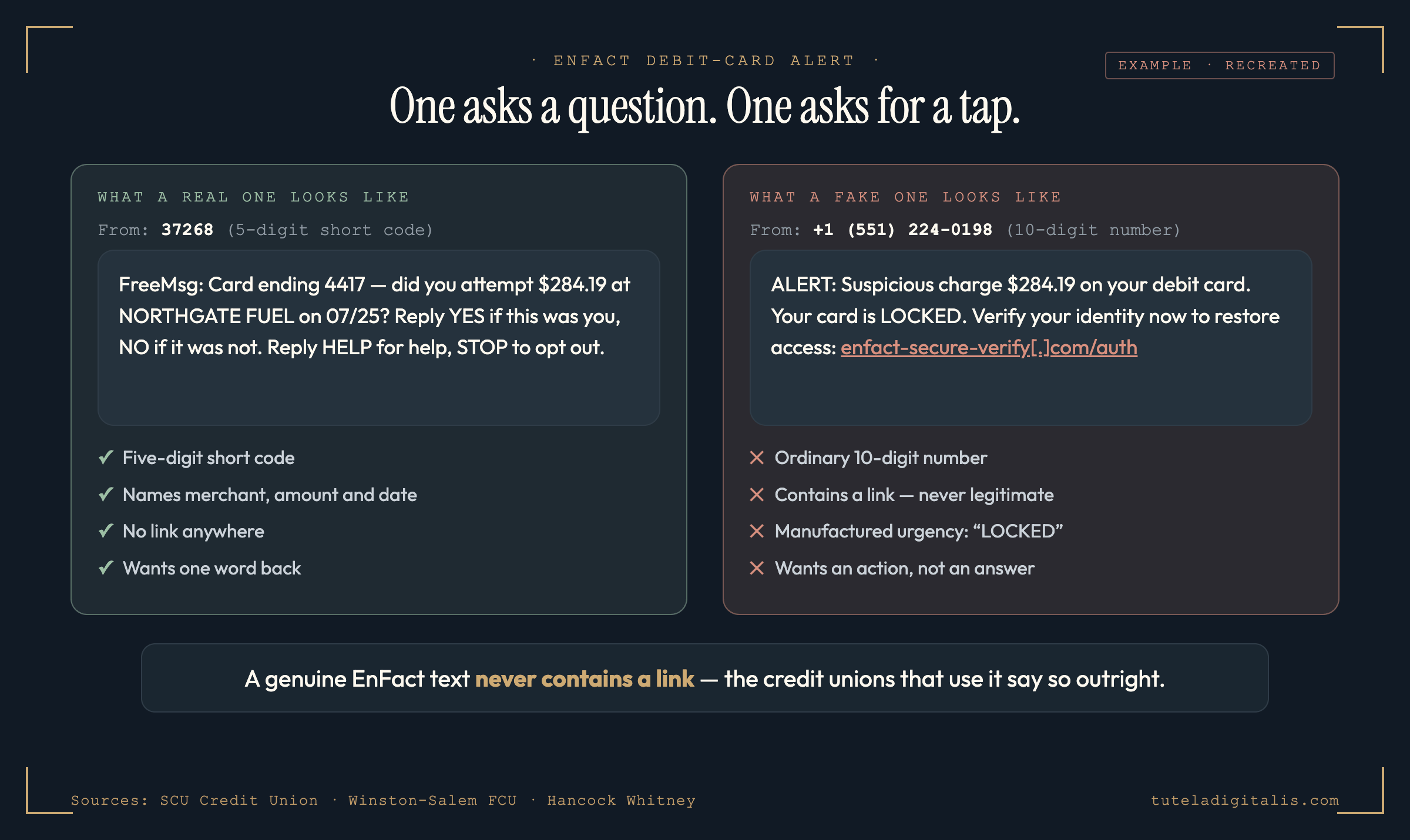
The signature of a genuine EnFact text
These are the properties banks that use the service publish about its texts. Each one is something you can check on the message in your hand, without calling anyone. They describe the institutions that publish them, so check your own bank’s page as well.
These checks describe EnFact texts; other banks use different services and sender details. For a message naming a different bank, consult our US bank fraud-alert sender register and follow the verification route on your bank’s own website. A matching sender is a clue, not proof that a message is genuine.
Where the fake version goes
A counterfeit fraud alert is rarely the scam by itself. It is the opening, and the FTC has documented where it leads. Its warning on text scams describes exactly this shape: some text scams start as fake fraud alerts, a message claiming to be from the fraud department at your bank, offering help with a suspicious charge. That is the hook to get you to reply or call a number, after which come the elaborate lies that drain the account.
Two demands mark the end of that road, and the FTC is unambiguous about both. One is the verification code: no caller, especially someone claiming to be from your bank's fraud department, will ever ask for it, because sharing the code is how a stranger proves to your bank that they are you. The other is the instruction to move money somewhere safe. In the FTC's words, your money is fine where it is, no matter how urgently someone says otherwise, and anyone telling you to move money to protect it is a scammer. We take that particular move apart in our breakdown of manufactured urgency.
What to do with the message in front of you
If you already interacted with the message
The reason this scam works is that the real thing is genuinely strange: an unfamiliar company, an unexpected message, an urgent-sounding charge. You cannot make that feel normal, and you do not need to. The genuine text is narrow enough to describe in five rules, and a counterfeit usually has to break one of them to get what it wants.
Common questions
Is EnFact a scam?
No. EnFact is a real debit-card fraud-detection service from Fiserv, used by a large number of US banks and credit unions to spot suspicious card transactions and check them with you. If your bank uses it, a genuine EnFact alert really can arrive without warning. The problem is that criminals send fake fraud alerts too, because a message about a suspicious charge is the single most reliable way to make someone react before they think. So the question worth asking is not whether EnFact is real, but whether the specific message in front of you matches what a genuine EnFact alert looks like, and whether your bank confirms it when you contact it yourself.
Does a real EnFact text ever contain a link?
Not according to the institutions that publish their rules. SCU Credit Union, which uses the service, states it plainly: a text alert from EnFact warning you of suspicious activity on your card will never include a link to be clicked, and cardholders should never click a link in a text that is supposedly from EnFact. A genuine text describes the suspect transaction and asks you to reply with a short word. If there is a link in the message, treat it as a reason to stop and contact your bank through a route you already trust, no matter how convincing the rest of it reads. Check your own bank’s published rules too, because each institution describes its own alerts.
What number does a real EnFact text come from?
A short code, not a normal-looking phone number. SCU Credit Union states that a text alert from EnFact will always come from a 5-digit number and not a 10-digit number resembling a phone number. Winston-Salem Federal Credit Union and Hancock Whitney both name the same short code for their debit-card alerts: 37268. Short codes vary by institution and you should check your own bank’s published number. A fraud alert arriving from a full 10-digit mobile number is a warning sign, and a matching short code is a clue, not proof.
What email address do genuine EnFact notifications come from?
Hancock Whitney publishes it directly in its help centre: for debit cards, email notifications are sent from noreply@enfactnotifications.com, with text alerts from 37268. That domain looking unfamiliar is exactly why people search for it: it is the vendor’s domain rather than the bank’s, so it does not match the name on your card. Be careful with this in both directions. The address being correct does not make an email genuine, because a From line can be forged. Treat it as one signal among several, never as proof.
Should I reply YES or NO?
Replying to a genuine short-code alert is how the service is meant to work: Winston-Salem Federal Credit Union describes replying YES to confirm a transaction. A NO reply can lead to a further message with a number to call, so a follow-up after NO is not by itself a sign of fraud. If you are not sure the alert is genuine, skip the reply and contact your bank through its app or the number on your card first.
Will EnFact or my bank ever ask for my PIN, card number, or a one-time passcode?
Not by text or email. Pinnacle Bank states it flatly: we will never ask you to verify your PIN or password via text or email. The FTC goes further on verification codes, warning that no caller, especially someone claiming to be from your bank’s fraud department, will ever ask for the code, because sharing it lets the scammer prove they are you. A genuine EnFact text needs one thing from you: confirmation that a transaction was or was not yours. It never needs your full card number, your PIN, your online-banking password, or a passcode that was just texted to you.
I already replied, clicked or shared something. What should I do now?
Stop interacting with the sender and call your bank on the number printed on the back of your card, not any number from the message. Tell them exactly what happened, because a reply, a click without entering anything, a password typed into a page, a shared passcode and money sent are different events. If you gave a one-time passcode, installed remote-access software or moved money, say so immediately, because speed matters most in the first hours. Ask them to lock the card and check for new payees or changed contact details, and change your online-banking password from a device you trust. Then report it to the FTC at ReportFraud.ftc.gov. If anyone later contacts you offering to recover the money for a fee, that is a second scam aimed at the same victim. Do not wait for a Tutela case review before calling your bank.
Sources
Bank pages rechecked October 16, 2026, except Winston-Salem FCU, which blocks automated reading; its details were last read September 29, 2026. Bank procedures change, so use your own provider’s current instructions.