On 3 June 2026 the FTC warned that scammers impersonating its staff now text victims a photo of a fake employee ID and badge to "verify" themselves, then offer to recover money the victim already lost. It is a recovery scam — the second con aimed at people scammed once — and it always ends in a fee, a "release charge," your bank details, or remote access to your device. Hold two rules and you defeat every version: a real FTC employee will never text you a photo ID or charge you to get your money back, and no genuine agency cold-contacts victims to recover funds for a fee. The badge proves nothing. Real verification only works one way — you hang up, find the agency's number yourself, and call to check.
The Federal Trade Commission does not usually make news with a single short alert. But the one it posted on 3 June 2026 is worth more attention than its length suggests, because it documents the moment a familiar scam learned a new move. Impersonators posing as FTC employees, the agency says, are now sending targets a photo of an official-looking ID badge to "verify" their identity — and they pair it with an offer to recover money the victim has already lost.
If you have been scammed and want the practical takeaway, skip to what this actually means for you. A badge photo does not authenticate the caller, and a demand to pay before an FTC refund is a scam. Genuine settled-case refunds can arrive unexpectedly; verify the case independently before acting.
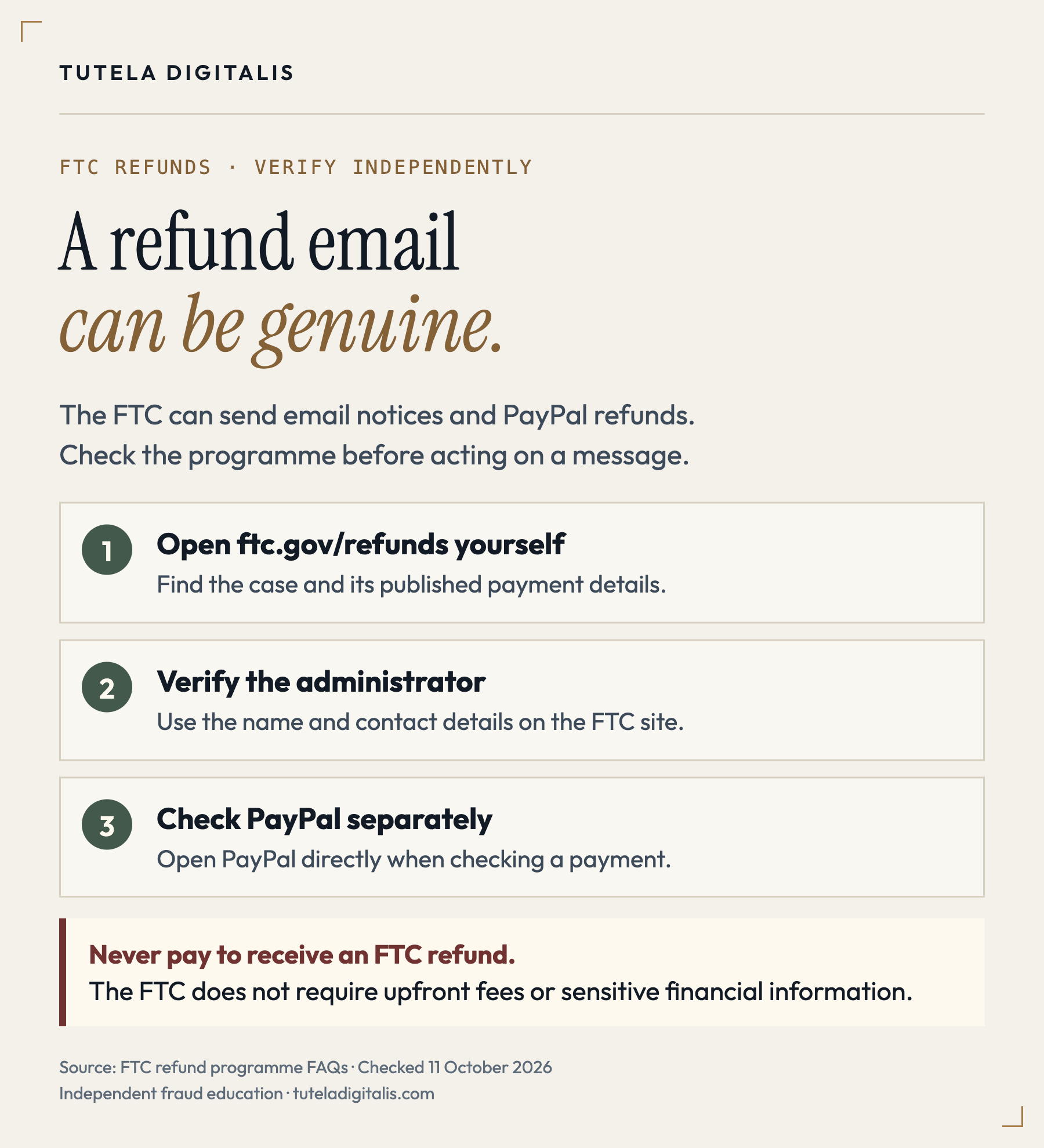
Correction — 11 October 2026: This article previously treated an unexpected FTC money-back offer as proof of fraud. The FTC does send genuine refund emails after enforcement cases. Its refund FAQ explains the process: verify the case and administrator through ftc.gov/refunds, without following the message’s links. A fee or sensitive-information demand is the warning sign; an unexpected email alone is not.
How to verify a real FTC refund
A current example makes the distinction concrete. In its 8 October Cleo AI announcement, the FTC says eligible customers will receive email notices through 26 October 2026, with PayPal payments beginning on 27 October. An email about that programme can be genuine. The announcement does not authenticate any individual message.

What the FTC actually warned
The alert is blunt. According to the FTC, scammers lie and pretend to be an FTC employee to trick people into handing over money, account access, or personal information. The newest version adds a recovery hook: the impersonator falsely claims to be an FTC "agent" who can help you get back money you lost in an earlier scam. To build trust, they send a photo of an employee ID and a badge — both fabricated.
So the agency drew a hard line around what a real employee will never do. A genuine FTC employee will not text you a photo ID to prove who they are. They will not claim they can recover your lost money and ask you to pay for it. They will not tell you to move your money into an account they name. And they will not ask for your financial information. Each of those, on its own, is enough to know the contact is fake.
The new twist: a photo of a badge that proves nothing
The reason the photo-ID move works is that it answers the exact question a wary person asks — "how do I know you're really from the government?" — with something that looks like an answer. We are trained to ask for proof. The scammer simply supplies it: a crisp image of a badge, a name, a title, maybe a case number to match. It feels like verification. It is theatre.
And that is the uncomfortable part. A photograph can be lifted, edited, or invented in minutes. A caller ID can be spoofed to read the agency's real name. An email signature can be copied pixel for pixel. Every artefact we instinctively treat as proof is now trivially manufactured — which means proof handed to you, by someone who contacted you first, is not proof at all. The only verification that still holds is the kind you start yourself.

Why this is a recovery scam wearing a uniform
Strip off the FTC costume and this is a recovery scam: the second con that deliberately targets people who have already lost money once. The logic is cold. Someone who has been scammed is desperate to be made whole, more willing to believe a rescuer, and — crucially — already on a list. Contact details of earlier victims are bought, sold, and re-worked among criminals, which is why a person scammed in January gets a "good news, we can recover your funds" call in June.
The government-impersonation flavour just makes the rescuer more believable. The script is always the same underneath: the agent has found your money or your case is part of an official recovery effort; to release the funds you need to pay a fee, settle a "tax," confirm your bank login, or let them onto your computer to "process" it. There is no money. There is only a second loss. We break the whole pattern down in the recovery-scams piece, and it is the most important thing to understand if you have lost money before.
What this actually means for you
The rules that defeat this are short, and they do not depend on spotting a good fake:
Got a call or text from an "FTC agent" about your money? Send it to us first.
Paste the message, the badge photo, the number that called you. A real expert reviews every case and replies within 24 hours — and our consultation exists for exactly this moment: a calm second opinion before any money moves. Free case review, confidential, no pressure.
Common questions about the fake-FTC-agent scam
Did the FTC really warn about scammers texting a photo ID to 'verify' themselves?
Yes. On 3 June 2026 the Federal Trade Commission published a consumer alert titled 'A real FTC employee won't text you their photo ID to verify their identity.' The agency says scammers are impersonating FTC staff and, in a new twist, sending a photo of an employee ID badge — all fake — to look legitimate and win a target's trust. The FTC's flat rule: a genuine FTC employee will never text you a photo ID, never claim they can recover money you lost for a fee, never ask you to move money into an account they specify, and never demand your financial information. Anyone doing those things is a scammer, regardless of what badge they show you.
Can a real FTC refund arrive by email?
Yes. The FTC returns money to eligible consumers after enforcement cases, often without requiring a claim. Its refund FAQ explains that it can send a .gov email before a PayPal payment, followed by a PayPal notification. That is different from someone offering a paid service to recover money from any scam. An unexpected message is not proof of fraud or authenticity. Type ftc.gov/refunds into your browser, find the named case and verify the administrator and payment method independently. The FTC never requires an upfront fee or sensitive information such as your Social Security number or bank account information to get a refund. Do not follow an email link or give anyone your banking login.
How does the fake 'FTC agent' recovery scam actually work?
It is a recovery scam — the 'second con' that targets people who have already been scammed once. The script runs roughly like this: someone contacts you claiming to be an FTC agent (or to work with the FTC), says they have identified the criminals who took your money or that your case is part of a federal recovery effort, and offers to return your funds. To seem real, they send a photo of an official-looking ID and badge. Then comes the catch — an upfront fee, a 'tax' or 'release charge', your bank details to 'deposit' the refund, or remote access to your computer to 'process' it. Every version ends with you losing more money or handing over the keys to your accounts. Victim lists from earlier scams are bought and sold, which is exactly why people who have lost money once get targeted again.
I already paid a 'FTC agent' or gave them my details. What should I do now?
Act fast, in this order. Call your bank and card issuer immediately and tell them the transaction was fraud — speed matters most here, because the fastest recoveries happen within hours or days through the payment system, not the courts. If you shared banking logins or installed any 'support' software, change your passwords from a different device and remove the software, or have someone help you. Then report the impersonation to the real FTC at ReportFraud.ftc.gov, and report the underlying scam to your national agency and police. Do not send the 'agent' anything further, and do not let embarrassment stop you from reporting — being targeted twice is a pattern the criminals engineer, not a failing on your part.
How can I tell a real government contact from a convincing fake?
Stop trusting anything the contact hands you to 'prove' themselves — a badge photo, a case number, a caller-ID that shows a real agency name, an email that looks official. All of those are trivially faked, and the photo-ID twist the FTC just flagged is the proof. Real verification only works in one direction: you initiate it. Hang up or stop replying, find the agency's number yourself from its official website, and call to ask whether the contact was genuine. A real agency will never object to you doing this; a scammer will pressure you not to. And hold the two rules that defeat every version of this: no genuine government body cold-contacts you to recover money for a fee, and none will ever ask for gift cards, crypto, wire transfers, or remote access to your device. When something feels off, run the message through a scam check before you respond.
Sources & further reading
Claims in this piece are attributed to these sources. Click any of them to verify.