The gold bar scam is a government-impersonation con that ends with the victim handing physical gold or bulk cash to a courier. It starts with a pop-up or call about a 'compromised' account, escalates to a fake federal agent who says your money must be 'protected' by converting it to gold in government custody, and finishes when a courier collects the gold from your home. The FBI documented 1,737 courier pickups and more than $186 million in losses between 2023 and May 2025, about 98% from people over 60. The one rule that defeats it: no real government agency will ever ask you to buy gold, withdraw cash for safekeeping, or hand anything to a courier — ever.
Read the image explanation
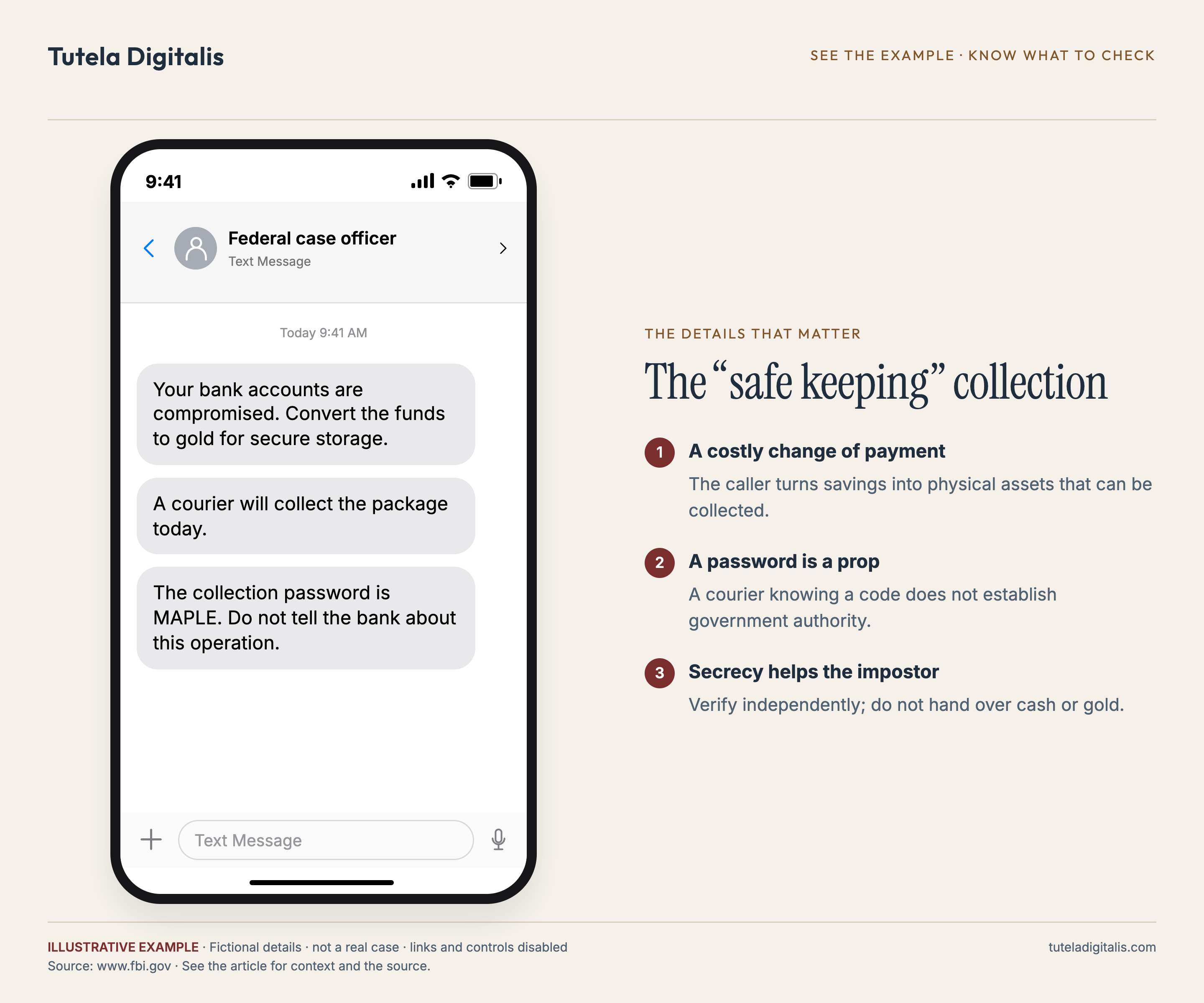
Illustrative example: Your bank accounts are compromised. Convert the funds to gold for secure storage. A courier will collect the package today. The collection password is MAPLE. Do not tell the bank about this operation.
- A costly change of payment. The caller turns savings into physical assets that can be collected.
- A password is a prop. A courier knowing a code does not establish government authority.
- Secrecy helps the impostor. Verify independently; do not hand over cash or gold.
"Simply put, what these con artists are doing is cruel. These literal gold diggers are trying to get rich quick at the expense of our aging family members and friends. We're working hard to educate folks about this troubling trend to prevent others from being victimized, and we need your help. Talk to your loved ones about how to protect what's theirs."
— Ted E. Docks, Special Agent in Charge, FBI Boston Division, September 2025, warning of the rise in gold bar and bulk-cash courier scams. The FBI's framing is deliberate: the most effective defense is not a piece of software — it is a conversation between a target and the family members who can recognize the script.
Most scams ask you to send money to a stranger. The gold bar scam asks you to do something stranger and more deliberate: to physically convert your savings into precious metal and place it into the hands of a courier who walks up to your door. It sounds, written down, like something no one would do. People do it every week — and the people who do it are not foolish. They are frightened, isolated for a few critical hours, and walked through each step by someone who sounds exactly like the authority they have trusted their whole lives.
This is the convergence of three scams this site has already mapped: the tech-support scam that opens the door, the government-impersonation pressure of the digital-arrest scam, and the cash-out logic of the Bitcoin ATM scam. Gold is simply the newest answer to the scammer's last problem: how to get the money into a form no one can claw back.
How the con unfolds, stage by stage
Every version follows the same arc. Recognizing the shape is what lets a family member spot it from one sentence of a phone call.
The scale is now in the FBI's own annual accounting. The 2025 Internet Crime Report, published in April 2026, lists gold courier scams as their own line for the first time: roughly 725 complaints and $311.8 million in reported losses in a single year, an average above $400,000 per complaint, filed under the same heading as the tech support and government impersonation calls that start them. The report's elder fraud section records $7.748 billion lost by people over 60 across all crime types in 2025, up 59% on 2024.
Why gold, and why a courier
The choice of gold is not random. By the final stage of any of these schemes, the scammer faces a single problem: how to extract value in a form that cannot be reversed. Different scams solve it differently, and gold has become a favored answer for specific reasons.
The tells: what no real agency ever does
You do not need to identify which agency is being impersonated or whether a badge number is real. You only need to recognize the actions that no legitimate institution ever takes. Any one of these means the call is a scam.
If it's happening right now: what to do
If you or someone you love is mid-scam or has just handed gold to a courier, the next few hours matter more than anything else. This is the sequence.
So, how do you beat the gold bar scam?
You beat it before it starts, with one sentence everyone in your family already knows by heart: no real agency will ever ask you to buy gold, move your savings for safekeeping, or hand money to a courier. That sentence does not require you to identify the agency, judge the badge number, or out-argue a practiced con artist. It only requires you to recognize the request — and to know that the request itself is the proof.
The scammers know their best target is someone who is alone with the phone for the next two hours. The simplest defense is to not be alone with it: agree, as a family, that any call about money — no matter how urgent or official — pauses for one call to a person you already trust before anything moves. The scam runs on isolation and secrecy. A single trusted phone call is usually all it takes to break both.
If you take one rule from this whole piece, take this: no government agency on earth will ever ask you to convert your savings into gold or hand cash to a courier — so the instant anyone makes that request, you already have your answer, and the only correct next move is to hang up and call someone you trust.
Did this just happen to someone you love? Let's look at the next steps together.
Tell us what was handed over, when, and what the caller claimed. A real expert reviews every case and replies within 24 hours. Free, confidential, no judgment, nothing to sell.
Common questions about the gold bar scam
What is the gold bar scam?
The gold bar scam is a variation of the government-impersonation and tech-support scam where the victim is convinced to convert their savings into physical gold bars (or bulk cash) and hand them to a courier who arrives in person. It usually starts with a computer pop-up or a phone call warning that the victim's accounts are compromised. A caller posing as a federal agent — often from the FTC, DOJ, Treasury, or Social Security Administration — tells the victim their money is no longer safe in the bank and must be 'protected' by moving it into gold held in government custody. The victim withdraws money, buys gold from a real dealer, and hands it to a courier sent to their home or a meeting point. The gold is gone the moment it changes hands. The FBI documented 1,737 such courier pickups between 2023 and May 2025, with losses of more than $186 million, and roughly 98% of the victims in its Boston data were over the age of 60.
Would a real government agency ever ask me to buy gold?
Never. No federal agency — not the FBI, the FTC, the DOJ, the Treasury, the IRS, or the Social Security Administration — will ever tell you to withdraw your savings, convert them to gold or cryptocurrency, or hand cash or gold to a courier. No real agency takes 'custody' of your money to keep it safe, asks you to keep the matter secret from your family and your bank, or gives a courier a password to prove they are legitimate. Every one of those is a defining feature of the scam, not of any real government process. If anyone claiming to be from the government asks you to do any of these things, hang up — it is a scam, with no exceptions.
Why do scammers want gold instead of a wire transfer?
Because gold is harder to trace and impossible to reverse. A wire transfer leaves a banking trail and can sometimes be recalled in the first 24 to 72 hours; a bank may also flag a large or unusual wire and ask questions that break the scam's spell. Physical gold handed to a courier has no chargeback, no reversal, and no paper trail once it leaves the victim's hands. The courier passes it up a chain and it is liquidated or moved overseas quickly. It is the same cash-out logic behind the Bitcoin ATM scam — the scammer's goal at the end of every one of these schemes is to convert your money into a form that cannot be clawed back.
Who is targeted by the gold bar scam?
Overwhelmingly older adults. In the FBI Boston data covering 2023 to May 2025, about 98% of the reported losses came from victims over the age of 60. The reasons are structural: older adults are more likely to have substantial savings and home equity, more likely to answer the phone and trust an authority figure, and more likely to be isolated enough that a scammer's demand for secrecy works. The scam also leans on a generational instinct that gold is 'safe' — which is exactly the belief the script weaponizes. This does not mean younger people are immune; it means the playbook is tuned for retirees, and the people most able to spot it are often their adult children and grandchildren.
What do I do if my parent or grandparent just handed gold to a courier?
Act immediately — the first hours matter most. Call the bank or dealer involved and report the fraud so they can flag accounts and any pending withdrawals. Report to the FBI at ic3.gov as fast as possible; for victims 60 or over, the DOJ Elder Justice hotline at 1-833-FRAUD-11 (1-833-372-8311) can help file the complaint. Preserve everything: the pop-up or phone number, any 'agent' names and badge numbers, the courier's description, the meeting location, and any code or password the scammer provided. Do not let the victim send another payment to 'help recover' the first — that is a standard second-stage tactic. And gently make clear to them that they are the victim of a crime, not at fault; shame is the emotion that keeps these scams going and stops people from reporting.
Can the money or gold be recovered?
Sometimes, but only if you move fast and report immediately. The FBI's IC3 Recovery Asset Team can work with banks and, in some cases, intercept couriers or freeze funds before the gold is liquidated — but the window is short and recovery is never guaranteed. The single biggest factor is speed: a report filed within hours has a far better chance than one filed after days. What does not work, and will cost you more, is any 'recovery service' that contacts you afterward promising to get the gold back for an upfront fee. That is the recovery scam, and it specifically targets people who have already lost money in schemes like this one. Every legitimate recovery channel — the bank, the FBI, the CFPB — is free.
Sources & further reading
Every figure in this piece is drawn from these authorities. Click any of them to verify.